

How Ukrainians Are Surviving
It's a day at a time.

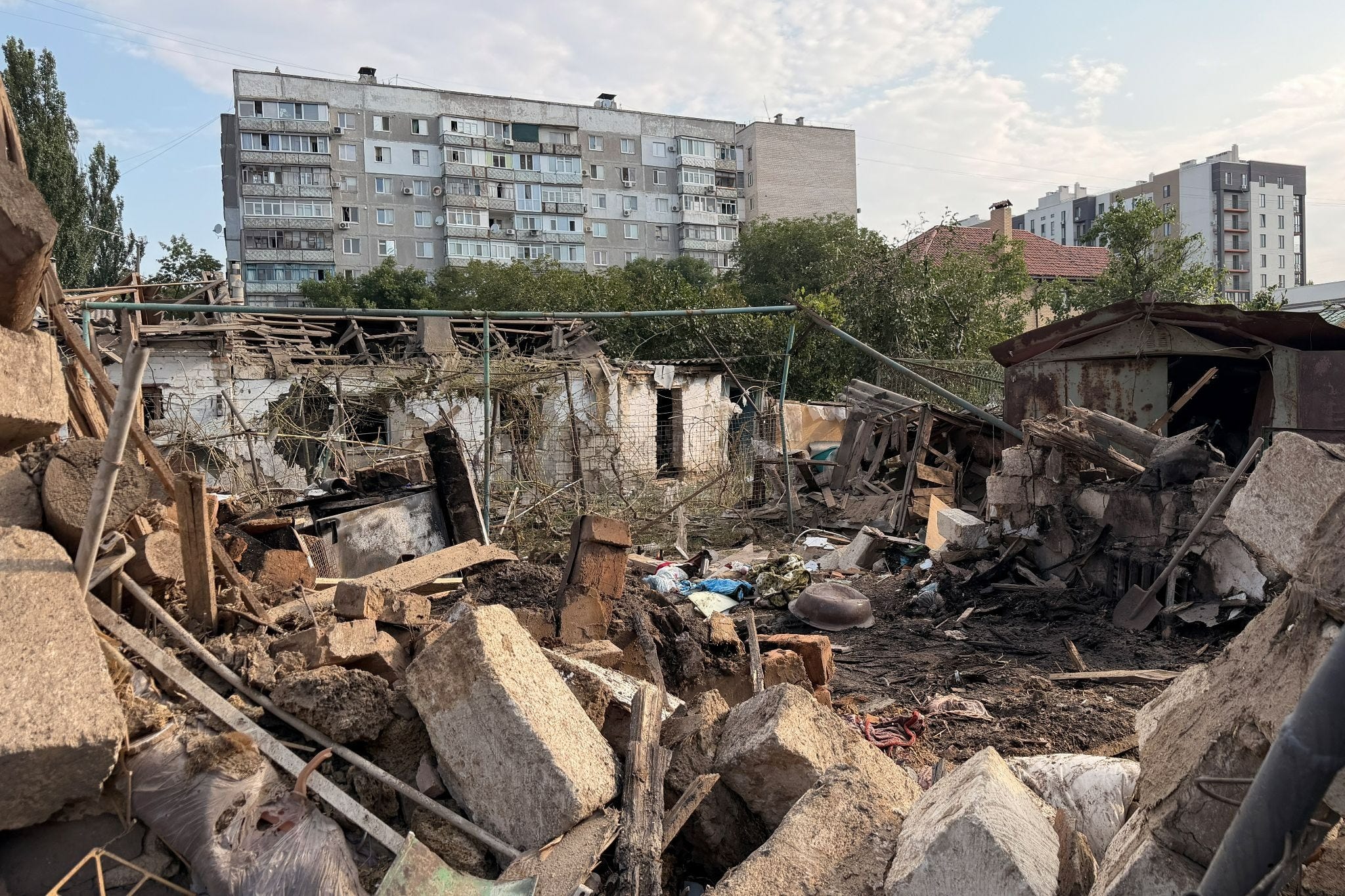
The last ever conversation I had with my Ukrainian grandfather was grim. He had lost his apartment, the place where he lived for over 40 years, to a missile strike. Usually a man with a tough exterior, he was inconsolable. “How many buildings are destroyed only in our city? Who will rebuild all that? What do we do?” He posed questions without expecting an answer, one after another. I patted him on the back. “Don’t worry, grandpa. We rebuilt after 1945, and we’ll rebuild again.”
What I said was true—at least partially. The full truth was: our city, Mykolaiv, located in the Ukrainian south, was damaged far less during the Second World War. Over 12,000 buildings have been destroyed since 2022, many times more than were wrecked in World War II.
Now to the good news—we were, indeed, rebuilding. And we were doing it not after, but during the war.
I know about it firsthand. My family suffered three nearly direct strikes in Mykolaiv—the kinds that you will read about in the news next morning, among dozens of others that happened in Ukraine that same night. But what comes next, after the headlines fade? It is nothing like what you might picture from a Hollywood movie. Losing a home during the war is more like walking through the multiple bureaucratic corridors of Kafka’s The Trial while ash from the strike is still blowing in your face. Here’s a glimpse of what life after a missile attack looks like from the inside.
My parents’ and my grandparents’ apartments were located within five minutes of each other, separated by a hotel and its large backyard. In 2022, the first year of full-scale invasion, Mykolaiv was attacked multiple times a day—and our central area has arguably suffered the most of all. I was then living as a refugee in Berlin, waking up to the photos of new destruction in the city every morning.
I still remember very vividly the first attack in March 2022. The missile destroyed the hotel; my parents’ building took on the impact of the blast wave. My mom was out doing her usual grocery shop in a supermarket nearby; my father was out of the country. “When you arrive at the scene of a strike, it’s absolute chaos. It’s hard to get through the crowds swarming the area,” my mother recalls. Emergency psychologists, police officers, city services, firefighters, and medics all filled up our backyard. Volunteers were there to give hot meals and psychological support to those affected, while city representatives assessed and noted down the damage.

The outer layer of our double-glazed windows was only cracked (“that good German quality,” my mom approvingly remarked); the building’s facade was scarred as well. The electricity was restored the same day, but the gas—not so fast. To be able to cook, all families in the building were linked up to the World Kitchen UA program. The volunteers delivered freshly-prepared food to the building for three months, twice a day, until the gas system was finally up and running again.
In the first year of full-scale war, national support for rebuilding didn’t exist yet. At that point everything depended on smaller-scale assistance organized by the local government. On the day of the strike, my mom received a one-time assistance of roughly $200, which she largely spent on replacing the damaged window glazing. Feeling that it was unsustainable, and too dangerous, to stay in Mykolaiv, my family, at my mother’s instigation, soon relocated to a village in the west.
They returned in April 2023, when the strikes on Mykolaiv appeared to subside in their intensity… and that’s exactly when the second attack happened, hitting the nearby Admiralty building. The strike badly damaged all apartment buildings in the vicinity, obliterating the roofs, balconies, windows, and the facades. Miraculously, our apartment did not suffer. The secret—the kinds of things you learn in wartime—was micro-ventilation. Our windows were opened only slightly, which saved them from blasting out completely from the wave.
As usual, the first phrase my mother told me on the phone was “I’m fine.” Everything was always fine—that was just the mentality people had to adopt by this stage of the war. I knew the adrenaline was still rushing through her body, helping her deal with all the logistics that came after—speaking with police officers, registering apartment damage, scheduling a window replacement for her parents. By this time the strikes had started to feel almost routine.
The worst of it came three months later, when my mother was in her village house outside of the city.
At 4am, she got a call from a friend crying hysterically on the phone. “Natasha, your parents’ building is burning. All of it,” was all she could make out. She jumped into her car and drove to the city during a curfew; the soldiers at the checkpoint let her through.
Here’s another thing nobody really anticipates about the aftermath of a strike: no one tells you which hospital the victims are taken to. Amidst the madness, each service is responsible only for their specific task. So while firefighters were fighting the fire, medics loaded up my grandparents into separate ambulances and drove away… at least, that’s what the policeman told my mom when she arrived at the scene. “Are you sure there was a woman as well?” she asked, looking despairingly at the gaping hole that was previously my grandmother’s bedroom.
“Yes, but you have to look for her.”
First comes the shock. Then comes the logistics, always the logistics. The calls to city hospitals, asking if they admitted the so-and-so looking people, the drives to identify them, and then doing it for hospital after hospital. My grandmother was in one of the hospitals; she was only lightly bruised, but there was damage to her lungs from breathing in the ashes. It was impossible luck—the elderly couple just above them were killed by the building debris. While in the hospital, she received a call from my grandfather. It turned out he had been sitting in his wheelchair in the backyard of our apartment building the entire time with the chaos swirling all around him.
In these several hours when she thought one or both parents might be dead, it didn’t even occur to my mother to think about damage to the apartment. And there turned out to be a lot of it—the worst impact yet. The front door was displaced by the blast wave, so she couldn’t even open it with the key. Inside, everything was upside down—windows missing, glass shards everywhere and mixed with the soil from broken flower pots. “At that point, you don’t know what to do anymore. So you just stand in lines,” she says. That was the bureaucracy of the missile strike, once again: the one-time aid, the damage registry, the window replacements. At least, she knew the procedure already. “There was something calming about it,” she says. The building burned for three more days, despite the heavy rain.
By this time the state had caught up to the need to have a reliable reconstruction procedure. In the early days of the war, Ukrainians assumed that they would have to deal with the loss of housing completely on their own or with piecemeal help from local authorities. Over the last three years, Ukraine’s national government has learned to use the war as a catalyst for change. It supports businesses by providing one-time payments and offering low-interest loans; and it supports individuals with government-backed affordable mortgage programs and housing certificates for damaged property. The eVidnovlennia (eRecovery) program institutes a process where the government’s Architectural Committee inspects a damaged building and prepares a technical report for each separate apartment, based on which the government issues certificates of equivalent value for the destroyed property.
It’s a good process but it still takes time and the labyrinthine Kafkaesque calculations are still there. In the hope that my grandparents’ apartment would be rebuilt, my family did not file for an eVidnovlennia certificate until 2026—at which point the Architectural Committee declared it unrepairable. By that point both of my grandparents had died of old age—within nine months of one another after a lifetime together.
All around us, though, little by little and step by step, reconstruction is happening. Three years after the most devastating strikes in Mykolaiv, the apartment buildings in my parents’ yard look new again—new roofs and balconies, windows installed, scars on the facade removed and polished, painted over with huge sunflower art on the side.
In the end, bureaucracy wasn’t the toughest part; it’s the memories. Having to come back to the apartment multiple times, clean it up, deconstruct her life—take what’s important and throw away what’s not—that continuous effort broke my mother. She put over twenty years of her time and energy into her apartment, watched her children grow up there, picked out exactly the furniture she wanted for it. “This was my entire life. Everything I built and everything I did there—they just came and destroyed it. It was heartbreaking,” she says. “In some ways, it was easier to lose a home completely. At least you don’t have to go back there, fix the mess, deal with the consequences. If it’s gone, it’s gone.”
My parents’ apartment is now being rented out—at some stage, as much as it broke her heart to leave, my mother realized that she was too exhausted from the strikes to keep reinvesting her energies in the apartment. There’s a new person living there now, creating new memories. As for my grandparents’ apartment, the commission that approves the issuance of certificates meets once a month. We are soon expecting to receive ours—and with that compensation to say goodbye to several generations of my family’s life in Myoklaiv. Some things are impossible to repair. One can only start anew.
Anastasia Lebedenko is a Ukrainian non-fiction writer. Her political and cultural writing in the form of first-person POV and personal essays explores her experience of living through a 21st-century war. She looks to bring Ukrainian voices to Western publishing and journalism.
Follow Persuasion on X, Instagram, LinkedIn, and YouTube to keep up with our latest articles, podcasts, and events, as well as updates from excellent writers across our network.
And, to receive pieces like this in your inbox and support our work, subscribe below:
 | A guest post by
|