

Beyond Race
At the end of his life, Martin Luther King Jr. focused in on poverty. So can we.

If Renee Good had been Black, the good word now would be that if she had been white, he wouldn’t have pulled the trigger.
ICE agent Jonathan Ross, that is. It is an article of faith among many Black people, as well as sympathetic others, that the police shoot Black people in situations where they would not shoot a white person. This is typically asserted with tart, communal, high-five confidence, as if it were a reality as clear as the operations of gravity. I get it, since I used to be one of the people under this very impression, complete with the high-fives.
But Ross did pull the trigger. And as tragic and unforgivable as Good’s murder was, it suggests—of all things—a way we might start thinking as Martin Luther King’s birthday gets us reflecting on what his legacy should be to us today.
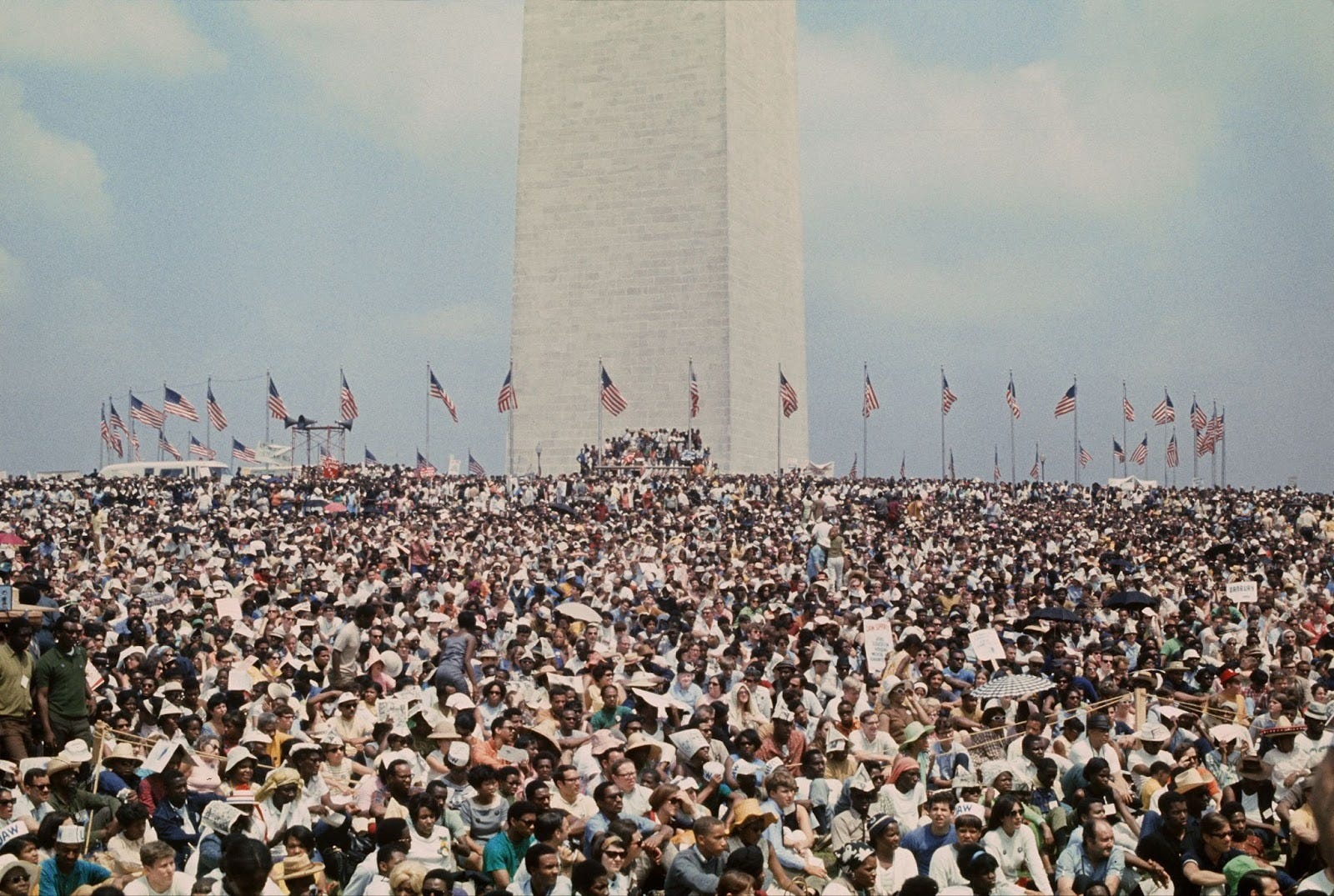
During his last year with us, King sought a new pathway after the signature victories against segregation and disenfranchisement in the form of the Civil Rights Acts of 1964 and 1965. His Poor People’s Campaign was going to foster a multiracial coalition, seeking justice for oppressed people of all walks.
It seemed like something of a letdown to many at the time, as if he were retreating from the most important battle. To a new crop of more radical Black activists this was one more example of King being insufficiently “militant.” Stokely Carmichael thought the approach undermined a Black sense of solidarity. Local activists reported that poverty felt abstract compared to focusing on race or the vote. Many people were uncomfortable identifying as “poor.” I must admit having often had a guilty sense that the Poor People’s Campaign was something of an anticlimax in King’s career. If Black is the hardest race to be in America, a part of me thought that, in 1968, surely any campaigns of reform would have treated us as first in line. I always checked that impulse, but the point is that I had to.
But King was right then, and would be even righter now. Ironically, Renee Good’s murder can help show why.
A key thing about the tragedy of Good’s death is that what happened to her was not a one-off freak event but just a day in the life of the U.S. of A.—for white people.
As “contrarian” on race as I am often thought to be, until only about ten years ago I assumed that the cops killed mostly Black people, with killings of whites a rare occurrence. In my book Losing the Race in 2000, while questioning various claims that racism remained an obstacle to Black success, I singled out the violence and murder at the hands of the cops as an exception, using the analogy of a house that has burned to the ground but with the chimney still standing. This even irritated many Republicans at the time who were hoping I would join their ranks.
No one was more surprised than I when, in conversations with criminologist Peter Moskos as well as my online sparring partner, economist Glenn Loury, I learned that I wasn’t seeing the whole picture. Namely, in this U.S. of A., the police shoot hundreds more white people than Black ones every year. Moreover, as author and podcaster Coleman Hughes has written, “For every black person killed by the police, there is at least one white person (usually many) killed in a similar way.” For example, the day before cops broke into Black woman Breonna Taylor’s home and killed her, police in Potomac, Maryland had broken into white man Duncan Lemp’s home and killed him as well as wounding his girlfriend sleeping next to him. The way George Floyd was killed seemed so singularly brutal in 2020, but unknown to me until then was the case of a white man, Tony Timpa, who in 2016 was killed by cops in Dallas in a fashion tragically similar to what befell Floyd four years later.

The actual number of Black people killed by cops is also vastly smaller than many think. One survey in 2020 of 980 people found that over half of the ones who identified as very liberal supposed that a thousand or more unarmed Black men are killed by police yearly, when the actual number in 2019 was 27, 13 by gunshot.
To be sure, there is more to know than that. The cops kill more white people per year, but we must ask why Black people are killed by cops at a disproportionately high rate. The journalist Wesley Lowery has observed that Black people are about two-and-a-half times more likely to be killed by cops than their representation in the population would predict. It is understandable to suppose that the cause is racism: that in the heat of the moment, subconscious bias, and perhaps fear of Black people, makes cops pull the trigger.
But the problem is that, actually, studies of the police’s encounters with people such as one by Harvard economist Roland Fryer have shown that, as counterintuitive as it may seem, cops are not more likely to shoot Black people. Another way of looking at the issue is that poverty makes one more likely to encounter law enforcement, and Black people are more likely to be poor than whites—an issue that the nation, hopefully, will eventually solve but which has this grievous additional effect. The figures on poverty corresponded neatly when Lowery made his observation about the 2½ times disproportion in 2016. That year the percentage of Black people living in poverty was about 2½ times that of whites (22 percent and 8.2 percent, respectively).
America’s problem is less racist cops than just cops, and other figures of authority like Jonathan Ross, entrusted with firearms and ominously comfortable with killing people who frustrate them. It was common for police forces to be nakedly racist in the past, such as the Rodney King-era L.A.P.D. under Chief Daryl Gates and in the Philadelphia I grew up in where Mayor Frank Rizzo egged on the cops against Black people. But in 2026, the Black community’s take on the cops should be less “Cops are racist” than “Since more of us are poor, we are more likely to end up in tense situations with cops.”
Martin Luther King’s birthday this year is an opportunity to consider hitting a kind of reset, returning to King’s idea that the main focus should be justice for all. We might reconsider the idea, whether overt or tacit, that Black Americans are ever a special question, ever an issue, ever out on a limb waiting for a promise unfulfilled.
For example, surely it is important to help what used to be called the “underclass”—for whom poverty is not a step along the way to middle-class success but a multigenerational solid state. However, today’s underclass is as white as it is Black, with whites in under-served areas enduring an epidemic of unemployment and drug addiction. The American “underclass” we want to save now knows no race.
Affirmative Action for Black people was a wise policy in the 1960s, with Lyndon Johnson famously saying at Howard University that “You do not take a person who, for years, has been hobbled by chains and liberate him, bring him up to the starting line of a race and then say, ‘you are free to compete with all the others,’ and still justly believe that you have been completely fair.” But Johnson said this in an America where the primary racial distinction was between white and Black, because immigration had been starkly limited since the 1920s.
That America ended with the Immigration Act of 1965, which created the highly diverse American population of today. Today, racial preference policies that give special attention to Black (and Latino) university applicants have been shown to all but require that Asian applicants reach a higher bar than any Black or Latino applicant would have to.
Ideally these Asian applicants and their parents might understand that they need to make allowances for the extent to which Black people were deliberately held back in America in the past. But there are now so very many groups of people in America, all having dealt with the grinding hardships of starting over, as well as degrees of discrimination. Hoping they will willingly move over for Black and Latino people because of events largely in the distant past is a big ask. Most of us can probably imagine being in the position of Asian students and feeling the way they do. Once again King’s perspective speaks to us: focusing preferences on present-day socioeconomic circumstances—i.e. class, not skin color.
The Supreme Court is eviscerating the Voting Rights Act of 1965, under the premise that racism has receded enough that it should no longer be necessary for states to submit changes in election laws to Federal approval. It is understandable that Black communities would see this invitation to redistrict as a threat. But in 2026, it can be hard to pinpoint just what the Black community’s unified platform is.
Not that individual Black voters don’t have their particular concerns—it’s just that they vary among us. A study late last year documented that older Black voters cite racism as a priority in determining their elective choices. But among the younger 59%, what most influences their vote are health care and inflation, as is true of so many Americans of all races. Then, 7% among this cohort regularly vote Republican, most of them men, and 15% of Black voters—nearly one in seven—voted for Donald Trump in 2024. Today the Black vote is ever more simply the American vote.
The new reality is clear even on the level of how creative people depict the Black presence. In the deliciously spare and weird television show Severance, the menacing manager, a quirky office worker, a woman the white male lead dates, and a woman helping him escape his bifurcated fate are all Black actors. In a version of Severance thirty years ago there would likely have been one Black character and likely in a far more stereotypically “Black” role.
I think also of the late, great Broadway musical about cartoon legend Betty Boop, which I wrote about here during its run. A Black woman, Jasmine Amy Rogers, played Betty. White guys in the plot pursued her with her Blackness never remarked upon. We moderns could just see Jasmine Rogers’ Betty as a race-neutral person—judging her by the content of her character, as it were. The logo alone was a sign of the times—the top part was old-time white Betty Boop, but then below the waist was brown legs. The point was that Betty is both things, and thus a new kind of whole.
The last thing I want to imply is that racism no longer exists. However, I look to degree: in some of racism’s remaining forms, the question is how much they even affect us. Research indicates that implicit bias exists but does not regularly determine people’s actual behavior. Meanwhile, the literature on what microaggressions are and whether they significantly affect people is conceptually vague and weak—with esteemed Emory psychologist Scott Lilienfeld, on the basis of a wide-ranging study, calling for “abandonment of the term ‘microaggression.’”
Even when racism is less subtle, context matters. Fryer’s study, for example, showed mixed results. While cops shoot white people more, they nevertheless are more likely to rough Black people up physically and verbally. That is revolting and must change. But along with it, we must also consider the increasing number of physical attacks of Asians since the pandemic, the increasing number of antisemitic bombings and murders, and the attitude towards women indicated in what Ross apparently called Renee Good after executing her. And in other news: a brutal, ignorant, and imperialistic presidential administration, a perpetually stalemated Congress, the physical ravages of climate change, an opioid crisis, a broken and pitiless health care system. In front of this backdrop, I see Black America less as a community uniquely in crisis than as a people living within a nation in crisis.
Many argue nevertheless that Black Americans’ past should be addressed with a program especially for us, i.e. reparations. A pioneering program in Evanston, Illinois has granted Black people mortgage assistance as reparations for what their ancestors endured, and the idea is being studied in other places. I have been skeptical about reparations in the past, but have softened somewhat of late. I would get nothing out of watching people be given money and thundering that they shouldn’t.
However, I could get on board with reparations only if they were thought of as the final reckoning so many have waited for. I worry that many would feel it as a duty to approve reparations as just a beginning, with the idea there still remained the “real work” to be done. One example, typical in my experience, is a report by the Economic Policy Institute that requires that reparations include not just apology and payment, but “commitment to structural change designed to prevent future racial injustice”—as in, even after the payments, “It’s not over!”
This impulse would be understandable, actually. It would reflect the perspective we have always known, that feels familiar and even like a kind of comfort zone: our self-image as a people having come a long way but still with a long way to go, the mountaintop still unreached. It can be hard to quite imagine what American Blackness would be without this sense of suspension, an eternal in medias res.
But it leaves us as the nation’s ever and future poster children. Today we should feel diminished by that characterization, impatient to be free of it even under conditions still less than perfect. We should join a battle against injustice and inequality that embraces all races. This is not a conservative position but a progressive one. I suspect Reverend King, looking upon us in 2026, would agree.
John McWhorter is an associate professor of linguistics at Columbia University, a columnist for The New York Times, and a member of Persuasion’s Board of Advisors. He is the author of, most recently, Woke Racism: How a New Religion Has Betrayed Black America and Pronoun Trouble: The Story of Us in Seven Little Words.
Follow Persuasion on X, Instagram, LinkedIn, and YouTube to keep up with our latest articles, podcasts, and events, as well as updates from excellent writers across our network.
And, to receive pieces like this in your inbox and support our work, subscribe below:
As always, I find a great deal of wisdom in your writing. I do take exception to one of your sentences: "America’s problem is less racist cops than just cops, and other figures of authority like Jonathan Ross, entrusted with firearms and ominously comfortable with killing people who frustrate them." Lumping all law enforcement in the same category as I.C.E. seems illogical. We are constantly being told that I.C.E. officers are being recruited and hired with significantly fewer requirements and decidedly less training than that received by most local law enforcement. (For example, in Seattle, police go through a significant application process, including interviewing references, several different tests, physical ,intellectual, psychological. Then go through four months of the state academy and I think three months of FTO, before being officially hired. And then they are on a probationary year.
Approximately 347 police were shot in 2025 which led to 45 fatalities. Sixty-seven ambush style attacks. Of course, there are bad cops, bad shootings. However, to assume that this number can be zero or close to it may be unrealistic when guns are so available and so often used in criminal activities.
Of course, you are correct that had Renee Good been Black, her tragic and unnecessary death would be reported differently. (I have seen commentaries that the shooter was obviously "homophobic" but there seems no basis for this.) Nonetheless, discussion of it might be more accurate if it looked specifically at all the issues involved with I.C.E. rather than with all law enforcement writ large. Seems like two separate discussions.
There is extensive empirical evidence of ongoing discrimination against women and minorities in employment—likely as a result of implicit bias. I am NOT talking about the gimmicky IAT but about correspondence studies in which employers are sent matched resumes sending the message that an applicant is black or white.
One thing I noticed in most discussions of discrimination in employment concern only jobs that require a college degree—whereas most Americans, who are not college graduates compete in a different segment of the job market. (Whereas the correspondence studies, for the most part, test hiring for entry-level positions that don’t require a degree) I’m an academic and I’ve been through many hiring processes for my department. I do not believe that women or minorities face any discrimination in hiring for academic jobs. And I suspect the same is true for most other ‘elite’ jobs. It is for ‘non-elite’ jobs that discrimination figures and for which, I’d argue, affirmative action is required—not to promote ‘diversity’ (which, I believe, is of no value) but to ameliorate ongoing discrimination.
I’ve always wondered why virtually all discussions I’ve read on discrimination and affirmative action focus on jobs for college graduates—or admission to colleges and professional programs—why no one pays any attention to the jobs most people do. Maybe it’s the all cats equally gray assumption—the assumption that all ‘bad’ jobs are equally bad for all people. More likely I think it’s a matter of ‘those who speak don’t know’. The speakers are members of the ‘elite’ who see themselves and others like them in the market for jobs in management and the professions. They don’t believe that they themselves, their children, or anyone with whom they socialize will be competing for jobs that don’t require a college degree.