

Columbus Day, Wounded Knee, and the Lessons of Pine Ridge
What the Lakota Music Project says about the United States.

This article is brought to you by American Purpose, the magazine and community founded by Francis Fukuyama in 2020, which is proudly part of the Persuasion family.
President Donald J. Trump’s Columbus Day proclamation, on October 9, pledged “to reclaim [Christopher Columbus’s] extraordinary legacy of faith, courage, perseverance, and virtue from the left-wing arsonists who have sought to destroy his name and dishonor his memory.” Implicitly disavowing the increasingly widespread celebration of Indigenous People’s Day, Trump called Columbus “a prime target of a vicious and merciless campaign to erase our history, slander our heroes, and attack our heritage.” Guided by “steadfast prayer,” his journey “carried thousands of years of wisdom, philosophy, reason, and culture across the Atlantic into the Americas—paving the way for the ultimate triumph of Western civilization less than three centuries later on July 4, 1776 … He planted a majestic cross in a mighty act of devotion, dedicating the land to God and setting in motion America’s proud birthright of faith.”
In the context of anti-immigration rhetoric, the MAGA espousal of a Christian America is provocatively exclusionary. Its most obvious targets are Muslims. However, as I happened to be on the Pine Ridge reservation in western South Dakota on Columbus Day, I had a different thought. Pine Ridge was the site of the last military engagement between the United States Army and Native America: the Wounded Knee massacre of 1890, in which perhaps more than 200 Lakota men, women, and children were murdered by soldiers sent by President Benjamin Harrison.
Also connecting the dots was the Trump cabinet member with the loudest Christian credentials: Secretary of War Peter Hegseth. During the Biden Administration, General Lloyd Austin, as Secretary of Defense, ordered an inquiry into Wounded Knee to ensure that none of the 20 soldiers awarded Medals of Honor “were recognized for conduct inconsistent with the nation’s highest military honor.” Enter Hegseth, in September, to announce that the medals would not be rescinded. He praised the recipients as “brave soldiers” and added: “We’re making it clear that they deserve those medals.”
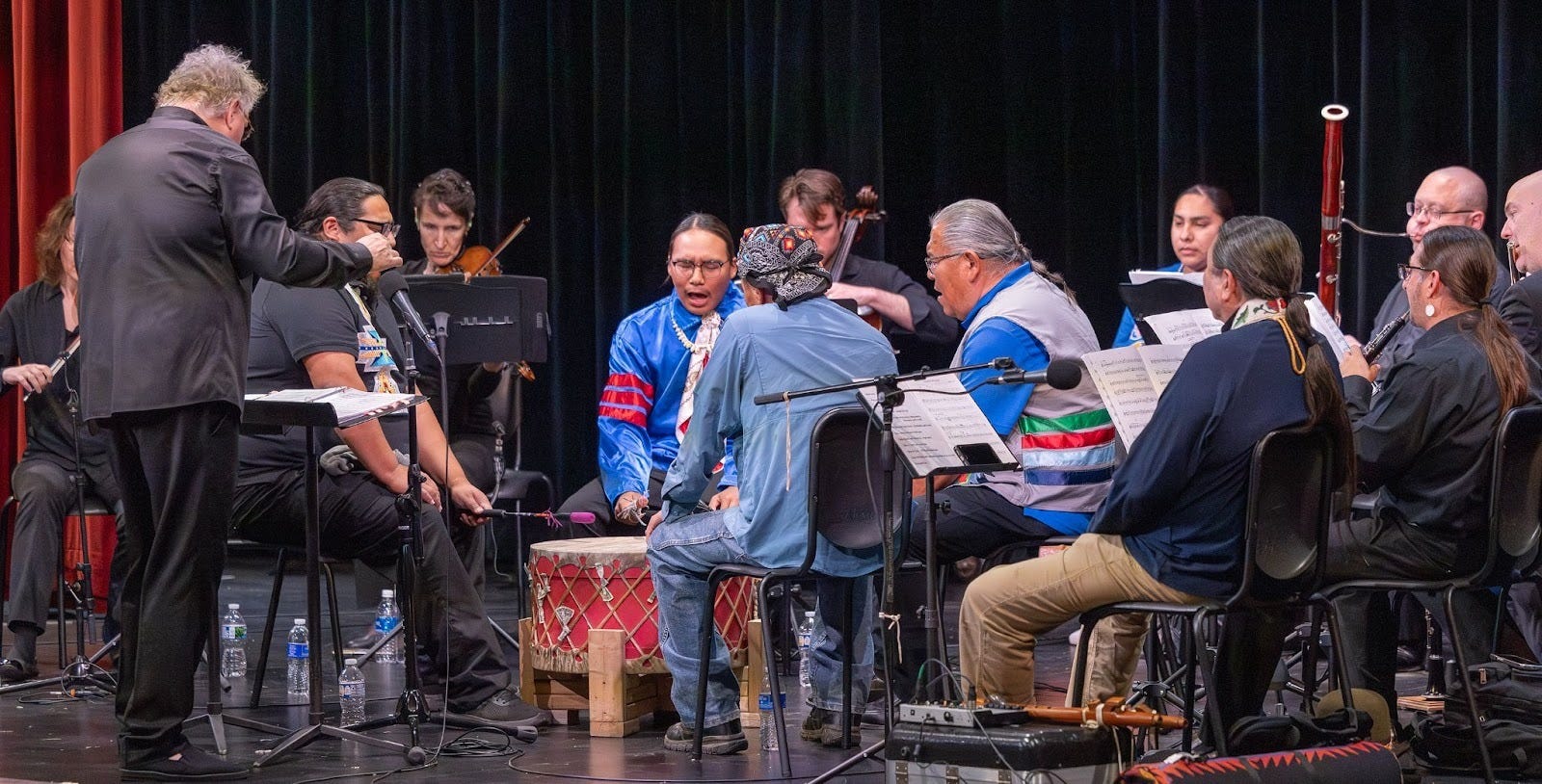
I visited Pine Ridge accompanying the fourth Lakota Music Project tour of the South Dakota Symphony. This initiative, now fully twenty years old, was conceived of by SDSO Music Director Delta David Gier in consultation with Lakota and Dakota leaders throughout the state in an attempt to deploy music to promote mutual understanding where a climate of mistrust has long prevailed. Gier himself happens to be a devout Christian. He told me: “I find it absolutely bewildering that we’re at a point where my faith has been attached to a right-wing political viewpoint. It’s directly opposite to what Jesus Christ not only taught, but demonstrated with his acceptance of the other, his ministry to the other.”
The participants in the week-long tour included nine members of the South Dakota Symphony. They also included the five members of the Creekside Singers—a Lakota drumming group based on Pine Ridge—as well as Bryan Akipa, a celebrated Dakota flutist who lives on the Sisseton reservation to the east. I asked Emanuel Black Bear, the leader of the Creekside Singers, about the recent statements of Trump and Hegseth on Columbus Day and Wounded Knee. “We know the truth,” he said. “So why should I worry about what they say? My life doesn’t involve them. My preservation, my culture, my language doesn’t involve them. It’s like the old saying: how you feel about me is none of my business. Their minds are made up already. All I can do is teach my children.”
Black Bear’s 21-year-old son, Ari, is now the lead Creekside singer. In fact, all five members of the group belong to the same extended Pine Ridge family. Black Bear’s father-in-law, Chris Eagle Hawk, is a tribal elder whose grandparents sailed to Europe with Buffalo Bill. At the age of six, he was removed from his family and sent to a government boarding school. “They put me in a strange chair and started cutting my hair,” he told me. “To a Lakota your hair is your spirit. I saw my hair on the floor and started crying. When they cut my hair they killed my spirit. Then they took away everything I owned. I had a little toy car. That was the only toy I ever had and I cherished it. They took that, too. They made us ashamed of our language and our beliefs. But we would speak Lakota in secret.” As a high school senior, Chris Eagle Hawk was transferred to the Santa Fe Institute of American Indian Arts. “It was like somebody turned the lights back on. I could be who I am. And I was ready to listen.”
One of the stops on the Lakota Music Tour was the city of Mission in the Rosebud reservation (population 1,135). The local performers included the Black Pipe Singers, 21 Lakota schoolchildren, ages 8 to 10, whose singing and drumming conveyed fervor and inspiration. I found myself thinking about the rootlessness of Gen Z—of young Americans questing for something in which to believe. The Creekside Singers and the Black Pipe Singers, however beleaguered their daily lives, believe in their cultural inheritance. At the same time, it is an inheritance difficult to merge with the contemporary American experience, let alone with New World notions of a “proud Christian birthright.” This is the conundrum that the Lakota Music Project seeks to address.
The place of Native America has been debated for as long as there has been a United States. And music has long been integral to this debate. In the early history of American classical music, the most influential proponent of Native America was an ecumenical outsider: the Czech composer Antonin Dvořák, who led New York City’s National Conservatory from 1892 to 1895. Dvořák arrived already fascinated by Indians and by Henry Wadsworth Longfellow’s The Song of Hiawatha, which he had read in Czech. He attended the Buffalo Bill show, and, in Spillville, Iowa, he closely observed the songs and dances of the Kickapoo Medicine Show’s Native American entertainers.
Dvořák inspired America’s fledgling concert composers to pay attention to Native America—which resulted in a musical “Indianists” movement lasting into the 1930s. Of its hundreds of symphonies and sonatas, songs and operas, the most enduring is Dvořák’s own New World Symphony (1893), in which Longfellow’s Hiawatha is a central influence. The movement produced a mountain of kitsch unremembered today. Equally unremembered are the Indianist compositions of Arthur Farwell, who detested kitsch and revered Native America. Unlike Dvořák, Farwell studied and adapted actual Indian tunes. Music like his astringent Navajo War Dance No. 2 for solo piano (1904) deserves to be known as an achievement parallel to the contemporaneous folk song adaptations of Béla Bartók in Hungary. Instead, Farwell—if recalled at all—is condemned for “cultural appropriation” alongside such Indianist merchandisers as Charles Wakefield Cadman, whose mellifluous From the Land of the Sky-Blue Water (1909) was once widely performed. The Trump White House enjoys no monopoly on phony history.

Much later, Louis Ballard (1931-2007), a Native American composer, restarted the movement to evoke Native America in the concert hall. Today, an increasing number of composers, both Native and non-Native, explore the resources of American Indian chant. South Dakota’s Lakota Music Project has taken a lead, commissioning, performing, and recording new works. The Creekside Singers and Bryan Akipa, key figures in the recent tour, have participated in the creative process. Another crucial participant has been an Austrian-American scholar of Lakota Music: Ronnie Theisz, who decades ago left New York City to teach at Black Hills State University.
The aspiration to marry Lakota and Dakota song with European instruments is complex; it is no wonder that neither Dvořák nor Farwell ever attempted it. But the two pieces premiered on the Lakota Music Project tour mark a breakthrough—a persuasive synthesis is achieved. The composers are Jeffrey Paul, who as the South Dakota Symphony’s principal oboist has known Bryan Akipa for nearly twenty years; and Derek Bermel, who lives in Brooklyn and has long specialized in integrating non-Western musical traditions.
Titled Songbird and Goose, Paul’s new piece combines Akipa’s wooden flute with a string quartet and wind quintet. Unlike his previous compositions for a similar grouping, it is less a description of nature than an abstract meditation ignited by a palpitating Akipa melody. Its serene energy is intoxicating. “Just discovering the sheer beauty of the sounds that Bryan makes with a wooden flute was staggering for me,” Paul says. He’s fascinated by the aromatic pitch fluctuations aerating Akipa’s tunes. “I tried to tap into the color of his instrument without trying to compose ‘Indian’ music. I wanted to be respectful both to Dakota culture and to the Western European classical tradition.”
Bermel’s Lakota Refrains, meanwhile, uses the same nine symphony musicians in combination with the Creekside Singers, whose songs he studied in consultation with Emanuel Black Bear over a period of two years. He fractures and recombines a series of Lakota tunes, creating a pounding cross-cultural mosaic. Not only do two musical genres feed off one another; the musicians themselves mutually ignite in performance. The final movement is based on a Lakota processional dance. At every one of the nine performances on tour, members of the audience—native and non-Native—spontaneously arose and formed a chain of dancers. At the final performance, in Sioux Falls, the dancers numbered more than 100. “I was absolutely overwhelmed to find the entire space filled with people holding hands and dancing,” Gier recalls. “It took my breath away.” Bermel, too, had never envisioned a dancing audience. “If we’re going to have a common future, it has to start with mutual respect,” he reflects. “The Lakotas have had a long time to respect our legacy. I think we need to start to look at the Lakota legacy that has persisted through great trials and attempted erasures. I think it’s the first step toward having a common future. And I think that attempt is at least a start. I think it can elevate us all.”
President Trump proclaimed that Christopher Columbus’s “noble mission” was “to discover a new trade route to Asia, bring glory to Spain, and spread the Gospel of Jesus Christ to distant lands.” Secretary Hegseth said of the Wounded Knee soldiers: “They deserve those medals.” The historian Heather Cox Richardson, author of Wounded Knee: Party Politics and the Road to an American Massacre, challenged both statements in a pair of posts dated September 26 and October 12. President Benjamin Harrison’s disastrous decision to send troops to Wounded Knee, she wrote, was linked to a battle over control of the South Dakota legislature. “Frenzied soldiers killed every Lakota they could find … The outcry against this butchery started in the Army itself.” General Nelson Miles, who commanded the Division of the Missouri that included Pine Ridge, “was incensed that the simple surrender of a peaceful band of Lakotas had become what he called a ‘criminal military blunder and a horrible massacre of women and children.’” Of Columbus Day, Richardson wrote that it “began in the 1920s, when a resurgent Ku Klux Klan tried to create a lilly-white country by attacking not just Black Americans, but also immigrants, Jews, and Catholics”—including the Catholic fraternal organization the Knights of Columbus. An Italian lobbying effort eventually led to a 1934 Columbus Day proclamation by President Franklin Delano Roosevelt, “aware of the need to solidify his new Democratic coalition by welcoming all Democratic voters.”
In South Dakota, Bishop Scott Bullock of Rapid City wrote of Hegseth’s announcement: “If we deny our part in history we deepen the harm. We cannot lie about the past without perpetuating injustice and moral blindness. We acknowledge the government’s intent to honor its troops, yet we reject any narrative that erases the humanity of the victims or glorifies acts of violence.”
The ongoing discourse on Native America is ultimately a discourse about origins. What Lakota origins may have to do with American origins will remain a necessary puzzle demanding diligent attention. Not a puzzle is the Lakota preservation of a cultural inheritance at various moments threatened, distorted, or denied. Never before in American history has the perseverance of cultural and historical memory been more inspirational—or more necessary.
Joseph Horowitz is the author of 14 books about the American musical experience. His December 1 NPR documentary about the Lakota Music Project tour, sampling the music of Jeffrey Paul and Derek Bermel, is archived here.
Follow Persuasion on X, Instagram, LinkedIn, and YouTube to keep up with our latest articles, podcasts, and events, as well as updates from excellent writers across our network.
And, to receive pieces like this in your inbox and support our work, subscribe below:
 | A guest post by
|
What Columbus’s first voyage really did was to initiate the largest and most consequential family reunion in human history. Two halves of the human race that had been separated for tens of thousands of years met each on a sunny beach in the Bahamas.
Except for some sporadic but inconsequential meetings such as the one the Norse initiated in Greenland four hundred years prior to 1492, the two halves of the human family knew nothing of each other.
The result of this reunion was temporarily quite beneficial to the Spanish, and far more so to other European countries as they too set up colonies in the ‘New World’, but for other half of the human family, the reunion was nothing short of catastrophic.
The so-called Columbian Exchange resulted in a number of valuable commodities moving back and forth, but of them all, European diseases were by far the most consequential. Lacking natural immunity, Native America death rates, although impossible to calculate with entire accuracy, were not infrequently over 90%.
For all his depredations over his four voyages and governorships, this catastrophe cannot be laid at Columbus’s feet. It was simply Nature doing her microbial thing.
For the rest, the work of far more knowledgeable historians than I is necessar. But that moment, in the dark of the night on October 11th, 1492, so well told by Samuel Elliot Morrison in his history of the first voyage, when (supposedly) the sharp eyes of Rodrigo de Triana atop the Pinta’s mast saw a light on an unknown shore ahead, must rank as one of the the most crucial in human history.