

Europe Can No Longer Trust America
The continent needs to build its own future—but to do so, it needs imagination.

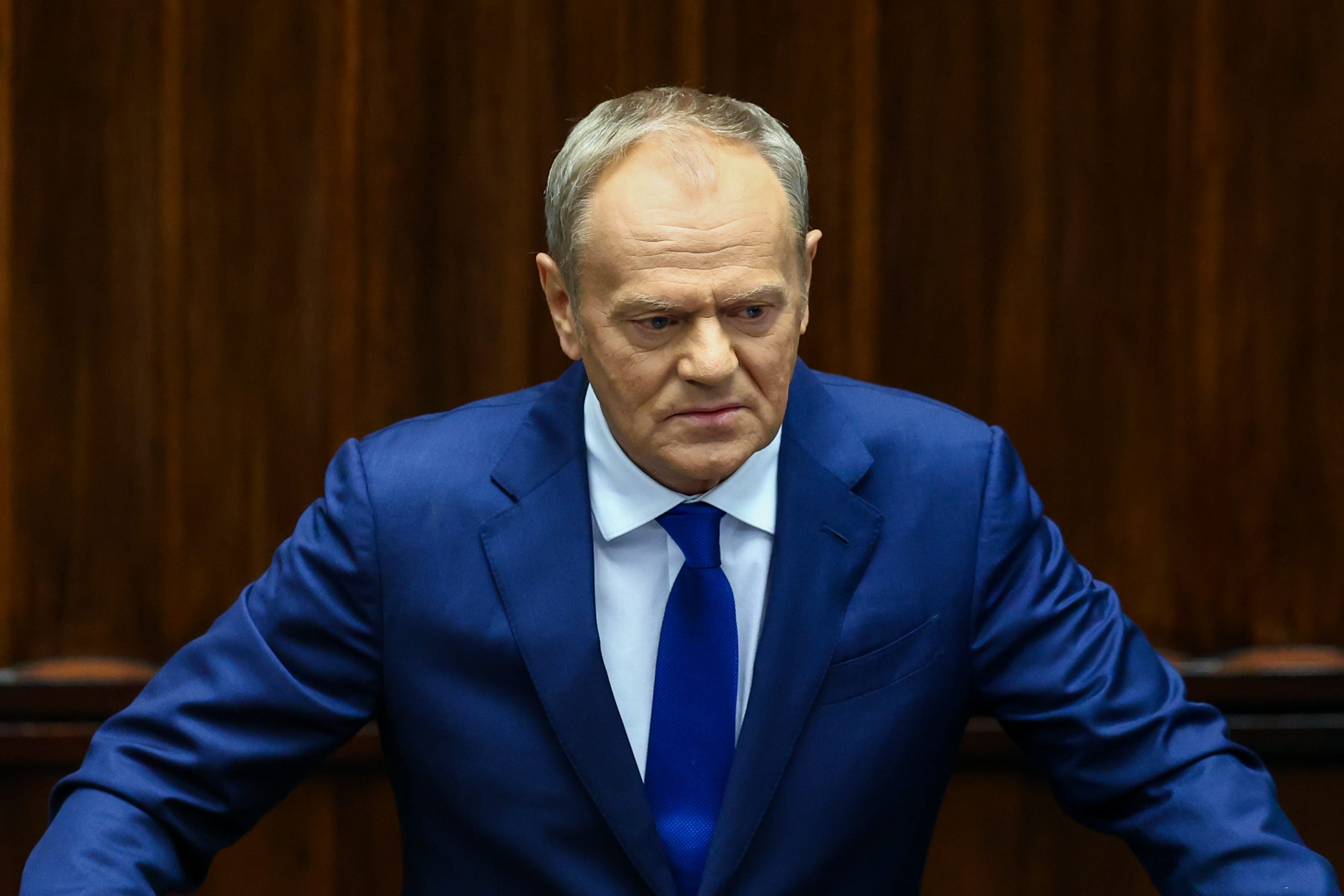
In his recent interview with the Financial Times, Poland’s prime minister, Donald Tusk, startled many by predicting that Russia might soon test NATO’s resolve to defend its allies. Yet what has ruffled feathers even more was his question about the “loyalty” of the United States as an ally.
Given Poland’s steadfastness over the past thirty years, it is easy to sympathize with Tusk. Regardless of who holds power in Warsaw, Poland has always taken its defense seriously. It has bought U.S.-made military equipment and welcomed U.S. investment—including in nuclear energy.
There is very little that the current administration has done in return for highly reliable allies such as Poland—notwithstanding the recent U.S.-brokered release of a Polish journalist held by Belarus. Polish exports to the United States face arbitrary tariffs. Washington has stopped almost all of its aid to Ukraine, whose victory remains an existential question for Poles. More recently, the U.S. president has picked NATO as a scapegoat for the failures of his ill-conceived war against Iran.
Yet Tusk is not a public intellectual, free to air musings about his country’s relationship with the United States. His task as prime minister is different. First, it is to ensure that Poland is ready for less-than-ideal scenarios in the U.S.-European relationship. Second, it is to help prevent the worst-case scenarios from materializing.
As a result, leaders like Tusk must resist the magnetic pull of the grotesque show that Donald Trump is putting on in the United States. It is easy to score political points at home by confronting Trump. Yet the further east one goes, the higher are the stakes of making the U.S.-Europe relationship a part of everyday political life. That does not imply rolling over in the face of the U.S. president’s antics. Quite the contrary: Europeans must be ready to push back whenever their interests are threatened, as they did when the Trump administration readied to take over Greenland.
It is also conceivable that voicing questions about the U.S. commitment to Europe, as Tusk did, will help mobilize the European (or Polish) public to do more to prepare for scenarios in which Europe cannot rely on the United States. Yet it can also act as a self-fulfilling prophecy, as any unforced fights with Trump risk accelerating America’s drift away from the continent.
To be sure, the odds that the current presidency is just a fleeting episode in U.S. history, to be followed by a swing back to the post-war norm, are slim. Hope, moreover, is never a substitute for strategy. Nor should one believe in the mistaken trope of “transactionalism” as a way of placating Trump. As Ukrainians have learned from their critical minerals deal, mutually beneficial business relations are no guarantee of staying in the good graces of the U.S. administration. Similarly, billions spent by European militaries on future deliveries of F-35 fighters may or may not be justified on defense grounds. However, one should not live under the illusion that such purchases would prompt Trump’s United States to rush to the defense of Europe.
Rather, the reason for restraint in rhetorical and other confrontation with the United States is that adaptation to America’s reduced reliability and wild swings in its politics is a long-term project, requiring not just unprecedented investment in defense but also the building of new institutions and new political projects. That takes time, intellectual leadership, and a willingness to look dispassionately beyond the immediate horizon, instead of just reacting to the latest outrage or international crisis provoked by Trump.
Why make institutions a part of the equation? Well, if the current moment teaches anything of value to international relations theorists, it is that institutions—understood both as organizations and as rules of the game—matter. Personalist alignments, flattery, bribes—or “transactionalism”—are no foundation for a stable international system. Never mind the one-sided deals meant to mollify Trump or outright bribes offered by the likes of Qatar and UAE; the U.S. president has only one loyalty—and it is to himself.
And no matter how skillful the likes of Alexander Stubb, Giorgia Meloni, or Mark Rutte have been, their sweet talk has not fundamentally altered the course that the U.S. administration is on. It is only a matter of time until the glamour of King Charles’ recent visit to Washington will be superseded by yet another episode of the administration’s lashing out against the UK and its government.
As Europeans look ahead, seeking to put the relationship with the United States on a more durable footing, they will have no choice but to think about institutions and institution-building. That means building structures of political, defense, and economic cooperation that can deliver in the absence of U.S. leadership and that could perhaps even provide a deterrent against America’s predatory behavior in the future. It also means building institutions that America would want to be a part of, allowing them to constrain and moderate its behavior in future political cycles.
The reason is simple. Institutions are sticky and they often survive under mercurial and unpredictable leaders. One tends to think, for example, of the post-war ecosystem of international organizations and treaties as hopelessly outdated—just waiting to be shattered by a Trump-like figure. Yet it should give one pause that ten years into Trump’s full-frontal assault, many of the relevant institutions still persist, weakened though they are.
Few in the Republican Party harbor any love of multilateral institutions; yet the United States has (for the most part) remained a part of the UN system, a member of NATO, and a party to countless international treaties and conventions.
In Washington, the International Monetary Fund and the World Bank are humming along, with a staff who may be a little confused about the new realities but who certainly do not feel under any existential threat. Sometimes, even Trump and his team seem to recognize the usefulness of the existing institutional architecture. More importantly perhaps, even for the Trump administration, it may not always be an appealing proposition to just smash things while being patently unable to come up with alternatives.
The Five Eyes alliance continues to function despite intelligence-sharing tensions. Meanwhile, the dollar-denominated international financial architecture appears resilient. And even if the United States withdrew from NATO tomorrow—reducing its own ability to project power globally through its European bases—the alliance would still be extremely useful to Europeans as a platform for ensuring interoperability, joint planning, and socializing allied militaries into fighting together.
Yet fundamental realities about the world have changed relative to the post-war era in which such international institutions, treaties, and alliances were being created. And unless those institutions adapt effectively, they will eventually be hollowed out and replaced by new ones. For all of the U.S. administration’s ham-fistedness, there is thus a grain of wisdom in the quest to build a “NATO 3.0,” or to create new structures of cooperation around critical supply chains.
It is an open question how effective the United States can be at institution building anytime soon, considering the magnitude of its domestic political crisis. But that provides an opening for others—perhaps for Mark Carney’s middle powers, perhaps for the EU, perhaps for China—to think about how the international arena could be structured by new rules and new political projects, sometimes working around an unreliable United States, rather than with it or under its leadership. Europeans must be at the forefront of that exercise, both at home (especially in updating and strengthening the EU) and in their engagement with the wider world.
Concrete moves underway include the expansion of the Comprehensive and Progressive Agreement for Trans-Pacific Partnership (CPTPP); the EU-Mercosur trade deal with Latin America; strengthening of the Canada–EU strategic partnership; and, in the context of European security, the Coalition of the Willing to support Ukraine and the Joint Expeditionary Force of Northern European nations.
“We have all the institutions we need,” one European diplomat claimed during a panel I moderated. “We just have to make the existing ones work.” But that betrays a deeply ahistorical view of our situation. States, governance structures, alliances, and institutions have changed constantly through human history—sometimes through war and chaos and sometimes through ordered, democratic change. The Holy Roman Empire, the dual monarchy of Austria and Hungary, Czechoslovakia, the Polish-Lithuanian Commonwealth, and the Soviet Union all seemed like basic, immutable artefacts—until they weren’t.
Tusk asked whether the United States is still a loyal ally. It’s a valid question, but not one for Poland’s prime minister to ask aloud. The right question—quieter, harder, and answerable only over years—is what institutions Europe could build that would make American loyalty matter less. In a few years, Donald Trump will be a memory. The institutional solutions that Europe and its partners come up with—or fail to come up with—in response to the change in America’s role in the world will shape the continent’s geopolitical future for generations.
Dalibor Rohac is a senior fellow at the American Enterprise Institute in Washington, D.C. and a contributing editor at American Purpose.
Follow Persuasion on X, Instagram, LinkedIn, and YouTube to keep up with our latest articles, podcasts, and events, as well as updates from excellent writers across our network.
And, to receive pieces like this in your inbox and support our work, subscribe below:
 | A guest post by
|
"We have all the institutions we need,” one European diplomat claimed during a panel I moderated. “We just have to make the existing ones work.” But isn't that the glaring question on the table? The 'existing ones' don't work, have not worked in years, because Europe got lazy supping at the 'trough Americana'. Current European leadership is, quite frankly, past its 'sell-by' date. The world in which it cosplayed its cosseted life of believing it was a player in world politics is gone ...and it has no answers for that.
The focus on Trump’s personality deflects from the structural issue. Europe has benefited for decades from an American security architecture that costs the U.S. tens of billions per year and likely trillions over the postwar period. Calling Trump grotesque or transactional does not answer the underlying question: why should American voters keep underwriting the defense of wealthy European states that often treat U.S. power as both indispensable and morally suspect?