

Europe Needs A New Union
It’s time for a “North-Eastern federation” as a bulwark against Russia.

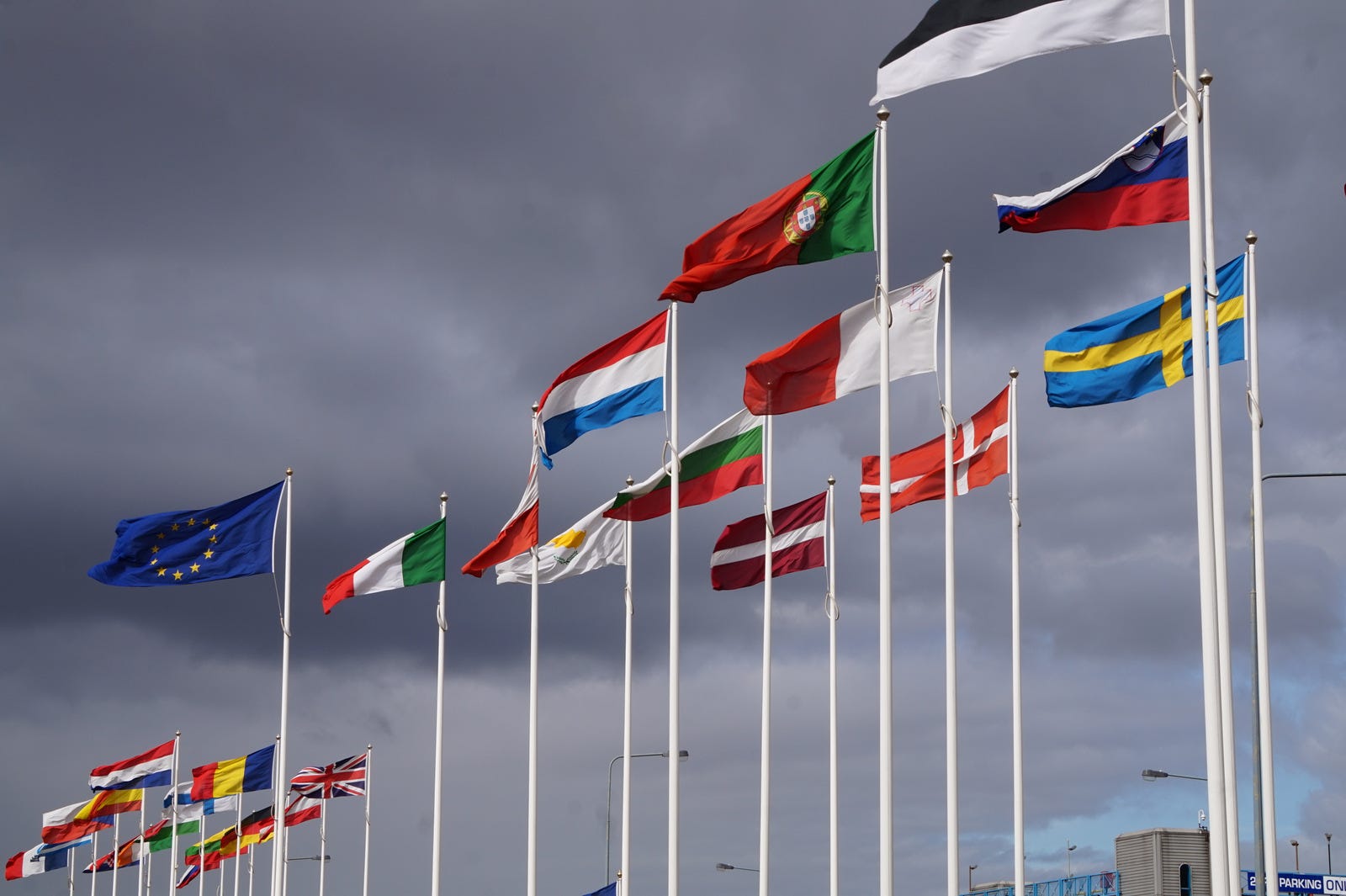
This article is brought to you by American Purpose, the magazine and community founded by Francis Fukuyama in 2020, which is proudly part of the Persuasion family.
To say that we live in unhinged geopolitical times is an understatement—and things may get worse still. Whatever the outcome of the current round of outreach to Russia by the Trump administration, the direction of travel is unmistakable. In fact, if an end to hostilities is agreed under U.S. pressure, Russia is likely to pose an even greater threat to its neighbors as the Kremlin will have to channel its war machine somewhere.
To believe in the existence of NATO as a real, credible military force to deter Russian aggression against the Baltic states, which Putin sees as a legitimate target, now requires a real suspension of disbelief. Imagine a Europe in 2030 in which NATO’s Article 5 has been exposed to be as hollow as the Budapest Memorandum. Perhaps Western Europeans would step in and fill the void—but perhaps not.

Worse yet, if current political trends hold, an unravelling of NATO as an effective military alliance might go hand-in-hand with the demise of the EU—especially if National Rally and/or Alternative for Germany accede to power in France and Germany, respectively. The collapse might not be immediate or dramatic. It may look like Brexit, but it may also take the form of either of the two key countries withdrawing from various aspects of EU policymaking and law. It is one thing when Viktor Orbán decides to be difficult; it would be quite another if a President Jordan Bardella or a Chancellor Alice Weidel demanded a thorough renegotiation of key aspects of European architecture or unilaterally withdrew from parts of EU law.
For countries in my part of the world, Eastern Europe, that prospect raises the question of how to preserve the achievements of 1989—which EU and NATO memberships were supposed to guarantee. Previous generations of Eastern European political leaders made the bet that U.S. security guarantees and European economic integration were the safest paths toward freedom, democracy, and economic prosperity. They were absolutely right under the circumstances that they faced—yet our generation might face radically different circumstances in which those two paths are not available.
Different responses to the challenge are conceivable. Yet the obvious one, namely some version of a stronger EU, or “European strategic autonomy,” begs the question, as it assumes away the European component of the current predicament. Sure, it would be nice if the prospect of a non-benign nationalist takeover of France or Germany went away, or if the EU responded to the failure of U.S. leadership by getting its act together—but this is far from a foregone conclusion. It is equally probable, if not more probable, that NATO and the EU were conceived as complementary elements, rather than as artefacts that can be substituted for one another. As a result, if one of them crumbles, the decay of the other will accelerate.
The more “robust” answer is for countries on the north-eastern periphery of Europe—confronted with an aggressive Russia, a hollowing out of NATO’s security guarantees, and a potential breakdown of the EU—to work together to create a new political project: a “federation” including the Nordic countries, Poland, the Baltic states, Romania, Ukraine—and possibly others.
Historically, federal political projects have arisen as ways of managing internal diversity in the face of shared challenges, oftentimes emerging in times of geopolitical distress, as in the case of the union between England and Scotland—or the early United States, where Benjamin Franklin supposedly quipped that “we must all hang together, or, most assuredly, we shall all hang separately.” In Eastern Europe, too, the Polish-Lithuanian Commonwealth emerged as a bulwark against the threat of Teutonic knights and later also of an aggressive Muscovy. It also provided the benefit of bringing local Slavic populations into the fold of Western Christendom, as opposed to Russian Orthodoxy.
To be sure, there have been many calls for federalizing the EU. The idea never materialized, for a simple reason: the bloc is too big and too heterogeneous. EU-27, or even just the Eurozone countries, never saw eye-to-eye on major strategic or economic questions such as a common European nuclear deterrent (as opposed to a French one), or a European welfare state. The sense of a shared threat from Russia, apparent in Europe’s north and east, is much weaker further west and south. In the current debate over frozen Russian assets, Belgium is not willing to take on even the most theoretical of risks for the sake of helping Ukraine—suggesting that the country’s elites simply do not see themselves as concerned with the consequences of a possible Russian victory.
What a Limited EU Federation Would Look Like
But what remains a bridge too far for the EU-27 might be possible for a smaller subset of countries, especially when faced with an existential threat in the form of an aggressive Russia operating in a post-American world. In an ironic twist of history, just as the United States celebrates the 250th anniversary of its founding, the federalist ideas that inspired it can also influence the region that owes much of its current success to the wisdom and perseverance of earlier generations of American policymakers.
The “North-Eastern Federation” could be a very thin one, initially delegating only a small number of powers to its center: foreign policy (including nuclear deterrence), trade, and the internal market. Unlike the EU, which has evolved into an unwieldy body with fingers in all areas of public policy and oftentimes without a clear focus, this Federation would be forced by circumstances to focus on the essentials, leaving the luxury causes du jour for some later date—or for the national governments to resolve themselves. The project would thus, by necessity, mirror the idea of subsidiarity—that higher forms of political authority exist only to address tasks that cannot adequately be dealt with at lower levels of government.
Since most of the countries in question are already EU member states, this project could align with their EU commitments. In practice, those that are not in the EU apply the bulk of EU law anyway (Norway, Iceland) or are in the process of negotiating accession into the bloc (Ukraine). For Ukraine in particular, federalizing with EU member states could accelerate the process of joining the bloc—not unlike in the case of East Germany, which became absorbed into the European Economic Community without a formal accession process. The Federation would enable participating countries to deepen the internal market in ways that have proven too difficult at the EU level, in services or in building a savings and investment union that would enable the emergence of a more significant venture capital ecosystem.
The Federation would need the power to tax and issue debt—something that has proven elusive at the EU level but might be more straightforward among countries in a better fiscal shape. Ukraine, devastated by war, is an exception. But by being a bulwark against Russian aggression, Ukraine has paid far more than its fair share of the price of admission into the club and future transfers needed to rebuild it—a proposition that is an easier sell to Ukraine’s neighbors, aware of its importance, than to European countries further away, more likely to be indifferent to its future.

In economic terms, the Federation would be a formidable force—even more since it would encompass the more economically nimble, less heavily-regulated countries of the European continent. Even without Ukraine, the Federation’s GDP, at some $2.9 trillion, would surpass Russia’s. With Ukraine, it would rival the GDP of France.
The idea of building new political institutions in Eastern Europe may seem farfetched, but it is simply a logical extension of the already existing, more loosely-structured initiatives uniting countries of the region. In the 2010s, the Three Seas Initiative sought to foster north-south connectivity on NATO’s eastern flank. Back then, common infrastructure projects and enhanced political dialogue, with the support of the United States, may have seemed sufficient to address the shared security challenge. However, as the geopolitical outlook for the region radically deteriorates, and may worsen even further, more ambitious thinking becomes necessary. After all, as has been proven many times by history, the alternative to hanging together is hanging separately.
Dalibor Rohac is a senior fellow at the American Enterprise Institute and a contributing editor at American Purpose.
Follow Persuasion on X, Instagram, LinkedIn, and YouTube to keep up with our latest articles, podcasts, and events, as well as updates from excellent writers across our network.
And, to receive pieces like this in your inbox and support our work, subscribe below:
 | A guest post by
|
Belgium does not want to take up the very real risk of having to reimburse money that it has no legal grounds to confiscate if its partners refuse to give serious guarantees, as they are refusing now. It also thinks that destroying the credibility of the European financial system and perhaps the Euro itself is not a genius idea that will be of much help to Ukraine. The real issue is that Germany and Hungary, each for their own reasons, are blocking the financing of Ukraine using either the normal budget or Eurobonds. As for a north-eastern European federation, that could be a very good idea but frankly, knowing how nationalistic those countries are, I am very skeptical. The EU framework is still the best available but we need to dump Moscow’s allies, starting with Hungary, and fundamentally change course on defence. The issue there is mainly NATO, which is fast becoming a burden but which most Europeans are loath to let go.
Well, there is already the Baltic Sea Region (BSR). It is still the only EU macro-region that was created "bottom-up" by the Nordic and Baltic governments, and not by a top-down method through decisions in Brussels.