


This article is brought to you by American Purpose, the magazine and community founded by Francis Fukuyama in 2020, which is proudly part of the Persuasion family.
For a staggering $15 million, a Taiwanese special forces pilot planned to defect by flying his CH-47 Chinook helicopter to a nearby Chinese aircraft carrier in a heinous act of treason designed to shatter the morale of the island’s military. Elsewhere, junior officers were blackmailed into filming propaganda videos, pledging to surrender to the People’s Liberation Army. These audacious plots, which took place in the past few years, are not isolated incidents. They are a narrow window into the vast, deeply entrenched network of espionage that Beijing has built in Taiwan for decades.
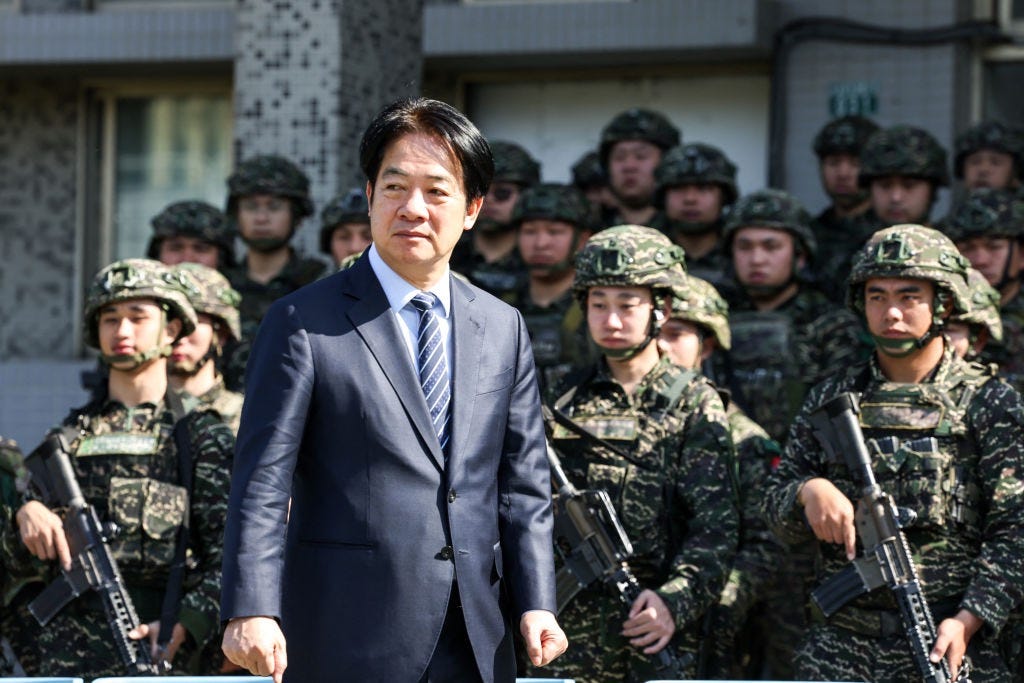
Until recently, Taiwan’s response to this shadow invasion has been lackluster and inadequate. But under President Lai Ching-te, that has changed. Lai took office in the face of unprecedented hostility from Beijing and intractable political division at home. Undeterred, President Lai has initiated a bold counteroffensive, bringing the shadowy conflict into the light. He is confronting a threat that has metastasized deep within the nation’s most important institutions. Taiwan’s democracy may very well hinge on Lai’s ability to enlist his countrymen in this fight.
His efforts have been refreshingly robust. Last year, in a landmark move, his administration officially designated the People’s Republic of China a “foreign hostile force,” and announced a sweeping 17-point national security initiative. This comprehensive strategy is designed to address five key vectors of attack: challenges to national sovereignty, military infiltration, the erosion of national identity, the subversion of civil society through “united front” operations, and the siren song of economic dependency schemes.
Lai’s plan crucially targets the epicenter of Beijing’s efforts to infiltrate Taiwan—the military. The Taiwanese armed forces constitute an astounding two-thirds of those accused in recent espionage cases. To address this, Lai’s plan reinstates military courts for active-duty personnel accused of espionage or treason. In the face of an active campaign to subvert the military from within, faster, more specialized, and more severe judicial consequences are a critical deterrent.
Lai’s approach is already bearing fruit. In 2024, espionage-related indictments surged to 64, more than the previous two years combined. Taiwan’s revitalized security agencies are finally equipped and empowered to hunt down the threats that have been allowed to fester for years. The dismantling of the 10-person ring plotting the helicopter defection, a network using encrypted apps like Telegram and cryptocurrency payments to avoid detection, was a masterclass in modern counterintelligence. Beijing intended to demoralize Taiwan’s military and its people, sapping their will to resist. Instead, the severe prison sentences handed down, some exceeding 13 years, sent a clear message: The age of impunity is over.
Lai’s resolve is further demonstrated by his willingness to pursue these threats to the highest levels, regardless of political affiliation. Investigations have exposed spies within the Presidential Office security detail and, in a politically charged move, led to the indictment of former officials affiliated with Lai’s own Democratic Progressive Party. This demonstrates a commitment to national security that transcends partisan politics, proving the fight is about protecting Taiwan, not consolidating power.
This work is made thornier by Taiwan’s fractious domestic politics. Lai is fighting a war on two fronts: one against Beijing’s spies, and another against political inertia and obstruction at home. He has called for a “whole-of-society” response, but a significant part of that society, led by the opposition Kuomintang (KMT), remains unwilling to even name the threat. This deep political polarization is Beijing’s most powerful weapon. It paralyzes policymaking and fosters a dangerous complacency among a public that wishes to believe the status quo is stable. According to 2024 polling, 60% of Taiwanese favor maintaining the status quo indefinitely or for the near future. Lai’s crusade is built on the recognition that Beijing is actively working to make that status quo impossible to maintain. Lai must convince his people that the house is already on fire, or Beijing will succeed in burning it down.
The failure of a citizen-led effort to recall 24 “pro-China” KMT politicians in July 2025 was a sobering reminder of this challenge. For many voters, abstract warnings about infiltration are drowned out by immediate concerns over the economy and cost of living—the very vulnerabilities that Chinese recruiters so skillfully exploit.
Lai is leading a nation that must defend itself with one hand tied behind its back. He is asking an open society to confront a closed, authoritarian regime that weaponizes that very openness. Lai is not just defending an island; he is defending the frontline of democracy. If he succeeds, he will preserve Taiwan’s right to determine its own future and, in the process, offer a blueprint for free nations everywhere to defeat the corrosive influence of authoritarianism.
Shahn Louis is the founder of Anansi Strategic Intelligence LLC, a Washington, D.C.-based geopolitical risk firm. A former senior intelligence analyst with experience across the Department of Defense and the Intelligence Community, he specializes in China analysis and East Asian regional dynamics.
Follow Persuasion on X, Instagram, LinkedIn, and YouTube to keep up with our latest articles, podcasts, and events, as well as updates from excellent writers across our network.
And, to receive pieces like this in your inbox and support our work, subscribe below:
