



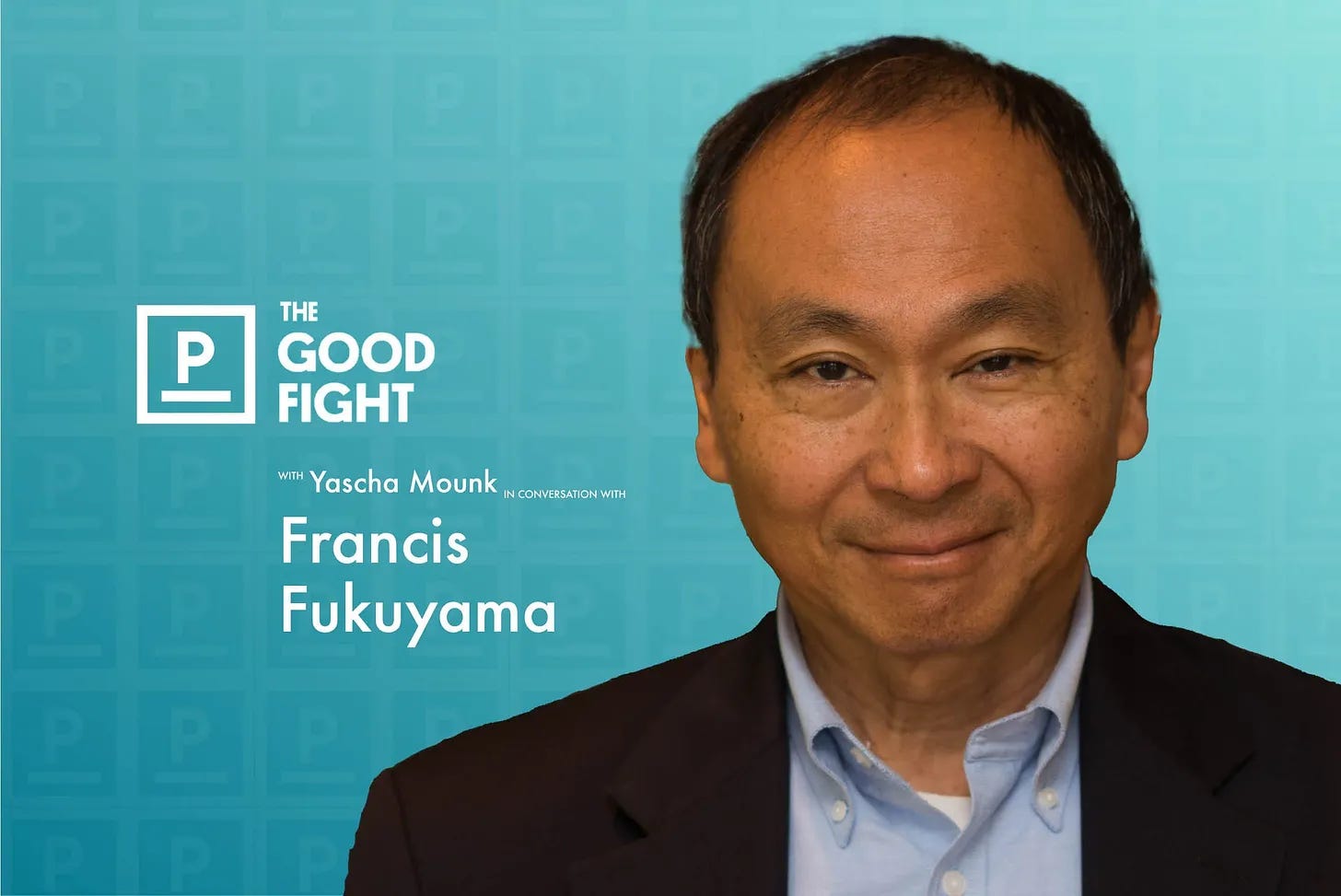
Francis Fukuyama is the Olivier Nomellini Senior Fellow at Stanford University. His latest book is Liberalism and Its Discontents. He is also the author of the “Frankly Fukuyama” column, carried forward from American Purpose, at Persuasion.
In this week’s conversation, Yascha Mounk and Francis Fukuyama discuss whether the unprecedented strikes on Iran will lead to the downfall of the mullahs, whether America can avoid getting drawn into a Middle Eastern quagmire, and whether the midterms will turn Donald Trump into a lame duck.
This transcript has been condensed and lightly edited for clarity.
Yascha Mounk: There is something remarkable about the fact that the president in recent memory who has been most adamant that he wanted to be, not his terms but basically an isolationist, that he thought that the American empire was overextended, that George W. Bush, his own predecessor as a Republican president, had chosen these disastrous wars of choice.
Now it’s Donald Trump who is engaged in a war of choice in Iran. At least according to Donald Trump and some Israeli sources, as we’re recording, it appears to be the case that they’ve managed to kill, in the first hours of this attack, the supreme leader of Iran, Ayatollah Khamenei. What do you make of this situation?
Francis Fukuyama: Well, I guess an initial thing to say is that I don’t believe almost any of the information I’m seeing, especially on social media, because I’ve seen a lot of assertions. Now, I assume that if Trump himself announces that Khamenei has been killed, that’s probably true. There are also a lot of videos of missiles hitting American air bases, of ordinary Iranians rioting and calling for the end of the regime. I don’t know how many of those are true. So it’s very hard to sort out what’s empirical at this point and what isn’t.
Mounk: I think we need to be careful in exactly how we frame things. It is clearly a massive attack on Iran. I developed a mini theory of how Trump wants to operate in foreign policy. It’s less of a doctrine and more of a playbook. It seemed to fit the initial attacks on Iran last June. It seemed to fit the attack on Venezuela in which he favored massive attacks that would move very quickly.
Basically, by the time that people woke up, they would already be over. This seems to be quite different from that. This does not appear as we’re recording this to be a conflict that’s going to be over in 24 or 48 hours.
Fukuyama: I think this is the case with all of these decapitation attacks. I actually had a former colleague at RAND, Steve Hosmer, who was a very wise political analyst who actually did a study of decapitation attacks going all the way back to World War II.
His conclusion from looking at these other cases is that they’re very unpredictable and they almost always don’t achieve the political end that has been sought. Now, I think that the problem here is that unlike the snatching of Maduro or the attack on the Ferdo enrichment facility, this is going to lead to a lot of internal instability. I think this is generally true if you take out the senior leadership.
You still have a very well-organized and very well-armed IRGC that has a real interest in the outcome of this because their lives are on the line. I think that what you’re going to get is a lot of internal conflict. You could get into conflict within the regime. Different parts of the regime seek to assert dominance over the whole thing and then between the population and the regime.
That is going to be extremely difficult to control. I think that this is not something that can be done on a single strike. They’re going to have to continue to try to influence things from the air. We have a lot of experience with strategic bombing and the political effects of strategic bombing. There have been many, many books looking at the effectiveness of this.
Just as in this study that I was mentioning of decapitation attacks, you essentially set up this extremely chaotic aftermath where if you’re not willing to put forces on the ground, you really cannot control things. That means that you’re right that this is not going to be a one and done situation. There’s going to have to be follow-up attacks. This is a conflict that is likely to continue for some time.
We hope you’re enjoying the podcast! If you’re a paying subscriber, you can set up the premium feed on your favorite podcast app at writing.yaschamounk.com/listen. This will give you ad-free access to the full conversation, plus all full episodes and bonus episodes we have in the works! If you aren’t, you can set up the free, limited version of the feed—or, better still, support the podcast by becoming a subscriber today!
If you have any questions or issues setting up the full podcast feed on a third-party app, please email leonora.barclay@persuasion.community
Mounk: You are very knowledgeable about a great number of countries under different circumstances. What do we know about the circumstances under which regimes fall and the circumstances under which they persist? It is quite clear that the Islamic Republic has some loyalists and some hardliners, but it also appears to be clear that there is very deep discontent in the Iranian population. We saw that with the courageous protests at the end of December and at the beginning of January. It took extraordinary force and extraordinary brutality to end those protests. There is a Revolutionary Guard that wants to preserve its own political power and its own economic might because they are very involved in every aspect of the economy.
I think it is hard to know to what extent they are at this point committed to the theocratic nature of the regime, as opposed to just wanting to preserve some form of quasi-military rule. What would it take to destabilize this regime? How big of a difference does it make whether the reports that we are hearing—claims by the president of the United States himself—that Ayatollah Khamenei is dead? Is that going to make a huge difference to the likely future of this regime in the next week? Is it unclear that it would actually make a giant difference?
Fukuyama: I think it’s already been destabilized. Unlike the case of Venezuela, where capturing one individual, Nicolas Maduro, left intact a power structure that then faced very different incentives on how it was going to act, I think in this case, it’s a much more complicated system. You have extremely well-entrenched groups. It’s not just the IRGC, it’s also the Basij, this other big militia that spread all over the country. They don’t represent anything like the greater part of the population, but they’ve also been pretty self-disciplined in suppressing any threats to the population. Now that the senior leadership is out of the way, you have multiple questions. Will they continue to suppress dissent? I’ve seen videos just in the last couple of hours of people protesting in the streets in different Iranian cities. Will they continue to want to shoot people in that situation? Will they turn their guns on one another? I think the only thing you can really predict at this point is that it’s going to be very chaotic and there’s going to be a lot of follow-up violence.
Mounk: What is the broader regional situation? It’s interesting that during the strikes in June, it took Iran a relatively long time to retaliate and the retaliation seemed surprisingly circumspect. They hit one military base the United States has in the region; they had some minor strikes on Israel and it was clearly calculated to deescalate to some extent. This time around the response from Iran came much faster, within about two hours. It hit a number of countries in the region that had actually apparently been trying to stay out of this conflict, including Saudi Arabia, giving them a strong reason to jump into the conflict.
It doesn’t so far look as though they’ve been able to do tremendous damage. There was relatively limited damage. What is that telling us about the future trajectory of this war, about Iran’s ability to retaliate and about whether this becomes a full-scale regional war involving Saudi Arabia and a bunch of other countries in the region?
Fukuyama: Iran is actually pretty weak at this point. I think they’re trying to throw everything they’ve got at the United States and its regional allies. I don’t think it’s actually going to do very much except for occasional damage to a hotel or an air base or something like that. I think that the issue really is not a wider regional war. In any event, the major allies of Iran, Hezbollah and Hamas, have both been severely weakened. It’s not as if they could start up other conflicts in other parts of the Middle East. I think the main action is going to be inside Iran. It’s going to be who survives, what kind of a leadership does the regime manage to retain? How do they deal with the population? I think it’s possible that the scales have been shifted so much that the overthrow of the regime is entirely possible. If that happens, then you have a whole different set of big questions that arises. How do you actually create an alternative to this regime that’s been around ever since 1979? I think that the fear of a wider war and more countries getting sucked in is not what I would focus on at the moment.
Mounk: Does this mean that the United States can choose when to escalate and when to de-escalate? Do you think the moment the United States feels that they’ve achieved their objectives, they can get out of this? Or is Donald Trump now on the road to a quagmire that he may not be able to get out of in the way that George W. Bush got sucked into a quagmire in Iraq and in Afghanistan?
Fukuyama: First of all, it’s not clear what Donald Trump’s objectives are. What a lot of people have been saying is that he never explained either to the American people and may not have clearly in his own mind what he hopes to accomplish by this. If his goal somehow is actually regime change that leads to a stable and reasonably democratic outcome, then that’s not going to happen for a long time and the United States is likely to get sucked into this much further. If it’s possible that Trump, if he actually has managed to kill off Ayatollah Khamenei and the senior leadership, he may say, okay, mission accomplished. That’s what we wanted to do. Now it’s up to the Iranian people to take over and then just stop fighting at that point.
At which point, the poor Iranians were then left to slug it out in what could be a pretty messy and bloody civil war. Given Trump’s earlier proclivities, it seems to me very unlikely that he has the intention of following through and actually producing a stable successor regime to the Islamic Republic.
Even if he did have that intention, he probably doesn’t have the capacity to do that. What you’re looking at is the prospect of just presiding over a lot of instability that the United States and Israel caused, but not a terribly satisfying outcome, except in these very reduced expectations, as I suggested.
Mounk: What are the offerings for him for claiming victory? Last June, he claimed that the Iranian nuclear program had been completely decapitated. That one’s slightly counter to the justification for this particular conflict and was contradicted by various intelligence assessments at the time, but it gave him a clean out: overnight attack, a bunch of very impressive bombs. We’ve achieved our objective, moving on. With Nicolás Maduro, there’s obviously the spectacular capture of the dictator of Venezuela, bringing him to Brooklyn where he’s sitting in jail, bringing him to a court in Manhattan. It was very easy for him to say the operation was a success. We’re cutting deals with the successor even though that certainly doesn’t fulfill the democratic aspirations of the Venezuelan people, moving on. What’s the success that he would claim in this case? Is it just that he’s going to say tomorrow, well, we’ve killed Khamenei and the rest is up to the Iranian people? Is it that he would wait for some kind of regime change? What’s the moment where he claims victory and turns his attention to whatever is next on the Trump administration’s agenda?
Fukuyama: Unfortunately, I think that his view of what success would be is a completely political decision that has to do much more with American public opinion than any reality on the ground in Iran or in any other part of the Middle East. I think that in the first place, one of the big motives for this attack was to take the attention away from the fact that his administration was failing in many respects in terms of its domestic policy. It’s funny, they were playing a clip when Obama was still president, Trump saying, well, this is what happens when our administration starts failing. They launch a war to distract people’s attention. I’m afraid that this is part of what’s going on here, that there’s a lot of negative things in terms of the way Americans think about his administration. That may have been part of the motive. If that’s the case, he’s really looking at the polls in this country to see what mission accomplished means. I think if there’s a point at which he gets widespread support for having launched the attack, for having killed a few leaders, he may well wash his hands of it, even though he has actually not accomplished the goal of a real regime change.
Regime change is really, really hard. I think there’s one thing that Afghanistan and Iraq taught us: Producing a stable political outcome that is consistent with American long-term security interests in that part of the world is really, really difficult. I just don’t think that he’s going to be able to get there, but he may not need to if the American people decide he did what he said he was going to do in terms of the decapitation and that’s that.
Mounk: I think let’s dream for a moment and go through some of the different scenarios from what might happen if the current regime is in some meaningful way replaced. Obviously, the best case scenario would be that we get a genuinely democratic Iran and that the aspirations of what does look like a very substantial portion of the Iranian people to have a reasonably secular democracy are fulfilled.
That would obviously have a potential to change the Middle East in a very significant, very positive way. I assume that the likelihood of that is small, in part because there are so many people in the military apparatus with a very strong vested interest in keeping control of power to some extent. It’s certainly something to hope for.
Fukuyama: I think that was true in Venezuela also. They had a very powerful military and the colectivos, local militias. The situation is very different in Iran. The main problem for any kind of democratic opposition in Iran is that it does not exist. It is not an organized force. The regime has been very good at jailing or killing anybody who seemed to arise. There is no María Corina Machado who had demonstrated her popularity and legitimacy in an election just a year ago. In Venezuela, there is actually a big organized emigre community that has been supporting her and could plausibly take over Venezuela at the right moment sometime in the next few years.
That kind of opposition really does not exist. Now, people have been fantasizing about Reza Pahlavi’s son coming back as a successor. The opposition is so fragmented that they basically have to unify around somebody; they need some figure who can provide them a little bit of coherence and stability. If it is the Shah’s son, maybe that will happen. I think that compared to Venezuela, they have a much tougher road to hoe. The other thing is that the Chavez-Maduro regimes got started in the late 1990s. They have had about 20 years to mess things up in terms of taking over the structure of the Venezuelan state. The Islamic Republic has been around since 1979. The ability of any kind of opposition group to simply take over the governing of that place is going to be a much harder task than I think it potentially would be if you actually had a democratic restoration. I know that is just one scenario that you are trying to think through, but I agree with you. It is not very likely to happen, certainly not in any short-term period.
Mounk: Yes, so perhaps what is more imaginable is that you get some of the most powerful military leaders within the country saying, we’re going to liberalize the regime in certain respects. We’re going to move it towards a form that either is no longer theocratic or only ostensibly theocratic, and basically join a long list of military regimes in the region. I think that’s a good test case on how much the ideology of a regime matters. If you have effectively some of the same generals in charge, but without the religious overtones or at least religious overtones significantly reduced, some of Iran’s national security interests are going to remain the same as they were. Some of its historical amenities to countries like Saudi Arabia would remain the same. The Iranian regime has also particular zeal in arming proxies around the region and sponsoring terrorist attacks. I’m sure that there’s some realist IR scholar among the close to thousand people who are listening to us live and among the many more who will listen to this as a podcast, who will try and explain why actually this is just a rational response for the Iranian regime. You just look at borders and arms and other objective factors and that’s what it should do.
It does seem like non-realist scholars of international relations would be right to press on that and to say, no, it does seem like a lot of those choices are driven by ideology and in this case, by religious beliefs and convictions more than just by the kind of objective self-interest of the regime. How do we disentangle those things? Imagine you get a pretty hard-nosed military general who wants to keep his hands on power, wants to make sure that all of his other generals and colonels and so on still get to run a lot of the Iranian economy, but does not want to give up their privileges. They think perhaps it’s in our interest to ratchet down conflict in the region a little bit. Is that realistic? How much would change under such a scenario?
Fukuyama: I have heard Iranian friends in the democratic opposition assert that if this regime falls, Iran is going to become one of the most secular countries in the whole world because they have had such a long experience living under this Islamic dictatorship that virtually everybody hates it.
Therefore, they are going to go to the other extreme of demonstrating anti-religious or anti-clerical faiths. There obviously are still true believers in this, but I think it is interesting. There has been a general pattern where you have ideological regimes that start out ideological that gradually convert themselves into not just authoritarian regimes, but highly corrupt authoritarian regimes. People may not have been following this that closely, but I think that basically happened in Cuba. Fidel Castro created a Marxist-Leninist dictatorship that was built around an egalitarian Marxist ideology. I think at this point, what holds them together is not ideology at all. It is really self-interest; it is all of the drug smuggling and extortion and other things that they can do. The Maduro regime in Venezuela had already gone a long way down that path. I am positive that something very similar to that has happened in Iran, where the main motive for a lot of the people in the IRGC and the Basij is not ideological at all. It really has to do with their economic interests. The idealism that may have existed at one point may well not exist anymore. We will have to see the extent to which that is really true.
The other thing is that the desire for revenge on the part of the population, I suspect, is going to be much more intense than it was in Venezuela. This is a subject for different podcasts. It is interesting the way that Delcy Rodríguez is actually kind of stabilizing things and actually doing things to stabilize the economy and to raise people’s living standards sufficiently that I think she has actually been able to mute a lot of the anger and the desire for immediate democratization that might otherwise exist. I think that these guys in Iran are going to have a much harder time dealing with that even if you had a pragmatic military guy who wanted to liberalize and restore relations with the United States. I think it is just going to be harder for them to do that.
Mounk: The Venezuelan regime has been extremely brutal and extremely corrupt, but the absolute brutality visited upon the protesters in Iran in January was rare even by the standards of these kinds of autocratic regimes. We do not have exact numbers because of how repressive the regime is, but the number of protesters who appear to have been killed there over the last two months is extraordinary.
Fukuyama: They are talking about tens of thousands of people killed just in a single month. As bad as Maduro was, it did not get to that point. The other thing is that the Iranian economy has been in collapse for some time. Inflation has been out of control. Nobody has any savings. There is really not a middle class anymore that has any kind of property they need. I think they are much, much more desperate than even people in Venezuela who are pretty desperate themselves.
Mounk: I think we both hope that even if it does not seem likely at this point, events do take a turn for the positive in Iran and that the aspirations of people in Iran are realized. Let’s talk about some of the other actors in the region and then return to the United States and Trump himself. How is Israel’s position? Israel suffered the horrible attacks and massacres of October 7th, sponsored in large part by Iran. They have been phenomenally successful in military terms over the last couple of years, really weakening their adversaries in the region to an astonishing extent, including Iran itself, but at a high humanitarian cost and a high cost in the country’s public standing.
Israel is in some ways more isolated now than it has been in most stretches of its history. There is a very interesting poll in the United States that was conducted in the last weeks, which suggests that for the first time since the start of this poll, more Americans now sympathize with the Palestinian cause than with the Israeli cause. Benjamin Netanyahu has been able to sustain himself in power despite his occasional deep unpopularity within his own country. Are these substantive victories for Israel that are going to make the country safer, or are these Pyrrhic victories that over the medium or long term are going to make Israel a lot more vulnerable?
Fukuyama: I think that the political damage that the Netanyahu government’s actions have created since October 7th are the single most damaging thing that Israel has suffered. The poll numbers that you just cited are true, but particularly among young Americans, support for Israel, which had been pretty much instinctive in my generation, is just completely gone right now. I think that this kind of use, just overt use of military force to get your way, which has been characteristic of both Netanyahu and of Trump, is not going to endear either of them to especially these younger constituencies, even if the outcomes are good in terms of raw power geopolitical terms. I think that that is what I would worry about because you cannot kill all your enemies and you cannot kill all your critics. You really need to retain some sense of legitimacy. I think this is not going to help things.
Mounk: That is very much the concern I have: that if you are in a moment of strength, it is easy to fall foul of hubris. But at some point as well, we will be in a moment of weakness. Of course, now it is easy to imagine either a Democratic president in the United States who does not want to help Israel or, for that matter, a Republican president of the United States who is quite hostile to Israel, given some of the voices and figures that are rising on the American right. Whether Israel can maintain its strength if it undergoes a period of economic crisis, it undergoes some kind of internal crisis, and if it can no longer count on the support of the United States is a very important question. The poll that I cited—there is some expected partisan split where Republicans are more friendly to Israel and Democrats are more friendly to Palestine. As you are saying, the most striking split is that Americans over 65 remain more inclined to support the Israeli cause. The younger the age group, the stronger they lean towards the Palestinian cause.
Fukuyama: The split within the American right is actually quite disturbing from the standpoint of Israel’s interest. There is a recent interview between Tucker Carlson and Mike Huckabee, who in essence represent these two completely radicalized poles, one being very anti-Israeli and I would say also pretty anti-Semitic and the other one being over the top pro-Israeli. That is something that is really new in the Republican Party. I do not think you have ever seen the kinds of expressions of hostility that Israel is leading America down the wrong path and manipulating American policy and so forth. People on the right have not said this kind of thing before. In the Democratic Party, you have a similar kind of split. It has recently not been publicly expressed in quite the same form, but you have Mamdani elected in New York City, who really is the first publicly elected official that has broken with the tradition of American support, the strong economic and military support, for Israel. On both the extreme right and extreme left, you are seeing this horseshoe effect where you have the two extremes on both sides of the political division coming together in opposition to Israel.
Mounk: One of the strange ironies in the region, before we return to the United States, is that Israel is losing a lot of support among the countries that have traditionally been allies to it. It also has lost whatever remnants of support it may have had in other countries of the region. However, the fact that Iran retaliated against American allies in the region, against Saudi Arabia and Jordan and other countries, means that they may now join a regional war on the side of Israel against Iran. The politics of the Middle East never fail to confuse and to be complicated. There is a strange irony in that.
Fukuyama: That is true. This trend started with the Abraham Accords in the first Trump administration where it turned out that these conservative monarchies in the Gulf were actually much more willing to make peace with Israel than their more left-wing counterparts. Now that there have been overt attacks on these countries, I think that is a trend that will strengthen. This is one of the geopolitical payoffs for Netanyahu; he has actually probably bolstered his support.
In thinking about international politics, sometimes actual outcomes really trump any ideological priors that people have. This is what you were suggesting earlier: although you may start out having a certain ideological point of view, at some point your material interests become overwhelming and you make excuses and you can come around to supporting things that you did not support earlier. I think that has already happened in a lot of the conservative Gulf countries. Down the road, whether that will remain the case, or whether these monarchies are actually laying the grounds for a populist revolt against their rule, is something that may happen in the future. We have not seen it yet, but it is something to keep an eye on.
In the rest of this conversation, Yascha and Frank discuss whether the MAGA movement will turn on Trump, the psychology behind his foreign policy, and the future of the Republican Party. This part of the conversation is reserved for paying subscribers…


