

In Britain, A Tragic Murder Was Followed By Mass Confusion
Here’s what the case looks like without the hyperbole.

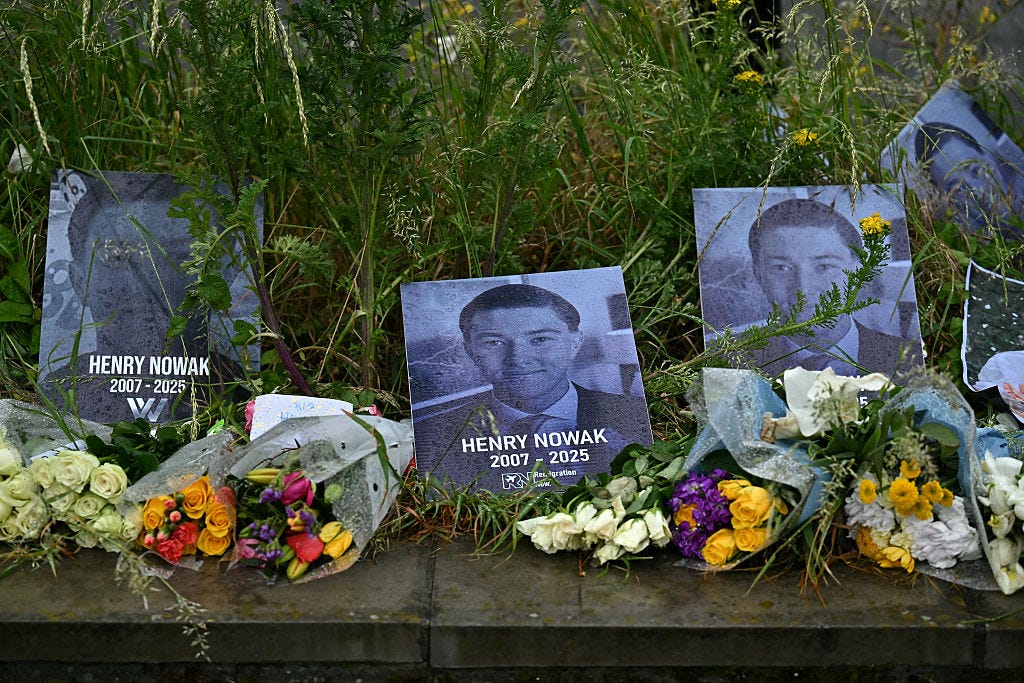
The tragic death of 18-year-old Briton Henry Nowak in Southampton last December, the gruesome details of which have finally been revealed after his killer was convicted of murder last week, has become a lightning rod for a racial controversy on both sides of the Atlantic.
The outrage has focused on the behavior of the police officers who arrived in response to the killer’s false report of a racist attack. (Nowak’s murderer, 23-year-old Vickrum Digwa, is Sikh.) Nowak, barely conscious and near death, was at first treated as the presumptive perpetrator and put in handcuffs despite his attempts to tell the officers he had been stabbed. In the United Kingdom, the backlash has already caused an anti-police riot. Even in the United States, it is starting to reverberate via social media and a growing number of articles covering the tragedy.
The anger is understandable: It is undeniable, and appalling, that the officers on the scene failed to treat the victim of a violent crime with the dignity he deserved or to offer him assistance. The case also raises serious questions about when the contemporary form of identity-conscious “antiracism,” which has been explicitly embraced by British police in recent years, itself turns into a form of racial prejudice.
Yet Nowak’s tragic death has also generated a tsunami of irresponsible demagoguery. Nigel Farage, the leader of Britain’s populist right, has called for “pure cold rage” in response to the case. Stateside, Elon Musk has declared that being “racist against Whites” is now “official police policy” in the United Kingdom.
So what exactly happened on that tragic night in Southampton—and what does that tell us about the state of Britain, as well as the global influence of a racial reckoning that began in the United States in the summer of 2020?
When Nowak was fatally stabbed around 11:15pm on December 3, 2025, he was on his way home from an evening out with friends celebrating the end of his first year of college. At some point he encountered Digwa, and noticed a sheathed blade on his belt, exempt from the UK’s strict knife possession laws for religious reasons.1 Nowak, who had earlier been filming himself singing songs, asked, “Are you a bad man?” and began filming him. Digwa, apparently perceiving this as a taunt, replied, “I am a bad man” and moved to grab the phone.
Moments later, Digwa stabbed Nowak four times, in the chest and in the legs; he also cut his face. The wounded young man attempted to flee, climbing over some trash bins and a fence before collapsing in the yard of a house. Digwa’s brother Gurpreet, who arrived shortly afterward from the family’s nearby home, called the police to report a racial attack by a drunk white male. (Tests later showed that Nowak was only mildly intoxicated at the time of his death, with a blood alcohol content below the drinking and driving limit.) As the family waited for the police to arrive, Digwa’s mother took the blade and the sheath home at his request.

The police arrived at 11.37pm. As bodycam footage released on Tuesday shows, Digwa claimed that Nowak had hit him and knocked his turban off, pointing to a supposedly swollen eye. When Nowak told one of the officers, twice, “I’ve been stabbed,” the policeman reacted dismissively: “Whereabouts? I don’t think you have, mate.” The policeman proceeded to put Nowak in handcuffs, ignoring his repeated pleas that “I can’t breathe.” He did tell a female officer that Nowak should be checked out and that “he says he’s been stabbed”; but the check was quick and perfunctory. At this point, a man, presumably either Digwa or his brother, can be heard saying: “He hasn’t been stabbed,” and the policewoman replies: “I know, but we have to check, don’t we?”
As Nowak lay on his side, motionless, the male officer told him he was under arrest for assault and read him his rights; the female officer called an ambulance. The video ends with her checking Nowak’s eyes, and then saying: “His pupils aren’t even reacting.” Moments later, one of the officers tried to give Nowak CPR and was shocked to discover that he really had been stabbed.
At 11:55, Digwa was arrested. About 40 minutes later, Henry Nowak was officially pronounced dead.
Many actions by the police officers that night raise serious questions. Why did they decide to handcuff Nowak, who was clearly in a weakened state and posed no threat—yet apparently, according to Nowak’s father, did not put Digwa in handcuffs after his arrest?
Why was an ambulance not dispatched straight away after the call to emergency services? Even in Gurpreet Digwa’s false account of events, he had told the operator that his brother’s supposed assailant might need medical attention after a fall from a fence. When the police got there, Digwa’s father, who was trying to help Nowak stand up, told the officers that “he keeps dropping down” and “he has a mouthful of blood.” After this, and after Nowak’s repeated assertions that he had been stabbed, the failure to thoroughly check him for injuries was inexcusable.
It is difficult to disagree with the statement by Nowak’s father, Mark, that Henry was treated in an “inhumane and degrading” way while he struggled for breath in his final moments of consciousness, terrified and desperate. These are shocking facts, and they certainly warrant an investigation, which—thankfully—is now being conducted by the Independent Office for Police Conduct.
However, these facts do not justify the inaccurate, hyperbolic, and plainly dishonest claims that have been circulated in recent days—not only by random social media posters, but by politicians and journalists. That includes outright lies: For instance, that Nowak was in police custody for an hour while he was dying and was “denied first aid” (in fact, the ambulance was called within three minutes of the police arriving), or that the murderer had his sentence reduced because, as a Sikh, he had a “good legal reason” to carry a weapon as a ceremonial religious item. In fact, it was the opposite: the judge explicitly said that Digwa’s abuse of “the privilege extended to Sikhs to have a knife in a public place for religious reasons” was a factor in increasing the sentence. Digwa was sentenced to life with a minimum of 21 years before he is eligible to be considered for release.
There have also been numerous assertions that Nowak was accused merely of “racism” or “saying racist things” when, in fact, he was arrested on charges of assault. In the initial call to emergency services, Digwa said (falsely, the court found)2 that he had been punched, pushed “till my turban came off,” and grabbed by the head.
Also widely repeated: The claim that Nowak “bled out” during his disastrous encounter with the police. Writing in The Free Press, the British right-wing commentator Konstantin Kisin asserts that Nowak was “bleeding from five stab wounds [in front of] officers who had decided that the man who put those wounds in him was the real victim.” These accounts imply that Nowak was visibly bleeding, and that the officers’ glib dismissal could only be due to them prioritizing alleged racism as the greater crime. Rupert Lowe, a member of parliament for the far-right Restore party, even describes Nowak as dying “in a pool of [his] own blood.”
But that’s false. Trial testimony made it clear that Nowak was bleeding internally—a particularly lethal situation when it comes to injuries. No blood can be seen on his body in the police footage. He apparently had a visible cut on his face: The footage shows the female officer who went to check Nowak for stab wounds asking where he may have been stabbed and then repeating twice, “In the face?” But that minor injury could have been easily attributed to his going over the fence and falling down. The lethal knife wounds to the chest were outwardly small and invisible, especially in poor lighting. The police clearly assumed, based on the earlier call from Gurpreet Digwa, that Nowak’s weakened and half-conscious state was due to intoxication. The calm and composed demeanor of four other people—Vickrum Digwa and his family—undoubtedly boosted their credibility.
Should Nowak’s statements that he had been stabbed have been taken far more seriously? Yes, of course. But did the officers ignore clear and visible evidence of the stabbing? No.
Was the officers’ dismissive attitude toward Henry Nowak, as many are claiming, a result and an example of “two-tier policing” that holds white people to a higher standard than minorities—or even of “anti-white racism”?
There is certainly substance to reports of “woke” pressures on British law enforcement. The fallout from the 2020 George Floyd “reckoning”—which had a strong impact in the UK, despite the very different history of race and policing there—led to a push for proactive “anti-racism” in police departments, such as a national “Police Race Action Plan” to address racial disparities in policing.
The 2024-2026 action plan for the Hampshire & Isle of Wight Constabulary, of which Southampton is a part, mentions a commitment to—among other things—“understanding the impact, trauma and history of policing ethnic minority communities.” How did this play out in practice?
According to a Times of London report, a recent survey of the officers and staff of the constabulary found that 15 percent “felt ‘controlled and pressured to feel certain ways’ by mandatory diversity training” which stressed “unconscious bias,” “privilege” and “the importance of being an ally.”
Did these trainings influence the police response to Henry Nowak? Would the officers have reacted differently if the emergency call had come from a white family reporting an alleged assault by an intoxicated black, Arab, or Indian man—and if that man was found in the yard in the same condition as Nowak? Would they have been more careful to make sure that the minority man wasn’t the real victim here, if only to shield themselves from accusations of racism? Such hypotheticals are impossible to answer (just as, in a different context, it is impossible to know whether the police would have treated George Floyd differently if he had been white). But the possibility itself is troubling.
The same questions are raised by the National Police Chiefs’ Council March 2025 guidance on anti-racism, which said that officers should:
Respond to individuals and communities according to their specific needs, circumstances and experiences, with understanding that these will be racialised and with the aim of reducing harm. It does not mean treating everyone ‘the same’ or being ‘colour blind’ (racial equality).
While it’s an obvious truth that people’s individual circumstances should be taken into account, this should not lead to a retreat from the principle of equal treatment. Abandoning that vital principle creates a clear potential for injustice and racial favoritism, and it undermines trust in the justice system. Policing minister Sarah Jones has insisted that the guidance was not part of formal training—but has also conceded that “this document is wrong.”
Many factors may have contributed to the policing failure in the Henry Nowak case: the killer’s brazen, sociopathic lies; the presence of his family; the “first reporter” bias; and the circumstances that created a plausible alternative explanation for Nowak’s condition. But given the broader climate in British policing, it seems entirely possible that the fact that his killer was a minority man claiming to have been the victim of a racist attack added a thumb on the scale. That in itself is unacceptable.
Many people, however, are making a much more serious accusation: that only racial dynamics and favoritism toward minorities can explain Nowak’s treatment. These claims simply do not hold up. It is also worth noting that Mark Nowak, who was scathingly critical of the initial police response in his first public comments, stressed that the subsequent police investigation and prosecution were handled with full professionalism and empathy toward the family.3
The reality is that policing is messy: officers often have to make split-second decisions, including assessments of who is the victim and who the perpetrator in a given situation. Police work also tends to lead to what some call “empathy fatigue”—or, to put it plainly, callousness—since officers so frequently come into contact with distressed or disturbed people who may be difficult to control and may pose a potential danger.
Ironically, claims that only racial prejudice was responsible for Nowak’s treatment resemble nothing so much as the claims, commonly made in 2020, that only racism and the white supremacy “baked into” American policing could explain the murder of George Floyd or the deaths and shootings of other black Americans at the hands of white police officers.
When these narratives were widely hegemonic in the United States, I pushed back against them. Now, I think it’s equally important to push back against today’s forms of hyperbole and hysteria. The assertion, by a right-wing American X account with nearly 130,000 followers, that Henry Nowak died because “the police thought [he] was a racist and that meant that they did not feel obligated to extend to him any form of human decency” is fact-free ragebait—just like the claim that George Floyd died because American society is systematically designed to “destroy black bodies” was in 2020.
The upcoming inquiry by the Independent Office for Policy Conduct, which will look at additional bodycam footage and documents, should answer many remaining questions about Henry Nowak’s death and the failures of the police response. It should certainly include an objective review of the role antiracism trainings may have played in priming the police to trust one side over the other.
In the meantime, it is worth paying heed to a recent intervention by the leader of the opposition Conservative Party. On Tuesday, Kemi Badenoch, who was highly critical of the “overcorrection” in response to the Black Lives Matter movement, also warned against a backlash in the form of “White Lives Matter.” The focus, as Badenoch says, should be on “common sense”: equality before the law, and treating people on the basis of their individual actions rather than their collective identities. It is high time for the British police, and everyone else, to return to that time-tested principle of equality.
Cathy Young, a contributing writer at Persuasion, is a writer at The Bulwark, a columnist for Newsday, and a contributing editor to Reason.
Follow Persuasion on X, Instagram, LinkedIn, and YouTube to keep up with our latest articles, podcasts, and events, as well as updates from excellent writers across our network.
And, to receive pieces like this in your inbox and support our work, subscribe below:
Sikhs are required to carry a small knife, called a kirpan, on their person at all times. This is usually small and worn under clothing. As a member of an order of Sikhs called the Nihang, who traditionally have a second, larger blade (though this is not required), Digwa carried two knives. It is this larger knife, also exempt from knife possession laws, that was the murder weapon.
In a secretly recorded conversation with his brother in Punjabi after his arrest, in which Digwa admitted to the stabbing, he said that he would not be able to successfully claim self-defense if there were any surveillance cameras that had recorded the encounter.
The uncorroborated claim by a far-right anti-immigration activist that “the police took Henry’s phone and his dad’s and read all the messages looking for racist comments or jokes,” amplified by some larger conservative accounts, appears to have no basis in fact. Henry’s phone, found in Digwa’s pocket, was appropriately taken as material evidence, since it contained video related to the murder.
 | A guest post by
|
Jesus. The facts of this case are horrendous. That a gaggle of racist trolls on Twitter, including the racist troll who owns Twitter, would run hogwild with them is despiriting and entirely unsurprising. It's just that in this case, the facts are *so* horrendous that they handily overshadow my distaste for the hogwild-running.
I get the impression this is the first instance of bias incidents involving the British Police you have examined. Perhaps you then made a cursory search to see if there were other incidents to establish a pattern and, for whatever reason, you dismissed what you found. You need to look more deeply into it, as this has been a growing problem. It extends to so-called "anti-trans" incidents as well, which have been the justification for numerous abuses of police procedure, as well as the Orwellian "non-crime hate incidents" which have seen thousands of people getting visits from British police over tweets and online posts.
These incidents are so extreme and widespread that they made an old American 90s liberal like me start to believe there was a shocking level of far left progressive bias in especially the London MET police force, but actually countrywide. This is not just coming from ideologues like Nigel Farage, and by portraying it that way you are part of a much larger failure to investigate the truth. Millions of us moderate liberals have now had the experience of being labeled "far right" or "conservative" and thus dismissed when we don't 100% toe the farthest left ideological line on every issue.
So no, woke anti-racism is not solely the reason for Nowak's death. It's a combination of that and a general incompetence.