

Another Reminder That Biology Matters in Elite Sports
On the pointlessness of non-binary marathon divisions.

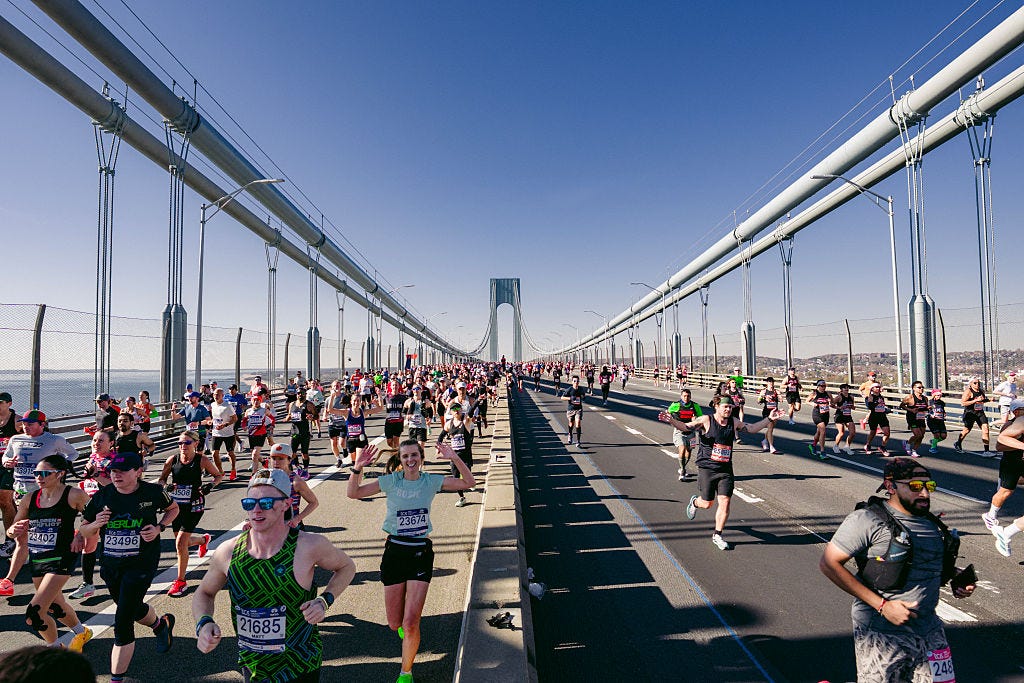
Marathons are one of the most inclusive institutions in modern life. Anyone can enter a marathon (or road race of any distance) and compete side by side—rich or poor, old or young, seasoned racer or first-timer, able-bodied or adaptive athletes. The starting line doesn’t check ideology, income, or appearance. A marathon is, by design, open to the world: thousands of individuals running the same distance on the same day under the same conditions. Some approach it as a battle against fellow competitors; others see it as a solo race against the clock.
Because participation is already universal, the competitive divisions within a marathon serve a different purpose: to make comparisons fair. Age brackets ensure a 25-year-old and a 60-year-old can each chase meaningful goals, even though their maximal physical capacities differ. The women’s division accounts for systematic biological differences that would otherwise push female performances off the podium entirely. Wheelchair athletes often finish minutes ahead of the fastest runners. Other para-athlete divisions allow athletes with distinct physical differences to race each other on even terms.
Competitive categories exist only where biology creates consistent, predictable differences in elite performance. Far from being exclusionary, these categories are what make the marathon inclusive. They give everyone—from elite professionals to recreational joggers to people with disabilities—a way to measure themselves objectively against competitors whose biology makes their performances meaningfully comparable. If such biological differences do not exist, neither does the justification for a separate category.

In recent years, however, some races have added non-binary divisions. New York Road Runners (NYRR), which helped pioneer the practice, describes its initiatives as an effort to “provide equity and access to athletes who identify beyond and outside of the gender binary.” The goal is humane, and gender identity is deeply meaningful for many people. However, non-binary runners already share the same physiological basis for competition as everyone else. That shared biology is what makes the marathon a single community event; it’s also why there is no athletic justification for a separate competitive category.
The introduction of non-binary divisions represents a shift in the purpose of competitive categories: every other division in the marathon exists to equalize biological or functional differences, not to recognize identity. Yet the Philadelphia Marathon provides equal prize money for men’s, women’s, and non-binary categories, and some NYRR races do the same. The 2026 and 2027 Boston Marathon, one of the few races that has a qualifying standard, requires men to run 30 minutes faster than those in the women’s divisions across all age groups. The non-binary standard aligns with the women’s field, even though the group may include runners with male biology.
The discomfort some non-binary runners feel when checking a “male” or “female” box is understandable; no form can fully capture the complexity of identity. But the box exists for a narrow purpose—because biology, not identity, determines how performances can be compared fairly. (This is a separate issue from that of intersex athletes, which involves biological variations that can be directly relevant to performance.)
Some races, like the Tokyo Marathon, handle this tension by allowing runners to register as non-binary for participation and recognition while still using sex-based categories for awards. It is a model that separates identity from competition. The distinction keeps the sport fair without denying anyone’s sense of self. A similar balance exists in elite track. Olympian Nikki Hiltz, who identifies as a transgender and non-binary athlete, competes in the women’s category because of their female physiology. Hiltz has expressed discomfort about “navigating the very gendered world of athletics,” yet the competition remains fair (Hiltz does not use gender-affirming hormone therapy, which would confer an unfair physical advantage). Commentators now respectfully use Hiltz’s they/them pronouns.
Part of the confusion in this debate comes from the tendency to conflate identity with biology. An analogy to medicine is useful here. A medical form does not ask about sex in order to validate identity; it asks because sex influences physiology, drug metabolism, and risk. Neither medicine nor sport is making a statement about the legitimacy of anyone’s gender identity. They are simply sorting people by the variables that matter for the task at hand. This is also why a marathon does not ask for education level, ethnicity, family structure, or income—those aspects of identity shape a person’s life, but they do not affect competitive potential. The absence of a dedicated competitive division does not imply that any group is unwelcome; contemporary marathons typically already allow all adults to participate.
Some argue that social or emotional challenges tied to gender identity may indirectly limit training opportunities, thus justifying the introduction of new categories. Those obstacles deserve empathy. But sport cannot turn every disadvantage into its own competitive division. Many runners train through hardship: parents juggling childcare, shift workers on erratic schedules, cancer survivors rebuilding stamina, people fasting for religious observance, individuals recovering from addiction or incarceration. New York Road Runners explicitly acknowledges the unique needs of nursing mothers, financially under-resourced runners, and historically underrepresented communities in its inclusivity initiatives—yet it does not create competitive categories for any of these groups. If identity (or personal challenge) alone justified competitive divisions, there would be no limiting principle.
All of this points to a broader concern. When a sport begins treating identity as equivalent to a physiological category, it sends a subtle but consequential message: performance gaps rooted in biology no longer matter. Once a sport signals that biology is optional or negotiable, it becomes easier for the broader running community to carry that assumption into other contexts. The marathon has long drawn its meaning from a simple covenant: anyone may participate, but the competition must remain grounded in the realities of the human body. Preserving that principle is what keeps the sport inclusive, comprehensible, and worth taking seriously.
James Smoliga is a professor in the Department of Rehabilitation Sciences at Tufts University School of Medicine and writes the Substack Beyond the Abstract.
Follow Persuasion on X, Instagram, LinkedIn, and YouTube to keep up with our latest articles, podcasts, and events, as well as updates from excellent writers across our network.
And, to receive pieces like this in your inbox and support our work, subscribe below:
 | A guest post by
|
The writer seems to be earnest and well-intentioned. Everything he says makes perfect sense, and most reasonable people will likely agree. But he doesn’t seem to understand the core issue at stake, or why this subject is so contentious. The runners who wish to register in a marathon in a “non-binary” category will not read his essay, slap their foreheads and exclaim, “Oh, ok, NOW I get it! Thanks so much for the explanation. No prob, I’ll just compete in my sex category!” Not one of them will say that. Because they believe their self-defined gender identity should trump biological truth in the public sphere. That is the whole point! They believe the rest of society should “affirm” what THEY believe (or in some cases simply what they claim to believe) to be true about who they are. So often this happens at the expense of others, especially women. “Non-binary” is not an actual biological category. It is a belief. People get to believe what they believe, and people believe a lot of bizarre stuff. A healthy society makes room for people to hold different beliefs. But if a Scientologist came to a marathon demanding to compete in a “thetan” category because he believes his true spiritual self is a thetan, there would be no need for an essay explaining why that should not happen. When institutions such as the Boston Marathon cave to such nonsense, only unfairness results. Even worse: truth itself is violated in the public sphere.
I disagree. Let them have the 'other' category where there are no rules at all least someone be offended. So long as there are categories for real men and real women, the 'other' category will be of interest only to a very few freaks and it could have some comedic value to boot. I'd like to see drag queens running in full regalia. Someone might enter a horse who identifies as a human. Let them make fools of themselves.