


This article is brought to you by American Purpose, the magazine and community founded by Francis Fukuyama in 2020, which is proudly part of the Persuasion family.
In 2003, Libyan leader Muammar Gaddafi agreed to dismantle his nascent nuclear weapons program in exchange for the West’s promises of sanctions relief and integration into the international community. Less than a decade later, in 2011, he found himself hiding in a drainage pipe with his golden pistol after NATO forces bombed his convoy. Gaddafi was dragged out of that tunnel by NATO-backed Libyan rebels, beaten, and executed for the world to see.
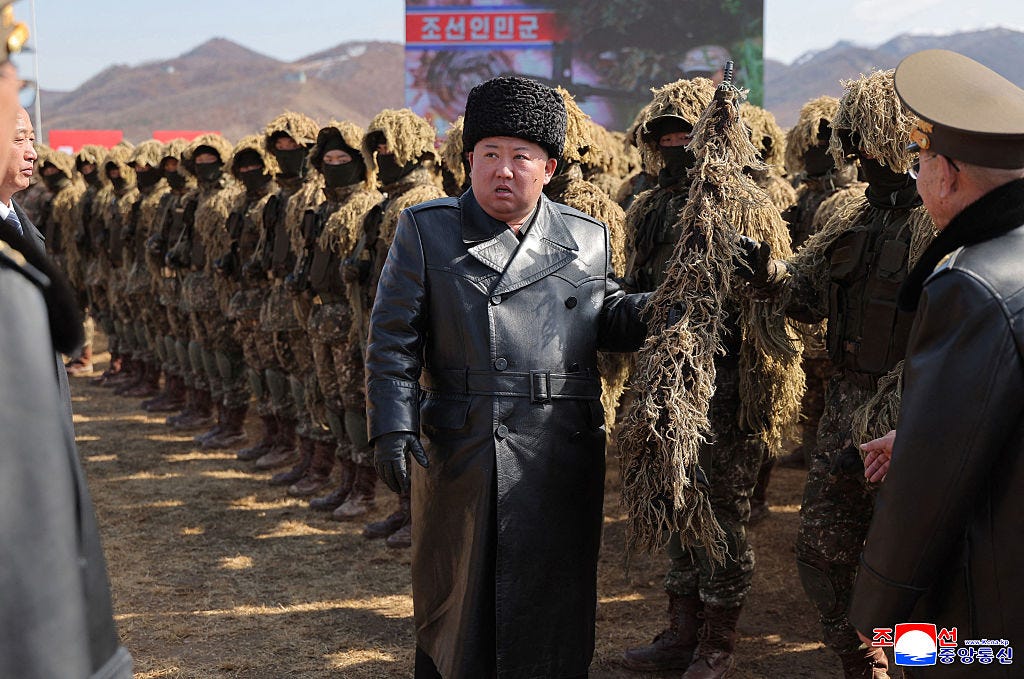
In Pyongyang, Kim Jong Un was taking notes. Throughout the 1990s and early 2000s, the West treated Kim Jong Un’s father, Kim Jong Il, as a comic book villain: a cognac sipping madman who reportedly claimed to have invented the hamburger and shot 38 under par on his first ever round of golf. The madman narrative about the safari suit-wearing cult leader was comfortable for the West: it allowed them to dismiss him as a relic of the past, a man stuck in time with a starving population destined to depose him.
That comfort is now gone when it comes to North Korea, and with it comes an indictment of the entire rules-based international order. The Kim dynasty has been vindicated—not morally, not ethically, but strategically. As the global security architecture of the post-Cold War era fractures under the weight of Russia’s invasion of Ukraine, China’s expansionist ambitions, and America’s reckless and illegal international military interventions, the Kims’ absolute refusal to denuclearize looks more and more sensible by the day.

Iraqi dictator Saddam Hussein attempted to follow the nuclear approach, but his nascent program was systematically dismantled by foreign strikes and the International Atomic Energy Agency (IAEA). He was left exposed when America invaded in 2003 and was killed in 2006. Gaddafi surrendered his weapons in 2003 and was killed in 2011. In 1994, Kyiv signed the Budapest Memorandum, surrendering the world’s third-largest nuclear arsenal in exchange for security assurances from the United States, the United Kingdom, and Russia. In 2014, it lost Crimea when Russia illegally annexed the region. Since 2022, it has been fighting a war for its existence—one that continues today without any signs of ending.
Iran, too, agreed to stall its nuclear program in 2015, then three years later the United States pulled out from the agreement, later bombed Iran’s nuclear sites, and is now brazenly conducting a regime change war. Nicolás Maduro never had nuclear weapons; he is likely wondering, from his jail cell in New York, how things would have gone if he did. Perhaps his successors in Caracas are thinking about whether they could get them now. Cuba knows they must be next—what will they do to ensure their own sovereignty?
This is not to oversimplify things; North Korea is the outlier here. Most nuclear aspirants never make it past the window of vulnerability—the period where nuclear capabilities are advanced enough to provoke intervention, but insufficient as a credible deterrent. The two main pathways to a nuclear weapon—thousands of centrifuges spinning at supersonic speeds or spent nuclear fuel reprocessing—provide little concealment. The large industrial footprint is nearly impossible to hide from modern thermal and satellite surveillance. And once the bomb is complete, aspirants face a second immense technical challenge: miniaturizing it and mastering the delivery vehicle.
Great powers are strongly incentivized to preemptively strike these nascent programs politically, economically, and kinetically. The great tragedy of the 21st century is that Pyongyang’s success has shown that, while the cost of trying to acquire a nuclear weapon is high, the cost of failure, as seen in Baghdad, Tripoli, and Kyiv, is existential.
Kim Jong Un is living proof, untouched despite a raft of sanctions, a starving population, and increased U.S.-Japan-South Korea unity against his country’s aggression.
The Kim dynasty understands something that eluded the architects of the liberal rules-based order and their autocratic enemies alike: In a world of laws and norms, there is no better security guarantee than a nuclear weapon. Conventional strength is a “might makes right” game, but nuclear weapons are the great equalizer. Pyongyang understood this before the rest of the world, and paid an unbearable cost to prove it.
The Kim dynasty, short on cash and with few options to acquire more, chose to pay in human lives. Hundreds of thousands have died in the kwan-li-so death camps, where guards rape and murder prisoners for sport. Millions more have suffered from stunted growth due to malnutrition and starvation. The Kims used the North Korean people as fodder to maintain their own cannon, hollowing out the core of their country to reinforce the walls. They turned 26 million people into a sacrificial offering, and the 21st century rewarded them for it.
The tragedy is not that the Kims are monsters; those are everywhere. The tragedy is that the international order, ostensibly designed to make nuclear weapons unnecessary, failed so spectacularly that the monsters ended up being right. The Ukraines of the world that trusted the system now find themselves begging for aid to defend themselves, while the Russians can take territory without ever fearing a B2 bomber over Moscow.
If the lesson of the Kim dynasty is that the only guaranteed security is a nuclear weapon, then every rational state can and should acquire one, provided they can survive the inevitable attempts by the status quo powers to crush them before they reach criticality. Already, a majority of South Koreans believe their country should obtain a nuclear weapon, citing fears of North Korean aggression and doubts about America’s nuclear umbrella. Saudi Arabia has promised to pursue nuclear weapons if their rival Iran gets them.
For the autocrats that can’t afford to get nuclear weapons, Kim has a solution for that, too: starve the people to feed the bomb. This is nothing short of a catastrophic outcome, yet it is the future the world built through our failures.
In the 1990s, Kim Jong Il was a laughingstock to the world. In 2026, his son looks right at home. Not because he has turned over a new leaf, but because the world has. The leaders of the United States, China, and Russia all subscribe to his worldview; Europe is too divided to speak with one voice.
This is a cause for mourning and deep reflection. Not because the Kims deserve sympathy; they deserve none. But because a world in which the Kims are vindicated is a world in which things like sovereignty, diplomacy, and the idea that nations can resolve disputes without the threat of annihilation are revealed as fictions.
The Kim family bet against civilization. And as of today, civilization is losing.
Shahn Louis is the founder of Anansi Strategic Intelligence LLC, a Washington, D.C.-based geopolitical risk firm. A former senior intelligence analyst with experience across the Department of Defense and the Intelligence Community, he specializes in China analysis and East Asian regional dynamics.
Follow Persuasion on X, Instagram, LinkedIn, and YouTube to keep up with our latest articles, podcasts, and events, as well as updates from excellent writers across our network.
And, to receive pieces like this in your inbox and support our work, subscribe below:
 | A guest post by
|
Great piece! So brutal that everyone is afraid to comment! I cannot fault the argument, the future looks grim.