

Pakistan Has Never Looked So Important
There’s only one winner of the Iran deal—the country that made it happen.

Will you be in Washington, D.C. on Wednesday July 15? I will be interviewing Francis Fukuyama about how liberalism should respond to the postliberal threat. Find out more and get your free ticket here! —Yascha
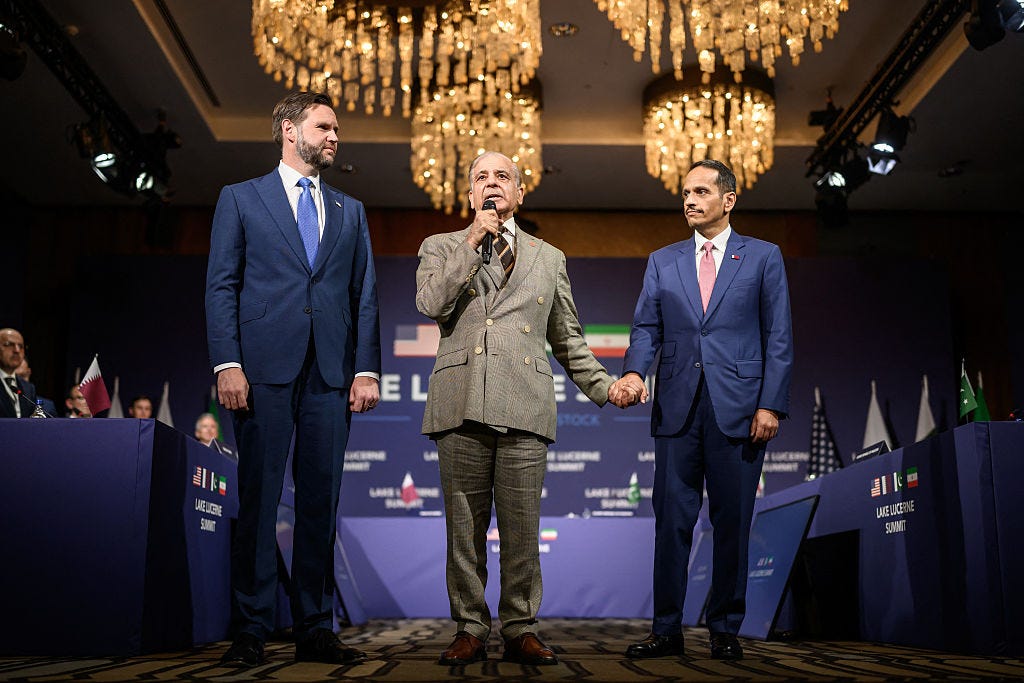
Pakistan’s reality from the very beginning, so it’s said, has always been about the three A’s: Allah, Army, America. The formal end of Donald Trump’s hot war against Iran appears to have added a fourth: Assertiveness.
Pakistan brokered both the April 8 U.S.-Iran ceasefire and the longer-term halt to hostilities under a document called the Islamabad Memorandum of Understanding. It subsequently mediated follow-up talks in Switzerland on June 21.
Key moments from those negotiations, preserved in multiple photos and videos across social media, show Pakistan bathed in a flattering glow. The U.S. delegation led by Vice President JD Vance warmly embraced the Pakistanis and repeatedly thanked them. In reference to the chief of the defense forces, Vance joked that there are “two very, very important people in my life, an Indian and a Pakistani. The Indian is my wife, and the Pakistani is Field Marshal Munir.” The Iranians, led by parliament speaker Mohammad Bagher Ghalibaf, were similarly cordial to the Pakistani leaders, though much less jokey. And Pakistan’s prime minister, Shehbaz Sharif, boasted about his “most cordial telephone conversation” with the ruler of Qatar.
As well he might. Pakistan’s success as indispensable intermediary between the United States and Iran—two countries locked in nearly half a century of animosity—has won it great praise and much international goodwill. Pakistan’s founder, Muhammad Ali Jinnah, set out the bold aspiration for his country to be “the pivot of the world.” Nearly 80 years after its birth, Pakistan may finally be on the cusp of achieving that vision.
It has played dealmaker before, of course, notably as the backchannel for the startling moment in 1972 when Richard Nixon became the first sitting U.S. president to set foot in the People’s Republic of China. It also had a key role in the 1988 Geneva Accords, which ended the Soviet occupation of Afghanistan.
But this time feels different—Pakistan appears more self-assured than ever. This might seem strange for a country beset by deep-seated political and economic problems. It is, after all, on yet another International Monetary Fund loan program, its 25th since the 1950s. And there is general unease over its metamorphosis into a democracy with profoundly “Pakistani characteristics”—which, as one Pakistani analyst put it, means combining elections with “military hegemony and weak institutions.”
But Pakistan’s view of itself and the way it deals with the world does seem to have changed. In his candid book Magnificent Delusion, Husain Haqqani, former ambassador to the United States, explains how it used to be: Jinnah asked America for an eye-popping $2 billion in September 1947, barely one month after the Pakistani state came into being (he got a mere $10 million the first year). In the early days, the most frequent visitor from Karachi to Washington was the Pakistani finance minister seeking aid.

Now, the main PR pitch is Pakistan’s key location at the crossroads of the Middle East and South Asia, balancing a close relationship with China alongside a renewed relationship with Trump’s America. Though Pakistan is not in the Middle East, it has long had key relationships with regional players. It is a prominent member of the two-month-old group of Muslim countries known as R-4, which also includes Saudi Arabia, Egypt and Turkey, all of whom have either strong armies or deep pockets. At the very moment American and Iranian officials arrived in Switzerland for those Pakistan-brokered talks, foreign ministers of the R-4 were engaged in their fourth meeting since February.
Pakistan is also the Muslim world’s only nuclear-armed state, making it well-placed to provide security guarantees; in fact, it formalized one with Saudi Arabia in the days after Israel’s September 2025 airstrike on the leadership of Hamas. Yoel Guzansky, formerly of Israel’s National Security Council, once mused about Pakistan “openly granting [a] ‘nuclear umbrella’” to Saudi Arabia. With the possibility of Turkey signing on to the Pakistan-Saudi defense alliance—five months ago, the Turkish foreign minister said that “discussions and talks are underway” on exactly this matter—a new alignment may be arriving. In a sign of growing alarm, former Israeli prime minister Naftali Bennett warned that “Turkey is the new Iran,” and claimed it is “trying to flip Saudi Arabia against us and establish a hostile Sunni axis with nuclear Pakistan.”
Despite Israel’s alarm, the Trump administration has reasons for allowing Pakistan’s influence to grow: it does not want India to become the dominant regional power. On a recent visit to New Delhi, U.S. Deputy Secretary of State Christopher Landau declared: “We are not going to make the same mistakes with India that we made with China 20 years ago (by allowing it to) develop all these markets” and then start “beating” the United States in “a lot of commercial things.”
Not only has Trump overturned decades of patient work by previous administrations who wanted to build a relationship with India, but he has also made clear his preference for Pakistan’s powerful Field Marshal Asim Munir. Pakistan has responded with shovel-loads of flattery, hailing Trump as the “savior of South Asia” and nominating him for a Nobel Peace Prize.
Another reason for the closeness is that, nearly five years after the Taliban’s reconquest of Afghanistan, the United States and Pakistan are finally on the same page about the Taliban. It’s no secret that Islamabad’s relationship with Kabul is in tatters. Each accuses the other of harboring fighters who carry out deadly attacks on its territory. The breakdown of Pakistan’s long alliance with the Taliban could prove the ultimate asset in building a successful new relationship with the United States. As former diplomat Ted Craig has noted, Pakistan’s “disappointment” with Taliban 2.0. has caused it to stop tolerating the group, and the Pakistan military has also reduced “its costly support to Islamist militancy” in general. This has eliminated the main point of friction between the Pakistan security establishment and the United States.
It’s not clear what will happen with the U.S.-Iran interim deal. It doesn’t resolve the thorniest issues: nuclear inspections, uranium enrichment limits, Iran’s ballistic-missile program, stewardship of the Strait of Hormuz, and how Iran will spend the billions of dollars soon to be released from sanctions. Meanwhile, Israeli operations in Lebanon could torpedo it all, Trump faces criticism at home, and there is a low rumbling of discontent in Tehran for even talking with the “Great Satan.”
But whatever comes next, one party has done well out of the deal: Pakistan.
Rashmee Roshan Lall is a journalist and academic. Her Substack is This Week, Those Books.
Follow Persuasion on X, Instagram, LinkedIn, and YouTube to keep up with our latest articles, podcasts, and events, as well as updates from excellent writers across our network.
And, to receive pieces like this in your inbox and support our work, subscribe below:
Sure, Pakistan wins. But so did Iran, which now has more influence than it did four months ago.
It might be true that Pakistan looks like winner in this US-Iran disaster- gloating on it might be too early! Bear in mind that hatred for Muslims is all time high- going higher with danger of violence against any brown is inevitable across the US.
Why is it that people point out US-Iran Bad relationship since 1979?
Iran has been the game the entire “ western civilization” has been coveting for more than 100 years! How do you ignore 1954-55 debacle when CIA along with the brits created mayhem in major cities and had elected PM assassinated? The root of the problem lies there in our life time.
Then supporting a brutal dictator for 25 yrs...then the newbies cry foul when the relationship goes bad!
In truth: the entire ME has been put in turmoil since zionistas have gone full Gestapo-SS with trillion $ US bank rolling plus WMDs to attack any state in the ME.
You hope Pakistan keeps all this in mind while aid-ul-amrika goes on in the halls of your military top brass..