

Perú Invented a New Form of Government, and Nobody Noticed
How a corrupt congress reinvented Westminster parliamentarism from the ground up.

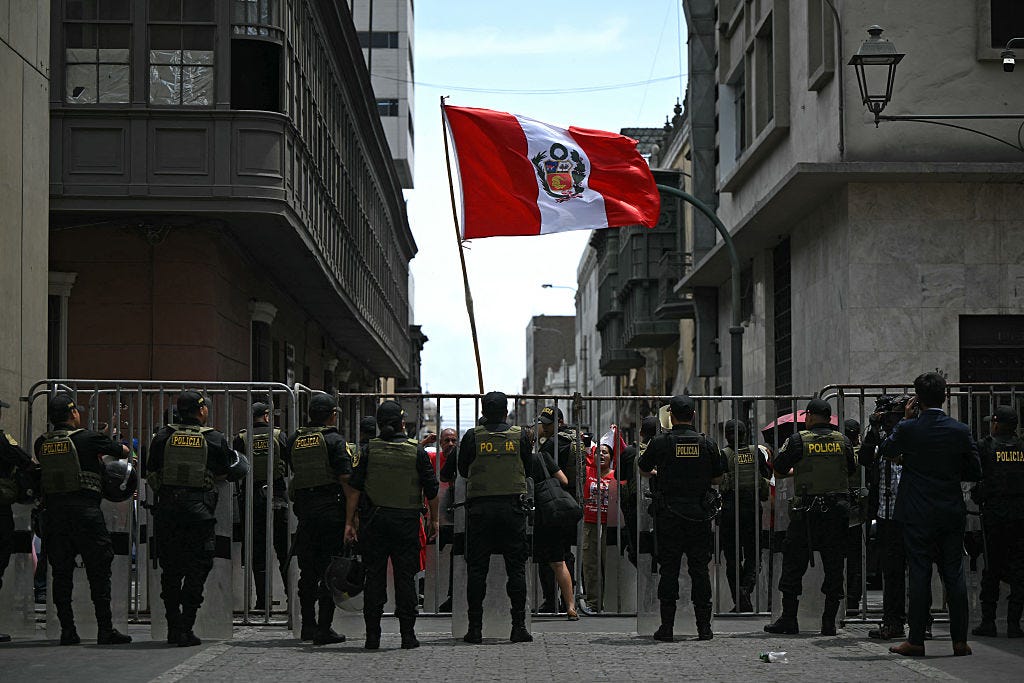
Perú’s congress voted last week to remove the country’s president—again. If you missed it, it’s because this barely counts as news anymore: it’s the ninth head of state they shed in a decade. This time, they shuffled the president less than two months before a presidential election that will pick its tenth.
The ousted president, José Jerí, had been in office for four months. His offense: attending a clandestine late-night meeting with a Chinese businessman wearing a hoodie to avoid recognition, then claiming the whole thing was preliminary planning for a Chinese-Peruvian friendship festival. Congress wasn’t buying it. It voted 75-24 to remove him, replacing him with José María Balcázar, an 83-year-old former judge currently under investigation for bribery, previously expelled from a regional bar association for suspected embezzlement, accused of plagiarizing a book his own son wrote, and on the record as the only Peruvian legislator to have voted in favor of child marriage. Balcázar will serve as caretaker until July. Congress chose this man specifically because he’s too weak to cause trouble; in any case, he won’t be around long enough to try.
To those of us who studied political science, Perú presents a bit of a taxonomic conundrum. We’re all taught at school that systems where the executive needs to keep parliament on side to stay in power are called “parliamentary,” and systems where the executive is separately elected and serves a fixed term independent of legislative majorities are called “presidential.”
These are the two flavors democracy comes in. Everyone knows this.
Perú didn’t get the memo.
Peruvian legislators have figured out one weird trick that magically turns a presidential system parliamentary. Buried in the 1993 constitution is Article 113, which allows Congress to remove the president on grounds of “permanent moral incapacity.” Who determines moral incapacity? Congress does. What does it mean? Whatever Congress decides it means.
The standard is, as legal scholar Francisco Guerrero put it, “completely elusive, viscous, fluid.”
In nine years, Perú has cycled through eight presidents. Three consecutive heads of state have been impeached by the current Congress, which has been sitting since 2021: Pedro Castillo—who was elected, then governed execrably—then Dina Boluarte, then Jerí. When Boluarte fell in October, Congress voted 122-0 to remove her. The coalition that had protected her for three years simply decided it was politically inconvenient to keep protecting her six months before elections, and that was that.
Commentators usually have some pat line about Peruvian political chaos, but at some point this isn’t chaos anymore: it’s a system. Not a good system. Not one anyone designed. But a system nonetheless.
What Peruvian legislators have done is reinvent Westminster parliamentarism from the ground up. They did it without anyone formally proposing the reform, without a constituent assembly, without any sort of consensus that this is what happened. In Perú, the president now serves at the pleasure of Congress. Nobody calls him a prime minister, but that’s what he is.
The normalization of this new way of governing hasn’t taken that long. The first impeachment was traumatic. The second was alarming. By the third and fourth, it was just procedure. Congress has also started setting explicit terms for what kind of president it will tolerate: when Jerí took over from Boluarte, congressional leaders demanded that his cabinet members be barred from running in the April elections. You’ll scour Perú’s constitution in vain for anything authorizing Congress to impose this kind of restriction on an incoming president, but that doesn’t matter anymore: the executive serves at Congress’s pleasure.

Peruvians, for their part, despise this state of affairs. Not because they love the presidents Congress keeps removing—they don’t. Boluarte’s approval rating bottomed out at 2 percent before she was ousted, a number so low it’s basically a measurement error. Congress’s approval rating spiked all the way to 19 percent after it ousted her, which is considered high in a country where hating all politicians is part of the national identity. One poll found that 48 percent of Peruvians don’t know who to vote for, will cancel their ballot, or have no favorite candidate at all.
To be sure, everyone everywhere loathes their political class. But in Perú, this sentiment is turned up to eleven.
The strangest fact about Perú is that none of this has stopped the economy from humming along. GDP grew around 3.4 percent through 2025. Fitch, Moody’s, and S&P all rate Perú investment grade, with stable outlooks. Inflation sits at 2 percent, among the lowest in Latin America. The share of the population living on less than $8.30 a day has halved since 2001.
The explanation lies in where actual power resides. Perú’s macro framework—the central bank, the fiscal rules, the investment protections—is run by technocrats whose positions don’t change when presidents fall. If anything, markets have come to view congressional dominance as a perversely stabilizing force: weak presidents don’t have the muscle to mess with technocrats. Investors have, grotesquely, learned to read an impeachment as a bullish signal. Political weirdness turns out to be perfectly compatible with fiscal orthodoxy, and foreign capital has noticed.
This is not a ringing endorsement of the system. The gap between macroeconomic stability and institutional legitimacy is not stable in the long run. Organized crime has filled much of the space that functional governance would normally occupy. Extortion cases rose sixfold between 2019 and 2024. A machine-gun attack on a cumbia band in Lima was the proximate trigger for Boluarte’s removal—which tells you something about how far things have deteriorated.
Yet, somehow, Perú’s political class has mastered the art of managing economic continuity while failing entirely at governing in any other meaningful sense.
Amidst this wreckage, 37 presidential candidates have filed to run in the first round to be held on April 12. The field includes a comedian, a former soccer goalkeeper, and a man whose brother was impeached, booted from the presidency, and is currently in prison for corruption.
The two frontrunners—polling in the low double digits, which counts as commanding in a field this fragmented—are Rafael López Aliaga and Keiko Fujimori. Together, they illustrate just how surreal Peruvian political life has become.
López Aliaga, a conservative former mayor of Lima universally known as “Porky” for his resemblance to a famous cartoon pig, is a Trump-admiring Opus Dei member who resigned as mayor to run for president and positioned his congressional bloc to support Jerí’s removal. His campaign platform is mano dura on crime, liberalization of markets, and the general proposition that what Perú needs is someone with the will to govern firmly.
Fujimori, running for the fourth time, is the daughter of Perú’s most effective modern economic reformer—who was also a convicted authoritarian who received a 25-year prison sentence for human rights abuses. Her party, Fuerza Popular, controls a significant bloc in Congress—the same Congress that has impeached three presidents.
Her lawmakers voted to keep Jerí in power. López Aliaga’s voted to remove him. Given Perú’s new habit of treating presidents like prime ministers, this disagreement is now, meaningfully, an electoral issue.
And yet the candidates have remained silent on the underlying constitutional problem. Nobody in the serious running is proposing to reform or constrain the moral incapacity clause—the mechanism that has made the presidency a temporary appointment. The platforms center on crime, corruption, and economic management, as if the relevant question is what a future president might do rather than whether they’ll stay in office long enough to do anything at all.
In other words, nobody is seriously questioning the strange system that Perú has blundered into: presidential in theory, parliamentary in its executive accountability, technocratic in its actual governance, and ungoverned on the street. The president is the most powerful person in the country in theory and among the most precarious in practice. Congress is Perú’s most despised institution while being its most functionally dominant. The economy works despite all of this, or perhaps because macroeconomic policy has been insulated from it.
Political scientists will have to invent a name for whatever this is. They may find that amusing. Peruvians surely won’t.
Quico Toro is a contributing editor at Persuasion, the founder of Caracas Chronicles, Director of Climate Repair at the Anthropocene Institute, and writes the Substack One Percent Brighter. He lives in Tokyo.
Follow Persuasion on X, Instagram, LinkedIn, and YouTube to keep up with our latest articles, podcasts, and events, as well as updates from excellent writers across our network.
And, to receive pieces like this in your inbox and support our work, subscribe below:
Fascinating effort to make sense of a topsy-turvy political environment. Not sure I could manage the same feat. When I was serving as an American diplomat in Peru focused on political affairs during Alan Garcia's second term, this system was in the process of being born, even if Garcia made it to the end of his term. Somehow, utterly dysfunctional politics managed not to undermine the country's underlying macroeconomic stability and solid growth. One got the sense that the political dysfunction was disconnected from critical economic decision-making, as you suggest. Now that I think about it, I remember one prominent APRA pol telling me that Garcia found himself increasingly frustrated by a system that managed to defy his every directive; when the president said "jump," nothing happened. Maybe that’s why his second term didn’t turn out so bad. Nicely done.
It sounds like it will fall into a Mexican style kleptocracy in time as the roots of organized crime spread.