



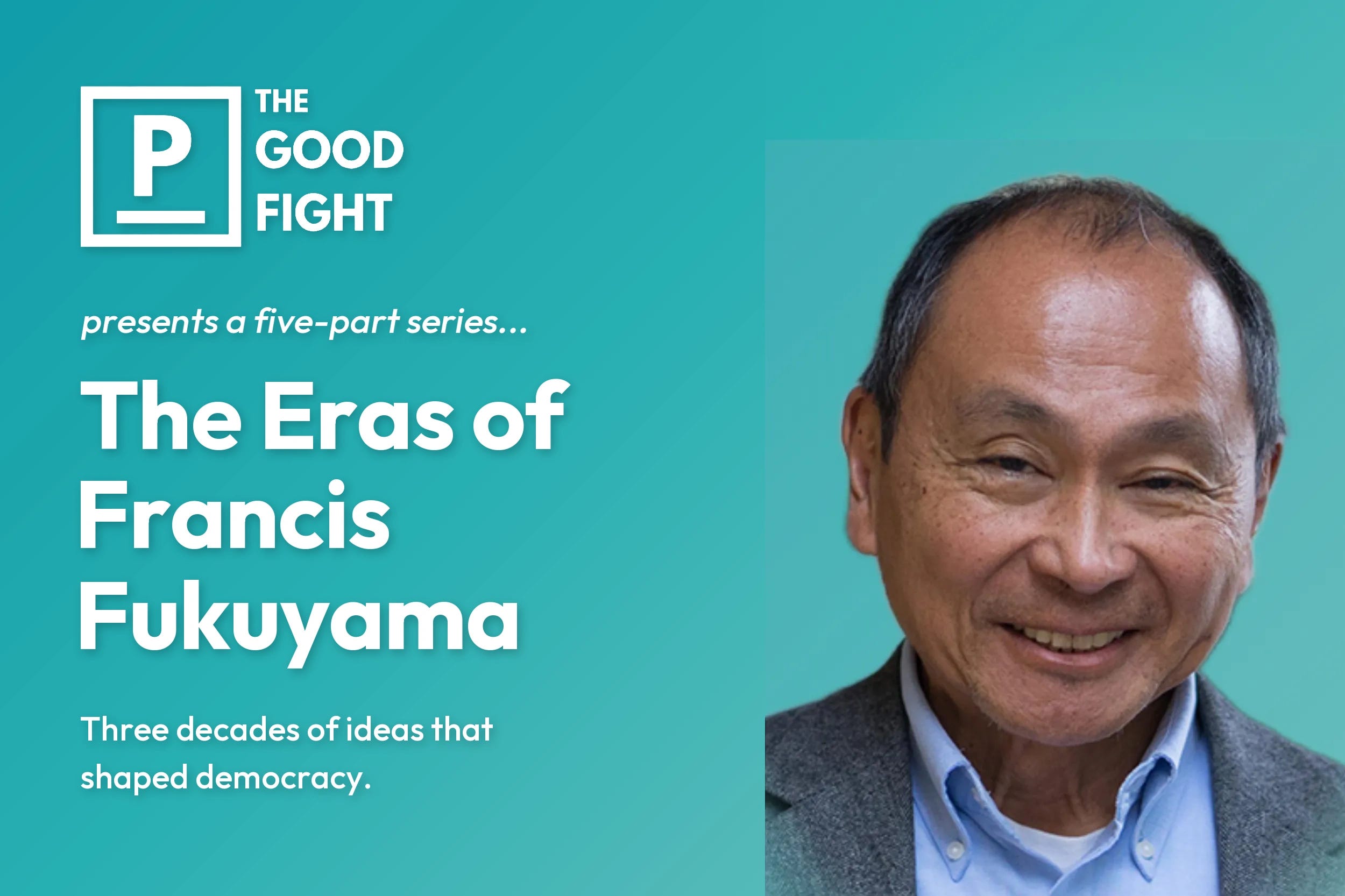
Francis Fukuyama is the Olivier Nomellini Senior Fellow at Stanford University. His latest book is In the Realm of the Last Man. He is also the author of the “Frankly Fukuyama” column at Persuasion.
In this week’s conversation, Yascha Mounk and Francis Fukuyama discuss why building things with your hands is an antidote to dependence on big tech, whether AI will erode the practical skills future generations need to survive, and what hobbyist robotics has in common with Ukraine’s battlefield ingenuity.
Enjoying this discussion? In an event exclusively for readers of American Purpose and Persuasion, Yascha Mounk will be interviewing Francis Fukuyama about his life and thought at 5pm on Sunday, September 6 at The Abbey Centre, London. Find out more and get tickets here. Paying subscribers of Persuasion and American Purpose can access a code for a free ticket here.
We’re delighted to feature this conversation as part of our series on Liberal Virtues and Values.
This series, made possible with the generous support of the John Templeton Foundation, features content making the case that liberalism has its own distinctive set of virtues and values that are capable not only of responding to the dissatisfaction that drives authoritarianism, but also of restoring faith in liberalism as an ideology worth believing in—and defending—on its own terms.
This transcript has been condensed and lightly edited for clarity.
Yascha Mounk: We started this series on a personal note, with the story of your family and your childhood. I thought in a sense we could end on a personal note. We’ll talk about some big issues, like artificial intelligence and the difficulty of getting things done in contemporary democracies, as well. But those are both related to some of your personal hobbies, which are varied and more manually dexterous than I certainly would be capable of.
Francis Fukuyama: Yeah, well, one of the reasons for writing a memoir is that I actually wanted to have the opportunity to write about my hobbies, which have consumed an awful lot of my time during my life and actually are the things I am most interested in—just like Trump is obsessed with his ballroom, not the Iran war. There’s something comparable going on with me.
Mounk: Well, so tell us about some of these hobbies. I see pictures of them cropping up on your Instagram every now and again.
Fukuyama: I’ve cycled through a whole bunch of different ones. Probably the longest-standing one was building furniture, which I started when I was living in Virginia, working at the State Department. That involved learning quite a lot of different skills, and I got into making some fairly ambitious things, like reproductions of Federal-style furniture. It then shifted—I’ve always had this tech hobby too. I’ve built computers, my own PCs, for myself ever since the mid-1990s. I’ve written my own software. I’ve gotten into flying FPV drones and so forth. There’s a lot of stuff I’ve spent time doing over the years.
Mounk: I want to get into some of these in particular, but what draws you to that? I guess the first question is, I think a lot of writers and thinkers of your stature are just consumed by the writing and the work. Before we get into why a manual hobby, and why these particular manual hobbies—did you always just have a need for something in a totally different realm? Did you discover at some point that it was good for your happiness, or your productivity? What made you first think, I should get into making furniture?
Fukuyama: Well, as an intellectual, what you do is just produce words. You sit in front of a computer screen, you write things, you give lectures, you talk to people. I became a professor, so I teach. But it’s very hard to know what the concrete outcome of any of that stuff is, because it’s all very ethereal in many ways. Maybe it did have a profound influence, but you’re really not going to know that. On the other hand, if you build beds for your children, as I did, they’re all sleeping on them, and you know it’s actually something useful. I built a kitchen table probably thirty years ago, and we still use it every day. There’s something very satisfying about producing a material object that is useful in a more immediate way than any of the stuff I’ve written or talked about. That was one of the motives.
Mounk: Is that a kind of personal satisfaction? I have hobbies like playing soccer, and recently I got into playing poker and things like that. In terms of producing things, I really don’t do much other than cooking, and I enjoy cooking for some of the same reasons—it’s a very concrete result, and it’s also a very fast result, unlike writing a book. You take a bunch of raw ingredients, and an hour later you have a meal that’s sometimes a little disappointing and sometimes, hopefully, delicious, and there’s a great satisfaction in that. Is it just kind of that? How do you feel about some of the more philosophical takes—Zen and the Art of Motorcycle Maintenance and so on? There’s a whole niche of books that depict this as a personal virtue, but also try to derive some kind of political significance from the act of creating something with your hands.
Fukuyama: Well, I’m not sure I would attribute any philosophical significance to it. I do think there’s a certain practical side to this, and it really has to do with individual autonomy. We are living in a world dominated by these giant tech companies—Meta, X, Apple, Amazon, Google, and so forth—and you become very dependent on them. If you are a tech-savvy person, all that means is you know how to operate their software, you know how to use your smartphone, but you really don’t penetrate any deeper than that. I’ve always thought that was a big mistake, because you really needed to understand how this stuff worked on a deeper level and be able to manipulate it yourself.
For example, I hate Apple. I have an iPhone and an iPad, for which there’s really no substitute. But what I hate about Apple products is that they deliberately make it impossible to hack into their machinery. Even to get an Apple computer open, you have to have a proprietary fastener that only Apple uses—it’s not modular. Whereas with PCs, you can take them apart. I frequently run into these problems that other people do, where your computer just stops working, and with Apple you have to take it into the Genius Bar and have them take it to the back room and tell you it’s going to take two weeks to get the thing fixed. With my computer, I just take it apart. I recently had to rebuild my big PC at home because something was screwed up with the operating system, so I basically took the whole thing apart, reinstalled the operating system, put everything back together, and it was working again.
I think that dependence on big tech is a problem for society as a whole. I do have this worry about the coming AI age, because we’re already getting very dependent on these AI systems, and I think as time goes on, we could raise a whole generation of people who basically don’t know how to do anything if they don’t have access to an AI. We’ve already experienced degrees of this. Most young people don’t know how to read a map—they’ve grown up with GPS and all these apps on their phone that let them get from one place to another. Suppose the global GNSS system goes down and you don’t have access to that anymore—how are you going to know how to get across town to visit your friend? You won’t have a map, and you won’t know how to read one even if you had one in front of you.
The way I think about it, there’s a kind of survivalist instinct at play here. If you think about survivalism, there are a lot of states of the world you could regress to. A lot of them, like Cormac McCarthy’s The Road or Octavia Butler’s Parable of the Sower series, you’re basically going back to caveman days, where you don’t have any access to technology, or maybe the gun is the highest level of tech you’ve got, and if you don’t know how to shoot a gun, you’re not going to be able to defend yourself. Nobody can prepare for that kind of future. What is more realistic is the situation the Ukrainians found themselves in after 2022, when they were invaded by Russia—all of a sudden they’re confronting a much more powerful enemy, and they really have to rely on their own wits to do that. It turns out they’re very good at things like robotics, like drones, like building a command-and-control system to coordinate all of their activities, and they did this all on their own.
That’s the level of tech ability I think I have. I know how to build robots. I know how to use Arduinos and Raspberry Pis to take inputs from sensors and control servos. I’ve built a whole bunch of robots—not lethal ones, the way the Ukrainians are doing—but I have a grounding in all of that stuff. If you’re cast into a situation where you actually have to use that level of technology to do something for yourself, you can do it. So I think that autonomy is the big issue for me.
Mounk: Fascinating. I’m not going to risk breaking into your home in case one of those robots does turn out to be more lethal than you say. What advice would you give to somebody listening to this who’s saying, I would love a hobby like that—I would love to really get into making furniture, or making these robots—but I don’t have the background in that? Certainly the education I went through at no point emphasized these kinds of skills. I guess I could have—I went to college in England, so I just studied one subject; it wasn’t really a liberal arts education. I tried to make up for that during my graduate school time. If I had been an undergrad in the United States, I could have taken courses in robotics or something like that. But if you haven’t done that, if you’ve gone through a pretty academic education, and you don’t feel like this is an area where you have a ton of experience—how do you start? How do you pick what to do, and how do you develop those skills?
Fukuyama: Well, picking what to do, I can’t give much advice on, because that’s a very personal issue. But the question of how to learn the skill—it’s YouTube. I never took a class in woodworking, in robotics, in any of this stuff—I just picked it up on my own. Furniture making, I actually started in the 1980s. At that point it was TV, not YouTube—it was before YouTube. PBS had this long-running program, This Old House, and the carpenter from This Old House had his own show about making furniture, so you could watch him build relatively simple tables and desks and this sort of thing. That’s how I got my start.
But YouTube is just unbelievable. There isn’t an obscure hobby in the world where there isn’t a whole series of instructional videos on how to do things. For some reason the visual aspect is really important, because I think any kind of hobby that involves manipulating material objects—if you don’t actually see a video of how people are doing it, you’re really not going to know how it works. That’s true of auto repair, it’s true of fixing computers, it’s true of making furniture. That’s really the path I followed.
Mounk: You mentioned AI, and I want to get to AI as a substantive topic later in the conversation, but do you use AI at all now when you run into a problem—when you’re unable to fix the robot, or install the operating system? Do you use an AI tool and say, hey, what am I doing wrong?
Fukuyama: Yeah, Claude has been very useful. For example, I had to migrate a couple of big databases. I had written a database program in Python on my own, which is really a stupid thing to do, because it didn’t use SQL—the structured query language that’s standard on databases. So I figured I needed to move it into a more robust, open-source product, and I couldn’t have done that without the help of ChatGPT at first, and then Claude. Claude is really great. I wrote pretty ambitious programs in my life—programs that were several thousand lines long—and you’d always get to a point where there was something you wanted to do and you couldn’t quite figure out, by reading the manual, how to get there. Now, with Claude Code, you just say, okay, add a button that will do the following, and it’ll just do it. You can run the thing right away and see that it works or it doesn’t work, and you go back and say, can you fix that? And you’re done.
But you can see the danger in this, because you don’t really have to—I’ve forgotten a lot of the coding I used to know, simply because I don’t need to use those abilities anymore. I think down the line there are going to be dangers there.
Mounk: It’s very interesting how quickly skills atrophy when you don’t use them. I wonder whether they also come back quickly if you had to use them again. I feel that languages are sometimes like that—a language like Spanish, which I’ve never really formally learned, but I speak a bunch of Romance languages and I’ve spent a little bit of time studying it on my own, and when I’m in Spain, quite quickly I start to be able to speak rudimentary Spanish, and I certainly understand it quite well. When I don’t use it for a while, it totally goes away. I wonder if skills like coding are similar—if you’ve done it a lot in your life and then you don’t do it for a while, it does go away, but it also comes back.
Fukuyama: Well, that’s true with software. There was a period in my life when I was building virtual furniture that I was putting inside virtual houses. I learned how to use this CAD software, like AutoCAD, because I could get access to a cheap educational version of it beginning in the 1980s, and I would draw the plans for my furniture on the computer before I built them in wood. It turns out there are all of these 3D graphics programs—like what used to be called, I think it’s now just called 3ds Max—where you can actually build an entire house. That’s what I did. I designed a Georgian house—I was building Federal-style furniture, so I needed a colonial house. I built the house in software, and then you can light it, so you can say, early morning in midsummer, when the sun is just coming over the horizon in this particular area, what’s it going to look like? The graphics program will actually show you the lighting coming through the window and falling on your piece of furniture, and then you can make a video where you walk around the house and see what it looks like in that particular environment.
We hope you’re enjoying the podcast! If you’re a paying subscriber, you can set up the premium feed on your favorite podcast app at writing.yaschamounk.com/listen. This will give you ad-free access to the full conversation, plus all full episodes and bonus episodes we have in the works! If you aren’t, you can set up the free, limited version of the feed—or, better still, support the podcast by becoming a subscriber today!
If you have any questions or issues setting up the full podcast feed on a third-party app, please email leonora.barclay@persuasion.community
This is a long-winded way of saying I can’t do that now, because you have to be immersed in this highly complex software. There are people who spend their entire lives inside Adobe Photoshop or Premiere, and they know all of the little tricks, but if you go away from it for any length of time, you’re lost, and you really have to relearn the skill. So yeah, there’s definitely this problem of skill atrophy.
Mounk: Skill atrophy is a great bridge to what I want to talk to you about next, which is the difficulty of building things in the United States today. There’s a remarkable way in which our ability to construct physical things in the world—or even non-physical things, in certain kinds of ways—has deteriorated. It’s amazing when you look at how quickly something like the Empire State Building was built, with what rapid speed railways were struck through the wilderness, how quickly America went from realizing we were behind in the space race to having a man on the moon, or even something as simple as building a highway or a railway in blue states like California.
Fukuyama: The loss of manufacturing capacity in the United States is not something that had to happen. We are suddenly discovering the dangers of being completely dependent, for the ability to manufacture a whole range of goods, from electric vehicles down to little keyboards for computers. All of that has moved to East Asia, and it didn’t have to. I would blame the economists for this, because the whole outsourcing craze was just driven by the economist’s concern for efficiency—if somebody else in the world can put together a computer mouse more efficiently than you can do it in America, then why not buy it from somebody else?
They didn’t understand the intimate connections that exist between high-level skills, like designing a computer or writing a very complex piece of software, and the low-level skills of actually translating that into a material product. It involves complex supply chains, where you have to have a good relationship—a social relationship—with the people who supply you, because you have to communicate what you need to the suppliers, and they have to be able to tweak their products. It also has to do with basic engineering skills, because a lot of that stuff is based on a kind of tacit knowledge, and once you lose that tacit knowledge, it’s gone, and it’s really, really hard to recreate. Anyone who’s worked on an engine knows that when you’re trying to take a bolt off of a gasket cover or something, if it’s stuck and you apply too much pressure, you’re going to strip the bolt, but if you don’t apply enough pressure, you’re not going to get it off—it’s just a matter of feel. A good mechanic knows exactly how to do that. Once you outsource a lot of those manual skills to other places, they learn them, and you don’t realize what you’ve lost, because you’re really not able to reproduce a lot of that mechanical ability.
One thing I think is interesting is that not every industrialized country has done that. Both Japan and Germany have held on to a lot of their mechanical skills much longer than the United States did. In Japan they’ve got this award—they’re called Living National Treasures—and there are maybe a hundred people the society honors for particular skills. Those could be culturally specific, like the tea ceremony, but they also give it to machinists—a machinist who can actually fabricate a very complex part with high precision is honored in that society. Germany has held on to that stuff much longer than the United States too. It’s funny that even though America is a democracy, we still have a very hierarchical sense about education, where there’s a sharp division between what people who go to university know and what people who work with their hands know. One of the great marks of social mobility is that you no longer have to work with your hands. I think other democratic societies have appreciated, to a much greater extent than the United States, the importance of some of those more traditional manual skills, and they’ve arranged things so that, economically, they can preserve them.
Mounk: That is really interesting. There are different kinds of theories you might have about what ultimately drives that decline. One that we’ve talked about, including in the last episode, is vetocracy and bureaucracy—anybody can sue against a project, there has to be a prolonged environmental assessment, you have to get building permits for everything, and so on. Another one you’re invoking now is just the actual loss of manual skills, which might be driven more by technological change, by free trade agreements, by China’s entry into the WTO—that’s a different set of explanations. Then, sometimes people think it’s just a kind of lack of ambition—that in the 1960s, when JFK said we’re going to send a man to the moon, by and large this was seen with great enthusiasm.
I recall a line from Tom Lehrer, whom I love—a wonderful American mathematician and pianist who wrote these great satirical songs in the 1960s—in a song about Wernher von Braun, the Nazi engineer who eventually went to NASA to help with the space mission. He asks who’s helping us spend seventeen billion dollars, or whatever it was, to send “some clown” to the moon, and answers: “good old Americans like Wernher von Braun.” So you can see skepticism about this project, even in the 1960s, from Tom Lehrer—why should we be spending billions of dollars to send some clown to the moon? Though you might think that attitude has grown today, that we’ve become less collectively ambitious. Between those different strands of explanation—do you think they’re in competition with each other? Do you think it’s all of the above? How do we think about this?
Fukuyama: I think it is a bit of all of the above. Part of it is this big political change that came about beginning in the 1970s and ‘80s, with the rise of politicians like Ronald Reagan and Margaret Thatcher, because there was a big shift in the way Americans thought about their relationship to their own government. In the Progressive Era, in the late nineteenth century and early twentieth century, and during the New Deal, Americans actually had a lot of faith in their own government. If you were an ambitious young progressive in the 1930s, you would want to go to work for the Roosevelt administration and head a federal agency—electrifying the upper South through the Tennessee Valley Authority, or being an engineer working on the Hoover Dam, or any of the big infrastructure projects they had. But by the 1960s, you had this big reaction, where a lot of Americans began to see the government as the problem. This was codified by Ronald Reagan—in his inaugural address he said the scariest words are, “I’m from the government, and I’m here to help.”
Some of that reaction was well taken. Robert Moses was seen as a villain in New York City for bulldozing neighborhoods in the interest of his big, ambitious infrastructure projects. There were concerns that many government agencies had been captured by corporate interests, and all of that was true to some extent. But I think it led to a general turning away from government, and frankly, government is the only social organization capable of undertaking projects like going to the moon. I think we’re still living in the aftermath of that. If you are a progressive person who wants social justice, over the last generation, if you graduate from Yale or Stanford Law School, you’re not going to go work for an agency—you’re going to go work for a public interest law firm that’s going to sue the government and stop it from doing things. That’s a shift in our ambitions. We now think the private sector has to undertake everything ambitious, and quite frankly, they’re doing some amazing things in data centers and AI and so forth. But it’s not the government that’s pushing the agenda of going to Mars—it’s Elon Musk. By the way, he’s never going to make it as a private company alone—that’ll never happen. But it might happen if NASA had that more clearly in mind, and if Congress were willing to fund it adequately.
I think all of the stuff—the excessive permitting, the loss of skills—all of that is part of the story. But there’s this larger meta-story about the ability of our democracy to imagine collective goals and actually see them through.
Mounk: It feels a little bit like a chicken-and-egg problem, where people don’t trust the government, which makes it very hard for the government to do stuff, but the government also has real trouble doing stuff, so it’s natural that people don’t trust it. I think Elon Musk is a great case of a rule I have about American politics, which is that people always live up to the worst stereotype of themselves. Many of his choices over the last few years, I find ridiculous and sometimes disgusting. But to be fair, you look at NASA’s budget and what they’ve accomplished in spaceflight, and you look at SpaceX, which now has a huge budget after the IPO but was a pretty scrappy company when they started, and how much they’ve been able to achieve technologically, and you say, well, why should I trust the government? Is there a way out of this chicken-and-egg problem?
Fukuyama: An economist would describe the chicken-and-egg problem as being trapped in a low-level equilibrium, where people don’t trust the government, they don’t want to pay taxes, therefore the government doesn’t have enough revenue to do the things it wants to do, and that confirms people’s view that the government can’t do anything. We’ve been in that trap really since the 1980s. It’s important to be fair and accurate about where a lot of this decline comes from. The one Elon Musk venture that’s really pretty spectacular is the space launch and Starlink capacity he’s put in place. A lot of the decline actually isn’t in NASA and the government—it’s in these old-line aerospace companies like Boeing, which has been a disaster over the last ten or fifteen years.
There was a vehicle that could go to low Earth orbit to retrieve people from the International Space Station, and there was an open competition—SpaceX bid on it, and Boeing bid on it. The Boeing Starliner was a disaster. They flew one successful mission to the space station, and then something malfunctioned, and they couldn’t bring the astronauts back, so they had to rely on a SpaceX Crew Dragon vehicle to actually rescue the astronauts. There’s no question a more Silicon Valley–oriented, innovative private company can do better than one of these old-line manufacturers, and that’s part of the story of American decline. But I do think that ultimately, in terms of setting goals, the really ambitious ones still have to be set by the government itself, representing the whole of society, and you need the kind of social buy-in necessary to really achieve them. Going to Mars is going to be unbelievably expensive, and where is that money going to come from? It isn’t going to come from private investors—it’s going to come from taxpayers, funding it through an agency like NASA.
Mounk: Let’s talk about artificial intelligence more broadly, though there’s an obvious link to our ability to build stuff. The optimists say AI is going to allow us to cut through this Gordian knot, and it’ll be so much easier and cheaper to build everything. I remember being in a room with Sam Altman as early as, I believe, 2017—it may have been 2018. I barely knew who he was at the time, but he had already founded OpenAI, which was an obscure company then, and he pointed out the window of a fancy conference room in Silicon Valley and said, “Two years from now, out here on the field, there are going to be robots building houses.” It’s nearly ten years after that, and that is not happening. But it is obvious that this is a transformative technology that can allow us to do many things.
At the same time, perhaps that line also indicates some of the ways it’s going to be hard for AIs to build things—not only have they not yet learned the kind of manual skills they’d need to single-handedly build those houses, but also they wouldn’t be allowed to, because a cop would come and shut them down and say, you don’t have a building permit, this hasn’t gone through environmental review, what about these seventeen regulations, you actually have to have members of trade unions present for a building of this size. So what about these robots? Can AI help us build things, and how do we need to rethink the regulatory state if we’re to take advantage of some of AI’s positive potential? I’m quite worried about its negative potential too, and perhaps we can talk about that later.
Fukuyama: I think the weakest part of the AI revolution has been the interface between, let’s say, LLMs and the real material world. There’s one element of this that gets into the really ridiculous and absurd—Elon Musk just gave this interview with Zanny Minton Beddoes of The Economist, where she asked what’s going to happen to money in ten years with this AI revolution, and he said people aren’t going to need money, because everybody will have everything they want. It’s such an absurd idea, because it completely abstracts from the material requirements of economic growth. We see this in the closure of the Strait of Hormuz—a simple act that basically sets the entire global economy on its heels, because it doesn’t have access to this one material resource, oil and gas, that it’s really dependent on.
I really think a lot of the speculative fervor behind AI is driven by people who are very smart, but in one rather narrow way—mathematically smart—and they overvalue intelligence, by itself, as having the ability to solve all problems. What they don’t get at is how that intelligence then interfaces with a world full of material constraints. I heard a briefing from an OpenAI engineer talking about how this was going to end global poverty, so every developing country could have clean water in every village. This is a subject I actually know something about—we teach several cases on water supply in South Asia. If you look at a South Asian city like Dhaka, the capital of Bangladesh, the knowledge of what a good water supply looks like isn’t rocket science—people know what it should look like. The reason it can’t be built is that there are water mafias—criminal gangs that control the existing water supply and make a lot of money off of it—and the Bangladesh government isn’t strong enough to enforce the law on them. How is a smart machine going to solve that particular problem? It’s simply a political constraint that no amount of intelligence can get around—the intelligent machine will say, boy, this is a really stupid political system, but it’s not going to have a way of getting around it.
I think this material interaction is going to be the slow part. They are building world models that will allow these machines to interact with the real world, but ultimately there are going to be really big constraints—raw materials, simply the carrying capacity of the Earth. Can you imagine—what are we up to now in terms of world population, eight billion people? If eight billion people started living at an American standard of living, the material strain that would put on the world—it’s just not going to happen. It’s simply not going to happen. That’s one of the big limitations I think a lot of AI prophets aren’t really taking seriously.
Mounk: What kind of world are we entering here? Clearly AI is going to be transformative—let me ask you that as a first question. At this point, do you think AI is going to be the most important technology that people remember about the time span from, let’s say, 1950 to 2030? I don’t want to project too much into the future, because who knows what’s going to come down the line in ten or twenty or thirty years. Or do you think it will look minor compared to the internet, or perhaps social media, or mobile telephony, or cable news, or the invention of fertilizer in agriculture, which certainly was a major technological turning point for the human species? I’m trying to think, off the cuff, of other competitors during that time period.
Fukuyama: In my humble opinion, the single biggest transformative technology was indoor plumbing. If you didn’t have indoor plumbing, you’d have to shit in an outhouse, and it would be really, really disgusting. That’s my candidate.
But, Yascha, I should be asking you this question, since you’re writing a whole book on this subject—I’ve started to read an early draft of it, and I think it’s very good. I would agree with you that this is absolutely going to be completely transformative. All of the complaints about interacting with the material world that I just mentioned abstract from the fact that most of the wealth in a modern economy like that of the United States is not produced by material interaction—it’s produced by people sitting in front of computers, providing services that are largely cognitive-based, and these machines are actually going to replace human beings. I think it’s going to be far more transformative, partly because it’s a general-purpose technology that can be used in virtually every aspect of a modern economy, unlike indoor plumbing, where you don’t necessarily need it in all situations.
Yes, I think it is going to have a huge economic impact. I think people are understating, for example, the job loss—the threat to service-sector jobs from these machines is going to be huge. I think a lot of the people pushing the technology are trying to soft-pedal the impacts it’s going to have, because it is going to take away the livelihoods of a whole lot of people in society.
Mounk: Let me put the question in relation to one of our early episodes. Liberal democracy, you argued in The End of History, is the set of ideas that can best honor the ambitions of human beings at our stage of history, and is better able to resolve the internal contradictions of political regimes than its ideological competitors. Was all of that based on a particular kind of technological stage, a technological age? If artificial intelligence radically remakes our world—in whatever exact way that turns out to look—but if it’s as fundamental a technology as I think you and I agree it is, might it erode the technological, and ultimately material, economic, and political, preconditions for a world of liberal democracy in such a way that we’re either likely to abandon this ideology, perhaps for the worse, or that the ideology will need to evolve and transform itself so much that we should start calling it by a different name?
Fukuyama: Here I hesitate to tread on the terrain you are plowing in your book, but I think that in all of my writings about the large arc of history, beginning with The End of History, technology was always at the core of it—you can define the social order that exists based on the level of technology. The invention of agriculture leads to the first rise of states in alluvial valleys, like the Nile River Valley or Mesopotamia, which leads to a vast increase in human inequality, because states are hierarchical and they can do things like enslave populations and use them to extract value for the elites.
When I wrote The End of History and the Last Man in the late ‘80s and ‘90s, I thought we were at the cusp of a digital revolution that was actually going to aid democracy. The earlier industrial revolution, based on gas and oil and mass production, actually supported a certain degree of state centralization—states could deploy the technology. You saw this in the former Soviet Union—the Soviet Union in the 1930s was the fastest-growing economy in the world, because Stalin could simply put a lot of capital behind building Fordist factories, imitating what had happened in North America and Europe. He was very successful at that, and it concentrated power. I, along with a lot of other people, thought that the invention of the personal computer, and then maybe later the smartphone, would reverse that trend, because it provided information much more democratically—people would have access to information. It’s true, people do have much better information, but they also have access to bad information, because you’ve wiped away all of the elites, the intermediaries who used to certify the credibility of information. That’s what we saw with the rise of social media.
Now, with the rise of AI, it seems to me the most obvious immediate effect is that this is, above all, a technology that benefits from economies of scale, and I think a lot of our problems have to do with these scale economies. The reason we’ve got these monstrously large tech companies, like Meta and Google, is that they’re all based on software, and software scales much more easily than, let’s say, manufacturing does. That’s why you’ve created these incredible fortunes. AI is a little bit different, because it does have a material base—you’ve got to build these big data centers—but it is going to have, I think, a huge effect on income and wealth, because the rewards for building these systems are going to go to the people at the top of the hierarchies of the companies that build them, and it’s going to take away the livelihoods of people in the middle—maybe not everybody at the bottom, because you’re still going to need plumbers and electricians, but all of the people sitting behind computers are going to see their livelihoods disappear.
That’s bad for democracy. That kind of inequality and concentration of wealth will get you to a point where the state itself may not be able to counterbalance the power of these private companies. We were in a somewhat similar situation in the late nineteenth century, with the rise of these big cartels and monopolies like the Standard Oil Trust, and that led to a political pushback, in terms of antitrust, where the government undertook to disassemble some of these big concentrations of wealth. I think that was an important move. It’s not clear to me that governments in the future are going to have the power to actually control these big companies, and that’s something I find rather troubling.
In the rest of this conversation, Yascha and Francis discuss the long-term impact of Francis’ work and his (unexpected) post-retirement plans. This part of the conversation is reserved for paying subscribers…


