


This article is brought to you by American Purpose, the magazine and community founded by Francis Fukuyama in 2020, which is proudly part of the Persuasion family.
Eleven months ago, I wrote an article trying to capture the shock and disappointment Ukrainians felt in February 2025 after a sharp shift in U.S. policy. How have these eleven months unfolded for us, and how do we in Ukraine see the situation today?
This is not an article about Ukrainian gratitude or Ukrainian resentment. It is about why the current approach is not bringing peace—and why deeper cooperation with Ukraine directly serves American interests, including the security of U.S. allies, global trust in American leadership, and the deterrence of nuclear blackmail.
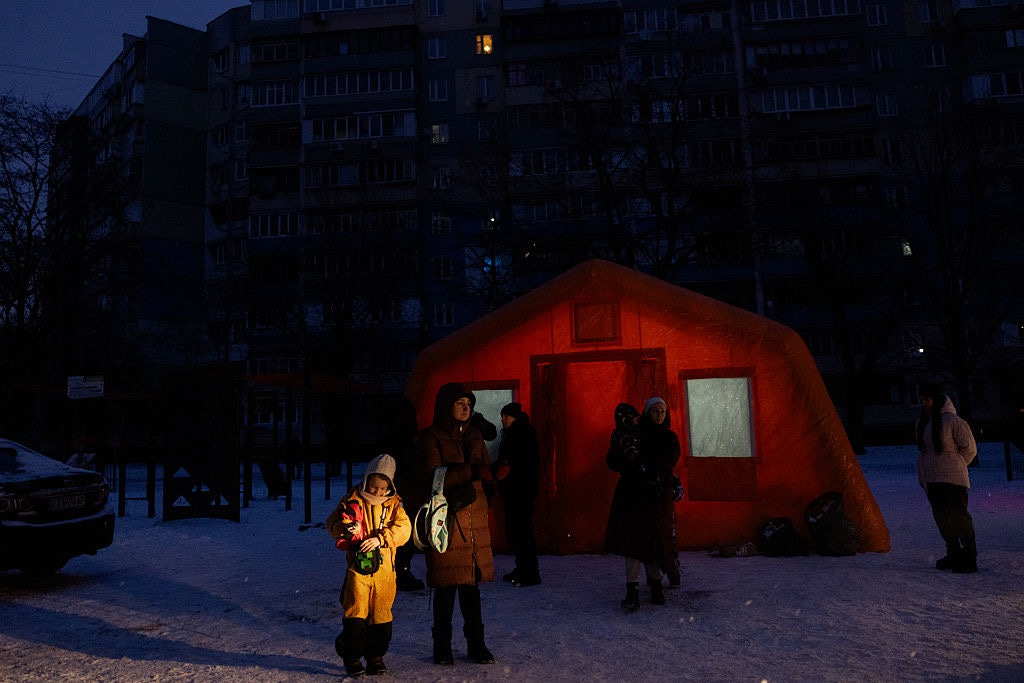
For the past year, Ukraine has been under fire, with daily heavy fighting on the front lines; regular strikes on Ukrainian cities using all types of long-range weapons, with numerous civilian casualties, including children; systematic attacks on energy infrastructure aimed at depriving Ukrainians of electricity—and, in winter, of heat as well; and continuous psychological pressure designed to force a war-weary society to capitulate. Soon it will be four years since the start of the full-scale invasion, and twelve years since the war first began with the invasion of Crimea.
Throughout 2025, the U.S. administration, led by President Donald Trump, pursued persistent peace efforts. At first, it appeared to Washington that organizing peace talks and reaching an agreement would not be difficult; relatively short timelines were discussed. Over time, those timelines stretched—and eventually disappeared from public discussion altogether. Eleven months of effort now appear to have produced no result. How could this happen? Why did such sustained efforts, backed by the immense authority and political weight of the United States, fail to deliver?
I can offer a perspective from Kyiv—one shaped by the fact that we live next to Russia, spent a long time within a single state, and know our neighbor’s history and political culture well.

In my view, there are several systemic blind spots that make it difficult for the United States to see a viable path toward peace for Ukraine, and at the same time toward strengthening American credibility and the international order.
The causes of the war
Moscow is not fighting for territory. Russia already has vast territories of its own—many of them underdeveloped and neglected. Moscow is fighting to destroy the Ukrainian state and nation, because without Ukraine, Russia cannot be an empire, as former U.S. National Security Advisor Zbigniew Brzeziński argued decades ago. These motives and goals have been stated repeatedly by Vladimir Putin and his closest associates.
Russia’s attitude toward the United States
Some in Washington believe Russia could be a U.S. partner. Indeed, “resetting” relations with Russia has been an objective of multiple administrations, both Democratic and Republican. Yet the Kremlin openly declares its goal of revising the outcome of the Cold War—a war it lost to the United States. In Russian thinking, the United States is a strategic adversary, and Russia seeks revenge for that defeat.
The military situation
Some within the Trump administration appear to believe that the Russian army is steadily winning and that Ukraine “has no cards.” If that were the case, why has Russia failed to capture a single major Ukrainian city? The reality is that after two years of continuous mass assaults, Russia has seized less than 1.5 percent of Ukrainian territory—despite the full mobilization of its resources. At current rates of advance, it would take many years for Russia to occupy the territories from which Putin demands Ukraine withdraw. Russia does not dominate at sea, in the air, or in cyberspace.
Russia’s military power
Historically, Russia has lost wars more often than it has won them. Its victory in World War II was achieved with decisive American military and industrial assistance, and through the opening of a second front involving U.S. forces. Many of Russia’s past military successes were achieved with substantial Ukrainian participation.
Russia–China relations
Detaching Russia from China appears to be a core objective of U.S. foreign policy. Belief in the feasibility of this goal may prove to be the greatest geopolitical error of the first half of the twenty-first century. A “reverse Nixon” is no longer possible. The split between China and the Soviet Union during the Cold War occurred at a moment of deep hostility between them. Today, the relationship is at its closest point. Russia cannot wage this war without China’s economic and technological support; it has already become China’s junior partner.
Prospects for American businesses in Russia
U.S. investors are not lining up to exploit Russian resources. They remember the experience of large-scale nationalizations and the complete absence of meaningful property-rights protection over the last few years.
Russian political culture
Russia’s leadership, shaped by KGB service, treats distortion of reality as a primary political instrument. Negotiations are used tactically, not as a path to compromise. Fabricated claims—such as the allegation that Ukraine is ruled by Nazis—or repeated false announcements about the capture of the Ukrainian city of Kupiansk—later disproven when President Zelenskyy visited the city himself—are illustrative examples.
I am confident that there are professionals within the State Department, the U.S. Armed Forces, and the intelligence community who understand all of this. I hope these systemic illusions—some of them carefully laid traps by the Kremlin—will be taken into account as future policy decisions are made.
So let us return to how U.S. policy is perceived in Ukraine. Ukrainians are sincerely grateful to the American people and government for their continued support and peace initiatives. Presidents change in both Ukraine and the United States, but mutual goodwill and support have long been the foundation of the relationship between our countries.
At the same time, as we can see, peace initiatives have not produced results. From Kyiv, the process looks like an endless déjà vu, a closed loop: Again and again, the U.S. president proposes peace plans, and again and again the Russian dictator rejects them. When arguments run out, another fabrication appears. The American leader continues to invest effort, and the cycle begins anew. Meanwhile, Putin merely imitates negotiations—dangling promises of lucrative economic projects while omitting any mention of the absence of investor protections in Russia.
Diplomacy and peacemaking work when all parties genuinely want peace. When one side seeks revenge for a war it lost to the United States thirty-five years ago, the possibilities of diplomacy are inherently limited.
Friends of mine in the United States ask how Ukrainians perceive the current U.S. course on Ukraine. From what I have outlined above, it should be clear why my answer is “with surprise.” But this is not about Ukrainian interests—the United States is under no obligation to prioritize them. It’s about America’s own interests.
Close cooperation with Ukraine benefits the United States for several reasons. First, Ukraine is actively weakening the anti-American axis, using its own people, with real results and without U.S. casualties. Second, Ukraine is fighting a twenty-first century war and gaining combat experience that will be invaluable to the United States—knowledge that cannot be acquired through exercises alone. Third, Ukraine provides practical proof of a conclusion that serves U.S. interests: nuclear blackmail is not an effective strategy. Fourth, Ukraine opens significant opportunities for the American defense industry and the innovative technology sector. Fifth, effective U.S. assistance to Ukraine strengthens America’s standing with allies in all regions, especially in Southeast Asia.
This list could be much longer. Supporting Ukraine is not altruism—it is a highly effective way to protect American strategic interests in a new geopolitical reality.
Valerii Pekar is a chairman of the board of Decolonization NGO, the author of four books, an adjunct professor at the Kyiv-Mohyla Business School and the Business School of the Ukrainian Catholic University, and a former member of the National Reform Council.
Follow Persuasion on X, Instagram, LinkedIn, and YouTube to keep up with our latest articles, podcasts, and events, as well as updates from excellent writers across our network.
And, to receive pieces like this in your inbox and support our work, subscribe below:
 | A guest post by
|
All excellent points!
Donald Trump is no friend of either democracy or the Ukraine. His hangup is his obsession with winning a Nobel Peace Prize, and he would happily throw the Ukrainians under the Russian bus if he thought it would end the war in a way for which he could claim the credit. But he is finally starting to realize that Vladimir Putin has no intention of assisting him in that attempt. Putin’s whole political career, and possibly his freedom (the Russians are notoriously hard on those who spend Russian lives too freely and fail) are tied up in conquering the Ukraine in order to reconstitute the Russian Empire. Putin is realpolitik. Trump is merely performative.