

What Tunisia Teaches the United States About Democracy
It’s (still) the economy, stupid.


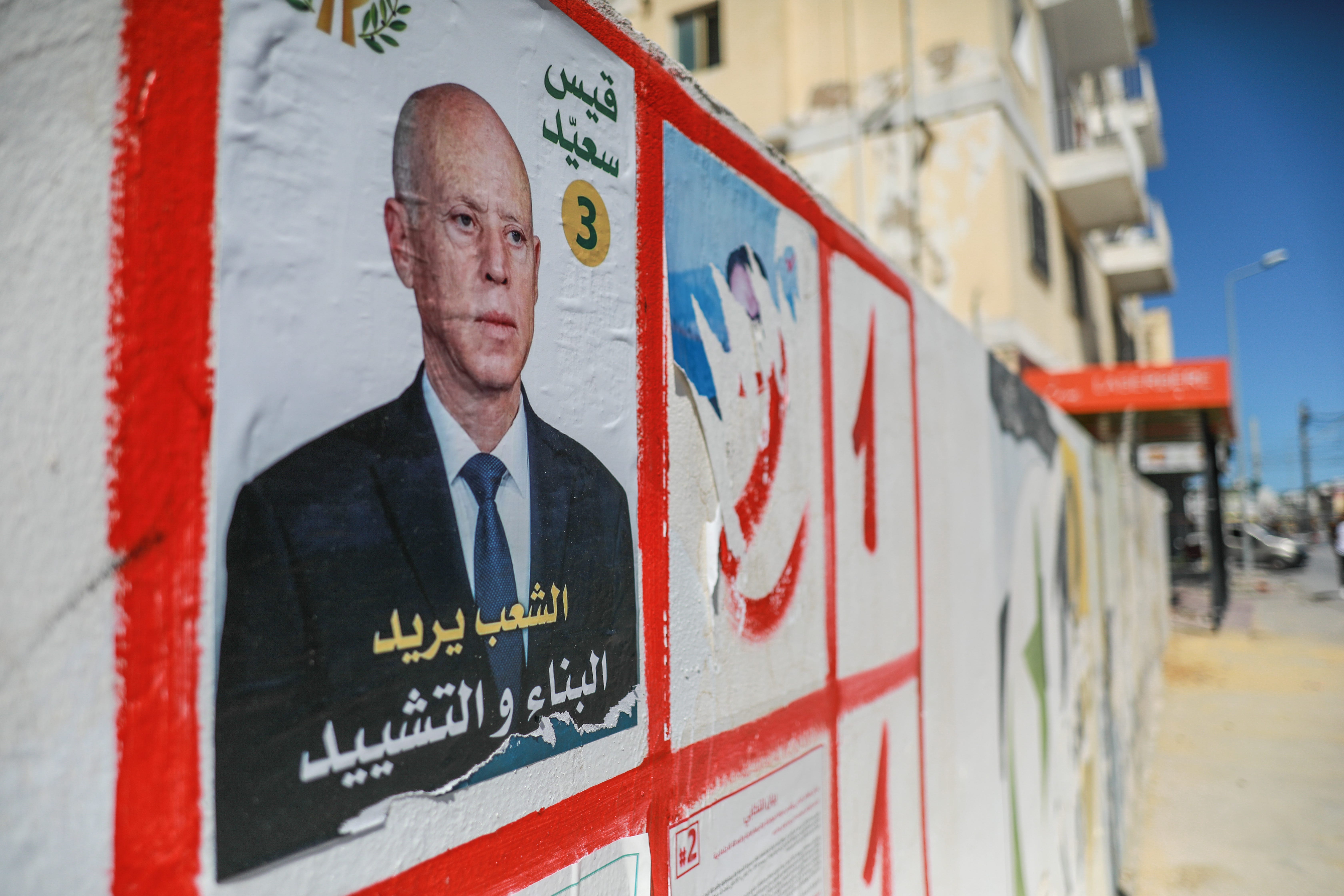
In July 2021, Tunisia’s president, Kais Saied, dismissed his prime minister, suspended parliament, and began ruling by decree. The country that had been the lone democratic success of the Arab Spring—the same country that had produced a Nobel Peace Prize-winning national dialogue, ratified a celebrated constitution, and held competitive elections—folded with little public resistance. Polls in the following months showed majority support for the consolidation. The institutions that Western democracy theorists had spent a decade praising did not so much fail as become irrelevant.
This is an intriguing puzzle. Tunisia had nearly everything a democracy requires, according to traditional political science. It had a civil society—particularly the powerful Union Générale Tunisienne du Travail (UGTT)—that had supported the country through the 2013 crisis. It had a written constitution drafted through compromise. It had elections, peaceful transfers of power, and an active press. By 2014, observers could plausibly point to Tunisia as evidence that Arab democracy was not an oxymoron. But seven years later, Tunisians traded that democracy for a strongman, and they did so without much regret.
The standard postmortems emphasize institutional weakness, factionalism, or constitutional design. While these factors had an impact, they miss the deeper story. Tunisia’s democratic collapse was not, at its core, a crisis of institutions. It was a crisis of economic performance that institutions could not absorb, which hollowed out trust, and finally made authoritarian populism look like the rational choice. This provides both a parallel and a warning for America.
The Economic Roots of Tunisia’s Trust Collapse
The 2011 revolution did not start with a vote or a manifesto; it started with an unemployed fruit vendor setting himself on fire in protest against police harassment. The original grievance was economic precariousness, and the democratic transition that followed inherited economic obligations it could not meet. Between 2011 and 2021, Tunisia’s youth unemployment hovered above 30 percent, with university graduate unemployment higher still. Real GDP growth lagged behind the demographic wave. Foreign direct investment never recovered to pre-revolution levels. The informal economy expanded as the formal sector failed to absorb new entrants.
Why couldn’t the new democracy deliver? Part of the answer is structural. Tunisia inherited a French-derived labor code that made hiring and firing costly, discouraging investment in jobs for young workers. These rules might suit a wealthy European economy with deep social insurance and high productivity. But in a middle-income country with 30 percent youth unemployment, they functioned as a ceiling on opportunity.
The deeper problem was political. The UGTT—without which the revolutionary coalition could not have held together—had veto power over the very reforms most likely to produce employment. IMF-backed structural packages stalled. Subsidies remained. Stagnation eroded trust.
This is the missing link between Ben Ali’s ouster and Saied’s coup: a decade in which democracy delivered freedom but not work, and in which young Tunisians, who had supplied the bodies for the revolution, found themselves with the same economic prospects under democracy as under autocracy—and concluded, not unreasonably, that the political form was a secondary concern.
The Civil Society Paradox
The role of the UGTT illuminates a paradox at the heart of democratic theory. Civil society is supposed to be a bulwark of democracy. In Tunisia, it was—yet it was also one of the obstacles to democratic survival.
The United States has no analog to the UGTT, and the decline of American labor unions is a real loss for workers’ voices. But the underlying pattern is familiar. Organized interests across both parties block productivity-enhancing reform—in housing, occupational licensing, infrastructure permitting, healthcare, and education—and citizens experience the resulting stagnation as a generalized institutional failure. The lesson is not that more unions would save American democracy, but that democracy requires coalitions willing to deliver material improvement, and that organized interest groups can obstruct this delivery. This is already apparent in many areas of American life, with democratic processes such as citizen participation or interest groups holding back infrastructure development.
How Economic Failure Becomes Institutional Failure
This economic story gives context to the decline of trust in the Middle East, North Africa, and beyond. Citizens do not lose faith in judiciaries, legislatures, political parties, and police in the abstract—they lose faith when those institutions fail to resolve economic tensions. And once trust bottoms out, institutions stop functioning as shields and instead start functioning as targets.
Tunisia’s party system collapsed because no party could deliver on economic promises, and the public concluded—reasonably—that the parties were a cartel of bickering elites who differed in every way except their inability to provide meaningful work. Saied’s ascent was a populist verdict on that cartel. The American parallel is unmistakable: decades of wage stagnation, regional decline, and elite indifference have produced populist movements on both the left (Bernie Sanders, Zohran Mamdani) and the right (Donald Trump, JD Vance) with a shared diagnosis of failure despite disagreement on solutions.
This is echoed in the undermining of the judiciary. Saied dismantled Tunisia’s judiciary by leveraging widespread perceptions of corruption—perceptions rooted in decades of Ben Ali-era capture that the 2011 transition could never fully repair. Low trust made the institution disposable. American politicized judicial appointments have similarly eroded perceptions of neutrality, creating a permission structure for narrowing judicial authority that would have been unthinkable even a generation ago.
Most striking is the trust differential between security services. Tunisia in 2019 had roughly 62 percent trust in the police compared with 96 percent trust in the armed forces—a pattern that recent research identifies as a leading indicator of backsliding. Low local-security trust drives protest; high military trust legitimizes consolidation. The United States is seeing declining confidence in federal and local policing alongside persistent high trust in the armed forces. While economic grievance is what puts citizens in the streets, the trust differential is what determines how the state responds when they get there.
The final warning is in the legislature. Saied sidelined parliament by ruling through decree once trust in the legislature had collapsed. The American legislative branch is drifting in the same direction, with executive orders rising as congressional productivity falls. A legislature that cannot deliver on economic policy becomes a legislature whose bypass the public will tolerate, and, eventually, ratify.
The American Ledge
The United States is not Tunisia, and the differences matter. America’s GDP per capita is more than fifteen times Tunisia’s. Its institutions are older, and its constitutional system has survived crises that would have ended most democracies.
But none of this is grounds for complacency.
The American trust collapse has its own economic roots. Median wage growth has lagged behind productivity for four decades. Housing and healthcare costs have outpaced wages on nearly every metric. Regional economic divergence has stranded entire communities—manufacturing towns in Ohio and Pennsylvania, agricultural regions across the Plains, former resource-extraction economies in the West—in conditions of long-term decline. The cohort of Americans now entering middle age is the first in modern history that does not expect to do better than its parents.
These conditions do not produce 30 percent youth unemployment. They produce something subtler and arguably more dangerous: the persistent political signal, sent through every available channel, that the system is no longer delivering. When that signal reaches every institution simultaneously—Congress, the courts, local police, federal agencies, the parties—the result is the sort of low-trust landscape that Saied exploited, transposed into a larger and more consequential democracy.
Restoring the Economic Foundation of Democratic Trust
Tunisia’s tragedy was not simply that its citizens lost faith in institutions. It was that its institutions, constrained by a revolutionary coalition that could not reform itself, could no longer earn that faith. This triggered the descent into authoritarianism.
The American lesson is therefore not to redouble institutional defense alone, but to build coalitions willing to deliver the housing, the jobs, the wages, and the opportunity that make trust rational. Democratic reformers focused only on procedural integrity are merely treating symptoms. Without economic renewal—and without the political courage to confront the organized interests that block it on every side—the institutional defenses will not hold.
Dania Arayssi is a Program Head and Senior Analyst at New Lines Institute for Strategy and Policy, where she works on policy research and analysis at the Central Asia Center.
Henry Rogers is a student fellow at the New Lines Institute, a contributor to the Middle East Policy Council, and a public affairs consultant with the Washington AI Network.
Follow Persuasion on X, Instagram, LinkedIn, and YouTube to keep up with our latest articles, podcasts, and events, as well as updates from excellent writers across our network.
And, to receive pieces like this in your inbox and support our work, subscribe below:
 | A guest post by
|
 | A guest post by
|
I see much truth here. Here in MA, the towns have authority over their own zoning. In Almost all cases, it is very restrictive and doesn’t allow for density. He do we dislodge this system?