

A Precarious Balance
Governments are increasingly taking undemocratic steps in the name of preserving democracy—but this must be done with caution.

This article is brought to you by American Purpose, the magazine and community founded by Francis Fukuyama in 2020, which is proudly part of the Persuasion family.
Canceling an election. Banning political parties. Blocking access to foreign media. Arresting demonstrators simply for holding signs.
These sound like the tools of dictatorships. But over the past five years, European governments have engaged in all these actions.
In each case, governments have defended these measures as essential to maintain democracy, national security, or the rule of law. Their explanations echo Karl Loewenstein’s concept of “militant democracy”—the argument that the defense of democracy sometimes requires undemocratic acts. Loewenstein published his theory of militant democracy in 1937 amid the rise of European fascism. Winston Churchill expressed a similar idea in 1948, writing, “The letter of the law must not in supreme emergency obstruct those who are charged with its protection and enforcement.”
And yet, these actions give ammunition to authoritarian powers that claim Western democracy is a sham. When Britain banned Kremlin media outlets RT and Sputnik after Russia invaded Ukraine, Vladimir Putin’s spokesman accused the UK of “another step to grossly restrict freedom of speech.”
How did European governments get to the point where far more repressive regimes like Russia can purport to give them lectures on political rights? More pertinently, are there ways European states can defend democracy and national security without using tactics that turn into political and reputational liabilities?
European governments have taken several actions in recent years that go beyond normal democratic practice.
In 2025, Germany’s domestic intelligence agency labeled the most popular party in the country, the Alternativ für Deutschland (AfD), “right-wing extremist.” The classification created a legal basis for wiretapping the AfD and infiltration by undercover agents. German officials said they took action against the AfD because its “xenophobic, anti-minority, Islamophobic” statements threatened the constitutional rights of citizens.
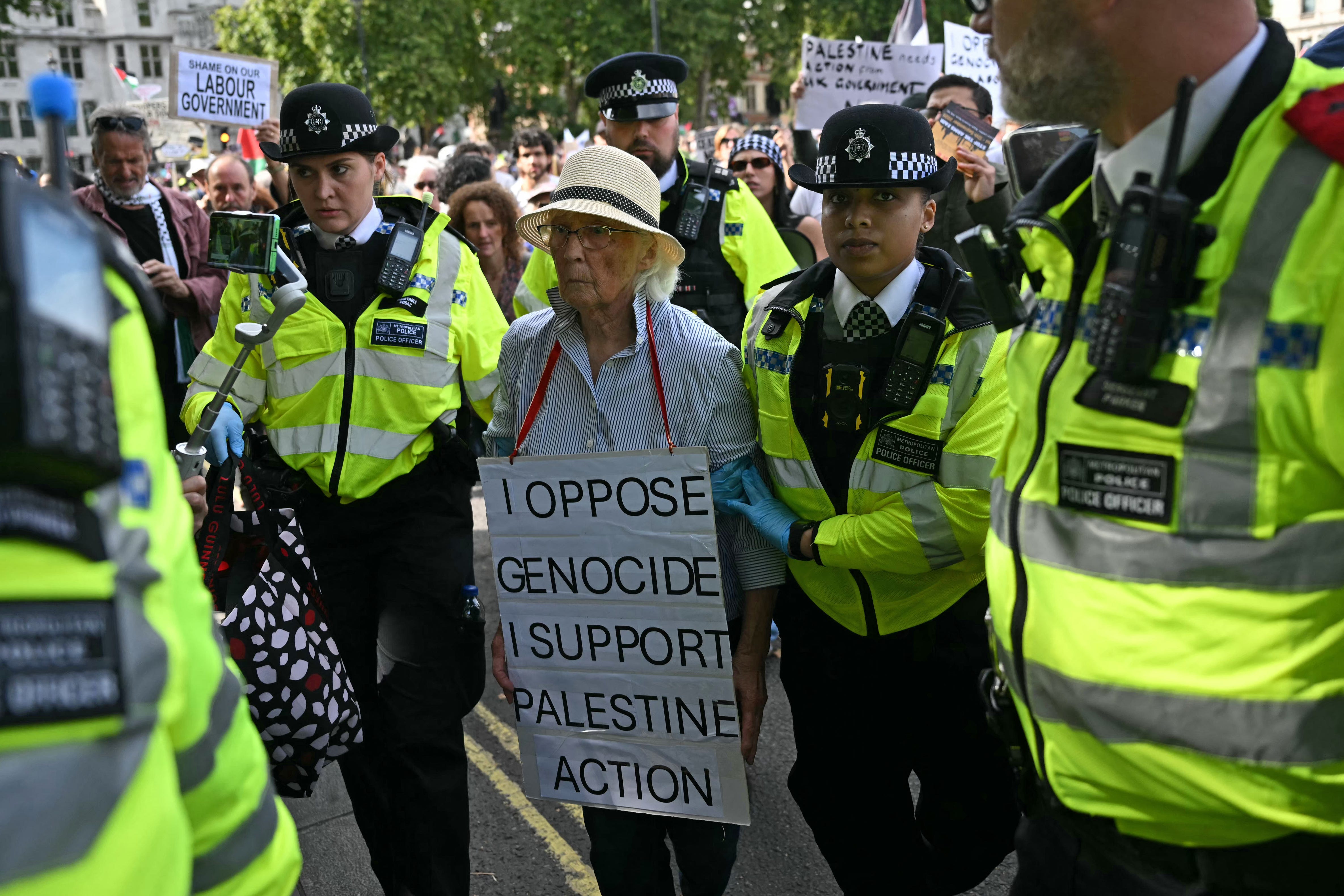
Last December, British police arrested hundreds of demonstrators just for holding up signs containing the words Palestine Action—the name of a group banned under UK terrorism laws after it carried out attacks on British military facilities, defense contractors, financial firms and universities. “This is not even ‘draconian,’ it is vile,” huffed a commentary published by Russia’s RT. (Russian police, meanwhile, have arrested demonstrators simply for holding up blank pieces of paper.)

Romania canceled the first round of its presidential elections in 2024 after the surprise victory of Călin Georgescu, a Russia-friendly new age Christian who appealed to conspiracy theories and superstition, while Moldova banned pro-Russian political parties in 2023 and 2025. Romania attributed the cancellation of its 2024 election to an intense, Russian-backed TikTok campaign supporting Georgescu that violated campaign financing and labeling laws.
There is no mystery as to why some governments have taken dramatic actions to protect liberal democracy from foreign and domestic threats. European society is under extreme stress. The Great Recession in the late 2000s, COVID lockdowns, the hollowing out of Europe’s industrial base, and the arrival of large numbers of immigrants have fed radical, populist movements on the left and right.
Right-wing parties believe national governments and the supranational EU have been far too liberal in economic and social policy, while leftists favor even more social diversity and public spending.
Meanwhile, many governments perceive a foreign policy emergency born of Russia’s invasion of Ukraine and the Trump administration’s ambiguity about defending Europe. They are spending heavily on their own militaries and aid to Ukraine. Leftists and rightists have been able to find common ground in opposing this spending, arguing it could provoke Russia further and that the money is better spent at home. Russian propaganda has sought to intensify the conflicts inside each European nation, amplifying grievances from any quarter against governments that stand up to the Kremlin.
Governments have been at pains to justify their coercive actions as individual special cases. For example, the EU’s ban on Russian media outlets recalled efforts by Putin’s Russia and the Soviet Union to block out Western broadcasts and news sources. But the EU bypassed questions of media freedom, saying its action was essential because Russia’s disinformation was “an operational tool in its assault on Ukraine.”
Still, as the saying goes: when you’re explaining, you’re losing. Despite constant justifications—many of them well reasoned—the succession of such incidents has a bad look overall for nations that see themselves as beacons of democracy.
The best guarantor of national security is a sense of national unity and confidence. Traumatized by the national chauvinism that unleashed World War II, European elites bet heavily on the EU to develop a “new European man” with a continent-wide, rather than a national, frame of reference. This boomeranged into extreme nationalism by some citizens and disaffection toward their nations by others. In 2023, for example, just 32 percent of EU citizens said they would be willing to fight for their country.
Reversing this trend requires inculcating national pride, spreading knowledge of how democratic societies work, and an understanding of what life is truly like in lands ruled by authoritarian governments and terror groups. Such education is also the best firewall against undemocratic domestic political movements. Making populations less vulnerable to messaging from the extremes is far better than banning parties or prosecuting their leaders once they have built large followings.
Governments need to be alert to threats in the shadows. For example, the massive TikTok campaign to support Georgescu, with its obvious violation of election regulations, was directed mainly to the social feeds of young, rural, and politically radical people. It was almost invisible to state authorities and the pro-democracy community before he emerged with an election win. If the machinations in Georgescu’s favor had been detected earlier, they could have been publicly exposed well before election day.
This is what Moldova’s government did when it disqualified pro-Moscow parties from running. It broadly publicized evidence of vote-buying and other irregularities, dampening claims the parties were banned solely for political reasons.
When the actions of anti-liberal actors are less egregious, strong actions are harder to publicly justify. When French right-wing politician Marine Le Pen was preparing to run for president last year, a court banned her from holding elective office for five years. It found her guilty of diverting millions of euros, provided to pay for aides when she served in the European Parliament from 2004-2016, to pay employees of her own party in France.
Such a crime was not the kind likely to incense citizens, meaning in practice that the verdict played easily into claims authorities were using technicalities to suppress her popular Rassemblement National party. Prosecutors are now investigating Jordan Bardella, who is expected to run in Le Pen’s place if her appeal is unsuccessful, for alleged fraud. A poll in May showed he could win the 2027 race for president.
Governments should also dare use their most coercive powers only when they are likely to prevail. The British ban of Palestine Action was overturned by the High Court in February; a government appeal is pending. A German court issued a temporary injunction against the state’s designation of the AfD as “confirmed right-wing extremist.” Such developments undermine governments’ claims they deploy extreme measures only in cases of unquestionable certainty and gravity.
Authorities have also looked rather hapless in their bans on RT and Sputnik. The bans sharply cut audiences on the outlets’ main channels, but the networks have gloated over their cat-and-mouse strategy to spread content through dozens of new information brands. “We spit on your sanctions,” RT Chief Editor Margarita Simonyan said.
Given present dangers, democratic governments may have no choice but to take highly undemocratic actions again to fend off authoritarianism and terror. But such measures should always be a last resort—and only after the exhaustion of the less draconian remedies of education, vigilance, and public exposure of malign actors.
Thomas Kent teaches at Columbia University. He was formerly president and CEO of Radio Free Europe/Radio Liberty and standards editor of The Associated Press.
Follow Persuasion on X, Instagram, LinkedIn, and YouTube to keep up with our latest articles, podcasts, and events, as well as updates from excellent writers across our network.
And, to receive pieces like this in your inbox and support our work, subscribe below:
 | A guest post by
|