


This article is brought to you by American Purpose, the magazine and community founded by Francis Fukuyama in 2020, which is proudly part of the Persuasion family.
The assassination of Ayatollah Ali Khamenei, the Iranian regime’s longstanding supreme leader, marks the most consequential rupture in the Islamic Republic since 1989. For nearly four decades, Khamenei stood at the center of Iran’s political order. His power was not only constitutional but also ideological and, most importantly, coercive. He presided over the gradual transformation of the Islamic Republic from a revolutionary theocracy into what can be described as a theocratic security state, in which clerical legitimacy and security power became deeply intertwined. With his death, the system has lost its anchor. With the massive missile attacks against the regime, the question now is not only who will eventually replace him, but who will govern right now in this moment of uncertainty.
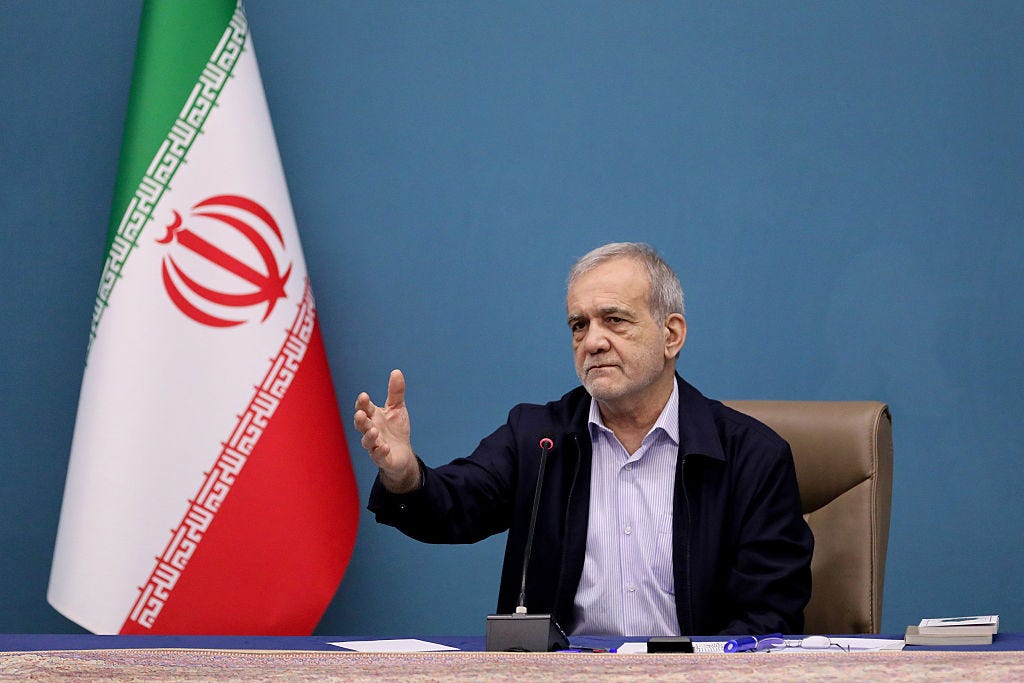
Formally, the answer appears straightforward. Under Article 111 of the Iranian constitution, a three-member interim council assumes the duties of the Supreme Leader until the Assembly of Experts selects a successor. That council now consists of President Masoud Pezeshkian, Judiciary Chief Gholam-Hossein Mohseni Ejei, and Ayatollah Alireza Arafi. Technically, this body exercises the Supreme Leader’s powers, supervising the armed forces, overseeing key appointments, and maintaining continuity in state authority.
On paper, the composition of this council reflects institutional balance. Pezeshkian represents the executive branch, Ejei embodies the judiciary and the security-oriented legal apparatus, and Arafi provides clerical legitimacy and ensures that the transition remains anchored in the religious establishment. The arrangement projects constitutional order and political stability; it signals that the Islamic Republic remains in power despite the tumult, and that it has the necessary mechanisms to manage succession and avoid chaos.

In reality, however, constitutional formality and political power rarely coincide in the Islamic Republic. Over the past three decades, real authority has increasingly shifted toward a security-elite coalition that operates beyond the state’s visible architecture. The institutions that matter most are not only those named in the constitution, but those that control coercion, intelligence, and elite coordination—meaning that the formally-named trio is not the ultimate authority.
Behind the constitutional council stands a more consequential alignment centered around three power-brokers: Gholam-Hossein Mohseni Ejei (the only one of the three to also serve on the official interim council), Mohammad Bagher Ghalibaf, and Ali Larijani. This is not a legally defined body, but an elite security and political nexus that reflects where decision-making power has accumulated over time.
Ejei is more than the head of the judiciary. He has long been a central figure within Iran’s intelligence and prosecutorial networks, with a career rooted in repression, surveillance, and the management of dissent. His presence guarantees that the security institutions remain unified and that any sign of fragmentation is quickly contained.
Ghalibaf, as Speaker of Parliament and a former commander in the Islamic Revolutionary Guard Corps (IRGC), bridges the military and political classes. He represents the bureaucratic and managerial face of the security state. Ghalibaf understands the Revolutionary Guard’s internal logic and maintains relationships across the more conservative factions. In a succession crisis, such networks are more important than formal titles. He is well-positioned to coordinate among parliament, the Guard, and other power centers, preventing institutional paralysis.
Larijani occupies a different but equally significant role. As the former IRGC commander and speaker of parliament, with deep roots in the clerical establishment and extensive experience in national security, he functions as a power broker among elite factions. As the secretary of the most important security body, the Supreme National Security Council, Larijani is adept at navigating the complex terrain between ideology and “pragmatism.” In a system where consensus among elites is essential for survival, his ability to mediate and align interests has become central. With influence lying in networks rather than constitutional power, he does not need a formal seat in the interim council to shape his preferred outcomes.
The distinction between the technical council of Pezeshkian, Ejei, and Arafi and the more substantive alignment of Ghalibaf, Larijani, and Ejei reveals an important feature of the Islamic Republic’s evolution: Over time, the regime has become less dependent on charismatic clerical authority and more reliant on institutionalized coercion and elite coordination. Khamenei’s personal dominance masked this shift, but his death exposes it.

If the regime survives this transition, it is unlikely to move toward liberalization. On the contrary, the logic of succession under pressure tends to favor securitization. In the absence of a leader of Khamenei’s stature, the system will rely more heavily on collective elite management and on the security apparatus to deter both internal dissent and external pressure. The IRGC and its allied institutions will not allow instability to open space for popular mobilization. Repression, surveillance, and centralized coordination are likely to intensify rather than diminish.
The Assembly of Experts will eventually select a new Supreme Leader—yet the identity of that individual may matter less than the structure that surrounds him. The future leader will inherit a state in which real power has already shifted toward a consolidated security elite. He may hold the title of Supreme Leader, but he will operate within a framework shaped by the very figures who managed the transition.
Khamenei’s death so far signals a moment of reconfiguration. But the formal institutions continue to function and the security elite remains cohesive. The key question is whether this coalition can maintain unity under mounting U.S. and Israeli attacks and domestic and international pressure. If it does, Iran will likely emerge from this crisis, not weaker in coercive capacity, but more openly defined by it.
Saeid Golkar is an associate professor of political science at the University of Tennessee-Chattanooga, a senior advisor at United Against Nuclear Iran (UANI), and a writing fellow at the Middle East Forum.
Follow Persuasion on X, Instagram, LinkedIn, and YouTube to keep up with our latest articles, podcasts, and events, as well as updates from excellent writers across our network.
And, to receive pieces like this in your inbox and support our work, subscribe below: