


This article is brought to you by American Purpose, the magazine and community founded by Francis Fukuyama in 2020, which is proudly part of the Persuasion family.
Iran is once again experiencing a wave of nationwide protests. The Islamic Republic’s history of popular unrest dates back to the early 1990s, when rising economic inequality and growing public frustration triggered widespread demonstrations in rural and impoverished areas. The first major post-Revolution uprising occurred in 1999, following a government crackdown on students and intellectuals. The 2009 Green Movement marked a critical turning point. Millions took to the streets to protest alleged electoral fraud by former hardline president Mahmoud Ahmadinejad, and to demand political reform.
A few years later, the 2017-2018 protests reflected deepening economic grievances across social classes, while the 2019 demonstrations, triggered by a sudden fuel price hike, evolved into one of the most extensive uprisings in the Islamic Republic’s history. The state responded with extreme violence, killing more than 1500 people in under a week.
Most recently, the 2022 protests following the death of Mahsa Amini in the custody of the morality police ignited a powerful movement centered on women’s rights, political freedom, and resistance to systemic repression. Again, the regime brutally repressed this movement, killed hundreds of Iranian youths, and intentionally blinded hundreds by shooting them in the eyes.
The current protests, which began last Sunday, are following a similar trajectory. As in 2019, the trigger was economic grievance, which has led Iranian demonstrators to pour into the streets and demand the dismantling of the regime.
Yet despite their scale and intensity, all previous protests failed. What might the future hold for this current round?
To answer this question, one should examine the regime’s resilience in the face of repeated mass dissent. The key factor is the structure of the Iranian state itself. Over time, the Islamic Republic has transformed into a highly centralized and professionalized security state, capable of managing, containing, and suppressing dissent with remarkable efficiency. Its resilience is not accidental but the result of decades of institutional learning and strategic adaptation.
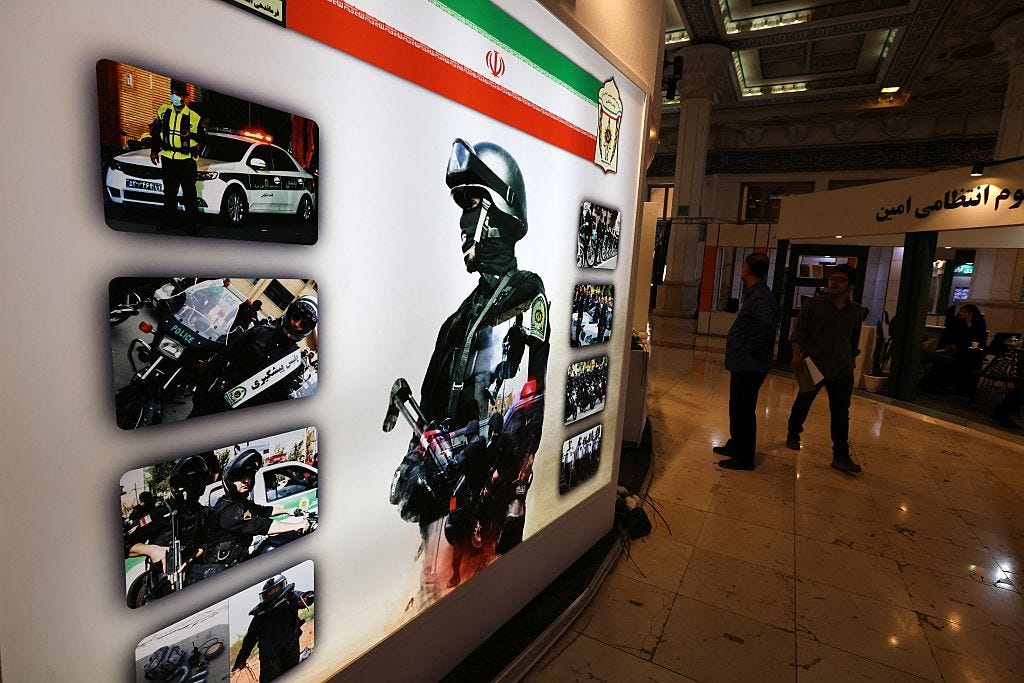
At the center of this system are the Islamic Revolutionary Guard Corps, the Ministry of Intelligence, the Basij militia, militarized law enforcement, and a massive network of low-ranking security offices that exist in every corner of Iran’s bureaucracy. These institutions operate not only as coercive forces but also as deeply embedded actors within Iran’s political, economic, and social life. Their expansive reach allows the regime to monitor society closely and to neutralize dissent at an early stage. Surveillance, intimidation, and selective repression have become routine tools of governance.
These security institutions, originally established to uphold the political order and safeguard the regime, have become deeply integrated. They have transformed the Islamic Republic from a revolutionary theocracy into a modern security state.
Unlike the Pahlavi monarchy, which collapsed amid mass mobilization during the Iranian Revolution of 1979, the Islamic Republic has internalized the lessons of revolutionary vulnerability. It has invested heavily in intelligence capabilities, cyber monitoring, and psychological operations. The regime now anticipates unrest rather than merely reacting to it, using data-driven surveillance and preemptive repression to prevent protests from coalescing into a unified movement.
One of the most significant obstacles to political transformation in Iran is the fragmentation of the opposition. Over decades, the regime has systematically weakened alternative centers of power through repression, exile, and targeted assassinations. This strategy has left opposition movements divided, leaderless, and often ideologically fragmented.

Although protesters broadly demand political change, they remain divided over its nature. Some call for a secular republic; others advocate reforms within the existing system; and a growing segment supports a return to monarchy. This trend is visible in chants such as “Javid Shah,” “Reza Shah, may your soul be blessed,” and “This is the final battle, Pahlavi will return.” These slogans, heard in cities such as Arak, Rasht, and Khorramabad, reflect renewed symbolic support for the exiled Crown Prince Reza Pahlavi, who has publicly endorsed the protest movement and urged unity, including appeals to the security forces to defect.
Yet this diversity of visions weakens collective action. The regime exploits these divisions through a deliberate strategy of divide and rule, ensuring that no single movement or figure can consolidate sufficient support. By controlling narratives and amplifying internal disagreements, the state prevents the emergence of a unified opposition capable of challenging its authority.
The resilience of Iran’s regime is also reinforced by its international partnerships. In recent years, Tehran has deepened strategic cooperation with authoritarian allies, most notably Russia and China. These relationships have strengthened Iran’s internal security capacity and reduced the effectiveness of external pressure.
Through long-term agreements like the 25-year partnership with China and cooperation with Russia from 2024 to 2025, Iran has gained access to digital authoritarian tools. These include deep packet inspection for internet shutdowns, AI facial recognition for social control, and advanced mobile tracking, enabling the move from reactive repression to predictive control. Russia has expanded as a supplier of anti-riot and electronic warfare systems, with cooperation agreements extending into the late 2020s. China’s “Safe City” infrastructure in Tehran and Isfahan has integrated high-resolution surveillance cameras with law enforcement databases, transforming cities’ ability to monitor unrest.
This international support network has significantly reduced the effectiveness of sanctions and external pressure, providing the regime with both technological resilience and strategic insulation.
The growing divide between Iranian society and the ruling system is undeniable. Repeated waves of protest demonstrate a deep and persistent rejection of authoritarian governance. Yet the failure of these movements to produce meaningful change underscores the regime’s ability to adapt, repress, and endure.
As Iran enters 2026, the current unrest represents not a temporary eruption but part of a long struggle against an entrenched security state. While popular demands for dignity, freedom, and accountability continue to grow, the regime’s sophisticated coercive apparatus remains firmly in place.
Any meaningful transformation will require confronting this deeply embedded architecture. Without a strategy capable of neutralizing the state’s coercive power and overcoming opposition fragmentation, the prospect of democratic change remains distant. The struggle continues, but the balance of power still favors a regime that has perfected the art of survival.
Saeid Golkar is an associate professor of political science at the University of Tennessee-Chattanooga, a senior advisor at United Against Nuclear Iran (UANI), and a writing fellow at the Middle East Forum.
Follow Persuasion on X, Instagram, LinkedIn, and YouTube to keep up with our latest articles, podcasts, and events, as well as updates from excellent writers across our network.
And, to receive pieces like this in your inbox and support our work, subscribe below:

Thank you! Very enlightening summary..