


This article is brought to you by American Purpose, the magazine and community founded by Francis Fukuyama in 2020, which is proudly part of the Persuasion family.
On February 14, 2025, President Donald Trump established the National Energy Dominance Council, a cornerstone of his “all of the above” energy strategy. What followed instead was a large-scale shift away from renewables: Trump killed Inflation Reduction Act subsidies, canceled green energy projects, and rescinded remaining clean energy Infrastructure Investment and Jobs Act funds. The president has allowed climate politics to obscure the goal of true energy dominance. Now, in the midst of the Iran war—an energy shock of its own making—America is feeling the consequences.
China, on the other hand, is building the energy infrastructure of the future. In 2025 alone, Beijing built nearly nine times more energy capacity than the United States; this includes: ~10x more solar power, ~15x more wind power, ~21x more coal/natural gas, and infinitely more nuclear since the United States built none. If the race for chips is a national security issue, so is the race for energy, and the United States lacks a strategy.
While Beijing is still heavily reliant on oil, it is pursuing the “all of the above” policy that America has failed to realize. In doing so, it is building an energy fortress and reducing its reliance on maritime oil and gas imports. Xi intends to eliminate strategic vulnerabilities and ensure that the CCP will never be vulnerable through its global supply chains.
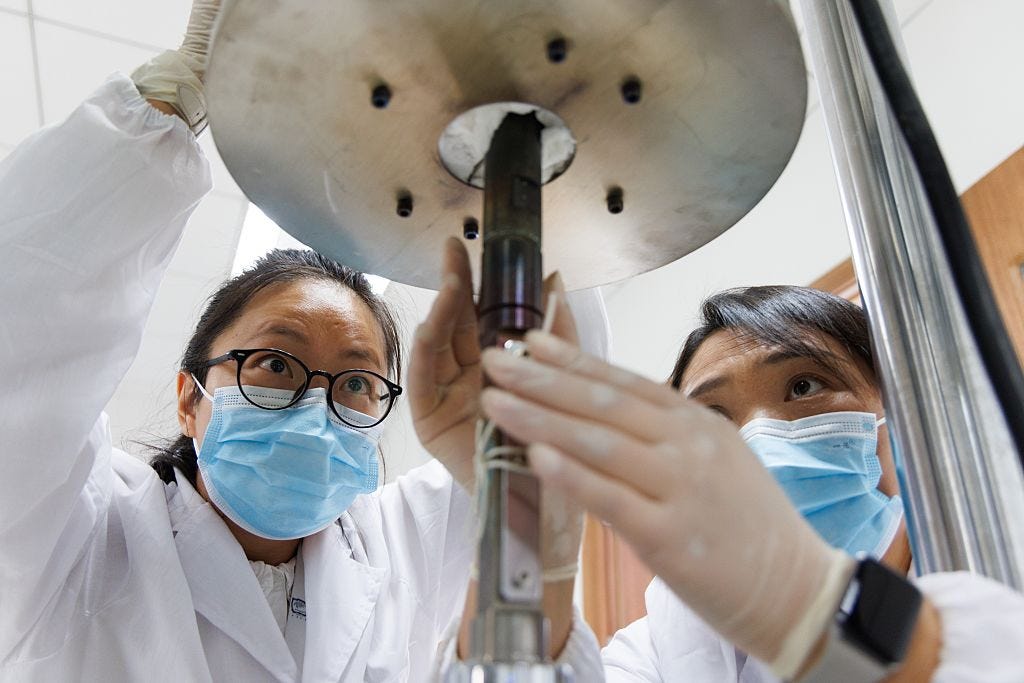
One of the centerpieces of this drive for energy security is a revolutionary nuclear technology pioneered by the United States at Oak Ridge National Laboratory: Molten Salt Reactors (MSRs). MSRs are a type of nuclear power plant that uses liquid, heated salt instead of water to cool the system. In most designs, the radioactive fuel is dissolved directly into this liquid salt, meaning the coolant and the fuel flow together as one mixture. This approach allows the reactor to operate at much lower, safer pressures than traditional water-cooled reactors while generating electricity more efficiently. America abandoned the program; China has since revived it. China is currently the only nation with an operational thorium-fueled MSR, the TMSR-LF1 project in Gansu province.
While these reactors are not yet ready for full commercialization, the national security implications of thorium MSRs are massive. Thorium is an abundant byproduct of Chinese mining operations; Beijing is largely able to bypass the global uranium market and onshore its supply chain for nuclear power. China has enough thorium to power itself for potentially thousands of years without relying on large inputs of unstable uranium.

MSRs have other benefits; they can be built anywhere. They do not require massive amounts of water for cooling or pressurized water systems. They can be deployed in the Gobi Desert, where TMSR-LF1 sits, or they can be deployed in mountain caves, safe from kinetic strikes in a conflict.
Finally, these reactors are orders of magnitude safer than uranium nuclear reactors. MSRs cannot “melt down” in the traditional sense; in a breach, the salt simply drains into a separate tank and solidifies. This passive safety system prevents MSRs from becoming liabilities in the event of a natural disaster.
China’s massive energy infrastructure build serves many purposes, but Beijing is explicit about its intentions with respect to AI. Beijing has codified a state-level effort called “Eastern Data, Western Computing.” The effort moves the energy and data centers to the western portion of the country, i.e. the deserts, caves, and mountains, while providing services to the eastern coastal cities. In China, the state coordinates the utility and the tech firm as a single national unit.
If China is able to scale modular reactors and data center builds to power AI while America allows partisan politics, permitting issues, and regulatory instability to stymie its energy goals, the U.S. lead in advanced chips may become irrelevant.
China currently dominates the entire supply chain of solar energy equipment exports and wind energy components. It is now racing to become the primary exporter of nuclear technology. If Beijing is able to commercialize MSRs and Small Modular Reactors (SMRs) first, they may be able to set the standards for the technology and corner the global market for critical energy infrastructure.
The military applications of China’s energy infrastructure are similarly seismic. Miniaturized MSRs can be used to power ships and submarines. These smaller MSRs could quadruple the endurance of nuclear powered vessels while increasing their safety and lowering their maintenance. Additionally, the Chinese are reportedly planning to deploy SMRs in the South China Sea to power the militarized islands they’ve been building there. This would protect them from supply chain disruptions caused by blockades and other sea lane closures in event of a conflict.
Beijing’s energy advantage is structural; centralized leadership allows the CCP to coordinate utilities, technology firms, and capital allocation to achieve its goals. The United States has no equivalent mechanism. America’s energy infrastructure relies on private investment, where capital flows towards stability and financial incentives. The United States is providing neither for green energy.
The United States has made acquiring and learning to produce high end chips a critical national security goal. Yet it is still blind to the next bottleneck: producing enough energy to power them. Securing high-end semiconductors and keeping them out of Beijing’s hands is a critical theater of competition, but it isn’t the only one. A million Blackwell chips are strategically irrelevant if you lack the domestic power capacity to run them.
The United States has for years struggled to build enough energy capacity. Energy companies and AI firms have been mired in regulatory gridlock and multi-year lead times for grid connections. American grids are managed by a patchwork of state-level authorities, often with different rules and regulations. The lack of cohesion makes cross-country transmission lines a minefield where cost-allocation disputes frequently derail energy projects essential to national security.
At the national level, Democrats and Republicans can’t agree on what the country should build. The result is chronic whiplash in incentives and regulatory structures, creating a hostile environment for long-term investment. America must find the political will to build domestic clean energy to reduce its reliance on global oil markets. The Iran war oil and gas shocks should be a wakeup call that this is unsustainable.
To his credit, President Trump signed four executive orders aimed at quadrupling U.S. nuclear capacity to 400 GW by 2050. The Department of Energy (DOE) established a program to have at least three advanced reactors operational by July 4, 2026—an ambitious goal it is unlikely to meet.
The administration has heavily prioritized portable nuclear solutions. In February 2026, the military conducted its first airlift of a 5-megawatt microreactor to Utah as part of a push to deploy localized power for data centers and military bases independent of the civilian grid. Despite these efforts, the current administration does not provide stability, which is a precondition for investments that will take years to pay off.
Energy is the ultimate precursor to all other forms of national strength: energy to power factories, energy to power military equipment, energy to power digital infrastructure, and now energy to power artificial intelligence in all its forms. China has recognized this reality and is meeting the moment; the United States must do the same before the gap becomes unbridgeable.
Shahn Louis is the founder of Anansi Strategic Intelligence LLC, a Washington, D.C.-based geopolitical risk firm. A former senior intelligence analyst with experience across the Department of Defense and the Intelligence Community, he specializes in China analysis and East Asian regional dynamics.
Follow Persuasion on X, Instagram, LinkedIn, and YouTube to keep up with our latest articles, podcasts, and events, as well as updates from excellent writers across our network.
And, to receive pieces like this in your inbox and support our work, subscribe below:
