

Blockading the Blockade Is Not as Insane as It Sounds
Putting economic pressure on Iran could work—provided it’s part of a genuine strategy.

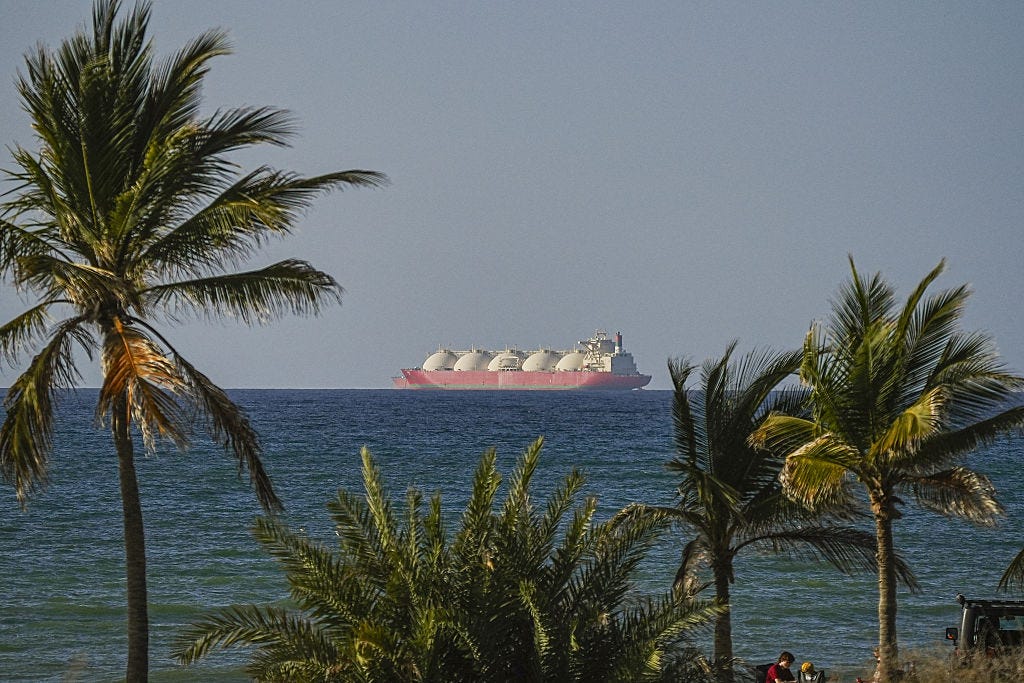
When the United States declared that it was going to start its own blockade of the Strait of Hormuz as a solution to the Iranian blockade, most commentators concluded that it is a very dangerous high stakes gamble, and some took it for just another symptom of the insanity that Washington has been exhibiting so profusely.
While there are ample reasons to find many of Donald Trump’s foreign policy moves objectionable, this might be the case where some refuse to see the logic simply because they no longer expect to see one. In reality, far from being random, the U.S. blockade of the Iranian blockade does in fact make sense—and what is more, it has the potential to solve the problem in a way that military means alone could not.
How Iran closed the Strait of Hormuz
Following the start of the U.S.-Iran war at the end of February, Iran first threatened to, and then actually did, close the Strait of Hormuz. Unlike closing land routes, where you can physically obstruct a narrow strip of land, closing the roughly 9km wide shipping lane requires a whole host of measures.
Iran achieved the desired result by declaring it had mined the strait and started collecting tolls—though the question of whether it was physically mined remains.
For context, Iran operates its own shipping corridor through Hormuz. This is used to export its oil, import goods, and allow transit to ships that paid for such passage. It stands to reason that this corridor has not been mined—they needed it unobstructed. Whatever mines Iran laid, they could not have touched the northern corridor running close to its own coast—the route via Larak Island.

Part of the international fairway (the route commercial shipping uses) runs along the Omani side of the strait, not the Iranian side. Mining it comprehensively would have required Iran to send minelaying vessels into waters approaching Oman’s territory in broad view of everybody when hostilities were already in full swing. It would be very difficult to imagine that the United States and allied surveillance would have missed it or, worse, allowed it. All we have to show for the mining activities is Iran’s word, and that’s not worth much these days.
Reports suggest that instead of vast minefields, a few dozen mines were laid in waters Iran could physically reach. Some reports indicate Iran even forgot to map the mines. As a result, all indications are that it was not the mines themselves that closed the Strait of Hormuz, but rather the idea of the mines and the impact the idea had on shipping insurance markets.
In effect, the vessels in the Persian Gulf are trapped there not because Iran does not let them pass through, but because of self-grounding—they are worried that they might not get through.
Don’t bullshit the bullshitter
The United States decided to call Iran’s bluff by sending two destroyers on a mine-clearance mission. On 11 April 2026, the USS Frank E. Petersen and USS Michael Murphy—two guided-missile destroyers—transited the Strait of Hormuz for the first time since the war began, operating in the Persian Gulf as part of what CENTCOM described as a mission to ensure the strait is fully clear of sea mines, before transiting back through to the Gulf of Oman. As expected, they transited the route without any damage, demonstrating there was a way through the strait.
However, for the ships to start using the fairway, more incentive was needed. And this is where the blockade of the blockade comes in. It is not intended to stop all traffic coming from the Persian Gulf; it is intended to stop the traffic coming from Iran or via Iran. Ships that transport oil from Iran would be stopped or turned back by the U.S. Navy, as would those that obtained permission from the Iranian side and paid tolls by calling at Larak. The vessels waiting in the Persian Gulf were thus given a choice—pay Iran a toll of up to two million dollars and then potentially be stopped by the U.S. Navy, or go past the Oman coastline and pay nothing.

An argument might be made that the United States would not be able to stop any Chinese ships since attacking Chinese vessels would constitute a serious escalation. However, information indicates that Rich Starry—a U.S.-sanctioned Chinese-owned tanker, formerly named Full Star and owned by Shanghai Xuanrun Shipping—turned back within minutes of approaching the chokepoint on 13 April 2026, the first day of the blockade. According to some reports it transited the following day, but it was not plain sailing.
Additionally, even if Chinese vessels are happy to pay Iran for the use of their fairway, there is no rational reason for other countries to do that if there is an alternative.
Starving the Guard
Alongside depriving Iran of any toll money and opening the shipping lanes, this move effects a complete economic blockade of Iran.
Over 90% of all imports and exports going in and out of Iran use the Strait of Hormuz. Whatever land routes they have via Pakistan and Turkmenistan cover only a small portion of goods, and railway capacity is insufficient for any meaningful transportation of crude oil. Iran does have one pipeline bypassing Hormuz entirely, the Goreh-Jask line, completed in 2021; however, its capacity is minuscule.
By cutting Iran off from its oil revenues and also from any imports it needs for domestic purposes, the United States is effecting a complete economic stranglehold. As Iran’s oil exports slow, its onshore storage fills up. With approximately thirteen days of spare capacity, Iran must then begin shutting its oil wells. Restarting them is technically demanding, expensive, and risks permanent oil well damage.
Based on accounts from Iranian commentators, the situation in Iran is increasingly unstable. The power conflict between the IRGC and more moderate elements is not imagined, although the Revolutionary Guard currently holds a monopoly on physical violence. This, however, can change if the economic situation deteriorates further—a position held by Pezeshkian’s moderate government, although it holds no visible power. There are already food shortages, cash machines have been out of order for months, and wages are going unpaid with increasing frequency. Unlike Russia, where unpaid wages are not sufficient cause for popular displeasure, Iranians are already unhappy. Suppressing popular dissent with a well-fed IRGC is one thing, but when your own guard starts grumbling, the regime becomes considerably less stable.
What the United States is trying to achieve
Washington may hold out for the maximum goal—regime change as a result of economic collapse—which might or might not happen. As is the way with revolutions, changes happen incrementally and then all at once. If the regime collapses, many will say they saw it coming. If it does not, they will say it was never going to fall. In any event, several revolutionary factors are already in place, the most important being popular dissent, the power struggle between hardline and moderate wings, and possible economic collapse, which operates differently in fractured societies than in cohesive ones. Iran is most certainly the former.
The alternative is to inflict economic pain and cut Iran off from its revenue, in hopes of forcing it to the negotiating table. What remains unclear, however, is who would negotiate from the Iranian side. As it stands, the power is in the hands of the IRGC, yet the only side willing to negotiate is the moderate government, as shown by the recent negotiations in Pakistan, where Iran was represented by Foreign Minister Abbas Araghchi and Parliament Speaker Mohammad Bagher Ghalibaf. Neither holds any authority over the IRGC commanders running the war. The problem is not only that the moderates lack a mandate, but that being seen to negotiate at all places them at personal risk. At the same time, their participation in negotiations might be an IRGC ploy. Diplomacy, it would seem, has its own minefields.
Unlike purely military pressure, this move gives Washington two possible outcomes. While achieving political goals with military means alone might not work, cutting the enemy off from its funds in addition to inflicting military losses could cause sufficient strife within the Iranian regime and force a result that seemed impossible before.
Whether Washington holds out for the full house or takes the bird in hand, the blockade gives it options. And not bad ones.
All of this, of course, is contingent on this being a deliberate strategy, and on Washington being able to stay the course.
Ines Burrell is a geopolitical analyst and political risk consultant based in the UK.
Follow Persuasion on X, Instagram, LinkedIn, and YouTube to keep up with our latest articles, podcasts, and events, as well as updates from excellent writers across our network.
And, to receive pieces like this in your inbox and support our work, subscribe below:
 | A guest post by
|
This was perhaps the most helpful account of the blockade that I have read. Thank you.
I agree with the assessment of the article. I just wish this had been part of the original American strategy, so we could believe that they are not flying by the seat of their pants.