

ICE Isn’t a Quick Fix for Airport Chaos
There's a deeper issue of trust.

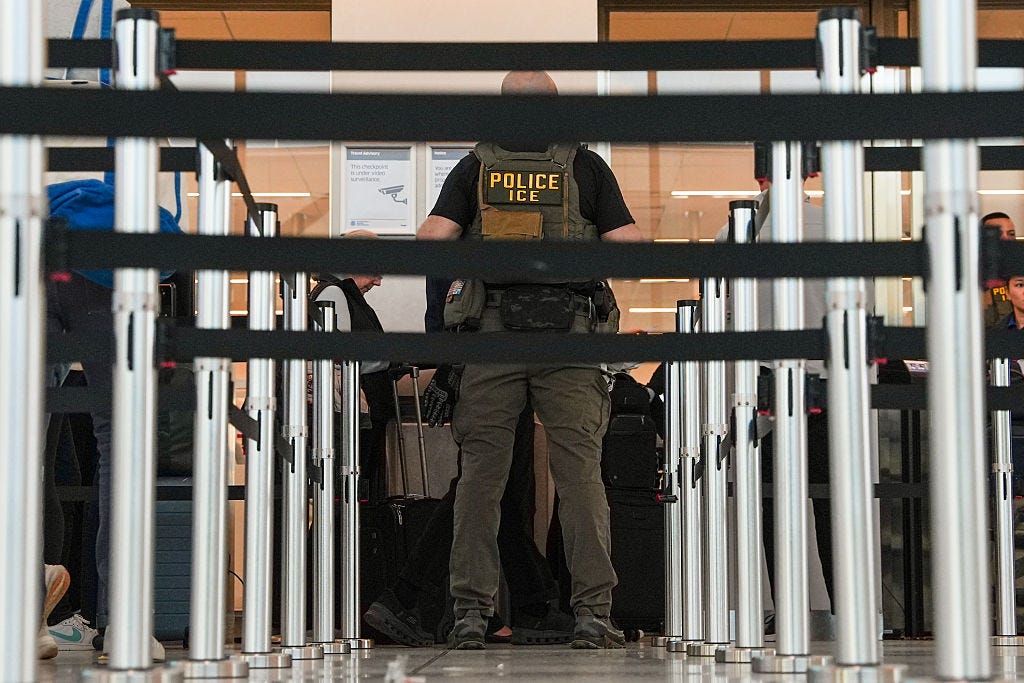
The Transportation Security Administration has one job. It is right there in the name: transportation security. Its purpose is not merely to screen bags and check IDs. It is to make a sprawling system of strangers, machines, procedures, and handoffs trustworthy enough that millions of people board planes without thinking twice.
For years, that trust has been thin. You do not need to follow GAO reports—which have raised serious concerns about the efficacy of some TSA protocols, equipment, and behavioral monitoring—to sense the problem. Travelers feel it at the checkpoint: inconsistent instructions, rituals whose connection to actual safety is far from obvious, irritated TSA agents projecting more contempt than concern for the traveling public. Airport satire works because it seems all too familiar. And it’s that experience that makes it harder for the public to see the TSA as a trust-generating institution devoted to the job of transportation security.
That is what made border czar Tom Homan’s recent comments about ICE’s deployment to American airports so revealing. “I don’t see an ICE agent looking at an X-ray machine, because we’re not trained in that,” he said. The problem was not merely that officials contradicted one another about what ICE would do. In a space where trust was already thin, confusion about who is trained for the core job is itself corrosive. It tells travelers that the government is improvising around a role that ought to be clear, disciplined, and fit for purpose.
The scramble to send ICE to America’s airports began on February 14, when members of Congress clashed over funding for immigration enforcement in the wake of Operation Metro Surge in Minneapolis. That deadlock led to a partial shutdown of the Department of Homeland Security, including the TSA. Because TSA screening is considered essential, TSA officers have had to stay on the job without pay, even as the shutdown drags on.
Across the country, more than 450 TSA officers have quit, while daily callout rates have risen from about 4% before the shutdown to 11%. And as spring break travel surged, passengers waited in hours-long lines, missed flights, and saw firsthand a system visibly struggling to maintain basic levels of service.
Within a few days of deploying ICE agents at airports, the division of labor had been clarified. ICE would handle checkpoint support—guarding exits, helping manage lines, checking some IDs—not the specialized screening work of TSA officers. But the political uncertainty only escalated. Last Friday, the Senate approved a bill to restore funding for TSA and most of the DHS. Later the same day, House Republicans angrily rejected the measure because it withheld funding for ICE and immigration operations.
An executive order signed by the president may provide TSA workers relief as early as today, but uncertainty remains, bringing an even larger question to the fore: Will ICE’s airport presence fade when the TSA’s funding is restored, or has an improvised substitute already become a normalized presence at the checkpoint? That is the pattern to watch. Just yesterday, Homan suggested that ICE agents could remain at airports even after TSA workers get paid.
Crises like this invite an expedient workaround. But what happens when that workaround becomes the new normal?
Free societies depend on institutions that reduce the trust burden of dealing with strangers. The work of political economist Elinor Ostrom reminds us that institutions earn legitimacy not by projecting authority, but by aligning rules, roles, and incentives with the problem they are meant to solve. When an institution is fit for purpose, people can see it. They may not love every inconvenience it imposes, but they can tell that it is organized around solving a real shared problem. That legibility is part of what makes trust possible.

Among Ostrom’s keener insights is that many of the good things that free societies offer are co-produced. She argued, for example, that effective policing depends not only on what police do, but on whether the public perceives them as legitimate enough to cooperate, comply, and share responsibility for public order. So too with transportation security. Safe passage is not delivered to travelers by force from above. It is co-produced through a relationship in which travelers submit to security procedures because they trust that the rules, the agents, and the institution itself are oriented toward a shared end. Once that trust begins to break down, the system does not simply become more irritating. It becomes harder to sustain as a cooperative enterprise.
That is the standard by which the ICE substitution should be judged. The question is not simply whether ICE can fill a few operational gaps. It is whether an agency identified with immigration enforcement can sustain the kind of voluntary confidence and cooperation on which transportation security depends.
And the answer is: probably not. ICE is a poor substitute not only because its mission is immigration enforcement rather than transportation security, but because it carries a trust deficit of its own. In Minneapolis, it became clear that ICE’s professional posture is optimized around demonstrating state power and demanding submission, not earning the public’s trust. We remember the killings of Renee Good and Alex Pretti. We remember seeing people arrested while going to church, picking up kids at school, and showing up at appointed court hearings.
Even if its airport role is officially limited to support functions, ICE’s presence tells travelers that the government is patching over a failure, not restoring the integrity of transportation safety. In a space where trust was already thin, that kind of improvisation erodes even further the trust upon which a successful co-production dynamic rests.
That is the deeper cost of institutional improvisation. Free societies work because people can move through complex systems without having to inspect every handoff for themselves. Regulation earns its keep when—and only when—it inspires that kind of confidence in people. When government answers a failure of transportation security with a poorly-suited substitute, it does more than create confusion at the checkpoint. It teaches the public that the institution is no longer secure in its own purpose. And once that confidence starts to erode, the freedom to move about the world feels less and less secure.
Emily Chamlee-Wright is the president and CEO of the Institute for Humane Studies.
Follow Persuasion on X, Instagram, LinkedIn, and YouTube to keep up with our latest articles, podcasts, and events, as well as updates from excellent writers across our network.
And, to receive pieces like this in your inbox and support our work, subscribe below:
 | A guest post by
|
I flew out of LGA this morning, and there were ICE agents at the checkpoints. I was skeptical, and it was certainly alarming to see agents in tactical gear. However, they went out of their way to be friendly, make jokes, engage the people in line, etc. That doesn’t take away from many of your points, but I was pleasantly surprised and it was a good reminder that, for the most part, the agents are just people trying to do their jobs like the rest of us.
It's my impression that putting ICE on airport duty has changed the narrative about ICE and made them seem like pretty ordinary law enforcement officers. I agree that I'd prefer a compromise be reached and TSA to be paid in normal fashion, but this seems to have changed ICE's public image to some extent.