

Green Shoots Amid the Third Wave of Democratic Backsliding
What we can learn from the countries where autocracies are on the back foot. (Part 1 of 2.)

This article is brought to you by American Purpose, the magazine and community founded by Francis Fukuyama in 2020, which is proudly part of the Persuasion family.
The last half century has seen the greatest reversal in the prospects for democracy in the world since the modern experiment in democracy was initiated 250 years ago by the American Revolution.
During the last quarter of the twentieth century, democracy expanded more than ever before, with the number of democracies in the world more than doubling from under 30 percent of all countries to over 60 percent. Samuel P. Huntington famously called this the “Third Wave of Democratization,” succeeding two earlier waves triggered by the American Revolution and the Second World War. Huntington saw five drivers of the third wave—a legitimacy crisis in many authoritarian countries; rapid economic development that raised education levels and the size of the middle class; the liberalization of Catholic doctrine following the Second Vatican Council, which made the Church a pivotal defender of democratic rights throughout most of Latin America, as well as in Poland, the Philippines, and other Catholic-majority countries; a greater role by external actors in promoting democracy, above all the United States and the then-European Community; and the contagious effect of democratic breakthroughs that Huntington called “snowballing.”
Huntington’s wave theory of democratization included the understanding that the consolidation of a democratic system after a period of dictatorship is a difficult process, and that some of the newly democratic countries might revert to autocratic rule in what he called a likely “reverse wave.” He noted that each of the preceding democratic waves had been followed by such a reversal, the first in the 1920s and 30s with the rise of fascist and communist totalitarianism, and the second from the late 1950s to mid-1970s when many newly independent or democratic nations fell to military or executive coups.
Although he couldn’t discern the nature and scope of another democratic reversal, he saw many possible reasons it could happen, among them governance and economic failures, a process of “reverse snowballing” if a number of new democracies shifted back to dictatorship, the weakening of democracy in many countries if a major nondemocratic state greatly increased its power (he mentioned China in this context), and the rise of various forms of authoritarianism in response to changing political and social conditions, from militant nationalism to religious fundamentalism to virulent populism.
A third reverse wave did, in fact, begin at the start of this century, spurred by the 9/11 attack on the United States and the growing threat of terrorism that led many governments to take security measures curtailing individual liberties. Other developments that fueled the crisis and steady decline of democracy included the backlash against the U.S. intervention in Iraq; the Orange Revolution in Ukraine in 2004 that led the Putin government in Russia—followed by many other governments—to pass laws tightening controls on NGOs and international democracy funding; the global financial crisis in 2008 that shook the confidence of U.S. and other Western leaders; the geopolitical resurgence of authoritarianism led by Russia and China; the backsliding of many new democracies; and the rise of illiberal democracy and populism in many established democracies, including the United States. Freedom House has charted 20 consecutive years of declining political and civil liberties in the world as a result of these developments, and the Swedish democracy-monitoring group V-Dem says that this reversal has “wiped out” all the advances in global levels of democracy that were made over the last 35 years.
This third reverse wave is especially worrying for three reasons. First, it’s more protracted than the earlier reverse waves, with V-Dem noting that the current “wave of autocratization has been going on for at least 25 years and shows no signs of cresting.” It has also raised doubts for the first time about the durability of long-established liberal democracies in the West, including the United States, where illiberal populism has made significant gains. Finally, while the United States has been the leader of efforts to defend and advance democracy globally since President Ronald Reagan gave his Westminster Address to the British Parliament in 1982—in which he called for the creation of the National Endowment for Democracy (NED)—it has now abandoned democracy promotion and is dismantling, or trying to dismantle, all the soft-power institutions that have been the bedrock of American assistance to people abroad striving to build democratic societies. It is therefore reasonable to ask if the fight to advance democracy in the world is doomed, or whether there’s a way for this effort to continue in the absence of support from the U.S. government.
The fight is certainly more difficult than it’s ever been since the end of the Cold War, and there has already been a pronounced democratic regression, as we have seen. But it’s crucial to stress that the battle for democracy has by no means ended, even if the U.S. government no longer supports it.

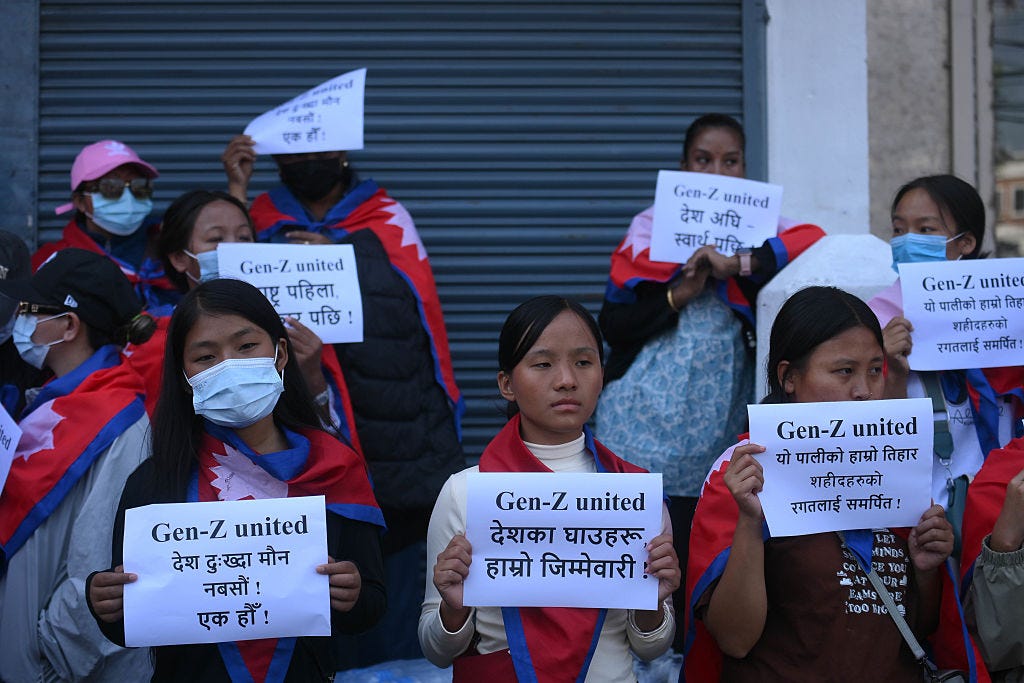
During the past year, for example, Gen Z youth-led protests erupted against corruption, economic distress, and ineffective government in Nepal, Peru, and Madagascar where the governments fell, as well as in Indonesia, Morocco, Kenya, and the Philippines. The protests followed upon earlier youth-led uprisings that toppled corrupt and abusive governments in Sri Lanka in 2022 and Bangladesh in 2024. Different issues sparked the outrage that led to these uprisings—a social media ban in Nepal, intense anger in Indonesia when MPs were given a housing allowance ten times the minimum wage, crime and corruption in Peru, poverty and police brutality in Kenya, water and electricity failures in Madagascar, and the embezzlement of $17.6 billion in the Philippines that was designated for flood relief projects. In Morocco crowds took to the streets chanting “No World Cup, health comes first,” having been galvanized by the deaths of eight women in an abysmal maternity ward in the city of Agadir at a time when the government was spending over $5 billion in preparation to co-host the World Cup in 2030.
Already, these movements have strengthened citizens’ rights and government accountability. The Atlantic Council has reported that because of such citizen pressure, six of the seven countries where these protests occurred score well above their respective regional averages in an index that measures the protection of civil and political rights. Erica Chenoweth has argued that the Gen Z protests, which are mostly leaderless and decentralized, could be an antidote to global democratic backsliding if they develop the capacity to channel their momentum and influence into formal institutional politics.
A different arena of contestation pits Russia, Iran, and China—the world’s three leading autocracies—against three smaller countries whose existence they threaten: respectively, Ukraine, Israel, and Taiwan. Jaroslav Kuisz and Karolina Wigura have written that the preservation of the sovereignty of each of these smaller countries is “a matter of global significance.” If that sovereignty collapses or is significantly eroded in any of these three countries, they note, it would have profound implications, not just for international law, alliance credibility, and what is left of the post-1945 liberal international order, but for the security of Western Europe, the Middle East, and the Indo-Pacific—and therefore for the United States as well.

For obvious reasons, democracy is not the paramount issue for Ukraine, Israel, and Taiwan—sovereignty is. Still, it is important to note the extraordinary political impact that the wars being fought by Israel and Ukraine have already had. Israel did not retaliate against the October 7 attack by Hamas and go to war against Hezbollah and Iran for the purpose of creating conditions for political change in neighboring countries. But a by-product of the fighting, Robert Lerman has argued, has been the creation of “the space necessary for the transformation of the region.” Its severe weakening of both Hezbollah and Iran contributed significantly to the fall of the murderous Assad regime in Syria following a devastating civil war in which 580,000 people were killed. The long process of recovery in Syria has now begun under a new government that has been able to unlock over $28 billion of investment and international reconstruction aid, in addition to encouraging the return of millions of refugees, beginning the difficult process of building a stable and ethnically integrated country, and becoming part of a new coalition to stabilize the region.
In Lebanon, Israel’s degradation of Hezbollah’s leadership and military capability ended a political deadlock that made possible the election of a new government committed to restoring state authority, disarming Hezbollah (which retains significant influence), and making reforms needed to attract aid and investment to rebuild the country. Not least, the dramatic blows that Israel delivered against Iran starting in October 2024 weakened the Islamic Republic’s military capability and political legitimacy, setting the stage for the current joint attack by Israel and the United States. While the outcome still remains uncertain, Saudi pressure on Trump to stay the course against the Islamic Republic could lead to the epochal fall of an odious regime that murdered tens of thousands of protesters in January and poses a grave threat to regional stability.
Putin’s rule in Russia has also become more precarious as a result of his disastrous aggression in Ukraine. Stephen Kotkin has argued that the survival of authoritarian regimes is always uncertain because they suffer from a “debilitating incapacity” stemming from overreach and corruption. Putin has emphatically demonstrated that incapacity. The so-called special military operation that was supposed to have conquered Ukraine in weeks if not days has now entered its fifth year due to the entirely unanticipated Ukrainian resistance. As documented in a new report by the Center for Strategic and International Studies, “Russia is paying an extraordinary price for minimal gains” in Ukraine, and popular support for the war has significantly declined. Russia’s economy is suffering from unsustainable war spending, major labor shortages, growing inflation, and a shrinking sovereign wealth fund that has been cut by more than half to cover budget deficits and war costs. Alexandra Prokopenko writes in The Economist that “Russia’s economy has entered the death zone.” It’s also extraordinary that 325,000 Russian soldiers have been killed in the four years of war, a number that exceeds by nearly 22 times the losses suffered by the Soviet Union in its decade of war in Afghanistan. As Putin well knows, it was Moscow’s debilitating failure in Afghanistan that precipitated the collapse of the Soviet Union, which he called “the greatest geopolitical catastrophe” of the last century. The consequences of Russia’s even more costly failure in Ukraine will inevitably affect the stability and legitimacy of Putin’s regime.
The Xi regime in China has not yet acted on its threat to attack Taiwan, but it, too, has grave vulnerabilities. Its core weakness is economic stagnation, which constitutes a serious threat to the stability of the regime. This danger was foreseen by the late Communist Party general secretary Hu Yaobang, who was removed from power in 1987 for warning that unless the country’s economic modernization was accompanied by reform and democracy, it would lead to political convulsions. Ironically, it was the outpouring of public mourning for Hu following his death in 1989 that morphed into the freedom protests that erupted in Beijing and 400 other cities across China. Those protests were crushed, but the aspiration in China for a more open society endures, along with the regime’s resistance to reform and opening.
Conditions in China today are far more volatile than they appear, and another political convulsion like Tiananmen Square is not unthinkable. The current economic slowdown has been accompanied by a surge of strikes by workers protesting against unpaid wages, excessive and uncompensated overtime, and poor working conditions. The underground house church movement has also surged to over 100 million Christian believers who are resisting the communist dictatorship’s interference in their worship. In addition, political resistance erupted in 2022 against the draconian zero-COVID lockdown in the form of the White Paper Protests, the most significant revolt since Tiananmen Square. The uprising occurred just a month after a dissident named Peng Lifa, later called the “Bridge Man,” hung banners from a busy overpass in Beijing with slogans reading “We don’t want lockdowns, we want freedom,” “We don’t want lies, we want dignity,” and “We don’t want to be slaves, we want to be citizens.” He was immediately arrested, but his demonstration set off solidarity rallies in 31 Chinese cities and at over 350 universities around the world, and the subsequent White Paper Protests broke out in over 50 cities across China, forcing the regime to call off its zero-COVID policy.
That wasn’t all. When people trying to break the regime’s tight censorship sent videos of the demonstrations to an overseas Twitter account named “Teacher Li Is Not Your Teacher,” the account’s manager, a Chinese art student in Italy named Li Yeng, posted the videos for the whole world to see, including tech savvy people in China using VPNs. The number of his followers quickly jumped to 1.6 million, and he became what Yaqiu Wang of Freedom House called “the aggregator” of independent and often politically sensitive information, something that is “very scary to the authorities … he has a kind of power that nobody else has had in the past.” According to the organization Human Rights in China, initiatives linked to Li now advance public-interest projects on worker exploitation, youth unemployment, and freedom of expression. It believes that digital activism in China is now capable of “challenging the #CCP’s Panopticon.”
This brief survey of some of the battles that are taking place today to expand rights, fight corrupt and unaccountable governments, and resist the aggression and arbitrary power of the world’s leading autocracies, shows that there are significant opportunities to make democratic gains despite the sustained reverse wave. In addition to promoting such openings, pro-democracy governments and nongovernmental groups need to respond to the increased strategic collaboration of the world’s leading autocracies.
Carl Gershman retired in 2021 after 37 years as the founding president of the National Endowment for Democracy (NED), where he oversaw the NED’s grants programs in Russia, China and some 100 other countries.
Follow Persuasion on X, Instagram, LinkedIn, and YouTube to keep up with our latest articles, podcasts, and events, as well as updates from excellent writers across our network.
And, to receive pieces like this in your inbox and support our work, subscribe below:
I read this with guarded optimism but also with trepidation. The fact that the US is among the backsliders is a worrisome indication of the uncertainty and the fragility of the democratic experiment which we ourselves began in 1789.
The democratic movement is the most extraordinary, the most crucial, the riskiest, and the most complex ongoing experiment in human society and government ever attempted. It requires a level of constant understanding and maintenance that too many Americans are now showing themselves ible of sustaining in the midst of the rigors of modern, industrial and technological life.
If we, the founders of the modern movement cannot sustain our own invention, created in a land of unparalleled bounty and protected by two vast oceans, then how can we expect others to do so in places far more proximate to dangerous neighbors.