

How The New Yorker Became Irrelevant
On the decline of America's premier magazine.

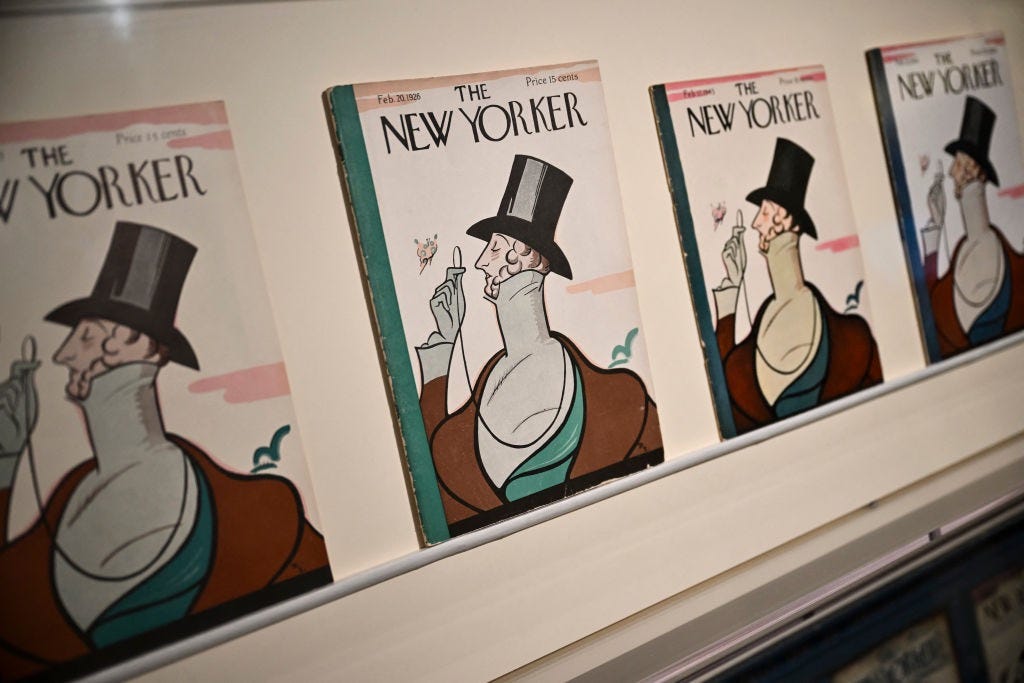
As that bon vivant Eustace Tilley might have put it, The New Yorker was recently spotted in an unlikely locale—on Substack. In a jaunty little note, the storied magazine declared, “Yep, we’re on Substack toö. Your favorite hundred year-old magazine is crashing the party.” And the reaction on the platform was… a bit different from what might have been expected. “Oh FUCK OFF please,” wrote one user in a comment that was liked over 100 times. “Who actually reads and enjoys this?” wrote another. “More and more the NYer feels like an artifact, no longer relevant to our time,” wrote The Literarian Gazette. “They’re not even sure what they do anymore,” wrote the essayist Jacob Savage.
The problem, really, was about register—and seemed to be entirely lost on The New Yorker. It was exactly as if your mother, who had abandoned you as a child to run off with the general manager of a golf club, had now returned to the neighborhood and wanted to be your best friend. The New Yorker—it’s absolutely true—is just about everybody’s favorite hundred-year-old magazine. It has a reputation for combining fun and sophistication that is unparalleled, and the magazine inspires a certain loyalty that is unimaginable in virtually any other publication. Ben Yagoda, in his magisterial history About Town: The New Yorker and the World It Made, opens with the anecdote of a nurse speaking to a dying soldier at the end of World War II and discovering that what he really wanted to talk about, most of all, was The New Yorker. That example, if extreme, is representative. In over seven hundred responses Yagoda received from a survey, the overwhelming sensibility was that The New Yorker was part of the deep structure of everybody’s intellectual life—respondents decorated their houses in New Yorker covers, spent decades trying to win the caption contest, described themselves as being “nourished” by The New Yorker or having their sense of humor “created” by The New Yorker.
And at 100, The New Yorker is barely showing its age. It is venerable, storied, indestructible, but has the same saucy tone of your very brightest child about to put on a living room extravaganza. Which is exactly the problem.
The New Yorker didn’t have quite the effortless path to success that everybody sort of assumes it did. It was founded, as Yagoda writes, “on champagne vapor”—an offshoot of the Algonquin Round Table, with the seed capital put up by the editor’s poker buddy and, for a while, it was, by all accounts, terrible. The blog My Life 100 Years Ago helpfully reads through the first issue—the racist cartoons, the sophomoric jokes—and, out of many candidates, settles on the following line as the single most boring from the gossip section: “Jerome (‘Jerry’) D. Kern was in town one day buying some second-hand books.” The kind of permanent souvenir of that time is the image of “Eustace Tilley,” the fictional monocled dandy who has been the logo of The New Yorker from that day to this. Tilley was meant to poke fun at other serious-seeming literary magazines of the day, but there was always the danger that the accusation could land on The New Yorker itself—that it was an extension of what the critic Edmund Wilson called the class of “people who had been taught a certain kind of gentility, who had played the same games and read the same children’s books—all of which they were now able to mock from a level of New York sophistication.”
Based on its early years, there was no particular reason to ever think that The New Yorker would outgrow the specter of Eustace Tilley. There was very little serious journalism, the short stories were basically glorified scene pieces, and the aroma of the student lounge clung to everything. But then, at some point in the 1930s, the miracle happened. A new group of streetwise writers, most famously Joseph Mitchell and A.J. Liebling, found their way into the magazine and introduced a grit and seriousness that had been utterly lacking in the frothy early years. To Yagoda, the magazine actually reached its peak in the ‘30s, but other accounts put the turning-point a little further forward—to the decision, in 1946, to turn the entire issue over to John Hersey’s searing account of the destruction of Hiroshima; or to the publication of J.D. Salinger’s short story “A Perfect Day for Bananafish” in 1948, which launched Salinger’s career and vaulted The New Yorker’s fiction department beyond the scene-y pieces of an earlier era.

I teach a journalism class, and when I do I seem to always find myself back in this same moment in time—when, in Yagoda’s framing, “lowlife [was] ascendant.” The new generation of writers worked hard to get beyond Eustace Tilley. “We were thinking about the best way we could write about the city without all the literary framework,” Mitchell recalled, and what they came up with transformed journalism forever. In 1942, Mitchell published a piece called “Professor Sea Gull” about a “Bowery Bum” named Joe Gould. It opens, “Joe Gould is a jaunty and emaciated little man who has been a notable in the cafeterias, diners, barrooms, and dumps for a quarter of a century.” The challenge for me teaching this piece is that it’s always difficult not to get a little misty with the idea of what the piece represents—that anybody is interesting, that, in the higher order of things, anybody is worthy of a New Yorker profile, that if you look and listen in the right way you find that any homeless person you pass on the street is worthy of a full book (or, in a way, of the entire career that Mitchell devoted to Gould).
As I continue with the course, I make my way through a greatest hits of other New Yorker pieces—all of them espousing the same virtues. There’s Alex Prud’Homme’s “Albert Yeganeh: The Man Behind the Soups,” the basis for the Seinfeld “Soup Nazi” episode in which the reader is perfectly on the knife’s edge between seeing Yeganeh as crazy, as a big city amusement, and understanding that his madness is a form of perfectionism worthy of any artist. There’s Ian Frazier’s “My Son Is The Naked Cowboy,” in which Frazier sits next to the father of the Times Square street attraction famous for wandering the city in his underwear and just lets him talk and it turns out—I have to be on my guard against mistiness here too—that the naked cowboy’s father is just really, really proud of him for having found his way in life. And there’s a tireless Good Samaritan who knocks on the windows of idling vehicles and asks them to turn off the engine to help the environment—and is, as often as not, flipped off or screamed at for his trouble. And there’s A.J. Liebling’s wartime obsession with “Mollie,” a Times Square busboy who somehow captured 600 Italian soldiers singlehandedly, and on and on it goes.
But something peculiar happens when I look at the more recent catalog. There’s a piece on “The Many Stages of Cynthia Nixon.” And one on how “Chloe Zhao Has Looked Into the Void.” And on how “Sarah Sherman Is Grosser Than You Think.” And on how “Mikie Sherill Intends To Move Fast.” And I have to scroll a long, long way, in other words, to find an article about somebody who has never appeared on HBO or has not been elected to office. Joe Gould—and the Naked Cowboy’s father and Albert Yeganeh driving himself to ever greater heights to perfect his soups—are all a long way away.
And the same goes if I start flipping around in the other sections—everywhere there’s the same overpowering sense that The New Yorker, which more or less invented profile writing and championed a very particular curious and irreverent sensibility, is no longer for or about anybody you know. The articles I’ve mentioned would all look perfectly at home if they were published instead in Vanity Fair. The sensibility is that it’s meant to be about people who’ve arrived—it’s something like Puck with a hundred-year head start. And, as The New Yorker, with all due fanfare and stentoriousness, celebrates its first century, it’s become clear also that it’s no longer really The New Yorker—the logo is there and the covers and cartoons are there, but the spirit that animated The New Yorker throughout its long golden era is finally gone.
This isn’t the first time that the more magpie-ish among us have claimed that The New Yorker has lost its way. Yagoda concedes that by the ‘70s or ‘80s The New Yorker was a “creepy place”—one aspiring editor, for his first assignment, found himself taking dictation from an old racing reporter who phoned in stories from his hospital bed about wholly imaginary horse races. An attempted takeover by Warren Buffett was stymied by the stratagem of setting up Buffett with the magazine’s longtime editor, at which point Buffett saw what he was up against and promptly divested his stock. In 1986, a book-length parody of The New Yorker appeared entitled Snooze. As far back as 1999, the writer and former New Yorker staffer Renata Adler declared, “As I write this, The New Yorker is dead.”
The usual story from this point is that after a period of ownership and editorial changes, The New Yorker found stability under editor David Remnick, who led the magazine into a new golden age. The internet presented an existential challenge, as it did to all print publications, but The New Yorker managed the transition better than most, with a robust online publication complementary to the print magazine, as well as podcast and video content. “The New Yorker has not only adapted to the digital age but thrived in it,” reported The Conversation earlier this year. In an interview for the Netflix documentary The New Yorker at 100, Remnick said simply, “The New Yorker is a miracle, ok?”
That’s the usual story. My contention is that The New Yorker has lost its soul, is now virtually interchangeable with a number of other publications, and is—spiritually speaking—in something like terminal decline, just another gilded gargoyle on the cathedral of polite thinking. Those are unprovable statements and whether you agree with them or not depends on your reading sensibility, but let’s consider a few areas of striking weakness.
In its fiction, The New Yorker was famous above all for launching the careers of writers. J.D. Salinger, John Updike, John O’Hara, John Cheever, James Thurber, E. B. White, Ann Beattie, among many, many others, got their real breaks through The New Yorker. There’s a sort of iconic story of literary persistence in which Beattie, then a college instructor, sent a submission to The New Yorker. An assistant pulled it out of the slush pile. Roger Angell, the chief fiction editor, sent a note to Beattie asking her to send future submissions to him directly. He passed on the next 13 stories she sent him, but when Angell finally bought one, he couldn’t have been happier if he had written it himself: “I think this is just about the best news of the year,” he wrote to Beattie. “There is nothing that gives me more pleasure than at last sending an enthusiastic yes to a writer who has persisted through as many rejections and rebuffs as you have.”

It’s a heart-warming story, but it could not happen now. Bill Buford, who was The New Yorker’s fiction editor for eight years, admitted that he hadn’t taken a single story from slush during that time, and Deborah Treisman, the current fiction editor, appears not to have either. That wouldn’t be particularly a big deal—lots of magazines limit submissions to “agent enquiries only”—except that The New Yorker keeps an open inbox and promises to read “all submissions within 90 days.” In other words, it is still masquerading as the magazine that discovered Beattie and profiled Gould, but in fact the real path to entry is to already be a part of whatever club Eustace Tilley is a member of. Even apart from the evident dishonesty in its policy, what The New Yorker’s down-portcullis approach seems to have done is to produce a stale, safe, walled garden of forgettable fiction. In a somewhat embarrassing moment in The New Yorker at 100, Treisman, in an editorial meeting, complains that one story under consideration is “right on that borderline of being like ten other stories,” to which her fellow editor less-than-ringingly responds, “I’d be borderline in favor.”
The same criticism goes for the Shouts & Murmurs section, which can feel like a roundtable of all of Eustace Tilley’s most toffish friends complaining about their imaginary problems. (The article “This Bowl Has One Hundred Grams of Protein,” on the website front page at the time of publication, can stand in for all the rest—unless you feel that “So You Want to Come to My New Vinyl-Listening Bar” covers it better.) And for the profiles, which have turned into frothy celebrity-bait. And for the attempts to connect with the American heartland in the Trump era, which often are embarrassingly tone-deaf. (In the documentary, staff writer Andrew Marantz concedes that The New Yorker’s haters may have a point when they accuse The New Yorker of being “elitist motherfuckers” and the magazine’s editorial department then carefully adds an accent aigu over the “e” in “élitist.”) And same goes for many of the reviews, which have become so predictable in their superior moralism that Charlie Kaufman dedicated an entire novel, Antkind, to parodying the movie critic Richard Brody’s wokey sententiousness.
When you start to take all that away, there’s not much left. Yes, The New Yorker has had some astonishing successes in the Remnick era—Ronan Farrow’s piece on Harvey Weinstein did a great deal to topple Weinstein and to spark the #MeToo movement; Luke Mogelson has had a gift for popping up everywhere from a trench to the Donbas to the mob storming the Capitol in 2021. But try to think of the last time The New Yorker has broken a story or captured the discourse in a way that used to be routine for them—and my guess is that you’ll find yourself thinking for quite some time.
The reasons The New Yorker may have struggled in the 21st century are certainly not entirely their fault. The landscape of journalism is very different. “Stories” are being broken all the time in social media posts; a “talk of the town” is hardly needed to generate gossip. A publication like The New Yorker is, very often, reduced to commentary on subjects that everybody else already has opinions about. And in that commentary there is an unmistakable tendency to just wish all the problems of the contemporary world away, to pretend that it is still 1925 and the only people one really needs to hear from are those in one’s club. (In one of The New Yorker’s earliest successful gags, the workers down an open manhole are discussing who and who isn’t a Whitney—talking exactly like high society would talk—and it can feel as if that actually is the heart of the publication: Eustace Tilley’s recurring fantasy that everybody else in the city and country actually turns out to be exactly like him.)
The New Yorker at 100 gives yet another glimpse of how this smugness plays out. Remnick, in an attempt to blow the dust away, has a meeting where he asks a group of the paper’s old guard what New Yorker traditions have outlived their time, and then he brings up the question of voice. “One subject that has come up for decades and decades is the following: I’m worried that I won’t be able to write in my voice,” Remnick says but gets no further than that. “When I have very occasionally had that experience, it’s ‘cause they’re bad writers,” one of the editors responds. At which point the room erupts in a chorus of Eustace Tilley-ish chuckles, and the issue, presumably, is laid to rest for another hundred years. And never mind that some of those bad writers who have complained are E. B. White, Louise Bogan, John O’Hara, Kay Boyle, Irwin Shaw, Edmund Wilson, Rumer Godden, Roald Dahl, Elizabeth Bishop, Tom Wolfe, and Renata Adler (Dahl, for instance, claimed the magazine’s edits made him vow to give up writing and become a bookie instead); and never mind that some of the writers The New Yorker has managed to reject, in what Yagoda calls “a grim anthology,” include Kurt Vonnegut, Flannery O’Connor, Jack Kerouac, Joseph Heller, Gertrude Stein, and Thomas Pynchon.
The point that Eustace Tilley might make, peering extra intently through his monocle, is that The New Yorker, my dear, has always been snobby. Actually, the snobbishness precedes the magazine itself. “The New Yorker will be the magazine which is not edited for the old lady in Dubuque,” its 1924 prospectus declared. (This, by the way, produced one of the better counter-offensives in literary history when an extremely erudite and cultured old lady from Dubuque showed up in New York in 1964 and gracefully did the rounds of the talk shows.) And, yes, it’s true that The New Yorker is proudly sophisticated. But sophistication and snootiness are very different—at its best, The New Yorker is always rooting for the little guy, its writers perfectly willing to chuck everything and wander around the city with Joe Gould. Or, as David Remnick put it in the documentary, “I want it to be great [and] I want it to be humane.”
It’s that sense of the humane that goes missing in the endless welter of celebrity profiles and smug cultural commentary—and, without it, The New Yorker loses all capacity to be great, no matter how assiduously they fact-check or how many rewrites they put their writers through. And that means that, when The New Yorker half-heartedly decides to leave its ivory tower and rub shoulders with the people for a bit, the people just aren’t really having it—any more than The New Yorker could expect the guys down the manholes to actually be discussing the pedigree of the Whitneys. The balance that the magazine has had to strike has always been razor-thin, but for it to work—this was what Mitchell and Liebling discovered in the ‘30s—you have to actually go down into the manholes and hear what, in New Yorker parlance, the “lowlifes” have to say. If you don’t do that, it’s just the ghost of Eustace Tilley goofing around with all of his monocled friends.
Sam Kahn is associate editor at Persuasion, writes the Substack Castalia, and edits The Republic of Letters.
Follow Persuasion on X, Instagram, LinkedIn, and YouTube to keep up with our latest articles, podcasts, and events, as well as updates from excellent writers across our network.
And, to receive pieces like this in your inbox and support our work, subscribe below:
Perhaps it becomes difficult to continue to be a cultural gatekeeper and maintain a distinctive edge when a medium you popularize is adopted by other publications? There are several recent examples of the NYer's exceptionality. Aviv's profile of Munro was a piece the few other venues could publish. A major investigative piece about the Letby investigation triggered controversy in the UK. It also was one of the first to publish an excerpt from this year's Booker winner. I disagree with Kahn that the NYer is irrelevant. In some ways it is a victim of its own success and in others it is nearly impossible to continue to standout when publication becomes democratized. I am a regular reader of the NYer because of its distinctiveness and blend of journalism, fiction, poetry, humor and cultural that remain distinct.
I love Persuasion but this is not the kind of stance that works. The site should stick to its steady center-left politics and not look-at-me culture swipes. The New Yorker is better than fine. Every issue there’s something very worth reading, from long form essays to a good profile to its poetry. Sure, like any other mag, some things misfire. But I trust Remnick and his editors to bring us the idiosyncratic, the elegant, the comic, the elegiac, the blissful, and the unexpected.