


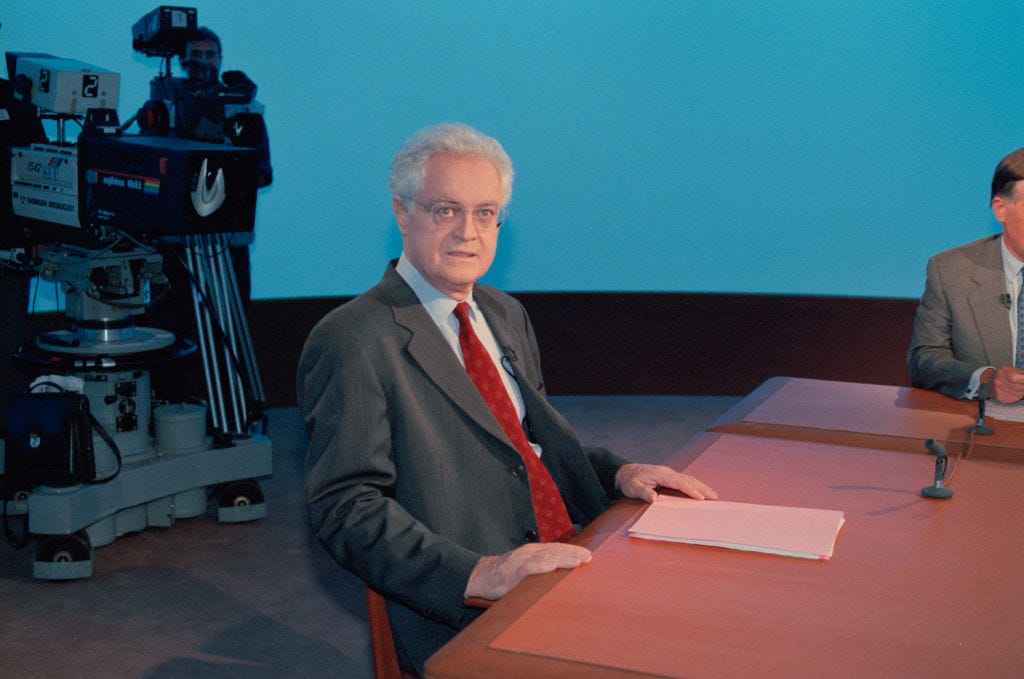
The death of Lionel Jospin on March 22, aged 88, has reopened familiar debates about the French left. Some hail the Socialist who, as France’s prime minister, brought Communists and Greens into a pragmatic governing coalition between 1997 and 2002, and see it as a template for the future. Others argue that the rift between radicals and moderates is now deeper than ever, making any such alliance a mirage. Jospin has been given credit for his stewardship of the economy and his signature social policy, the 35-hour week. For critics, the dream of France working less and maintaining its rank among nations has been conclusively crushed. These are legitimate arguments. But this article sets them aside to examine something on which there is near-universal agreement: Jospin’s moral character, or rather, the legend of it.
When he was alive, Jospin was widely regarded as the most honest president France never had. Words like “probity,” “sincerity,” and “honor” tripped off the keyboards of journalists who wrote about him. Much was made of his Protestant background (why Catholics, Jews, or Muslims should inspire less trust was never explained). After his greatest setback—his elimination in the first round of the 2002 presidential election, eventually won by Jacques Chirac—he was praised for withdrawing from politics. “Jospin is a man of principles who does not deceive himself and acts on his convictions, even at his own expense,” the veteran analyst Alain Duhamel wrote in a recent series of political sketches.
In death, he has been virtually canonized. “Jospinism was above all the ethics of a man,” declared Le Nouvel Observateur. He “refused to separate ethics from politics,” wrote Le Monde. The right-wing channel CNews faithfully compiled the tributes heaped on him by political friends and foes alike: “rectitude,” “a model of integrity,” “an exemplar of hard work and exacting standards.” Lost in the encomia, or discreetly relegated to a footnote, is the fact that Jospin led a political double life for decades on his way to the top—and lied about it repeatedly once it was exposed.
“We live at the mercy of certain silences,” Henry de Montherlant wrote. For Jospin, the silence was broken in June 2001, four years into his prime ministership. An elderly revolutionary Marxist, Boris Fraenkel, revealed that in 1964 he had recruited Jospin into the Organisation Communiste Internationaliste (OCI), a cloak-and-dagger Trotskyist group dedicated to infiltrating key institutions. Jospin, then a student at ENA, an elite school for bureaucrats, was quite a catch. “We didn’t have any énarques in the movement then,” Fraenkel told Le Nouvel Observateur. “It was a unique chance to penetrate the upper reaches of the civil service.”

In 1970, after five years as a diplomat, Jospin became a university professor. More interestingly for his revolutionary handlers, Jospin—codenamed “Michel”—decided to join the Socialist Party (PS) the following year. OCI leader Pierre Lambert, an imperious guru who kept a personal grip on every tactical move, gave his blessing. The PS had just been relaunched by François Mitterrand with a programme of “rupture with capitalism,” and having a mole on the inside was an opportunity not to be missed. Jospin, Lambert later acknowledged, “went into the Socialist Party with my consent” and “had a particular job to do.”
The operation was a ringing success. “Michel” rose through the ranks of the PS. By 1979, he was Mitterrand’s second-in-command, running the party by day and discussing the revolution in cell meetings by night. He hid his clandestine activities even from his wife. By the turn of the 1980s, he was easily recognizable by his owlish glasses and frizzy hair, and rumors about his Trotskyist connection began to circulate. His response: people must be confusing him with his brother, an avowed OCI member. Although Jospin became PS leader in 1981, and a cabinet minister in 1988, the press looked away. In 1995, when he seemed well-placed in the presidential race, Le Monde mustered the curiosity to ask him if he had ever been a Trotskyist. He flatly denied it, once again sheltering behind his younger brother.
Six years later, now prime minister, Jospin was finally cornered. Both Fraenkel and Lambert had gone public and the game was up. In June 2001, he rose in the National Assembly to deliver what passed for a confession: “It is true that in the 1960s I took an interest in Trotskyist ideas and established relations with one of the groups of this movement. This was a personal, intellectual and political journey of which I have no reason to be ashamed, if that is the right word.”
This masterclass in evasion warrants close scrutiny, as every word is carefully chosen to blur facts without lying outright:
In the 1960s: This conveniently ignores credible reports that he remained an OCI operative well into the 1980s, and more than a decade of entryism within the PS is airbrushed out;
I took an interest in Trotskyist ideas: This sounds like a case of youthful intellectual exploration rather than a structured clandestine activity, complete with a codename and deliberate double membership;
I established relations with one of the groups: The indefinite article deepens the fog. The OCI is not named—as though he had vaguely frequented one club among many others;
A personal, intellectual and political journey: The three-word formula dilutes a political commitment into something resembling a voyage of self-discovery;
Of which I have no reason to be ashamed, if that is the right word: The final rhetorical caveat allows him to both distance himself from his own formulation and reinforce it. He does not merely deny shame—he questions whether shame is even a relevant category.
In France, Trotskyism—an anti-Stalinist strand of Marxism dedicated to permanent revolution—is not the quaint ideological relic it might seem elsewhere. Among baby boomers, former devotees rose to prominent positions in politics, the media, and the civil service. Many have worn their past affiliation with pride. The late Socialist senator Henri Weber was a notable exception: “Permanent revolution, what a load of balls!” he once thundered. Jospin, who had belonged to a particularly conspiratorial branch of the brotherhood and traded on an upright public image, was not capable of such plain-speaking.
In 2010, Jospin had a chance to come clean. After an inconclusive flirtation with the presidential race three years earlier, he was well and truly out of politics. Two journalists approached him to take stock of his career. In the resulting TV documentary and book—both entitled Lionel raconte Jospin—Lionel may have told Jospin’s story, but he dodged all questions about “Michel.”
“I was first a Trotskyist and a Socialist, then the Trotskyist faded before the Socialist,” he said, not mentioning that he was a Trotskyist long before joining the PS and neglecting to specify when he left the OCI. Most analysts place the final break in 1988, when he became education minister.
No one is accusing Jospin of corruption or attempted subversion. By the standards of French leaders, his record is honorable. At first, his secret revolutionary identity was a way of managing an inner tension: in the late 1960s, the budding diplomat felt out of place climbing the career ladder in de Gaulle’s France while the country’s idealistic youth was rebelling in the streets. In the 2010 interview, Jospin described his OCI membership as an “antidote” to the risk of “conformity.”
But the dynamic of the double life gradually reversed itself. He continued to play the undercover agent without believing in the cause; it was his open life—a life in which he made a real difference—that became his true self. His first wife put it plainly in 2002: What had begun as a conviction had become a constraint, and eventually a prison. Jospin was a decent man whose past had caught up with him.
But to then make him out to be a paragon of probity—that is a step taken with remarkable ease in the only Western country where at least two rival Trotskyist candidates stand in every presidential election. One of his eulogists (ironically, one of the journalists who had first unmasked him) went so far as to write: “Jospin was never more sincere than in his double life, never more honest than in his secrecy. Never more free than in his contradictions.”
Mendacity elevated to the highest form of sincerity! To understand that, to quote the late Madeleine Albright in a rather different context, “you have to be either a genius or French.”
Henri Astier is a London-based journalist who writes for French- and English-language publications. He writes the Substack Out of France.
Follow Persuasion on X, Instagram, LinkedIn, and YouTube to keep up with our latest articles, podcasts, and events, as well as updates from excellent writers across our network.
And, to receive pieces like this in your inbox and support our work, subscribe below:

I don’t know how I missed this. Every time I think about canceling all of my Substack subscriptions, a fine analysis such as this comes along that adds a little bit more to my worldview. Perhaps this is because “the press looked away” and therefore, made understanding what is true that much harder. I don’t recall reading about this in Le Monde, although I might have missed that too.