

What Obama Meant
And why the social sector abandons his philosophy at its peril.

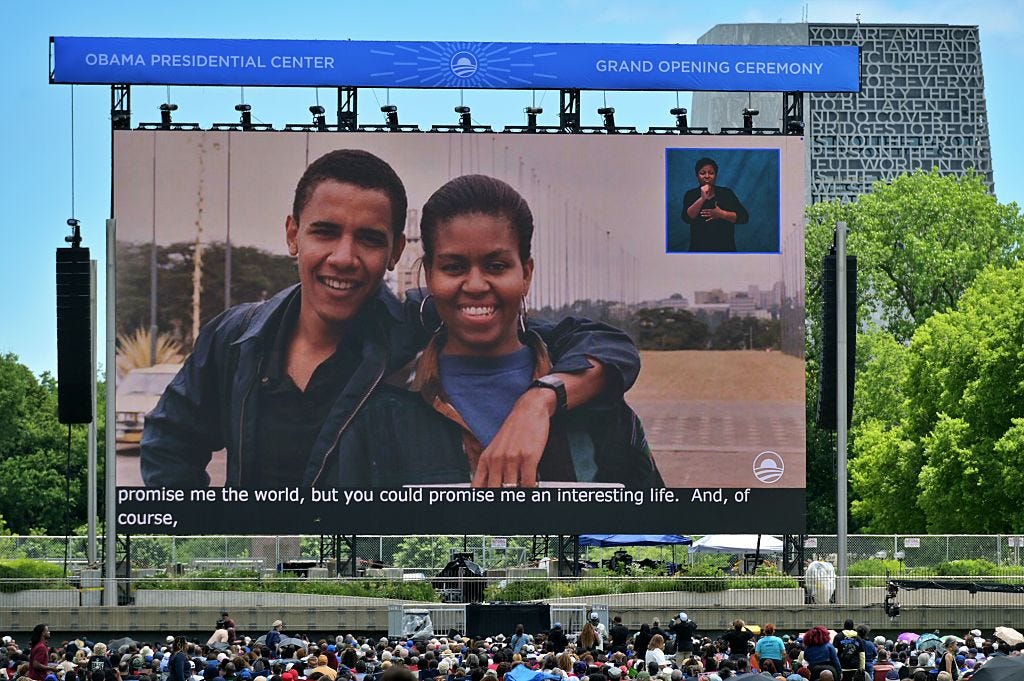
I recently got the chance to walk through the exhibits of the Barack Obama Presidential Center before its opening on Thursday. Looking at photos of the young Obama as a community organizer in Chicago, watching video clips of those iconic speeches that marked his dream-like rise from a nobody to leader of the free world, I was reminded of a time when our politics was more hopeful, our social sector was more constructive, and the two were aligned in the service of the nation.
I first met Obama in 2004 at a campaign event when he was running a distant third for the Democratic nomination for U.S. Senate in Illinois. There were maybe 25 people milling about a modest condo belonging to early Obama fundraisers Alan and Andrea Solow. I told Obama about the various programs my nonprofit organization, Interfaith America, was running to bring people of diverse faiths together to solve social problems.
The early 2000s was a golden era for the social sector. It was a time when talented college graduates were just as likely to start nonprofit organizations as they were to head to Wall Street. Civic institutions like Ashoka, Teach for America, the KIPP network of charter schools, Public Allies, Partners in Health, the Harlem Children’s Zone and City Year were broadly known and widely admired. These organizations shared a common ethos: to recognize that talent exists everywhere, to build excellent institutions to nurture people’s potential, and to cooperate across differences to lift people up.
Obama was a product of the nonprofit world. His formative years were spent as a community organizer, a profession that relies on storytelling to bring people together and whose cardinal rule is “never do for others what they can do for themselves.” He served on the board of the Chicago-based philanthropic foundation the Woods Fund, which made grants to community-based organizations. He had been the youngest participant in the political scientist Robert Putnam’s 1997 Saguaro Seminar, a workshop for leaders committed to strengthening social capital. And his wife, Michelle, had been the Chicago director for Public Allies, an organization that trained young people to be civic leaders, and then found them a one-year placement in a nonprofit organization.
In that post-9/11 era, my friends and I in the social sector were thrilled by Obama’s rise. Here was a black man with a Muslim name, raised by a single mother, shaped by his work in Chicago communities, staking his claim to the nation’s story, and showcasing his talents to lead us into the next chapter.
In the Obama narrative, America is a nation defined by people who fought for freedom and defeated repression. The 1776 generation won a victory over the British Empire and established the foundational promise of the nation: that all people are created equal and have the God-given right to life, liberty, and the pursuit of happiness. Black people fought against slavery and segregation, and women fought against misogyny and patriarchy, so that promise could be extended to everyone. Veterans fought repression around the world. Immigrants fled economic, religious, and political persecution in their home countries, and came here to build a better life, and through that process America became a better country.
There is a genius to this narrative. It recognizes the ugly parts of American history without getting mired in them. It hands the victory not to the slave drivers but to the freedom fighters. It identifies a common, heroic thread that connects a wide range of communities. And it provides clear direction and forward momentum for the future.
From his very first appearance on the national stage, at the Democratic National Convention in 2004, Obama was explicit about what that future should look like: teach the black child on the South Side of Chicago to read, ensure the senior citizen can get access to her prescriptions, protect the Arab-American family who is suffering discrimination, create job training programs for the laid off white factory worker.
In the heady days of that first presidential campaign, the nonprofit leaders I knew were fully aware that Obama was casting us as a central character in the American drama. Obama-ism was the belief that the talent development, character formation, and civic bridgebuilding of the social sector could be elevated into a governing philosophy. We embraced the challenge. Our work was concrete evidence of his famous “hope and change.”
As president, Obama turned that governing philosophy into concrete policy. He established two White House offices to work with the nonprofit sector, the Office of Social Innovation and the Office of Faith-based and Neighborhood Partnerships. He increased funding for charter schools. He created “Promise Neighborhoods” across the country, based on the model of the Harlem Children’s Zone. He launched a major White House initiative called My Brother’s Keeper that partnered with nonprofit organizations to invest in black men. Even his signature government initiative, the Affordable Care Act, relied heavily on nonprofit organizations to be “navigators,” helping enroll people in Obamacare. He even partnered with my organization to launch a program called the President’s Interfaith Campus and Community Service Challenge.

Increasing social investment in communities that had experienced marginalization was one part of the Obama philosophy. The other part was calling for more personal responsibility. Obama addressed minority youth in blunt terms: Yes, you will experience racism, he would tell them, but you cannot let it prevent you from trying your best. Your ancestors overcame far greater obstacles than you. Focus on the things you can control, not the things that are holding you back. View your identity as a source of pride, not of victimization. Remember that you owe something to your forefathers and foremothers. Never make excuses.
Every narrative is a script for forward action. If you are moved by Obama’s “Yes, we can” interpretation of American history, then it inspires you to do a set of things: Yes, we can help children achieve academically, no matter their circumstances. Yes, we can bridge the divide between urban America and rural America. Yes, we can transition industrial-era workers to knowledge economy employees. We are all agents of constructive change in this story.
But this talk of personal responsibility angered a set of progressive intellectuals, who accused Obama of emphasizing respectability politics over addressing structural racism. In 2014, Ta-Nehisi Coates published a blockbuster article in The Atlantic called “The Case For Reparations.” It became the cornerstone of a worldview that presented a stark contrast to the Obama story: America was not defined by the expansion of freedom, but by the legacy of slavery.
What Coates wrote was true—systemic racism is very, very real. And he was right that Obama rarely talked about that dimension of American life. But Coates was also not telling the whole truth. He ignored the part that Obama emphasized—slavery and segregation really were abolished, and the progress of minority communities in the United States since then has been stunning, if uneven and incomplete. Coates’ own rise to intellectual stardom is a signal case.
In the Coates narrative, you are either a victim of America’s continuing legacy of slavery, or you are a villain. Thinking of yourself as a victim is terrible for your mental health, and ensures failure before you begin. In fact, it sets up a perverse incentive structure: to prove that America holds minorities back, you have to present yourself as a victim or a failure.
Moreover, the white men cast as villains in the Coates story just so happened to be the group who experienced the most dramatic increase in mortality rates during the 2000s, a spike dubbed “deaths of despair” because so many of them had to do with suicide, alcoholism, and opioid addiction. A handful of white men in woke circles might have embraced the term “privileged oppressor,” but the laid-off factory workers dying from fentanyl overdoses in Macomb County, Michigan were not having it.
In 2016, a Black Lives Matter activist from Chicago publicly spurned President Obama’s invitation to visit the White House and discuss civil rights issues with the great John Lewis. Progressive activists were embracing the “America is a continuation of slavery” narrative. I viewed this as par for the course for activists. What surprised me was how that narrative started to shape the worldview of mainstream social sector organizations. Seemingly overnight, the conversation went from having a “Yes, we can” orientation to being obsessed with dismantling systems of oppression and challenging white supremacy. Nonprofit organizations adopted the Coates worldview, not as a critique of Obama-ism, but as an alternative to it. The clenched fist replaced the extended hand as the symbol of social change.

Charter school networks that once told families that their children could achieve academically whatever their circumstances changed their tune entirely and started to claim that black and brown kids were too oppressed to learn. Minorities were now valued for talking about their trauma, not their talents. Cooperation across difference was viewed as doing harm to BIPOC communities. The laid-off small town factory worker did not deserve a job training program—he needed to be reminded of his white male privilege and scolded for not stating his gender pronoun. Canceling coworkers over microaggression became standard practice in nonprofit organizations.
If your governing philosophy is to elevate the social sector to write the next chapter in the story of America’s continuous expansion of freedom, and significant parts of the social sector decide that their real job is actually to protest America’s legacy of slavery and criticize you for not doing enough about structural racism, then your governing philosophy collapses. That is effectively what happened to Obama-ism.
The alternative to Obama-ism did not turn out to be a glorious antiracist revolution followed by a socialist paradise. It turned out to be Donald Trump. A black president with a Muslim name was always going to face racist opposition from right-wing elements in America. But I don’t think those right-wing elements would have had the opportunity to build a political movement that won two presidential elections had the social sector not cannibalized itself.
Still, I am happy to report that things are changing in the nonprofit world. It turns out that when you embrace a “disrupt the system” worldview, the first system that your junior staff will try to disrupt is the institution that employs them. A decade of organizational turmoil was enough. Executives in the social sector are putting a stop to the crazy practice of cancellations within their own shops. Moreover, responsible leaders in the nonprofit world were sobered by the fact that many minorities voted for Donald Trump in 2024, preferring a candidate who called Mexicans rapists to a candidate who used the term “Latinx.” Maybe the nonprofit world didn’t understand BIPOC communities quite as well as they thought.
Whatever the reason, I am hearing a lot more talk about investing in potential and building civic trust than I am about dismantling patriarchy and white supremacy in social sector spaces. Which means it is a perfect moment for the opening of the Obama Center. The goal should not be a nostalgia trip; it should be a revitalization of the central role the social sector can play in the next chapter of America’s glorious story of expanding freedom.
Eboo Patel, a contributing writer at Persuasion, is the founder of Interfaith America and the author of We Need to Build: Field Notes For Diverse Democracy. He served as an advisor on faith to President Barack Obama.
Follow Persuasion on X, Instagram, LinkedIn, and YouTube to keep up with our latest articles, podcasts, and events, as well as updates from excellent writers across our network.
And, to receive pieces like this in your inbox and support our work, subscribe below:
 | A guest post by
|
I think this author articulates a way forward for the Democrats.
One of the things I love best about Obama, and one reason a lot of people don't understand him, is that he doesn't see the world in terms of Our Side is Pure Good and the other side is Pure Evil. It confused people, to the point where he could deliver the biggest expansion of health insurance in fifty years, the biggest expansion of regulating Wall Street in eighty years, and the (at the time) biggest expansion of renewable energy ever, only to leave the very people who agreed with those goals feeling like he was accomplishing nothing. To the point of both left and right running to the familiarity of polarized morality, of the idea that the more extreme you are the more principled you are. Well, if you haven't noticed how thoroughly the past ten years have disproved that hypothesis, I don't know what to tell you.