

My Third Winter of War
A dispatch from Kyiv in a season of drones.
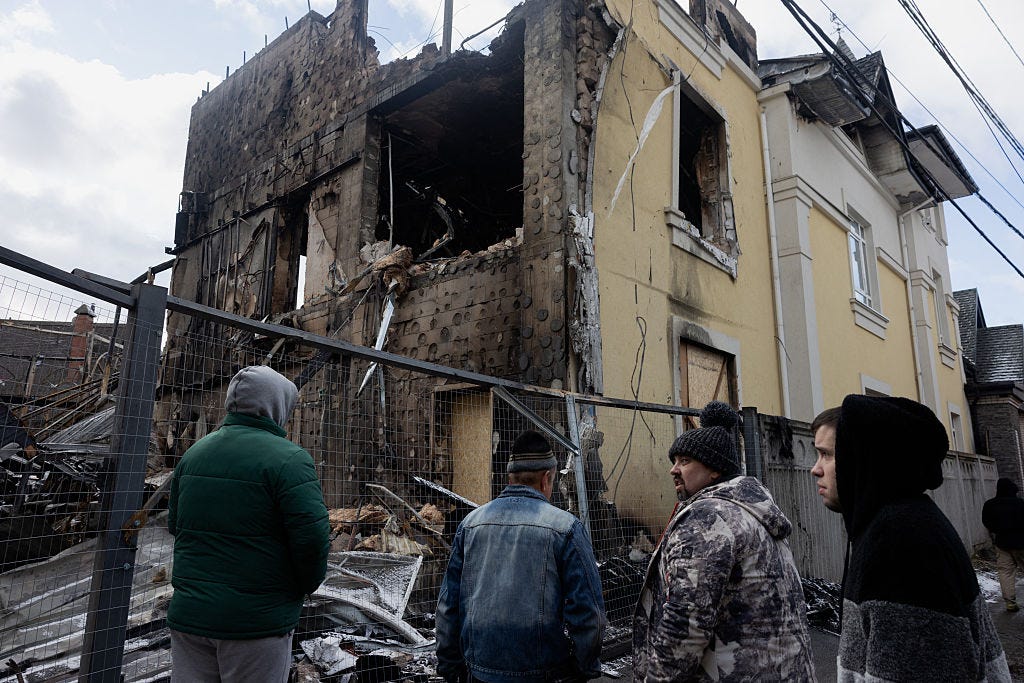
Regular readers will know that, since shortly after the Russian invasion of Ukraine in February 2022, Persuasion has been following the war through the voice of one Ukrainian, Kateryna Kibarova. Kateryna’s accounts of the ongoing horrors—from the first days, to her return home to Bucha, to the fear of constant drone attacks on Kyiv—capture the seemingly never-ending nightmare facing civilians far from the frontlines.
This winter, as Ukraine’s future remains deeply uncertain and the capital routinely faces aerial bombardment, Kateryna wrote to say that a recent air raid had caused damage in her neighborhood and blown out one of her windows. What follows is her most recent dispatch on the aftermath of that attack and the continuing challenges of daily life. (You can read all of Kateryna’s installments here.)
Members of the Persuasion team—in our individual capacity—are raising some funds to help Kateryna offset the cost of the emergency window replacement. If you’d like to consider supporting this effort, we’ve set up a GoFundMe page here.
Wishing you a peaceful start to 2026, and with thanks for being part of our community,
David, Senior Advisor
by Kateryna Kibarova
Last year, things were easier because the electricity and gas infrastructure was not attacked to the same extent. This year, they really carried out intense shelling of the energy sector and gas hubs. Energy workers once needed hours for repairs—now they take days. Absolutely everyone is cut off.
We have special Telegram groups, “Ukrainian Power Grids,” with subgroups for each region. You receive an updated list and a schedule. In the evening when I go to bed, I check the schedule to understand what time I need to get up to get ready for work. You adjust your schedule if, for example, there will be no power from 6am to 11am. I’ll get up at 4am to get ready for work, dry my hair. But these schedules are often unpredictable, and I have to go to work with a wet head.
A difficult stage has begun, because it is winter and there is very little gas and electricity. The state can’t cope. This year, they didn’t even start the heating season on time. Usually the radiators in apartment buildings begin to warm up when the temperature drops below 59 degrees. The first sectors to be launched are kindergartens, hospitals, schools. We had a very cold summer and the fall was also very cold. By mid-October, the heating season would normally have been launched. It’s one thing when you walk along the street if the sun is shining on a 45-degree day. When you sit in an apartment, you just freeze.

This fall, I lived for some time with acquaintances at their home, which they heated with a large fireplace. Other people used electric heaters and overloaded the system. Now people have huge generators, but there are crazy power surges and sometimes the generators catch fire. Our utility systems aren’t adapted to this. One house in Khmelnytskyi exploded because they were turning the gas on, turning it off, and something went wrong. Tragically, people died.
The company where I work ordered powerful generators from Europe. They told everyone that whoever has no light can come, can wash up, charge phones. They put in little sofas for people to lie down. If you go with a wet head, you take a hair dryer with you. Large businesses are very serious about providing for their staff. At stores you can sit down, take a break, get warm, heat up. They offer you warm tea. Businesses take care of Ukrainians and try, in difficult conditions, to create comfortable places where you can put your thoughts in order or answer calls.
But scammers are also very busy here. They steal money from card accounts overnight. I fell for a scam, so I decided to save money and travel on public transport. One day an air alert began and all transport stopped. When this happens you cannot move anywhere, you are simply dropped off, stand in huge lines, and you don’t know what to do. I just started crying. People are frozen in horror. You don’t know if a rocket is coming, you have nowhere to hide, there is no bomb shelter anywhere nearby. It’s cold outside, and you are trying to somehow think about what to do next and how to save yourself.
There have been very heavy attacks on Kyiv with drones and missiles. You see these Shahed drones flying over apartments and killing families. You don’t know if you will be next or not. People have started going into bomb shelters more often.
During one attack, I got scared and ran out into the corridor of my building. They’d shot down many Shahed drones in the neighborhood, and there were fires. When I went back home it was dark, and in the morning I woke up because it was cold—some kind of wind was blowing through the apartment. I went into one of the rooms and saw the window had been blown out badly. The curtains were still hanging. It’s good that I wasn’t in there when it happened, because I would have been slashed by the fragments.
There used to be a repair program for things like that, but now there are so many victims that the program no longer works. We sealed up the window with plastic wrap, and it was like that for a while. During this time I lived at my aunt’s. It’s harder for me to get to work from her place. But compared to people who lose their entire homes, their apartments, mine was a slight scare. Our local TV channels interviewed one man who lives in the center of Kyiv. It often gets hit there. He has already changed his windows eight times. He says, “Every time I still change them in the hope that this will be the last time.”
No one can say this happens accidentally. They attack near hospitals, houses. You see for yourself that they are targeting the population. You can drive through Kyiv and see scorched apartments. You understand that there were people who died there. One morning, my Dad called from Zaporizhzhia and said, “I don’t remember it ever being like this, so many rockets flew over the house. I thought, That’s it, this is the end.”
Many people have started getting sick, especially after attacks. It is very strange that so many people just get knocked off their feet. It hits the throat, it hits hard. And I myself was sick recently with COVID. My voice disappeared. The worst thing is that Russia is now tactically hitting medicine warehouses, and because of this many people cannot get vital medicines. My colleague was asking for a medicine that only just became available at the pharmacy near my house. I arrived there, and the pharmacist told me that their warehouse was completely destroyed. Only today did a truck arrive from Germany with the drug. I bought four packs for my colleague.
And then there’s the political situation. One day we hear that Donald Trump has talked to Putin, that things are sort of getting better. Then we get bombed again, everything is smashed, people die. Then Trump says he’s disappointed with Putin. Every time he says something like, “Putin disappointed me,” my colleagues and I laugh. These are political games that are won and lost by casualties among the civilian population. And how many of our military have died? How many young guys, young girls? It’s a horror. And it’s difficult to speak about anything else, because, unfortunately, we are just pawns in this big game—nothing more.
Kateryna Kibarova is a Ukrainian economist and resident of Bucha.
With translation assistance and thanks to Julia Sushytska and Alisa Slaughter. This transcript has been edited for concision and clarity.
Follow Persuasion on X, Instagram, LinkedIn, and YouTube to keep up with our latest articles, podcasts, and events, as well as updates from excellent writers across our network.
And, to receive pieces like this in your inbox and support our work, subscribe below:
Dearest one, as Nina (above) said - my heart breaks for you and your fellow countrymen and women. This war is an abomination that Putin started. Trump is Putin's tool, and I am ashamed of him and his disgraceful impact on the welfare of Ukraine's citizenry. Any comfort I offer will be trite compared to the life-threatening conditions you all face. I support you, your family, Zelensky, and Ukraine. You are beautiful people.
My heart is broken for U and your Country. Last evening while I was enJOYing the company of friends, good food, music, & laughter Ukrainians were STILL struggling.
I won't give up HOPE. In my community I still see Ukranian flags, colors, words of support scattered about.
I truly appreciate your reporting, REAL news. Stay safe Kateryna.