

Israel—It's Complicated
A visit to a nation as resilient as it is traumatized.

I recently returned from four weeks in Israel, a reporting trip for a book I’m writing. Two weeks in Tel Aviv, a week in the south, a week in Jerusalem. Some thirty interviews, and many informal conversations, with fellow alumni of the progressive Zionist youth movement in which I came of age, Americans who immigrated in the 1980s. Not a representative group of Israelis, but a deeply informed one, including the leader of the country’s environmental movement (who is also a former member of Knesset); the host of the most prominent English-language podcast on Israeli politics (who is also a historian and Tel Aviv city councilor); the opinion editor of The Times of Israel; the president of a major university; the head, past or present, of several leading human rights organizations; activists for feminism, religious pluralism, intergroup dialogue, and Palestinian-Israeli coexistence; educators; health professionals; and business people. Politically, they ranged from the center to the far left; religiously, from Orthodox to secular.
Plus, of course, I kept my eyes open: on the streets and at the holy sites, at a protest rally and along the roads, in suburbs, office buildings, a kibbutz. Here’s my sense of what I saw.
This is a country that is deeply traumatized, and not only because of October 7. The traumas are multiple, layered, ongoing. The trauma of October 7. The trauma of seeing images of October 7 replayed endlessly in the media. The trauma of the hostages. The trauma of urban combat, and of knowing that your loved ones are in it: of hundreds of soldiers killed, many thousands injured, many tens of thousands deployed into life-threatening situations. The trauma of repeated individual mobilizations—men in their 20s and 30s and 40s serving totals of 200, 300, 400 days—and of what the mobilizations have inflicted: the lost jobs, broken marriages, failed businesses. The trauma of waking up to discover that your country is surrounded by enemies, far more capable than you had thought, who really do want to murder every last one of you. The trauma of rockets and missiles and drones being aimed at your head, of air raid sirens, of wars within wars. The trauma, for liberals and leftists, academics and artists, of betrayal by your former allies in the West.
Miriam Schler was the longtime executive director of the Tel Aviv Sexual Assault Crisis Center. “So many who champion human rights, feminism and social justice,” she wrote a few weeks after the attacks, “some of whom I have long considered friends or looked up to for their moral courage, have been bending over backwards to justify atrocities and rationalize rape.”
(None of what I’m saying here is meant to minimize the trauma on the other side. This is a conflict of two peoples, each with deep wounds, valid grievances, and legitimate claims to a state. Anyone who cannot feel that is morally obtuse; anyone who doesn’t understand it cannot usefully contribute to a just and peaceful resolution.)
One friend told me that she’d been unable to get out of bed for months. Another said he hadn’t slept for more than fifteen consecutive minutes during his son’s deployment in Gaza. A third could not stop talking: about the prime minister and his cowardice, the government and its evil, the fact that his friends were sick of his incessant talking, the recognition that it was itself a post-traumatic symptom. Miriam has founded Kehilanu: Helping Israel Heal, a nonprofit dedicated to addressing the unprecedented scale of need. According to a report by the State Comptroller, she told me, nearly 40% of Israelis are suffering from trauma.
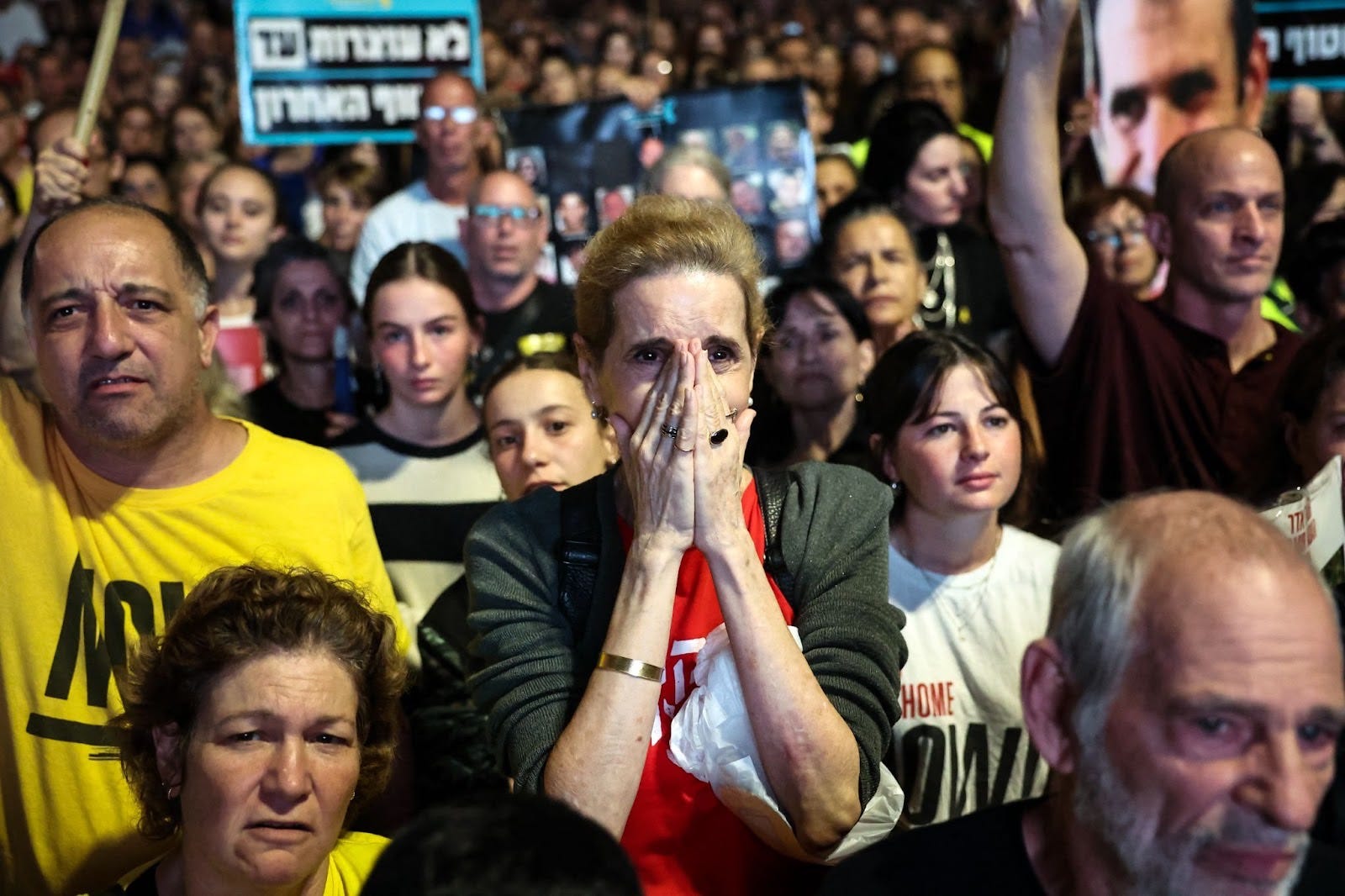
Still one more form of trauma must be tallied. I began to understand it at the weekly protest rally at Hostage Square in downtown Tel Aviv, the first one after the remaining living hostages had been released. To say the mood was lighter is to speak only in relative terms. Eighteen bodies remained unreturned, and the crowd was not going to let the government forget about them. Einav Zangauker, a leader of the hostage families, whose son had just been freed, gave a speech of fierce gratitude to those who’d stood beside her—who’d come out in heat and rain and cold, she said, week after week after week—but also of resolve and fury. Her words were iron spikes pounded one at a time into stone: indicting the prime minister, whose name invariably elicited jeers, indicting the Speaker of the Knesset, who had made a show of removing his yellow-ribbon lapel pin before Trump’s speech to the assembly earlier that week, as if the issue of the hostages were over. The issue of the hostages, Zangauker and others insisted that night, was not over.
This was a citizenry, I grasped, that had been abandoned by its government. Before October 7, when the latter had failed to prevent the attacks. On October 7, when it had failed to mount an effective response. After October 7, when it had failed to provide the victims, including hundreds of thousands displaced from the vicinity of Gaza and the northern border, with anything like adequate support. Not once had Netanyahu come to Hostage Square. Funds to rebuild the attacked kibbutzim had taken many months to be disbursed. The conduct of the war had deprioritized the hostages at every turn. My friend Abraham showed me a screenshot of a Times of Israel headline: “Health Ministry Opens Helpline for Medical Needs of Those Evacuated, Displaced.” It was dated November 1, 2023. “They opened up a helpline three and a half weeks into the war,” he said. “Can you imagine? Where were they for the last three and a half weeks?”
And yet, into that void, had stepped the citizenry itself. This was also viscerally evident that evening at the rally. “You are not alone,” went the crowd’s repeated chant, directed at the hostage families. “We are with you.” “Am Yisrael,” pronounced Zangauker with defiance, again and again: the nation of Israel, the Jewish people. Am Yisrael is standing with Am Yisrael.
I heard of this throughout my trip: how Israelis from across the political and religious spectrums, including Palestinians, had organized in response to the crisis, beginning on the very morning of October 7. A vegan restaurant prepared and distributed 3000 meals a day. A group of writers composed eulogies on behalf of the bereaved. Teams went in to clean up the homes of the displaced—who often fled at a few minutes’ notice, leaving food to go bad in refrigerators—in advance of their return. Teams built ramps and other accessibility features at the homes of disabled veterans ahead of their release from the hospital. Protective equipment for soldiers was purchased and brought from abroad. Warehouses were set up with clothing, diapers, anything that the displaced might need. If a child had a birthday, a cake was baked for them. If they played an instrument, one was sourced and delivered. “Anybody you talk to in Israel,” one friend told me early in my trip, “ask them what they did after October 7. Everybody did something.”
The country may be traumatized, in other words, but it is not demoralized. Instead, it has responded to the crisis with the sense of solidarity, the talent for organization, and the ethos of mutual aid that lie deep in Jewish culture, the products of millennia of life in the Diaspora, when Jews had no one to rely on but themselves, and that have characterized the country since the earliest days of the Zionist return. The one thing that Israelis understand, at least when circumstances force them to, is that they are all in it together. That they share a fate.
Which helps explain another fact that I registered during my trip, and that contributes to the country’s inner strength. Israel has a left, has liberals and progressives and socialists, who still believe in it. Who still identify with it, still sacrifice for it, still love it. Who, whatever their critiques and disillusionments, are still committed to perfecting it, and not just in the name of universal values, but also for its own sake, the sake of its unique, particular existence.
The same may be said of the young. There has been a lot of talk in Israel of this, and it began before October 7, with the protests against the government’s proposed judicial reforms in early 2023. Abraham described the largest, which took place the night that Netanyahu fired his defense minister, who opposed the proposals. “Now it’s not 300,000 people” in the street, he said, “it’s 800,000. Who is there is all the young people, and then I realize they’re singing. They were singing, ‘Try to steal our democracy, we’ll storm the Knesset. You’ve messed with the wrong generation.’ And while I see them doing this, a boy comes over and grabs me like that”—he put two fingers on my wrist, as if he were taking my pulse—“and he says, ‘Don’t you worry. We’ve got this.’ And eight months later, those kids were fighting in Gaza, fighting for us, and they’ve now become known as the greatest generation.”
It is also to the point—to several points—that they are a large generation. Israel is not a place, like so many in the world, that doesn’t seem sure that it wants to keep going. Jewish history selects for the survival instinct, and when people have been trying to get rid of you for two thousand years, you don’t give up that easily. Almost everyone I spoke with has three or four kids. Among the people I know in the States, the norm is two or one (or none). The discourse about the fertility crisis in the developed world invariably cites Israel as the exception (its current rate is roughly 2.8; the next highest industrialized countries come in around 1.7). The ultra-Orthodox bring up the average, but that is not the main explanation. Nor is the idea, which I heard expressed, that Israelis feel driven to make up for the Holocaust.
No, Israelis just like kids. They like being in large, close-knit families. I could feel this even in Tel Aviv, which in other ways resembles Brooklyn: how children are accommodated, normalized, enjoyed. In other words, the explanation is cultural (which means it can’t be replicated). Judaism is a family-centered religion, with many rituals conducted in the home, most obviously Sabbath dinner. My friend the university president has three young adult children, each with a partner and one with a baby. All of them come home, he said, at least two Friday evenings a month. This is, if anything, below average. The Sabbath, even among the secular, is a day consecrated to family.
Still, one shouldn’t overstate these themes. If most of the people I talked to have three or four kids, most of them also have at least one who is currently, perhaps permanently, overseas. If Israelis remain committed to the country’s future, by and large, more of them are leaving, with emigration since October 7 roughly double the previous annual average and expatriate communities growing in places like Portugal and Thailand. If the country demonstrates remarkable solidarity, especially in times of crisis, it also has savage internal divisions. There is widespread rage against the ultra-Orthodox for shirking military service while continuing to soak up public subsidies. One protest sticker said, “The secular are not slaves.” Another formulation that I’ve heard goes, “They pray for us, and we die for them.” The country’s political discourse is sulfurous; its politics, poisonous. Had the hostages been West Bank settlers instead of leftist kibbutzniks and festival-goers, some of the people I talked to insisted, they would’ve been out in a couple of weeks.
More than anything, my visit left me with a sense of just how complicated the country is, including, or especially, people’s feelings about the war. The same person who said, “I’m sorry that babies and children have to pay the price for the hatred of their parents, but we have no choice,” also spoke about the “moral injury” experienced by Israeli troops in Gaza from the things they’d had to do there, which has led dozens to take their own lives. The same one who told me that, contrary to the narrative one hears in Western media, there are many Israelis who are not in denial about the horrors in Gaza, that she herself reads Al Jazeera, The Jordan Times, the Lebanese Ya Libnan, and the London-based New Arab, also told me that she understands why many Jewish Israelis feel triggered when they hear Arabic on a bus.
A professor at my friend’s university who is one of tens of thousands of Israelis who have publicly protested the civilian deaths in Gaza has also, since October 7, had her academic articles consistently rejected, usually without their even being sent out for review, in international journals in which she used to publish routinely, and she is pissed about it. The guy who said that, given what their country did in Iraq, let alone Vietnam, Americans have no ground to stand on from which now to demonize Israel also spent 72 consecutive days during the winter of 2024 (and still spends one day a week) doing “protective presence” in the hills south of Hebron—meaning that at 64, along with a few other activists scarcely a third of his age, he lived in Palestinian villages, sleeping in a sleeping bag, going without hot water, and escorting shepherds with their flocks or children to school, to protect the local population from settler violence.
“It’s complicated”: this would ordinarily be the laziest, most useless conclusion a writer could offer. In this case, however, it may be the thing that most needs to be said. Opinions on Israel outside the country, be they for or against, are typically loud, enraged, extreme, self-righteous, proudly simplistic, profoundly underinformed, and ultimately about the speakers themselves. Former prime minister Shimon Peres told a story about visiting a school in Harlem and telling the children that he was from Jerusalem. “Jerusalem?” one boy said. “I thought that was in heaven.” More than any other country, Israel is for others an idea, a symbol, a fantasy, a screen, a mythological entity. It is good to be reminded now and then that it is also an actual place.
William Deresiewicz is an author, essayist, and critic. He is working on a historically situated memoir about being Jewish in modernity.
Follow Persuasion on X, Instagram, LinkedIn, and YouTube to keep up with our latest articles, podcasts, and events, as well as updates from excellent writers across our network.
And, to receive pieces like this in your inbox and support our work, subscribe below:
 | A guest post by
|
They killed thousands of children with no regret, no remorse and only excuses and denials. This piece confirms they have very few qualms about the dehumanization and destruction done in their name.
Thank you, William, and thank you Persuasion for publishing this truthful, if painful portrait of Israelis in the current moment. I have a friend from one of the southern kibbutzim, one just outside the range of the terrorist attack. But of course, it's a very small country and she knew and loved people who were killed and kidnapped. She and her family had been protesting the government regularly before October 7th. They have not ceased to do so almost every week since then. Your quotes, descriptions and depictions match what I have learned from her over the years and especially since Oct. 7th. You are right--people are deeply traumatized, yet they also refuse to be defeated, even as their government has abandoned them.