

Protests Are Not Emotional Support Groups
Why No Kings continues to fail.


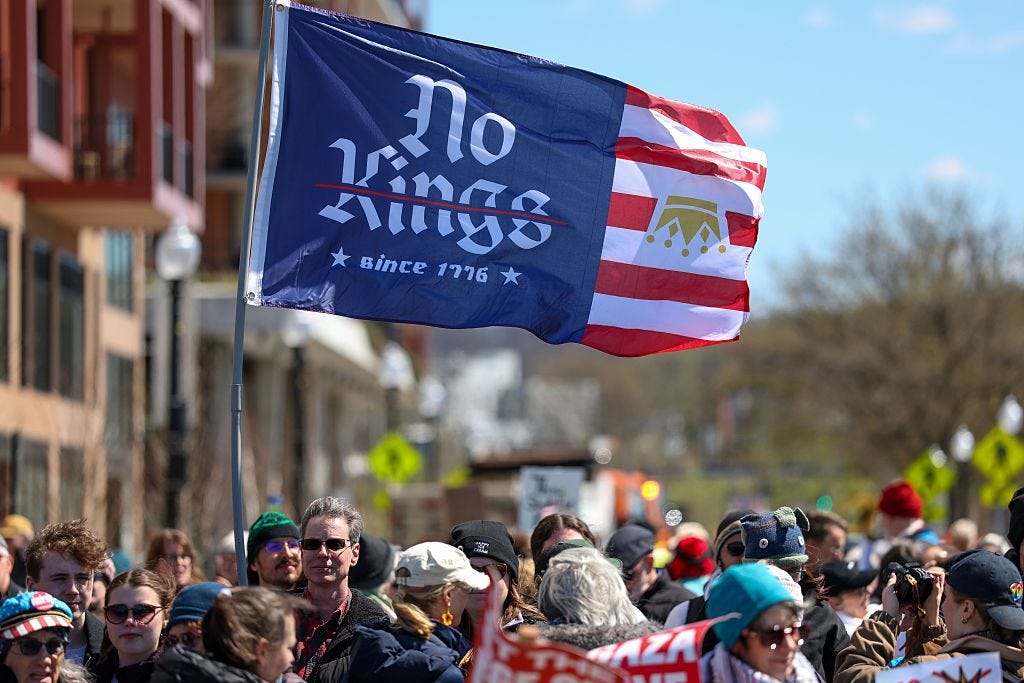
The No Kings rallies in March 2026 were perhaps the largest single-day protest in the United States since the first Earth Day in 1970. Millions showed up at over 3,000 locations in a display of resistance against the second Trump administration.
But days later, the protests had already faded from the public mind. The White House seemed unbothered. Trump continued to embrace authoritarian tactics, targeting his enemies in the courts and waging a war in the Middle East without the consent of the legislative branch.
That hasn’t stopped No Kings from trying again. Today, the movement is co-hosting a “Rise Up, Sing Out” concert in New York (with watch parties across the country) to coincide with Donald Trump’s 80th birthday celebrations. According to the No Kings website, the event is an opportunity to “sing along, make art, share food, connect with neighbors, and take meaningful action together.”

If Americans want to actually enact change, they seriously need to re-think their strategy. Take it from us: we both grew up in Putin’s Russia and saw well-intentioned protests fail to stop an aspiring despot. We know that authoritarians are typically unwilling to respond to the kind of protest No Kings exemplifies: loud, raucous, and ultimately harmless. These “festival protests,” as we call them, are convenient for their participants. They are fun and usually do not require much sacrifice or risk. They also look good on TV and TikTok feeds. But they often achieve next to nothing.
Why are so many people convinced they work?
The festival approach to protesting has its roots in the end of the Cold War. The fall of communism in Eastern Europe was accompanied by largely peaceful popular mobilization, which created a perception that revolutions are something fun and frictionless. The Czechoslovak anti-communist protests in 1989 even got the Slovak moniker of nežná—the “gentle” revolution.
These protests were subsequently written up as a key reason for communist collapse. The perception that a successful revolution can be a fun affair was so omnipresent it seeped into theories of change and scholarly work. Theoreticians like the late Gene Sharp wrote protest manuals which popularized the idea that even a hardline dictator will bend to popular will if that will is manifested in a suitable rousing manner.
The ensuing “color revolutions” of the early 2000s—a series of protests that sought to peacefully enact democratic transformations in post-socialist countries—seemed to vindicate this approach. The meek strongmen Eduard Shevardnadze in Georgia and Viktor Yanukovych in Ukraine melted away under the creative slogans and color-coordinated marching columns of bright-eyed youth.
But the real story of those successes is much more complicated. The regimes fell in places where their foundations were already weak. Shevardnadze, famously, couldn’t even pay police officers. It’s no wonder they did not want to protect the regime once protesters came. Similarly, in Ukraine’s protests of 2005 and 2013-2014, a large sector of the elite—oligarchs, high-level officials, politicians, and members of the security apparatus—were willing to defect to the side of pro-democracy protesters.
We are not seeing massive defections among American elites. Republicans in Congress support the vast majority of the administration’s initiatives, while business leaders rarely stand up against the president, even when his actions (such as tariffs) hurt them directly. Establishment media such as The Washington Post and CBS News already show signs of self-censorship. Courts and some Democratic states are the only traditional institutions that display systematic resistance.
Then there’s the fact that protests in general are becoming less effective. In the 1990s, around 65% of non-violent movements succeeded in overthrowing a dictator. In the late 2010s, that figure was down to 34%. Violent movements are even less effective—their success rate is currently around 8%, down from a peak of more than 40% in the 1970s.
This is partly because authoritarian rulers have learned from their mistakes since the color revolutions and the Arab Spring. When one leader gets in trouble, others come to help. Russia, for example, sent troops to Venezuela and Belarus during recent protests. The regime also invested massively in preventing protests at home. The pro-democracy “Snow Revolution” of 2012 flopped because the Kremlin was able to maintain elite cohesion and police loyalty. Moscow was an odd city during the snow protests: While several squares in downtown were occupied, ordinary life more or less went on as usual.
Making life comfortable enough that most people can disengage from politics and ignore protests is Putin’s greatest accomplishment. The well-educated urban elites do not call for civil disobedience or direct action—they know that most Russians are not ready for such sacrifices.
So what lessons are there for the resistance in the United States? Let’s look at Minneapolis. During ICE’s raids earlier this year, protesters made sure to warn the local community by blowing whistles, shouting, and banging drums. They organized solidarity networks and boycotts. The tactics were extremely demanding: protesters had to engage in constant surveillance of law enforcement and skip work to participate in non-violent direct action. Two lost their lives.
These disruptive tactics deeply angered officials, and eventually made them retreat. It slowed the repressive machine of the state. The faces of the anti-migrant campaign—Border Patrol Commander-at-Large Greg Bovino and Secretary of Homeland Security Kristi Noem—were quickly fired.
Minneapolis proved that resistance movements should not be evaluated by the number of people they bring to the streets. Resistance to authoritarianism is not an emotional support group.
In Russian, there is a joke about good-hearted but ineffective pro-democracy protesters: “They are for everything good and against everything bad.” A successful anti-authoritarian movement in America will be a movement of people who are ready to make sacrifices. It will not come from a place of comfort.
Maria Kuznetsova was part of Russia’s protest movement from the 2010s up until her exile. She is the co-author of How to Survive Authoritarianism: A Russian’s Phrasebook for Everyday Life in America.
Dan Storyev has covered protests on the ground as a photographer and reporter. He is the co-author of How to Survive Authoritarianism: A Russian’s Phrasebook for Everyday Life in America.
Follow Persuasion on X, Instagram, LinkedIn, and YouTube to keep up with our latest articles, podcasts, and events, as well as updates from excellent writers across our network.
And, to receive pieces like this in your inbox and support our work, subscribe below:
 | A guest post by
|
 | A guest post by
|
All of it is pointless. Winning the last election was entirely within the grasp of the Democratic Party. The big problem was/is the failure to offer a real democratic alternative. There were no serious primaries. Anti-democratic insiders substituted a weak candidate at the last minute. There wasn’t and isn’t a serious platform beyond “vibes.”
No wonder there are “vibes” festivals pretending to be protests. Obviously, protests cannot substitute for a compelling alternative.
This article gets the democratic question completely backward.
Illegal immigration is anti-democratic by definition. It means people are entering or staying in a country against laws passed by that country’s citizens. And this is not some small technical issue. Illegal immigration is massively unpopular, and everyone knows it.
So when elites tolerate it, excuse it, or block enforcement, they are not defending democracy. They are overruling the people.
Mass illegal immigration makes it even worse, because it changes the future electorate, the culture, and the long-term power of citizens who never agreed to that transformation.
Enforcing the border through legal means is democratic. Preventing people from controlling their own national future is not.
That is the real authoritarian move: elites and their violent supporters nullifying the people’s will, then calling the people authoritarian for objecting.