

Russians Are Finally Angry About Censorship
Why internet blackouts show the limits of an authoritarian regime.

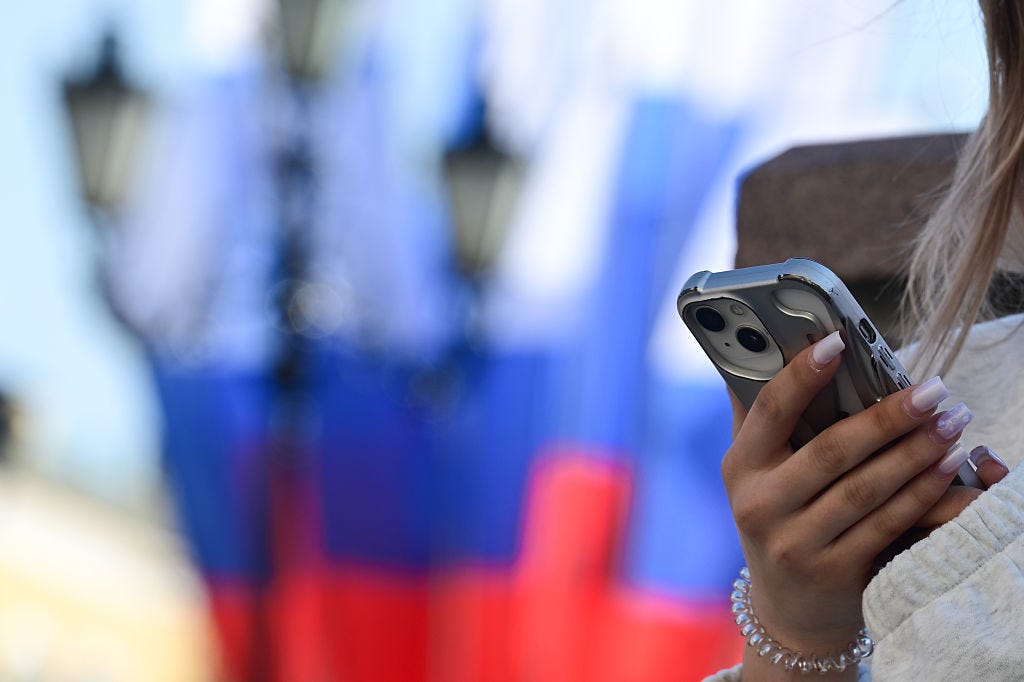
Russians have learned to live with a lot: a devastating war next door, sanctions, inflation, mobilization, repression, and the full disappearance of independent politics. But the recent wave of internet restrictions—mobile internet blackouts across major cities, disruptions to Telegram and WhatsApp, and pressure on VPNs—has touched a nerve that the Kremlin may have underestimated.
Since 2025, Russia has seen repeated mobile internet shutdowns, officially justified as protection against Ukrainian drone attacks. By spring 2026, the problem had reached Moscow: mobile internet outages disrupted banking, ATMs, coffeeshops, taxi apps, and even officially approved “white-list” websites.
The response has been unusually visible. In April 2026, approval of Putin’s performance dropped below 80 percent for the first time since the fall of 2022, declining by 8 percentage points since September 2025. Influencers who normally stay far from oppositional politics have started complaining publicly. Victoria Bonya, the television personality and Instagram celebrity, posted a viral appeal to Vladimir Putin criticizing internet shutdowns, economic stress, and the growing distance between the authorities and ordinary people. The episode quickly became a meme: people joked that Bonya had “saved Telegram” after reports that authorities might soften some restrictions. More seriously, even Putin seemed concerned enough to urge officials to explain internet restrictions better to citizens, and then advised lawmakers “not to get stuck” on prohibitions too much.

It is not that Russians have suddenly discovered censorship—they have lived with expanding digital restrictions for years. In March 2022, a Russian court banned Facebook and Instagram after designating Meta an “extremist” organization. YouTube has been slowed, foreign media have been blocked. Yet ordinary users adapted: VPNs have become part of everyday life. Illegal Instagram remains widely used by citizens, influencers, businesses, and even elites. CEPA cited a survey showing that 48 percent of Russian influencers kept earning money there after the ban. For ordinary Russians, this created a bargain: you may use the internet as long as it’s for personal purposes rather than political ones. What is different now is that the state is no longer only blocking “political” content, but breaking the infrastructure of everyday life.
Russia is not a digitally backward country. At the start of 2025, it had about 133 million internet users, internet penetration above 92 percent, and roughly 106 million social media user identities. Telegram alone reached 61 million daily users in Russia in 2024. Digital technologies are the foundation of everyday comfort for the majority of Russians. Russians are so accustomed to the convenience of digitalization that Russian migrants living in wealthy European capitals often complain that Europe feels digitally backward by comparison.
Reportedly, a three-week disruption in Moscow produced backlash not only among ordinary users but also among parts of the political and business elite. In Moscow alone, business losses during a five-day outage were estimated at 3–5 billion rubles. Nationally, internet shutdowns and throttling cost Russia close to $12 billion in economic output in 2025.
But Russia’s digital economy is also about millions of people making small amounts of money in semi-formal and informal ways. Hairdressers, tutors, nail technicians, and repair workers all depend on visibility and communication online. Avito, Russia’s dominant online marketplace for privately buying and selling goods and services, had a monthly audience exceeding 72 million users and 230 million active listings in 2024, and had even overtaken the U.S.-based global powerhouse Craigslist years earlier. When the internet is broken by the government, people lose clients and income.
Russians are not particularly happy about losing money in this economy. By the end of 2025, inflation, rising utility bills, and tax hikes were hitting many Russians hard. Alena Ledeneva’s work shows that informal networks have long been central to how people navigate scarcity, uncertainty, and just everyday life in times of crisis in Russia. Internet restrictions now interfere with the updated digital version of that survival economy.
The internet is also where many Russians find coping mechanisms. Online life offers distraction, self-expression, and psychological escape. A huge virtual industry of coaches, fashion bloggers, psychologists, self-improvement gurus, and esoteric practitioners exists partly because people are looking for ways to manage the daily anxieties of life in today’s Russia. In 2024, online schools on the Russian platform GetCourse earned over 168 billion rubles, including more than 16 billion rubles in the “psychology” category. After the full-scale invasion of Ukraine, Russians’ interest in magic and esotericism increased, with people spending about 6.6 billion rubles on such virtual courses in 2022. Seventy-seven percent of active Russian internet users regularly play online video games, and market estimates put Russian gaming spending in 2024 at roughly 170–200 billion rubles. As described by Alexei Yurchak, late Soviet citizens often created spaces of vnenakhodimost—being inside the system but mentally elsewhere. Today, for many Russians, the internet performs a similar function. When the state breaks these spaces, it invades the fragile private zones where people have learned to hide from politics.
The aggressive promotion of MAX, the state-backed Russian messenger, makes the situation even more difficult. In 2025, Russia ordered the app to be pre-installed on phones and tablets sold in the country, positioning it as a domestic alternative to WhatsApp and Telegram. Reuters reported that MAX is integrated with government services and that critics fear it could be used for surveillance. During shutdowns, authorities have also discussed allowing access only to approved domestic services (so called “white list” websites) while restricting the broader internet. To Russians, it means that the internet becomes a completely state-curated space.
The Kremlin’s logic is not irrational. Authoritarian governments have learned from Iran, China, and other countries that control over connectivity can be crucial in moments of crisis. The internet helps people document violence, coordinate protests, receive uncensored information, and maintain horizontal ties outside state control. From the regime’s perspective, the internet is political infrastructure.
But the Kremlin seems to deeply misunderstand the society it governs. It has spent years building a political order in which citizens are encouraged to be private, consumerist, and demobilized: do not interfere in politics, and the state will preserve stability and everyday convenience. Internet blackouts attack the second half of that bargain by punishing not only activists, journalists, or opposition-minded citizens, but also loyalists, apolitical consumers, and even pensioners trying to reach relatives.
There is also a symbolic problem. Russians know that Putin is not an internet user. He has repeatedly displayed suspicion toward the digital world, famously describing the internet in 2014 as a “CIA project.” Internet restrictions make the generational and experiential distance between ruler and ruled especially visible. There is the collision between two Russias: a digitally integrated society and an analog authoritarian state. For years, the Kremlin managed to combine political repression with technological convenience. But as the war pushes the regime toward deeper isolation, that compromise is becoming harder to maintain. The paradox is that many Russians may tolerate war more easily than they tolerate a broken internet, because it is more immediate in revealing the limits of authoritarian adaptation.
In an autocracy, it is difficult to predict how public anger will play out because there are no meaningful democratic channels through which frustration can be expressed. Some Russians will likely respond as they have before: by looking for an exit from the situation, adding to the steady flow of people who have left since the invasion. But Russian society may also change once again while its rulers are “sleeping,” until a seemingly stable system suddenly discovers that society has no need for it.
Ivetta Sergeeva is a Senior Research Associate at the Elliott School of International Affairs, George Washington University and a Research Affiliate at the Center on Democracy, Development, and the Rule of Law, Stanford University. She is a co-principal investigator and co-founder of OutRush, a longitudinal survey of Russian migrants who left the country following the invasion of Ukraine in 2022.
Follow Persuasion on X, Instagram, LinkedIn, and YouTube to keep up with our latest articles, podcasts, and events, as well as updates from excellent writers across our network.
And, to receive pieces like this in your inbox and support our work, subscribe below:
 | A guest post by
|