


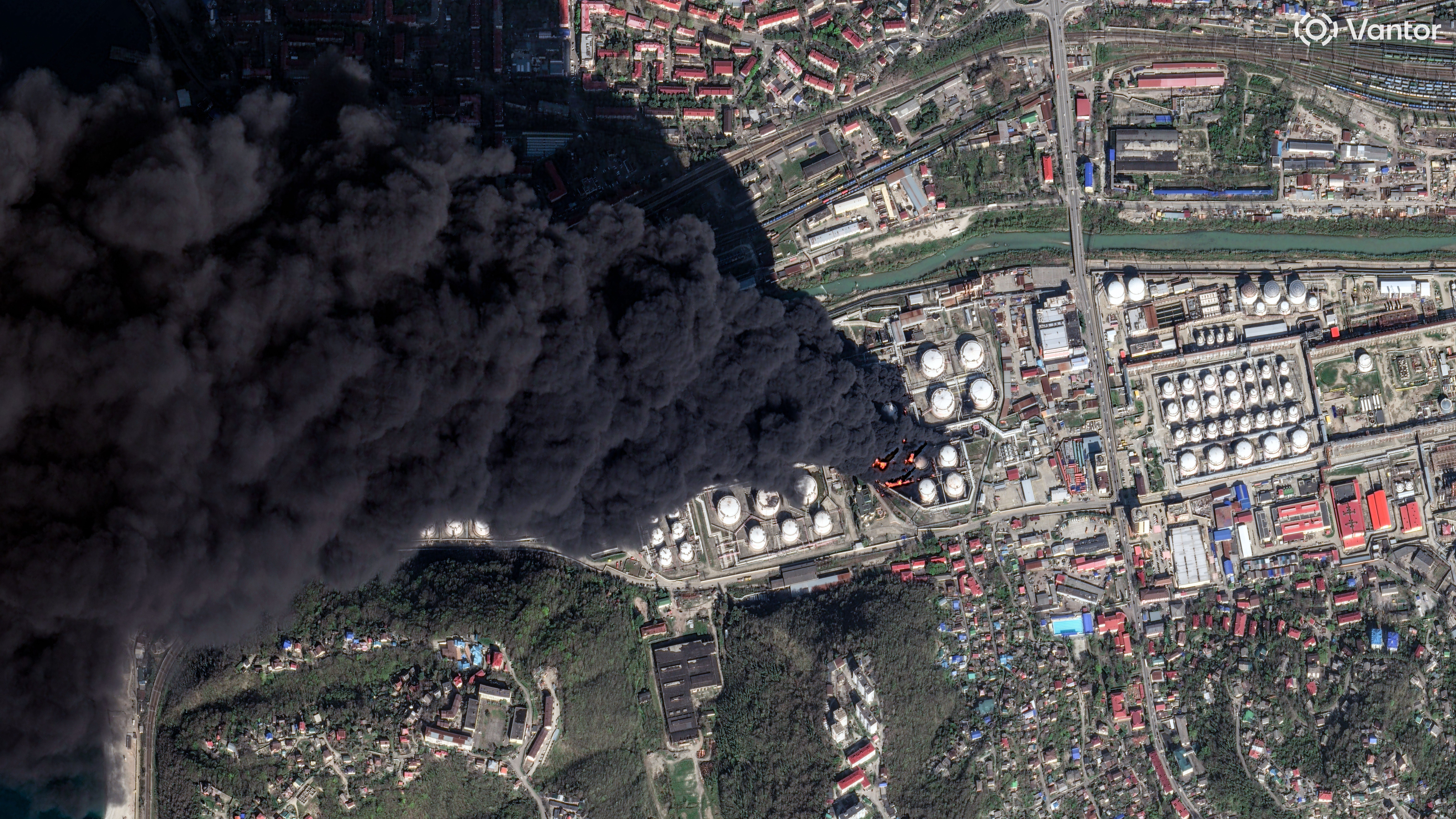
The apocalyptic scenes coming from Tuapse in the Russian Federation, with oil raining from the skies and burning through the streets, are just the latest illustrations of the measures Ukraine is taking against the Russian oil industry. Ukraine has taken a hammer to Russian oil processing and exports, calling this their long-range sanctions in lieu of European and U.S. sanctions that do not work.
From afar, it might seem that Ukraine is hitting anything within the oil industry it can reach. In fact, Ukrainian attacks are three-pronged, directed at Russian export capacity, budget revenue, and future oil production.
The Way We Were
Although hardly anybody remembers it now, the first Ukrainian attack on Russian oil infrastructure came very early in the war. Two Ukrainian Mi-24 helicopters crossed the Russian border at low altitude in the early hours of April 1, 2022. The target was a Rosneft-owned fuel depot in the city of Belgorod, approximately 35km from the Ukrainian border. Eight fuel tanks caught fire. Two depot workers were injured. Nearly 200 firefighters were deployed.
At the time the rationale for the attack, in addition to a much-needed morale boost for Ukraine, was that it would complicate Russian troop movements by depriving them of fuel.
In 2023, as Ukraine increased the range of its attack drones, it started attacking oil refineries in Russia—initially only within a 500km radius, as the current 2,000km range was still years away. Ukraine targeted specialized equipment—catalytic crackers, hydrotreaters, vacuum distillation units, and primary processing columns. These are technologically complex and depend on Western specialty manufacturers, and Russian sanction avoidance was still in its infancy, so spare parts were difficult to come by.
In fact, Ukrainian attacks contributed to the first fuel export ban in September 2023. A combination of a spike in military demand, holiday traffic, the autumn harvest, and refinery repair delays under sanctions had created real shortages within the country. The state often described as a “fuel station” had no fuel. And since it did not have any storage, it did not have reserves.
The Other Side of the Refinery
At the start of 2024, Ukrainian drones turned to oil and gas depots, terminals, pumping stations, and port facilities. The burning storage tanks produced the most spectacular results—they burned for days and were filmed extensively by locals. However, the overall consensus was that they were merely a sideline for Ukrainian attacks, and that processing equipment and port infrastructure constituted more valuable targets.
These and further attacks caused Russia some difficulties, but the losses were not considerable—until the war in Iran started. Russia should have finally been able to cash in by selling oil at a higher price. But, in late March 2026, Ukraine hit its most valuable ports in the Baltic Sea, so Russia could not get its oil out of the country.
Then, in April 2026, the Tuapse refinery and marine terminal were hit four times in two weeks, destroying 24 storage tanks as well as the marine terminal that loaded the tankers. Days later, Ukraine struck Perm, over 1,500km from the border, hitting both the Transneft pumping station and the Lukoil-Permnefteorgsintez refinery within 24 hours, with most of the storage tanks at the pumping station reportedly burning. That is when Ukraine’s strategy became clear.
Ode to Storage
Most countries have strategic oil reserves intended for a rainy day. The United States has massive salt caverns that can hold up to 700 million barrels of oil. Their structural integrity requires a certain amount of oil to be kept there at all times, so the oil available for release is usually less. China’s strategic oil reserves are well over one billion barrels, although the exact number is not publicized, and a large part of this storage was created within the last ten years.
Russia, on the other hand, has no strategic oil reserves. They never built them.
The main reason is that most Russian infrastructure was built in the Soviet era, when labor was cheap and the working population had no choice. Corruption existed, but it took different forms. Elites had better access to goods, schools, and housing rather than money. Money could not buy everything. There was no private property in the USSR, and no private businesses. So, all the large infrastructure projects were built to last centuries and withstand a nuclear strike.
However, Soviet officials determined that they did not need any strategic reserves because their oil was in the ground. Consequently, no storage facilities were built. What they did build, though, was a vast network of oil refineries with substantial operational storage. This processing buffer was the closest thing Russia had to a reserve, and this is what it inherited after the fall of the Soviet Union.
While the attacks on oil refineries and the storage tanks were disregarded almost as publicity stunts, they turned out to be very important in combination with the attacks on Primorsk, Ust-Luga, Novorossiysk, and Tuapse ports. When ports are damaged and cannot move oil or fuel out of the country, that oil or fuel has to stay put, so needs to be stored somewhere. Further, attacks on ports usually involve attacks on storage tanks as well, meaning the remaining tanks are insufficient to store all the leftover oil. Again, it would not be an issue if the refineries had all their oil tanks intact and ready for storage. Refineries, however, have been fixing or replacing their storage tanks almost non-stop for the past couple of years. Building a large 50,000 cubic meter storage tank can take up to two years, smaller ones up to a year—and that’s assuming the imported parts are available.
In summary, Russian producers end up with oil they cannot store. Existing storage is full, so they have no room for newly extracted oil. Oil wells, however, cannot be turned on or off with a flick of a switch—at least not in Russia. Oil wells in Russia are mostly old, drilled decades ago and worked hard ever since. They depend on continuous water injection to maintain reservoir pressure, and they produce oil with very high water content. When such a well is closed, paraffin solidifies inside it, pressure drops, and the reservoir itself suffers permanent damage. Once production has been stopped, it can be restarted only with significant investment, and that investment exceeds the future profits from the well. Which means that once an oil well is closed in Russia, that should be the end of it.

When the Wells Bottom Out
This is already happening. According to Reuters reporting in late April, Russian oil output has fallen by up to 600,000 barrels per day compared to late 2025 levels—roughly 7 percent of total production, and the sharpest monthly drop since the COVID pandemic. Industry analyst Mikhail Krutikhin has cited more recent reports suggesting the figure may already be approaching 800,000 barrels per day. Either way, this is not the total. Production has been falling steadily as long as ports and refineries remain under attack.
That production will not come back. Russia can drill new wells, yes—but with what money? Foreign investment has dried up, almost all oil companies are under direct Kremlin rule, and around 40 percent of the Russian federal budget is committed to defense and security. There is simply no money for new wells.
If the irreversible decrease in oil production were not enough, the current shutting of wells also reduces budget revenues. Oil in Russia is taxed at the point of extraction. As long as oil is being extracted, the revenue stream is maintained and taxes are paid into the budget, even if it never leaves Russia. When oil can no longer be extracted because there is nowhere to store it, even if there is demand domestically, current tax revenues drop. And future ones are affected too—there will always be less oil to tax from that moment onwards.
Sanctions Are as Sanctions Do
Most of the recent commentary has framed Ukraine’s spring 2026 strikes on oil infrastructure as an effort to prevent Russia from cashing in on high oil prices during the Iran war. And that is correct, although only on the tactical level. Denying Russia additional revenue is only the immediate result of these attacks. The strategic objective is to reduce Russia’s oil production capacity altogether—not to lower earnings per barrel, but to ensure that fewer barrels exist to be earned from. The Iran war provided a tactical opportunity to accelerate the campaign and to magnify its visible effects. But the campaign was already a long time in the making.
Western sanctions, such as they were, sought—in theory—to restrict Russia’s oil revenues. In reality, they never worked. Russia routed around the G7 price cap from the start, and the West lacked either the will or the means to close the loopholes. Under Trump, sanctions multiplied while enforcement disappeared entirely.
In the meantime, Ukraine, having relied on the Western world to do what it claims to do best—namely, enforce the international order—in the end had to work out how to decrease Russian oil revenues on its own. Unlike Trump’s sanctions, which can be turned on and off without rhyme or reason, and unlike European sanctions, which can be reversed the moment the EU’s financial position weakens, Ukrainian strikes cannot be walked back once a certain result has been achieved. By hitting the entire oil chain, including depots, pumping stations, marine terminals, and storage facilities, Ukraine has removed close to 10 percent of Russian oil production from the equation. Unless Russia makes considerable investments in new oil wells, this 10 percent will not be recovered.
And under current circumstances, with a large fiscal deficit, an economy in catastrophic condition, and almost half of the budget committed to the war, that investment is not coming.
Ines Burrell is a geopolitical analyst and political risk consultant based in the UK. Born in the Baltics, with a degree in International Relations from the University of Exeter, she writes and gives live commentary on European security and Russia.
Follow Persuasion on X, Instagram, LinkedIn, and YouTube to keep up with our latest articles, podcasts, and events, as well as updates from excellent writers across our network.
And, to receive pieces like this in your inbox and support our work, subscribe below:
 | A guest post by
|