

Socialism Could Be the Future of the Democratic Party
We should reject the new DSA platform without underestimating its popular appeal.

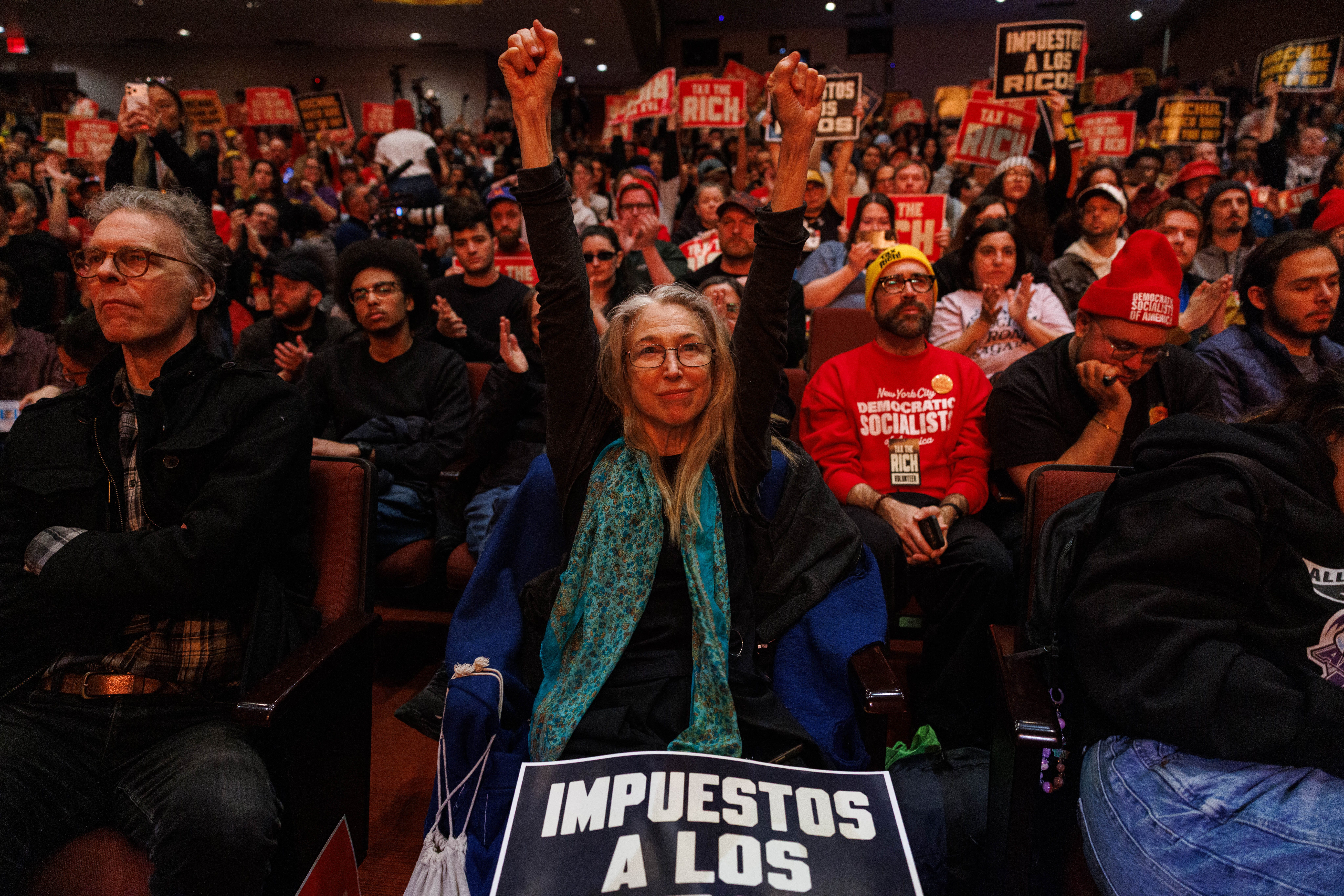
“The Communists disdain to conceal their views and aims,” Marx and Engels declared in 1848. Apparently, the same goes for the Democratic Socialists of America.
Earlier this month, the DSA unveiled its platform, and no one can accuse them of hiding their radicalism. The DSA promises public ownership of large corporations, elimination of prisons and police, a “defunded” Pentagon, and much freer migration across U.S. borders.
But what really stood out among this standard far-left wish list was the platform’s call for a total reshaping of the U.S. constitutional system. Instead of three branches—legislative, judicial, and executive—the DSA would replace the president and Supreme Court with “an executive and judiciary chosen by and subordinate to Congress,” which in turn would no longer have a Senate but consist of a single House of Representatives.
This goes beyond previous DSA proposals to rein in the Supreme Court’s power of judicial review and elect the president by popular vote. Now, the DSA is repudiating the separation of powers itself, which has been the essential bulwark against tyranny since the American founding.
Obviously, the DSA feels energized and validated by having defeated establishment Democrats and captured the mayoralties of New York and Seattle, the Democratic nomination for Washington, D.C.’s mayoralty, plus four likely seats in the U.S. House in recent months. This raises a troubling question: What if the radicalism of the DSA’s constitutional plan is not its weakness but its strength?
That is the really scary possibility. And it’s worth taking seriously.
The DSA issued its platform against a backdrop of deep, widespread public frustration with the United States’ institutions. This legitimacy crisis, in turn, has spawned a sense among many—possibly most—Americans that our political system is broken and needs fundamental change, not incremental reform.
Public opinion data documents this sentiment. Just last year, a Pew Research Center poll found 77 percent support among Americans for “major” or “complete” reform of the U.S. political system. This was far higher than figures for peer nations such as Germany (48 percent) or Canada (47 percent).
A 2025 Navigator Research survey, meanwhile, found that three in five Americans—across all parties and ethnicities—favor “major changes” to the political system. A full one in eight said it “needs to be torn down completely.”
Then there’s the 2024 poll for Penn State’s McCourtney Institute on Democracy. It found that 20 percent of adults, when presented with the statement “when I think about our political and social institutions I cannot help thinking ‘just let them burn,’” agreed with it. Among respondents aged 18 to 27, the figure was 32 percent.
Of course, this is a far cry from evidence that voters would necessarily back the specific items in the DSA’s platform. Many people who tell pollsters they want to blow up the system and start fresh support President Donald Trump. Their notion of political reform would probably include Republican policies like mandatory voter ID or ending mail-in ballots.

In spirit, though, the DSA’s platform is not out of sync with the public, whose restlessness is fueling unorthodox, disruptive ideas and behavior at both edges of the ideological spectrum. It is of a piece with phenomena as disparate as the mass protests against ICE in Minneapolis, or Spencer Pratt’s quixotic AI-enhanced campaign for mayor of Los Angeles, or the surge of support in Maine for Senate candidate Graham Platner—which persisted for weeks in spite of multiple personal and sexual misconduct allegations.
The mere fact that the country is talking about the DSA’s outré ideas shows that the Overton Window has opened wider. It’s yet another victory for this erstwhile far-left microfaction in addition to the offices it has captured and the influence it is gaining over Democratic Party politics.
Countering the DSA will require an effort by the Democratic Party and its leading figures to defend the constitutional system. This should be no problem given that the Constitution has stood the test of time for more than two centuries, and that the Democrats have—with reason—invoked it against Trump.
For now, however, they still seem spooked by the DSA’s rise, and at a loss for clear, crisp words. Asked if she supports the DSA proposal to abolish the Senate, possible presidential hopeful Alexandria Ocasio-Cortez said she didn’t, but mainly spoke of the upper chamber as a necessary evil: “It is what it is,” she said. AOC sounded very much like a progressive politician struggling to retain mainstream viability without getting outflanked on the left.
The truth is that the two-member-per-state Senate is, by design, a quasi-aristocratic restraint on the House of Representatives, which is closer to the people. Making his case 239 years ago, James Madison told his fellow Framers that “the nature of the senatorial trust, which requires greater extent of information and stability of character,” would allow the chamber “to proceed with more coolness, with more system, and with more wisdom than the popular[ly elected] branch.”
Madison’s argument was wise then and remains so today. But his logic lacks intuitive appeal to modern generations. They have been educated by their professors to think of the Founders as self-interested elitists, and by their populist politicians, including President Trump, to think of Madison’s whole system as “rigged.”
The DSA’s new platform represents a bet that the U.S. political system is losing legitimacy, and that they have an opportunity to assert power over the left side of a deeply polarized electorate before, ultimately, remaking American democracy in their image. They are confident and they mean business.
The question is whether their opponents do, too.
Charles Lane, a contributing writer at Persuasion, is a nonresident senior fellow at the American Enterprise Institute and a columnist for The Free Press.
Follow Persuasion on X, Instagram, LinkedIn, and YouTube to keep up with our latest articles, podcasts, and events, as well as updates from excellent writers across our network.
And, to receive pieces like this in your inbox and support our work, subscribe below:
 | A guest post by
|