


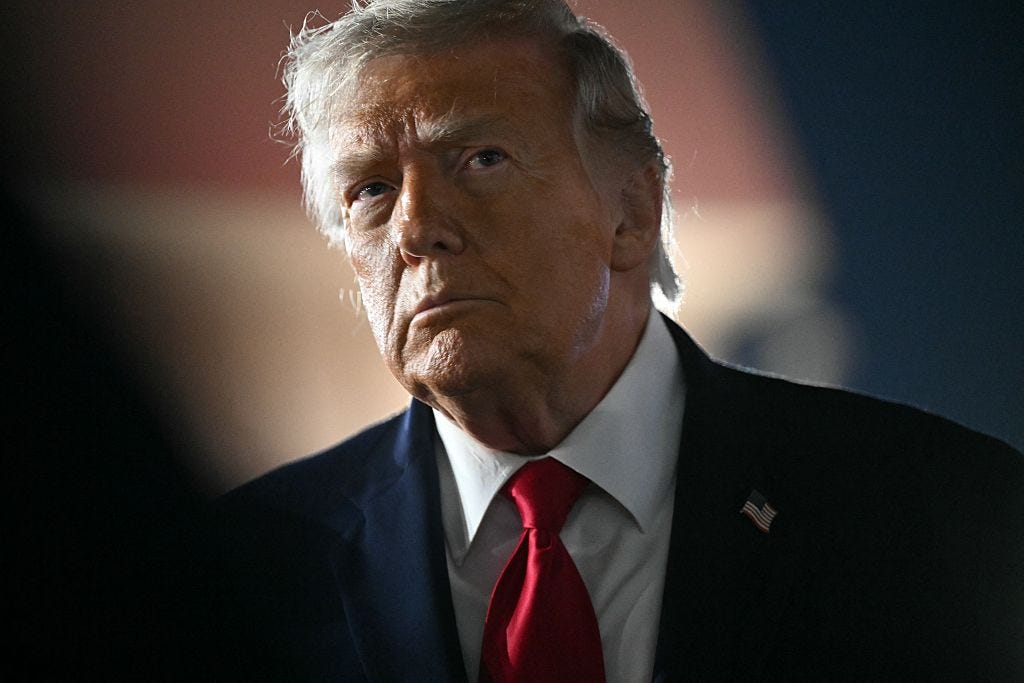
So Donald Trump, on his 80th birthday, announced a deal in which there would be a 60-day ceasefire. Precise details have not yet been officially published. But, according to reports, they apparently include a cessation of attacks in Lebanon, the reopening of the Strait of Hormuz—according to Trump, “permanently toll-free”—and lifting the U.S. naval blockade of Iranian ports. He touted this as a key win, in the process praising China’s Xi Jinping and Russia’s Vladimir Putin for helping secure it.
This “deal” was nothing of the sort. If the reports are accurate, it instead represented a total U.S. capitulation to Iran. It basically set the clock back to February, when the Strait was open and the United States and Israel had not yet started bombing the Islamic Republic. It merely solved a problem that Trump and Israeli Prime Minister Benjamin Netanyahu had themselves created by launching the war in the first place.

Still left up to future negotiations are all of the objectives that the Trump administration has set forth over the past three months in trying to justify the war:
There was no regime change or “unconditional surrender”; the Islamic Revolutionary Guard Corps remains even more firmly in control of the country than previously;
There was no commitment by Iran to turn over its stockpiles of enriched uranium;
There was no commitment to stop enriching uranium, either immediately or on some specified date in the future;
There were no commitments on ending Iranian support for allied groups like the Houthis or Hezbollah in the region;
There was no agreement by Iran to let up on the violent suppression of protesters.
The reported “Memorandum of Understanding” (MOU) kicks all of the contentious issues down the road into negotiations that are to take place during the 60-day ceasefire. Trump treated all of these issues as having been conceded already, but if that were the case, why weren’t they in the MOU? It is very unlikely that Iran will budge over the next two months, since it is precisely these issues that speak to the regime’s core identity.
Trump stated that if Iran didn’t agree to these outstanding terms, he would re-commence the war and possibly make the United States “the guardian of the Middle East” in return for 20 percent of the region’s revenues. It is hard to know whether such an initiative is more ludicrous from the standpoint of countries in the Middle East, including U.S. friends like Saudi Arabia or the UAE who would now be paying explicitly for U.S. protection, or from domestic opinion in the United States, where everyone would like to be done with the region as soon as possible.
The MOU that Trump celebrated is a worse agreement than Obama’s 2015 deal, which Trump endlessly castigated in the past. Obama’s deal forbade Iran from enriching uranium beyond 3.67 percent for 15 years (far below the 90 percent enrichment necessary for bomb-grade purposes), and provided specific measures for removing enriched uranium from Iran. All of these provisions were to be overseen by outside inspectors, and Iran complied with its terms until Trump withdrew from the agreement. The major criticism of the deal, which U.S. hardliners stressed, was that it said nothing about Iranian support for regional proxies and that it provided sanctions relief at the start of the agreement.
Trump’s reported MOU, meanwhile, places no limits on Iran’s nuclear capabilities, and makes no commitments about regional proxies. It does not provide for sanctions if Iran doesn’t concede by the end of the 60 days, though the Iranians have said that they will not proceed with final negotiations unless such relief occurs first. So Trump’s purported deal achieves considerably less than the agreement that Obama made.
It is clear that Trump is being driven to reopen the Strait of Hormuz at virtually any cost by the domestic pressure from rising oil prices and inflation. Being unwilling to send ground forces to Iran, he has had few cards to play over the past six weeks to get further Iranian concessions. So he has chosen to back down and accept a return to the status quo ante from before he began the war on February 28.
The world will indeed be better off if the Strait is re-opened. Perhaps Trump’s hardcore MAGA supporters can be persuaded that he has negotiated a consummate deal and achieved a great victory. But everyone else will understand that the world’s most powerful country is being run by a feckless and ignorant president who will impose immense costs on both other countries and his own people if he thinks it will benefit himself.
Francis Fukuyama is the Olivier Nomellini Senior Fellow at Stanford University. His latest book is Liberalism and Its Discontents. He is also the author of the “Frankly Fukuyama” column, carried forward from American Purpose, at Persuasion.
Follow Persuasion on X, Instagram, LinkedIn, and YouTube to keep up with our latest articles, podcasts, and events, as well as updates from excellent writers across our network.
And, to receive pieces like this in your inbox and support our work, subscribe below:
What Trump accomplished with this war:
1) He's let Iran make him look submissive.
2) He betrayed the supporters who he promised no more wars and lower prices.
3) He's practically guaranteed the Republicans a disaster in November.
4) He's given people reason to compare him unfavorably to the person he hates more than anyone in the world.
Am I missing anything?
I am, again, Persuaded. Perhaps enough has been written about how we got here, or rather the psychology of someone that would put the US in this position in the first place. Words like naivete and egotistical and even deluded come to mind. But I think there is another one that is more accurate, and that is Gambler. I am beginning to think this is actually what is behind the mask. Perhaps the other words as well, but definitely Gambler. Just like Putin walking into Ukraine was a big bet on the West not being willing to get involved (how's that working out for ya Vladi?). Trump trying to show he can do it too! Try it out and if it doesn't work, then obfuscate and back out. The Gambler.