

Why Iran Continues to Choose War Over Peace
A deal may be in sight, but it won't bring peace in the Middle East.


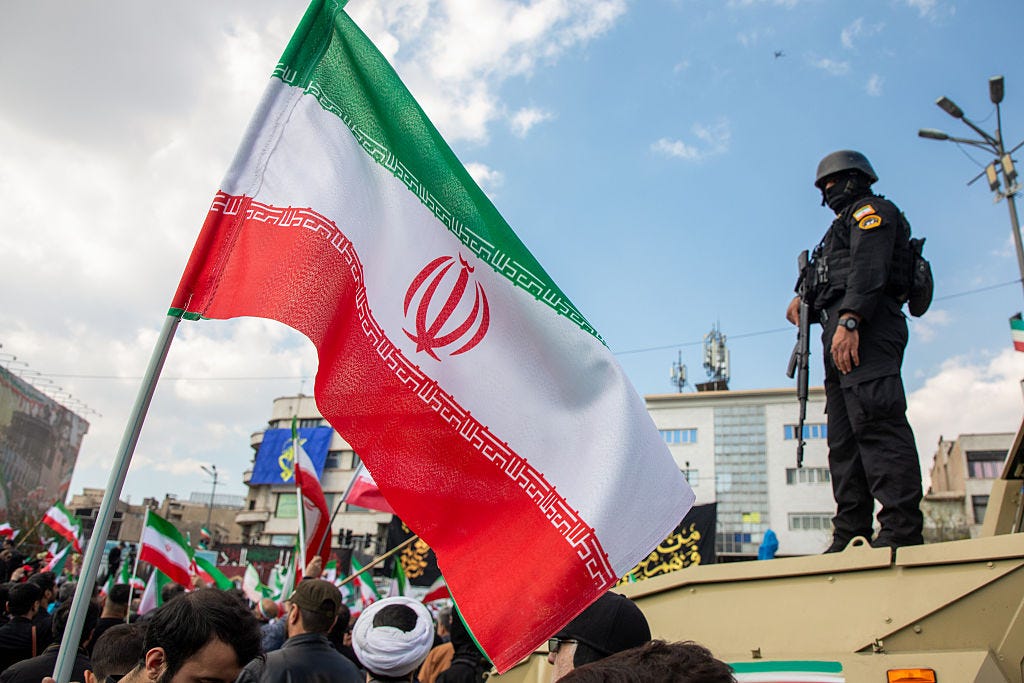
On June 9, a U.S. Apache helicopter was reportedly shot down by the Islamic Revolutionary Guard Corps’ (IRGC). Forty-eight hours prior to this, the IRGC fired ballistic missiles towards Northern Israel. These attacks on Israel came just days after Tehran carried out strikes on Bahrain and Kuwait—and as President Trump attempted to pressure Tehran to reopen the Strait of Hormuz and move toward a broader settlement.
These events should temper Western optimism about the negotiations currently underway between Iran and the United States. Even if a deal to reopen the Strait of Hormuz and extend the ceasefire has “never been closer,” as Iranian Foreign Minister Abbas Araghchi said on Friday, the issue is that the main actor shaping Tehran’s behavior is not the civilian government but the IRGC. For the Guard, keeping the Persian Gulf in a state of controlled crisis is not just a bargaining tactic; it is also a way to further marginalize civilian institutions and preserve the security order through which it now dominates the Islamic Republic.
The extent of the IRGC’s dominance in the regime was made clear when it singlehandedly decided to wage a drone attack on the United Arab Emirates on April 30. Based on leaked reporting, President Masoud Pezeshkian was furious over not being informed about the IRGC’s decision, reportedly calling the escalation “madness” and warning that it could push Iran back into a full-scale war. The military-security core of the regime, especially the IRGC, sees a contained war and crisis as an opportunity to accelerate its existing plan to completely take over the state.

This runs against the view of some observers who believe the Islamic Republic will eventually choose a deal over war. From this perspective, Iran is under pressure, its economy is being destroyed, its society is exhausted, and its military infrastructure has been badly damaged. Therefore, according to this view, as a “rational” regime, Iran will seek de-escalation, compromise, and sanction relief. But this take fails to properly grasp the nature of the IRGC.
The IRGC does not view war and peace the same way a normal state institution does. It is not simply a military organization defending national borders. Instead, it was created to defend the Islamic Revolution, the Velayat-e Faqih (clerical guardianship), and the regime’s ideological identity. Its mission has always been larger than Iran’s territorial security: it includes exporting the 1979 Islamic revolution, eradicating the State of Israel, confronting the United States, protecting the regime from internal enemies, and reshaping the regional order.
This is why the IRGC may prefer a contained war, or at least a continued limited confrontation, to a deal based on major concessions. For the Guard, compromise is an ideological danger. Shaped for decades by thorough indoctrination, selective recruitment, and internal surveillance, IRGC members are trained to see the world through the lens of resistance, martyrdom, anti-Americanism, antisemitism, and blind loyalty to the Supreme Leader.
Since its inception, every major crisis in the history of the Islamic Republic has resulted in the expansion of the Guard’s role. The 1980-88 Iran-Iraq War transformed the Guard from a revolutionary Islamist militia, which was established to protect the clerical rule, into a professional military force with five branches. Similarly, the 2009 Green Movement uprising—which saw millions of Iranians take to the street—resulted in the IRGC’s monopolization over the security and intelligence apparatus of the regime. Much like the Iran-Iraq war, the Syrian civil war led to the expansion of the IRGC’s elite Quds Force. The IRGC has calculated that, unless it results in the complete collapse of the system, the current war—which began in June 2025 and continues to this day—can accelerate this trajectory by further empowering the Guard and turning it from a deep state into the dominant state itself.
As a result of the war, IRGC commanders have become indispensable, while the state bureaucracy, parliament, diplomats, and even presidents are completely secondary. Nobody takes the president seriously, even in his own administration, while the parliament has been closed since February, and many of its members are unaware of wartime developments. The state apparatus has been marginalized completely—while the security forces are now making all decisions.
Furthermore, IRGC members live in an isolated, institutional world, and their salaries, businesses, privileges, housing, hospitals, and networks are tied to the regime, meaning they often do not feel the same pressures ordinary Iranians do. Sanctions hurt Iran, but they also create opportunities for the IRGC. A closed and sanctioned economy increases the value of those who control borders, ports, contracts, hard currency, and black-market channels. And while the IRGC would still benefit from the lifting of sanctions—as was the case under Obama’s 2015 nuclear deal—the illicit economic ecosystem it currently commands remains of greater strategic value.
Finally, since the conflict began, the United States and Israel have eliminated more than 100 high-ranking IRGC commanders as well as the late supreme leader, Ali Khamenei. For the IRGC, these were spiritual leaders, peers, mentors, brothers, and fathers. Accepting a deal with Trump could be framed as a betrayal of the martyrs, not just inside the organization itself but also among the roughly 10% of the Iranian population who are radical Islamists. Thus, such a “betrayal” would risk the collapse of the IRGC’s reputation within its core support base.
But what does all this mean for the Trump administration? It is clear that as long as the IRGC exists, a permanent solution to the Strait of Hormuz crisis—and long-lasting peace in the Middle East—remains unattainable. Any strategy pursued by Trump and America’s Western allies should therefore focus on continuing to undermine the IRGC. This includes a range of measures, from restricting the Guard’s access to financial resources through clamping down on illicit sanctions evasion networks and stricter sanctions enforcement—something Trump should pressure European governments to implement—to dismantling its regional infrastructure and weakening the organization through military means.
Despite the defeatist rhetoric that is prevalent in much of the mainstream media, regime change in Iran remains possible—but only if the IRGC is significantly weakened. Until then, the IRGC will pursue its “forever war,” threatening regional stability, the global economy, and U.S. national security.
Kasra Aarabi is the Director of Research on Iran’s Islamic Revolutionary Guard Corps at United Against Nuclear Iran.
Saeid Golkar is an associate professor of political science at the University of Tennessee-Chattanooga, a senior advisor at United Against Nuclear Iran, and a writing fellow at the Middle East Forum.
Follow Persuasion on X, Instagram, LinkedIn, and YouTube to keep up with our latest articles, podcasts, and events, as well as updates from excellent writers across our network.
And, to receive pieces like this in your inbox and support our work, subscribe below:
Kill the civilian leadership, and the IRGC becomes more powerful. Gee, who could have predicted that?
This is a very helpful article for those of us who are trying to understand Iran and its relationship to the IRGC. It is much clearer now (to me at least) than what I've been reading, which is not extensive.
But I have one question that has been on my mind from the start of this war. The authors say that, among the things the IRGC is devoted to is "blind loyalty to the Supreme Leader." That seems to be an entirely logical consequence of their founding and growing influence. But what does that mean right now, exactly?
We know the former Supreme Leader has been killed. Apparently there is a new Supreme Leader, though no one has seen or heard from him directly. Is it an actual fact that he is alive and/or conscious? While that doesn't seem to be verifiable, I'm sure it's possible. But like God, himself, we only know about him because of hearsay by certain self-appointed spokespeople.
If he's not alive or able to lead, though -- which I continue to think is also quite possible -- doesn't that leave the IRGC leadership (what's left of it) in a very convenient situation with respect to one of its guiding precepts? Don't they have the ability to make things up? Aren't they, in fact, kind of supreme by default?
I don't know what to think about that, and the mystery of their leader's existence is a constant irritant to me as far as understanding this story. That's also been a problem for me with my own Catholic religion, of course. But at least what we have for a Supreme Leader on earth is an identifiable human with a voice, however much we may sometimes question it. And he has no military forces at his disposal, which is a comfort to me. Religions with organized and funded armies are a scary thing to contemplate. Particularly if they don't have anyone to answer to.