

The Islamic Republic Is More Dug in Than Ever
The propaganda war has tilted the regime’s way.

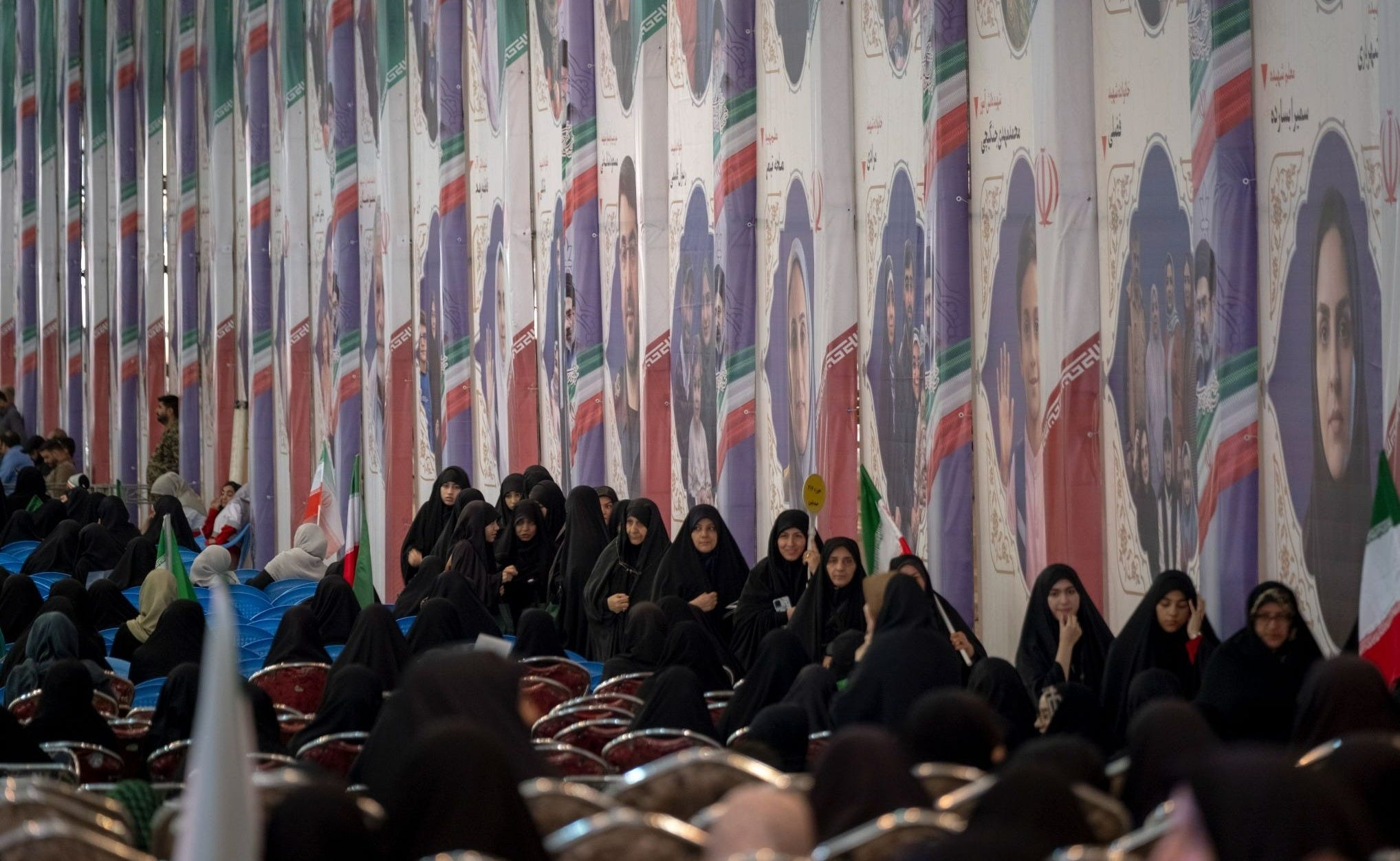
The war with Iran is now in limbo, somewhere between ceasefire negotiations and the next explosion.
After weeks of joint U.S. and Israeli strikes, the elimination of its top leaders, and President Trump’s repeated threats, the Islamic Republic appears not weaker but something else… exposed. The war pulled back the curtain. What was standing behind the regime was the Islamic Revolutionary Guard Corps (IRGC), now more powerful than before and more visible than ever. At the same time ordinary Iranians have lost more freedom and access to basic rights. With the blockade of the Strait of Hormuz, the regime displayed how far it could flex its muscles and hold global markets hostage, while the United States appeared far less decisive than initially expected. Both sides have declared victory, and neither can explain what was won.
The most underreported story of this war is the information war, and in many ways, the Islamic Republic has proved far more adept at it. The side that controls the flow of information gains more than the side that inflicts the most damage. The true legacy of this war may not be the destruction of the Islamic Republic; it may be who gets to narrate what happened.
Every time I talk to people in Iran, the first question they ask me is: “What do they say over there? What’s happening?” There is something deeply unsettling about people living inside a war asking those of us outside to tell them what’s happening.
During the last 90 days of the internet shutdown, there have been only a few ways to connect with those inside: a phone call that costs a fortune, or an IRGC-backed app called Bale, both heavily monitored by the military. Unless you are among the small group granted privileged SIM cards by the regime, real communication has become nearly impossible. I have not been able to have a candid conversation with those inside. Not for weeks. They’re afraid. Phones are tapped. Silence has become the only safe language. This is what the information war looks like from the inside: a vacuum the regime fills, unopposed, with its own version of events.
I spoke to a family friend who left me a voice memo explaining the mood inside Iran:
It’s like they spread death dust over the city. Everyone is depressed. People are sad and checked out. Especially seeing how emboldened the Islamic Republic supporters have become.
The fear is no longer just of the government. Regime supporters have become more impassioned. They are out in the streets every night guarding neighborhoods, gathering publicly to show support—some holding guns, others appearing on state television celebrating marriages with rifles in their hands.
My friend continued: “This is what they wanted all along—to die for their cause. And now the war is giving them exactly that.”
For almost five decades, the Islamic Republic has maintained itself through a narrative of confrontation with the West, particularly the United States and Israel. In schools, after Friday prayers, during national ceremonies and state broadcasts, there were chants, slogans, and stories centered around hatred of Israel and the United States. The regime framed its identity not just as a government, but as part of a cosmic struggle between good and evil, connected to the next return of the Mahdi—an apocalyptic vision of justice and redemption. To many of the Islamic Republic’s committed followers, conflict with the West is not just political. It is existential, even sacred. And when that conflict finally arrived in the form of airstrikes a few months ago, it did not shatter the narrative—it confirmed it.
The regime exploited this information vacuum. With independent journalists absent from the ground and social media flooded with competing narratives and AI-generated content, the line between truth and fabrication became impossible to discern. In that confusion, what was happening to ordinary Iranians became ever-harder to verify.
Among those captured by this shift are people I never expected to succumb to the regime’s propaganda. Family members who lost loved ones to its prisons. Friends who had been arrested. Acquaintances who spent years in exile because of the Islamic Republic. Under foreign bombs, something in them shifted. Nationalism filled the space where opposition had been. I have watched some of them, in recent weeks, post on social media defending the Islamic Republic—not out of belief, but out of something older and harder to argue with: the patriotic defense of their country. The regime didn’t have to do anything to persuade them. It only needed someone to drop bombs on their loved ones.

The Islamic Republic is not misunderstood in one direction; it is misunderstood in every direction. The American right views the regime as irrational, incompetent, and easy to defeat from the air, hence the recent war. The left often frames it as an underdog, a product of Western intervention, shaped more by outside pressure than by its own intentions.
Recently, at a gathering, I found myself surrounded by progressive liberals mourning Islamic Republic figures such as Ali Larijani and Ali Shamkhani, senior regime insiders killed in airstrikes, as Iran’s “moderate voices who could have potentially led Iran to democracy.” These—it seems too easy to forget—are the same men who spent decades holding Iranians hostage to an ideology, overseeing the repression and killing of thousands.
This is another Western misunderstanding that strips the regime of something essential: agency, capability, and intelligence. The Islamic Republic is a system built with a purpose and is deeply invested in its own survival. It learns to adjust quickly, and under pressure does not dissolve but consolidates.
The Islamic Republic is a revolutionary ideological system rooted in political Islam. Its foundations were built not on delivering prosperity, but on preserving an ideological project. That project is rooted in resistance, in the belief that pressure from outside is not a threat to the regime’s existence but a validation of its purpose.
The war that the United States and Israel waged was not a surprise to the regime. It was something the regime had structurally prepared for and, in some ways, leveraged. The attack has not only empowered hardliners but has also allowed the regime to reframe survival as victory. If the war was fought on two fronts—physical and informational—the Islamic Republic proved far more prepared for the latter.
Now everyone is waiting for a deal. But a deal requires something neither side has shown it can do: admit the other side is here to stay. For the Islamic Republic, that means negotiating with the country it has spent 47 years denouncing. For Donald Trump, it means accepting an outcome that looks less like victory than a compromise with a heavy price tag. Neither side wants to be humiliated. And the fear of humiliation, more than questions of uranium enrichment or sanctions, may be the greatest obstacle to peace.
But there is a third party to these negotiations with no seat at the table: the Iranian people. Any deal struck now will be made in the dark without their voice, without their knowledge, possibly against their interests. The information war did not just shape the military outcome. It is now shaping the peace.
The internet is slowly returning. A deal may be somewhere on the horizon. But I keep thinking about my friend’s voice memo:
I will delete this voice message, but you can keep it. Listen… if this war ends with no real result, we’re in deeper trouble than before. God help us.
Mitra Vand is an Iranian-American writer from Tehran. Her work examines authoritarianism, exile, and the emotional consequences of political violence. She writes under a pseudonym.
Follow Persuasion on X, Instagram, LinkedIn, and YouTube to keep up with our latest articles, podcasts, and events, as well as updates from excellent writers across our network.
And, to receive pieces like this in your inbox and support our work, subscribe below:
 | A guest post by
|
There is only one way to defeat fanatic terrorists. Exterminate them.
Mersi Mitra, for elucidating the information environment of the Islamic Republic and the war