

The Japanese Love Their Prime Minister. This Is Huge
An apolitical nation is genuinely excited about its new leader.

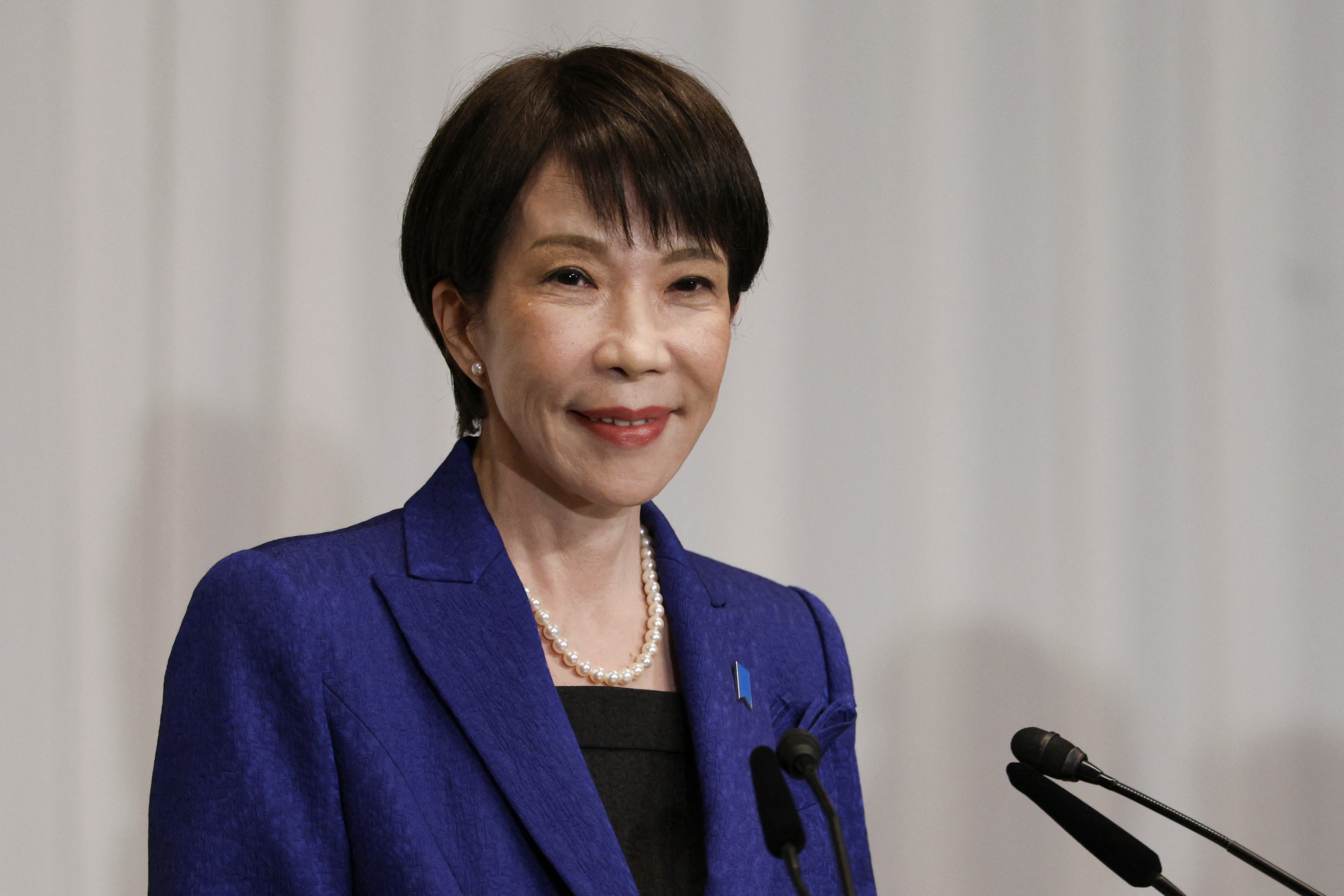
On paper, Sanae Takaichi is the kind of leader Japanese people ought to hate. Bossy, opinionated, conspicuously unbothered by the rituals of consensus that grease every surface of Japanese official life, she comes across as everything the country’s political culture is designed to sand down. She doesn’t schmooze with captains of industry over kaiseki dinners at fancy Tokyo restaurants. She goes home and reads her briefing papers.
She plays drums in a heavy metal band—or used to in college, and still can, as South Korean president Lee Jae-myung discovered to his evident alarm at their January summit. She has opinions about Taiwan and isn’t shy about sharing them, which in the context of Japanese-Chinese diplomacy is roughly equivalent to setting your hair on fire at a funeral.
Something for everyone to hate.
And so the three months since Takaichi took office have been a bit of a surprise. A country that famously “doesn’t do” politics—where low voter turnout is a punchline and prime ministers are interchangeable grey suits cycling through a revolving door—has seen a wholly un-Japanese surge of popular enthusiasm for a national leader.
If the TV news is to be believed, young women are copying her outfits, and teenagers are tracking down the exact model of her pink ballpoint pen. She placed third in the annual trend rankings for junior high and high school girls, wedged between an influencer and a boy band. Her nickname, “Sana,” has spawned “Sana-katsu”—essentially, fan activities—a term borrowed from idol culture and now applied to a 64-year-old conservative politician with rheumatoid arthritis.
One poll after her October inauguration put overall cabinet support at 71%. Among 18-to-39-year-olds, it was 80%. Another poll went further: among 18-to-29-year-olds, specifically, support hit 92%. That’s not a typo.
Yet another poll, with more conservative methodology, still found 78% support in the 18-to-39-year-old bracket in January—roughly 30 points higher than the previous prime minister, Ishiba Shigeru, whom Takaichi replaced after he stepped down last year following a string of bad election results for the conservative Liberal Democratic Party (LDP).
Takaichi’s support among women (72%) ever so slightly outpaces her support among men (71%), which is worth noting because every liberal commentator in Tokyo has spent the past three months insisting that Takaichi doesn’t represent women.
Then came the election. When she called a snap dissolution of parliament in late January—branded “the selfish dissolution” by opposition parties who resented being made to campaign in the dead of winter—the gamble looked risky. When she broke the LDP’s longstanding coalition with Komeito—a centrist party with roots in a strange Buddhist cult—commentators thought she’d straight-up lost her mind.
It turned out, instead, that voters didn’t mind the snow, and loathed the weird Buddhist hangers on. In the election, held last Sunday, the LDP won over two-thirds of the seats in the House of Representatives, surpassing the historic high-water marks of Japan’s most successful post-war leaders—Nakasone in 1986, Koizumi in 2005, and Abe in 2012. Until now, no single party has held a two-thirds supermajority in the lower house in the entire postwar era.
This isn’t about the LDP’s popularity. The party itself remains weighed down by financing scandals and decades of institutional rust. This is all about Takaichi. Voters told pollsters they were voting for her, often for the first time in their lives. One woman quoted in the Financial Times—a twenty-something in Tokyo who’d never before cast an LDP ballot—put it simply: “Japan needs someone different.”
What the hell is going on, exactly? Is this about policy or personality?
Japanese commentators are split, though the honest answer is probably: yes.
The personality case is strong. Takaichi’s brand rests on a perception that she is what the Japanese internet calls gachi—the real deal, dead serious, incapable of simply going through the motions. As the commentator Inoue Toshiyuki put it, young voters think she’s serious. Serious about politics. Serious about policy. Serious even, it turns out, about the drums.
She has a personal story to back this up. She wanted to attend a private university in Tokyo; her parents forced her into a national university with a six-hour daily commute because they didn’t think it was appropriate for a single girl to live alone. She broke through anyway—studying abroad, becoming a TV personality, entering politics, enduring a divorce, a remarriage, her husband’s declining health, and her own battle with rheumatoid arthritis. Japanese commentators call it haran banjō—a life of dramatic ups and downs—and it resonates in a culture that romanticizes perseverance.

Then there’s her work ethic, described as almost puritan. Takaichi doesn’t do the after-hours networking dinners: she’d rather be at home reading policy briefs. Whether this is principled or antisocial depends on your priors, but for a generation that associates the high cuisine ryōtei circuit with backroom corruption, it plays as refreshingly clean.
Then there’s her political brand. Takaichi is a conservative—not in the bland, split-the-difference way that characterizes usual LDP politicos, but in the muscular, conviction-driven register that Japanese politics generally filters out. She has visited Yasukuni, the incandescently controversial shrine that honors fallen Japanese soldiers very much including WWII-era war criminals, and she doesn’t apologize for it. She opposes allowing women to keep their own family names after marriage. She talks about constitutional revision to allow Japan to use its military more freely without whispering.
And, in November, she did something no previous Japanese prime minister had dared: she stated plainly, in a parliamentary session, that a Chinese military attack on Taiwan would constitute an “existential threat” to Japan, triggering the legal framework for collective self-defense.
Beijing lost its mind. The Chinese foreign ministry summoned Japan’s ambassador. Chinese state media ran furious editorials. A Chinese consul in Osaka posted on social media that Japan’s “dirty head” would be “cut off without hesitation.” China suspended travel advisories encouraging tourism to Japan.
From Takaichi’s perspective, this was perfect.
Polls showed 61% of respondents considered her remarks appropriate. The confrontation accomplished something extraordinary in Japanese politics: it made a security policy position popular. China’s overreaction made Takaichi’s nationalism cool, affirming the narrative that Japan faces a genuine external threat and needs a leader willing to name it. Some commentators suggested she’d bumbled into a confrontation, but she did no such thing. She walked in with her eyes open, and she walked out stronger.
The deeper point is about coherence. Takaichi’s muscular conservatism and her personal style aren’t two separate things packaged together for electoral convenience. They’re expressions of the same disposition. The woman who wouldn’t give up on a six-hour commute is the same woman who won’t back down from Beijing. The woman who goes home to study instead of networking is the same woman who gives straight answers in parliament instead of hiding behind diplomatic mush.
This is what distinguishes her from the parade of grey suits who preceded her. It’s not that Kishida or Ishiba—Japan’s previous two prime ministers, who came and went without you ever having to learn their names—lacked policy positions. It’s that their positions felt detachable from their personalities, like accessories swapped out depending on the occasion. Takaichi’s don’t. The conviction and the person are fused, and in a political culture exhausted by decades of anodyne consensus management, that fusion registers as a kind of electric shock.
Does any of this suggest Japanese society is fundamentally changing? Maybe. But I’d be cautious.
I doubt a single Japanese man has washed a single extra dish since October just because there’s a woman running the country. Takaichi won’t transform gender relations, and she has zero interest in trying. She opposes the one reform—allowing women to keep their surname after marriage—that feminists have spent decades fighting for. The junior high schoolers tracking down her ballpoint pen aren’t budding feminists; they’re fans, in the same way they’d be fans of an idol or an influencer. The engagement is real, but it’s not political. Not really.

What Takaichi is exploring is Thatcherism with Japanese characteristics. She’s a strong woman operating in a patriarchal culture, and she succeeds not by challenging the patriarchy but by being so conspicuously competent that the patriarchy can’t find a handhold to push back. A conviction politician first, a woman second.
In 1980s Britain, Margaret Thatcher didn’t advance the cause of feminism one inch. She advanced the cause of Margaret Thatcher, and she did it by being better at the job than the men around her. That’s the mold Takaichi is following, consciously—she cites Thatcher as a role model—and it’s working.
This matters because the alternative—Japan’s consensus-seeking political mainstream, the politics of managed decline and diplomatic euphemism—looks increasingly out of step with the times. China is threatening Taiwan, and Japan sits directly in the path of any conflict. The United States is under the most erratic leadership in its history. Russia’s war in Ukraine grinds on. The world feels more hostile than it has in decades, and the Japanese public seems to have concluded, with startling speed, that times like these call for someone who will say what she means and mean what she says.
That’s the Takaichi proposition. Not that she’ll remake Japanese society or close the gender gap or usher in progressive values. Just that she’ll be serious about the things you need a leader to be serious about: threats, policy, and the job itself.
In a country where the political class has spent a generation perfecting the art of studied vagueness, that turns out to be more than enough.
Quico Toro is a contributing editor at Persuasion, the founder of Caracas Chronicles, Director of Climate Repair at the Anthropocene Institute, and writes the Substack One Percent Brighter. He lives in Tokyo.
Follow Persuasion on X, Instagram, LinkedIn, and YouTube to keep up with our latest articles, podcasts, and events, as well as updates from excellent writers across our network.
And, to receive pieces like this in your inbox and support our work, subscribe below:
The word "right" as in "rightist" appears nowhere in this essay, and "nationalism" appears once without elaboration. Could you go into that aspect of the subject a bit more?
We need more smart writing like this about Japan right now. With all the talk of the rupture of the Post WWII international order, the collapse of NATO, and the dissolution of international institutions writ large, there’s too little discussion about Japan and the US-Japan Security Alliance. People seem to forget Japan is quietly still the world’s third largest economy, a top 5 military power, and capable of turning a key and reacquiring nuclear weapons overnight. Throw in its geographical proximity to China and the justifiable foundering of its trust in Trump’s self-centered America, and you have the makings of a tectonic shift in geopolitical relations. The current self-confident Japanese prime minister may be a preview of coming attractions. Nicely done.