

The Pentagon vs Mark Kelly
What happens when the duty to uphold the Constitution clashes with the duty to obey orders?

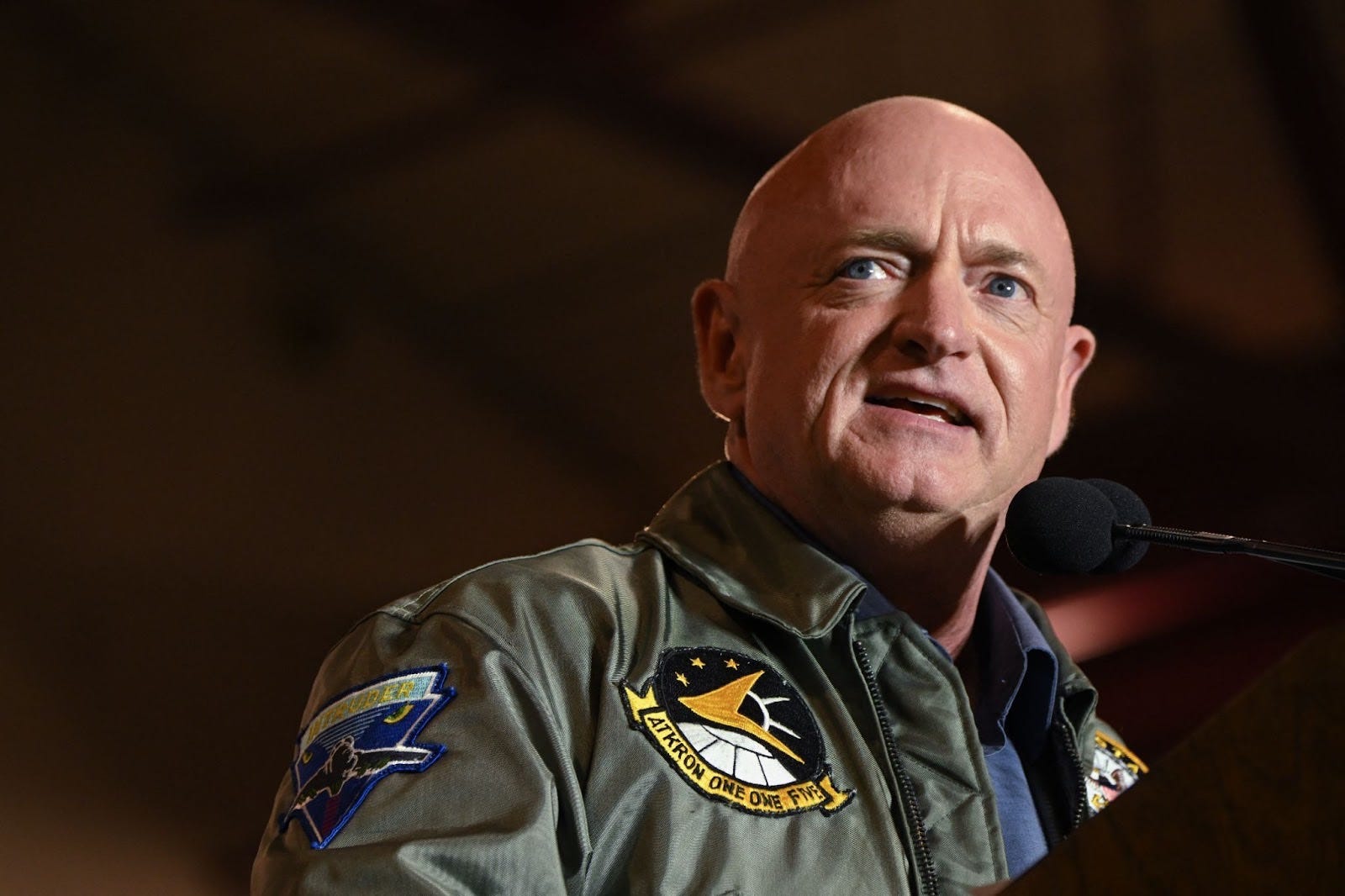
One of the main tactics of the second Trump administration has been the frequent use of threats and legal action against people who, for whatever reason, have attracted the ire of the government.
The latest such example is the Pentagon’s investigation into Senator Mark Kelly for a video in which he urged members of the military to refuse to obey illegal orders. In the video, published online earlier this month, Kelly, along with five other lawmakers who are veterans of the military or intelligence services, said the following:
This administration is pitting our uniformed military and intelligence community professionals against American citizens. … Right now, the threats to our Constitution aren’t just coming from abroad, but from right here at home. Our laws are clear. You can refuse illegal orders.
On November 20, Trump took to social media claiming that these words were “SEDITIOUS BEHAVIOR, punishable by DEATH!” He later rowed back on the idea that he was calling for the death penalty, but continued to insist that the words amounted to sedition. On November 25, the Department of War posted a memo on X in which Secretary Pete Hegseth ordered Navy Secretary John Phelan to investigate “potentially unlawful comments” made by Kelly. This came a day after the Pentagon posted another statement about “serious allegations of misconduct” it had received against Kelly, going on to say: “All servicemembers are reminded that they have a legal obligation under the UCMJ [the Uniformed Code of Military Justice] to obey lawful orders and that orders are presumed to be lawful.”
There are several things to say about this latest flare-up.
First, the lawmakers’ video did not appear in a vacuum. On multiple fronts—the ICE raids against illegal immigrants in multiple American cities, the strikes in the Caribbean Sea against ships carrying alleged Venezuelan narcoterrorists, the government’s use of force to quell protests in cities like Los Angeles and Portland—the Trump administration is enacting policies that require the direct participation of military and intelligence personnel, and which many observers argue are illegal. The situation is complicated by the fact that some of the government’s actions (such as the domestic deployment of troops) have been challenged by judges, whereas others (such as the strikes against civilians accused of narcoterrorism) have not yet made it to the courts. Yet these cases were surely on the minds of the lawmakers who made the video. The administration’s current actions are the clear context of the remarks.
Second, the language used in the video is extremely vague. The lawmakers speak in broad terms about the requirement that the military and intelligence communities uphold the Constitution (which is trivially true), and make the aforementioned (extremely vague) allusion to the government’s current actions. In part, this vagueness is probably because the legality of many of these actions is at least contestable, however tenuously. On those matters which have so far come before the courts, the judges have often ruled against the government. Still, members of the military and intelligence communities would want to be absolutely certain that an order is illegal before disobeying it. This would require the illegality of the order to be clear on its face, per the “manifestly unlawful” test. But the way the system works, courts usually determine whether the actions of the Trump administration are legal over the course of weeks or months, and they don’t always rule in the way legal observers predict. The kind of situation in which blatantly illegal orders come down the chain of command, providing an officer an unambiguous opportunity to disobey them, is quite rare. This might explain why the lawmakers were unwilling to single out any specific action for criticism in their video.
Third, most Americans would unambiguously have the right to express such a message thanks to the First Amendment. But the rules are different for military and intelligence personnel. Kevin Carroll, a lawyer and retired military intelligence colonel who served as senior counselor to the Secretary of Homeland Security during the first Trump administration, told me via email that “unlike a civilian, a servicemember can be court-martialed for disrespecting a superior officer, or using ‘contemptuous words’ against elected officials.” But it would be hard to argue that this is what Kelly did: He “just accurately cited military regulations. Most every commander and every judge advocate in the military has made some version of Kelly’s remarks to the troops in training or before a deployment.”
Even if Kelly had breached the Uniformed Code of Military Justice, the fact that he is retired should shield him from prosecution. As Carroll told me, “a court would reasonably find that this power does not apply to alleged crimes committed after retirement, only to crimes committed by officers on active duty about which fresh evidence is subsequently discovered, newly implicating a retired officer in past misconduct.”
Fourth, the government had a point when it argued that “orders are presumed to be lawful.” As David French writes in The New York Times: “You can’t fight a war… if every soldier acts as an independent legal check on every order he or she receives. Individual service members don’t have sufficient knowledge or information to make those kinds of judgments. When time is of the essence and lives are on the line, your first impulse must be to do as you’re told.”
As such, the vague and uncontroversial appeal to constitutional principles made by Kelly and others in their video does not clarify the very real stakes of applying these principles in the real world. The duty to disobey illegal orders has been given special emphasis in the military ever since the infamous My Lai massacre of 1968, in which Lieutenant William Calley and his soldiers murdered hundreds of unarmed Vietnamese civilians. But as one retired lieutenant colonel told me via email, things get tricky when the orders originate from much higher up—from cabinet members, or indeed the president. In such cases, it may be “the responsibility of senators, members of Congress, the courts, and the American electorate”—not individual troops—to judge the legality of the orders they receive.
Fifth, the government’s response to the video has been predictably hysterical and autocratic. There should be a strong norm against levelling threats against military veterans, especially if they are sitting members of Congress. To give the government the power to court martial any elected official who strongly criticizes the president under suspicion of treason would obviously create an enormous chilling effect. The Pentagon’s investigation of Kelly violates that important norm in an extreme way.
Furthermore, as countless observers have pointed out, the idea that Kelly is guilty of sedition is laughable. Kelly was right when he described the administration’s response as blatant intimidation. It matches the characteristic tactic of the government in recent months: Go after prominent figures who resist or rebuke you, find every loophole, exploit every misstep, clog up the courts, put your enemies through hell fighting to clear their name, and mobilize your supporters to harass them—all in the name of enacting a policy platform that is, at best, erratic, and at worst, illegal and unconstitutional.

And here lies the difficulty. Kelly and co. were well within their rights to publish that video. If—like me—you are deeply worried about a presidency which is blatantly overstepping the boundaries of its rightful authority, you should applaud their courage in reminding servicemen and women that they have duties to the Constitution which take priority over their loyalty to particular commanding officers. Anyone familiar with the 1964 Kubrick classic Dr Strangelove will recall the iconic moment in which one of Peter Sellers’ characters, Group Captain Mandrake, attempts to resist an insane general who wants to launch unilateral nuclear strikes against Russia. Yet the world we live in rarely permits such moments of clarity: Ours is a world in which orders are legally dubious rather than blatantly insane, and come from the top of the chain of command, rather than from rogue generals.
There may come a time when members of the military will be faced with orders that are clearly illegal. They will then have to make a judgement about how to act, possibly in the course of minutes or seconds. That is not a long time to balance the necessity to (in French’s words) do as they are told against the necessity to (in Kelly’s words) obey the Constitution. And it will be all the harder for them to do so in a principled manner if they have legitimate reason to fear that any hesitation may lead to the most powerful man in the world calling for their execution.
Luke Hallam is senior editor at Persuasion.
Follow Persuasion on X, Instagram, LinkedIn, and YouTube to keep up with our latest articles, podcasts, and events, as well as updates from excellent writers across our network.
And, to receive pieces like this in your inbox and support our work, subscribe below:
"One of the main tactics of the second Trump administration has been the liberal use of threats and legal action against people who, for whatever reason, have attracted the ire of the government."
No, it isn't just because they have attracted the ire of government, it is because they have done something that has pushed the boundaries of legal behavior. Jesus, given all the vile and dirty mudslinging and name-calling the Democrats have lobbed at Trump and his supporters, if this claim of only "ire" being the motivation, we would have seen a constant sea of legal actions against Democrats and other anti-Trump and anti-MAGA people.
It is intellectual hogwash to keep making this claim that Trump is exploiting the judicial to punish his enemies. First, there have never been anything close to the number of judge rulings against a sitting President as Trump has endured. Trump's cases against people that are his political opponents are 100% based on an opinion that laws have been broken, and people need to be held accountable for their illegal behavior. It would be irresponsible for any administration to ignore these types of cases as the broken window theory proves.
When it comes to questions about the legality of its actions, the administration doth protest too much, me thinks. (And when it comes to politics within the beltway, there are always plays within plays.)