


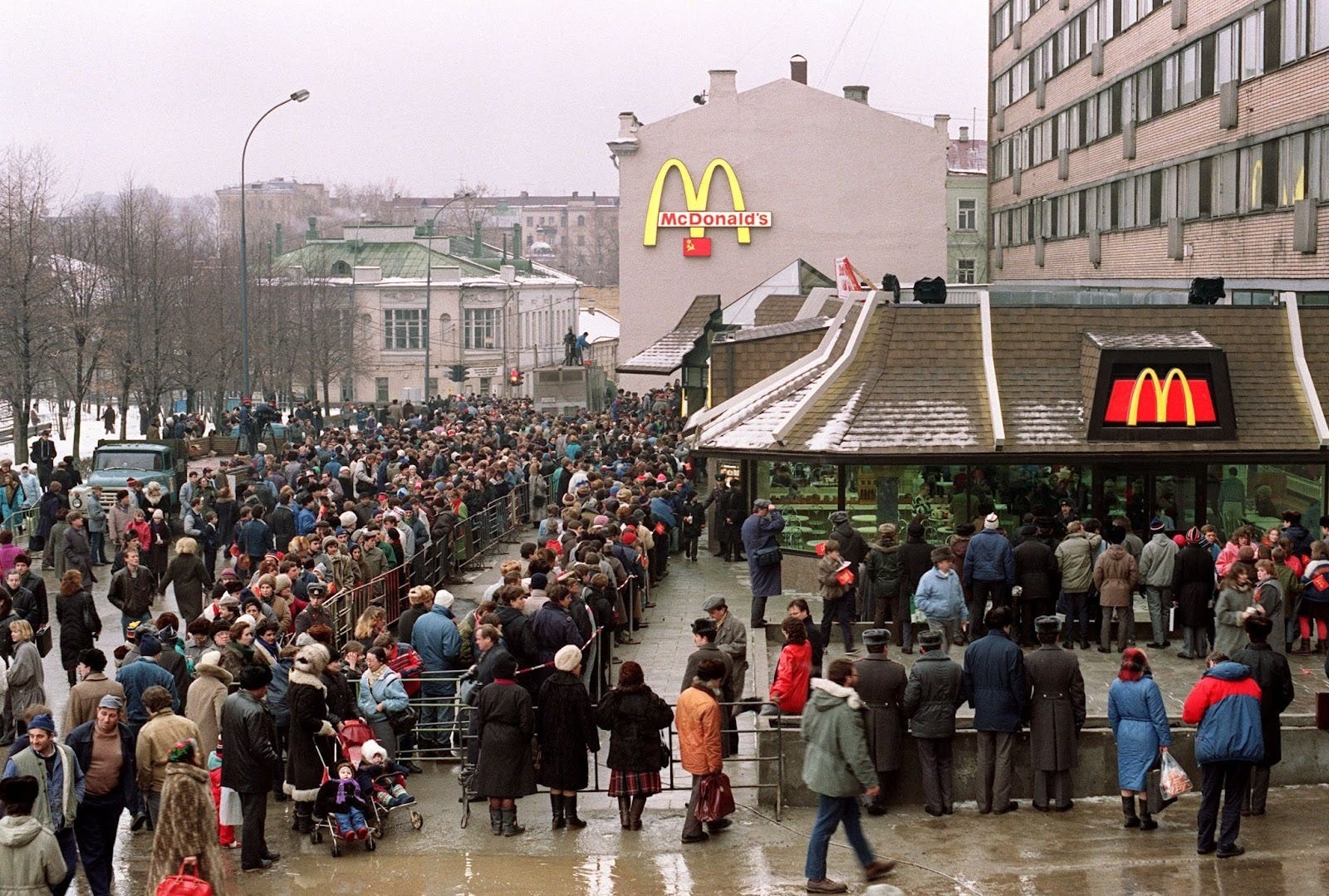
To truly feel the force of America’s cultural attraction you have to be born outside of it. The natives see the cracks up close and learn to take the whole thing for granted. Growing up in the Soviet Union in the 1980s, none of my friends had to be convinced of America’s appeal. Its jeans-clad, Ray-Ban-wearing, moon-dancing cultural exports were the opposite of propaganda. They were the natural overflow of a society so confident in its own desirability that it never had to make a case for itself.
That dominance is what the Civilization video games once called a “cultural victory.” I’m not talking about soft power, a much-abused concept that, in seeking to be policy-relevant, folded in American political values and U.S. foreign policy as part of its definition. The dominance I’m talking about is not built on government-funded exchanges or diplomatic initiatives, but on the organic triumph of a society’s language, art, music, media, consumer brands and, on a deeper level, its norms and aesthetics.
For decades, this was America’s most formidable and least appreciated strategic asset. Except for the occasional CIA-sponsored literary magazine, American culture never had a budget line in the federal government because it was produced by society itself. Yet it accomplished a great deal invisibly. Hollywood normalized American values; American universities trained foreign elites who came home with American contacts; Silicon Valley’s platforms became the infrastructure of global public life.
This inculcation is in some sense pre-political: it shapes the moral imagination which then invisibly structures political choices. And it’s that invisibility that makes it so powerful, because it made American leadership feel less like domination and more like the natural order of things.
The slow erosion of that dominance over the past decade is therefore not just a commercial setback for studio execs but a change in how American power operates. In movies, music, even in higher education, the United States is experiencing something it hasn’t faced for a while: actual competition. The country is still on top of most global rankings of cultural influence, but it’s descending from a peak that was probably unsustainable. The 2026 Soft Power Index, for example, saw the United States declining more steeply than any other country. (To be fair, this is an index built on little more than clickbait and vibes. But when it comes to cultural power, vibes are what counts.)
It’s not just due to Trump. Global opinion polls have dipped before, most dramatically during Bush’s invasion of Iraq, and then rebounded. But in 2003 the American cultural infrastructure remained mostly intact. Hollywood kept producing globally dominant films, U.S. tech platforms were ascending, and the country’s universities remained the undisputed global pinnacle of higher ed. Today, audiences and consumers are increasingly turning away from American cultural products—not even due to anti-American sentiment, although that plays a part, but chiefly because alternatives are now finally available.
The cinematic multiverse
Hollywood has been the architect of global aesthetics for almost a century, exporting an American worldview that served as the country’s most visible form of cultural power. In Lenin’s Tomb, his reportage of late Soviet life, David Remnick recalls attending a pre-collapse screening of Wall Street during which young Communist apparatchiks whooped unironically as Michael Douglas’ character praised the virtues of capitalist greed. American movies didn’t just entertain but provided the ideological vocabulary through which the world understood concepts like individualism and democracy. This unipolar movie order is slowly giving way to a cinematic multiverse.
Hollywood’s share of the global box office has dropped from roughly 92 percent to about 66 percent over the past two decades. China was once Hollywood’s most reliable overseas piggy bank, but has now basically turned away. Hollywood’s market share in China fell to 21% in 2024, down from 35-40% in the pre-pandemic era. Local films accounted for nearly 90% of ticket sales in China last year, and all ten top-earning films were domestic productions, with the animated juggernaut Ne Zha 2 generating over $2 billion at the box office. Meanwhile, over the past decade, China’s global share of the movie market has almost tripled from 6 to 17 percent.

Streaming has accelerated this fragmentation by eliminating distribution bottlenecks that sidelined foreign content. Netflix data from last year shows that one-third of all viewing now comes from non-English titles, with Korean content leading the way. Streaming of non-English content on Netflix rose 71% since 2019 among Americans themselves, suggesting that even domestic viewers are developing global tastes.
Hollywood, meanwhile, has aided in its own marginalization by reducing its output. Between 1995 and 2009, major U.S. studios averaged around 112 releases a year; by 2025 that number was 78. The industry has retreated into a defensive posture, relying on a dwindling number of tentpoles, and the resulting product is often culturally odorless. Hollywood’s creative conservatism is probably accelerating its cultural decline as viewers around the world find novelty and local specificity in new-wave cinema that aging superhero franchises cannot provide.
The global jukebox
Global music is a similar story of cultural fragmentation, with the clearest evidence coming from billboard charts. In 2021, English-language music accounted for 67% of the top 10,000 most-streamed songs globally. By 2024, that share had fallen to 55%. “While English may still dominate the streaming charts for now,” concluded one analysis, “that dominance is beginning to wane.”
The rise of K-pop is the most visible challenger. In 2024, the International Federation of the Phonographic Industry noted that seventeen of the top twenty albums came from Korean artists, with Taylor Swift the only Western entry in the top ten.
Latin music, meanwhile, has been the fastest-growing segment of global music for more than a decade. Bad Bunny, the Puerto Rican reggaeton artist, was Spotify’s most-streamed artist globally from 2020 to 2022 and again in 2025. While an American by citizenship, his cultural center of gravity is firmly Latin American. His rise has not been a crossover success in the conventional sense, where foreign artists molded themselves to American tastes, but victory on his own linguistic and cultural terms, with American audiences, including at this year’s Super Bowl, doing the adapting.
The shrinking campus
The ivory tower is undergoing the same structural decline. It’s tempting to blame this on Trump’s crackdown on foreign students, which has accelerated the trend. New international student enrollment at U.S. colleges declined by 17% last academic year, the first decline after four years of growth. To use an anecdote from my own experience, applications for Toronto’s political science PhD program, where I teach, rose from 201 two years ago to 385 this year. In the past, many of those students would have focused on American schools, but not anymore.
But even here, Trump-induced declines are part of a longer and more structural trend. In the Times Higher Education’s 2026 World University Rankings, the United States fielded just 102 institutions in the top 500. That was the lowest total on record, down from 125 in 2018. Twenty-five American universities fell to their lowest-ever positions, including historical heavyweights like Chicago, Columbia, and Duke.
The global market for higher ed is expanding even while fewer international students choose the United States, which means the country is actively hemorrhaging market share. The United States is losing international enrollments to universities in Europe and Asia, which are aggressively stepping in to absorb the demand. China has been leading the charge with a transformative higher education initiative that, over the past twenty years, has seen university enrollment increase nearly tenfold while 18 of its universities achieved their highest score ever in the most recent World University Rankings. Times Higher Education’s chief global affairs officer called the shift of higher education’s center of gravity from the United States to Asia “a dramatic and accelerating trend.”
From the U.S. perspective, the enrollment decline of international students translates into over a billion dollars in lost revenue and nearly 23,000 fewer jobs. As one analysis warned, the combination of visa restrictions, enrollment declines, and growing competition represents “a potential inflection point for American scientific leadership.” The students who once would have come to America are going elsewhere, absorbing different values, and building different lifelong networks.
The Tower of Babel
American cultural prestige isn’t going to collapse overnight. A country can coast on accumulated cultural capital for a long time before the consequences become acute. And the world is not converging on a new cultural hegemon; no other country is surging to replace American dominance. China’s cultural exports remain modest relative to its economic weight. Ne Zha 2 earned almost nothing outside China. Unless you’re from the country, have you even heard of it? The index of soft power mentioned above, despite recording a steep American decline, still placed the United States first. This is not a cultural hegemonic transition but a gradual climbdown from a very high peak. But it’s still a climbdown.

American culture has historically functioned as a flattering self-portrait, projecting back to Americans an image of their own society that reinforced its best aspirations. The society that produced jazz, Hollywood, and the Ivy League had good reasons to believe in its own project. When cultural hegemony fades, so does this source of national self-confidence. It might be replaced by a more brittle kind of superiority that needs to be asserted not assumed.
The Soviet kids listening to bootleg Metallica tapes in the 1980s and the Chinese students watching Titanic in the 1990s were both being drawn into a common cultural orbit that made the world, in some diffuse but real sense, more universally legible to itself. That orbit is weakening.
Some people might welcome this change as another element in the demise of American hegemony, but I’m not sure a world without a cultural center of gravity will be a more open one. It may simply be more fragmented, where the shared reference points that invisibly facilitated international cooperation slowly dissolve. America’s cultural Tower of Babel is slowly crumbling and no new structure is rising to replace it. What follows is not pluralism but mutual unintelligibility.
Seva Gunitsky is the George Ignatieff Chair of Peace and Conflict Studies at the University of Toronto. He writes at hegemon.substack.com.
Follow Persuasion on X, Instagram, LinkedIn, and YouTube to keep up with our latest articles, podcasts, and events, as well as updates from excellent writers across our network.
And, to receive pieces like this in your inbox and support our work, subscribe below:

The cycle of all human systems requires ongoing constant maintenance to prevent the inevitable decline as people exploit every loophole in pursuit of personal gain. The post WWII Bretton Woods Global Order should have ended 30 years ago because we noted how it was hollowing out working class communities throughout the country. It was not maintained, and too many figured out how to loot from it. It broke. And with it, the US broke. We gave away American exceptionialism for more corporate profits. The top 10% has benefitted hugely but at the expense of everyone else. Corporatism replaced real capitalism. Democracy too has been corrupted by money. The old system needs to be pulled out by the roots and replaced with a national industrial policy.
'Crazy Like Us: The Globalization of the Western Mind' Ethan Watters
An interesting read