

The Two Nightmares of Jürgen Habermas
In remembrance of Germany's acclaimed philosopher.

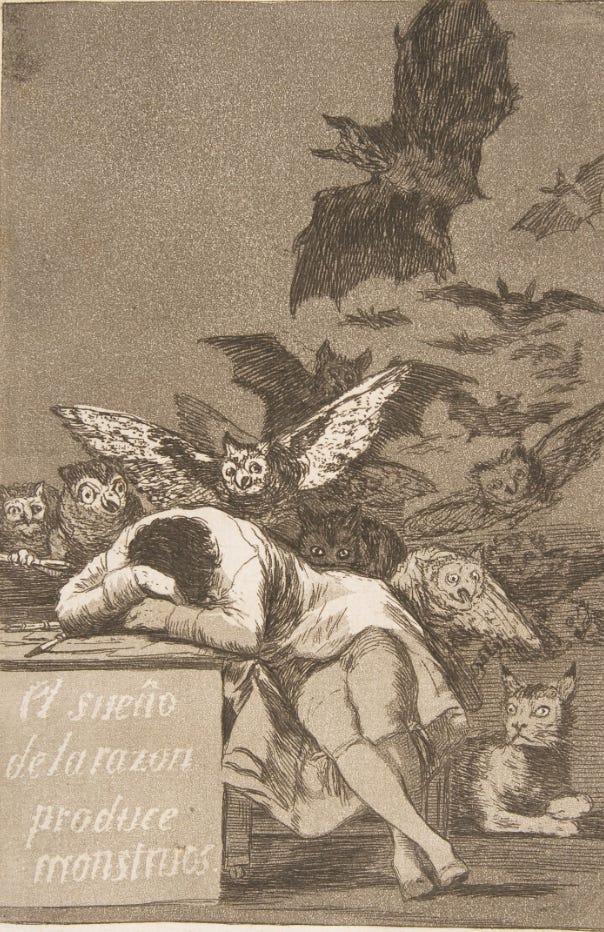
One of the peculiarities of English-language academic publishing is that, unlike the French and the Germans, and regardless how esoteric the subject, English university presses like to have an illustration on the front cover of their books. This is presumably just a convention, and not a business decision, since it is difficult to imagine that it improves sales. Either way, it often puts philosophers in a tight spot when they are pressed by some junior graphics designer to answer questions like “what is your book about?”
I can remember therefore the palpable excitement back when I was a graduate student, when my thesis advisor, Thomas McCarthy, came across the 18th century etching by Francisco Goya bearing the inscription “the sleep of reason produces monsters.” McCarthy served, for many years, as Jürgen Habermas’ right-hand man in America, having both translated Habermas’ monumental book, The Theory of Communicative Action, into English and written a useful introduction to his thought. Having recently completed another book on critical theory—defending Habermas’ position—he was looking for an image that would capture what was at stake in the debate. The Goya image was perfect.
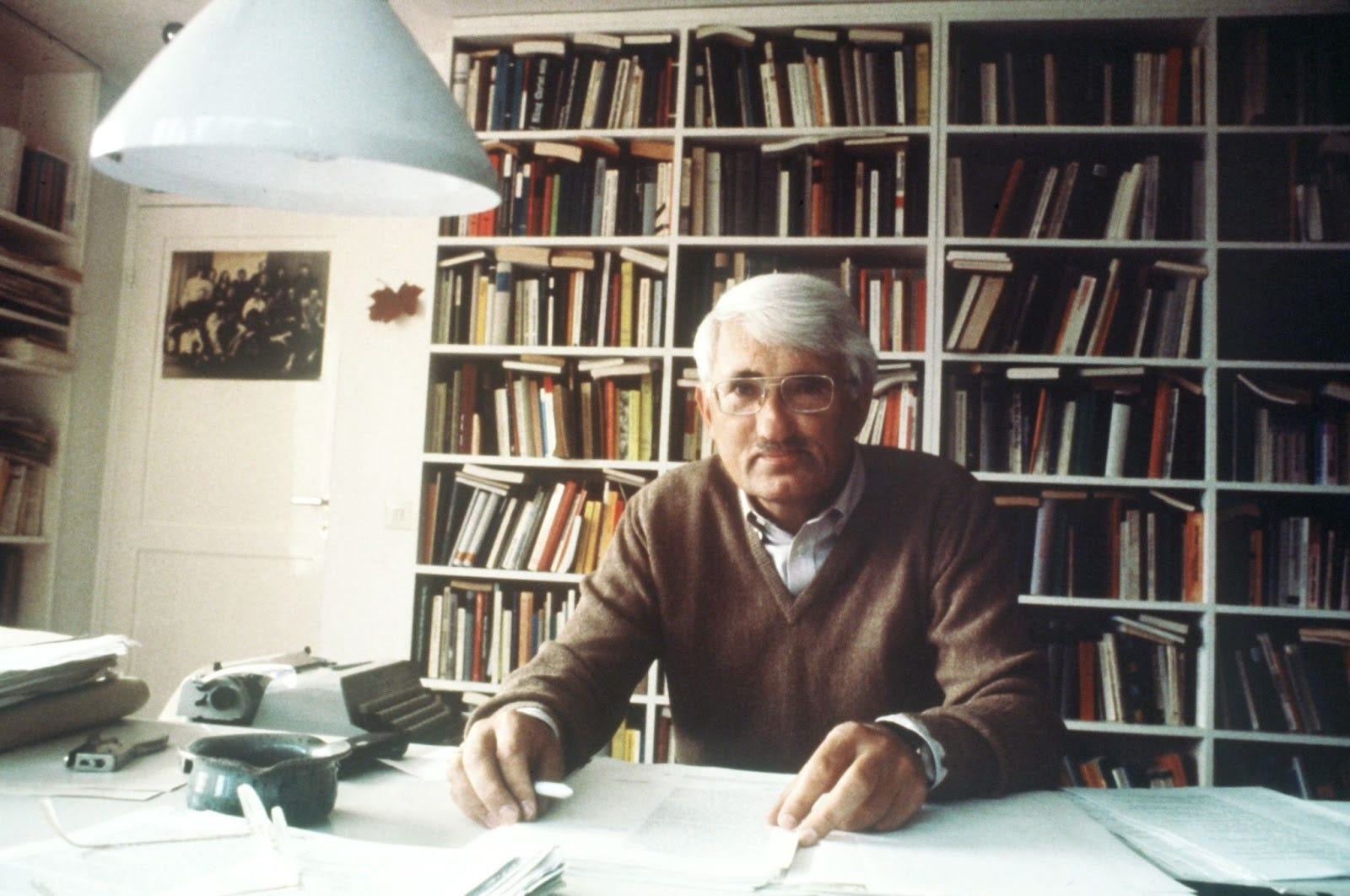
Habermas, who died on March 14 at the age of 96, was best known as a philosophical defender of rationality at a time when the very concept had become deeply unfashionable. (The first book of Habermas’ essays to be published in English, back in 1970, was called Toward a Rational Society.) As the foremost representative of Frankfurt School critical theory, Habermas defended the Enlightenment conviction that the powers of human reason could be employed not only to better understand the natural world but to improve the human condition. This preference for reason in human affairs was not merely temperamental; Habermas understood better than most how monstrous the alternatives could be.
Born in Düsseldorf in 1929, Habermas came into a world that was ruled by monsters. Indeed, he was born into a waking nightmare, which came to an abrupt end in 1945 with the Allied defeat of the Nazi regime. As a young German from a moderately patriotic middle-class family, Habermas had been, as we would now say, “all in” on the Third Reich. When the war ended, and the process of denazification began, he came to realize how completely he had been brainwashed by the ideology of a totalitarian state.
When the full extent of the Holocaust became known, the slogan “never again” was widely adopted as a simple summary of the moral imperative that it generated. Few people took that slogan more deeply to heart than Habermas. Yet despite its apparent simplicity, the slogan raised a number of philosophical difficulties. If it was merely a matter of stopping bad men from performing terrible deeds, the project would be clear. Unfortunately, the “good guys” and the “bad guys” are not self-identifying, and the bad guys have a perplexing habit of believing that they are the good guys. Faced with such confusion, what powers of intellect must we exercise in order to sort things out?
It may help to reformulate the question in more personal terms: Suppose that you had been born in Nazi Germany. Suppose that you found yourself, at the age of 12, in a Hitler Youth summer camp, singing “Deutschland über alles” alongside your friends. Would you have been able to figure out that you were supporting the wrong side of the war? If so, what intellectual resources would you require to arrive at this conclusion? Moreover, what is there to stop a totalitarian regime from denying such resources to its people?
These are the questions that animated Habermas’ critical theory. Like many Germans of his generation, his work was haunted by the specter of totalitarianism. In Habermas’ specific interpretation this took two forms, which we can think of as Orwell’s nightmare and Kafka’s nightmare.
Orwell’s nightmare: Whoever controls language controls thought
Karl Marx once declared that “the ideas of the ruling class are in every epoch the ruling ideas.” This was based on the observation that, no matter how cruel and unequal the class structure of any society, it was always accompanied by some story that explained why all of the cruelty and deprivation was in fact merited by its victims. Acceptance of this story, Marx thought, explains why the poor and downtrodden, who are typically the vast majority of the population, passively accept their fate rather than rebelling.
This is Marx’s influential theory of ideology. It implied that certain beliefs were widely held only because society, in some sense, needed people to believe them. It also gave rise to the suggestion that intellectuals could make themselves useful by criticizing those ideas. If the acceptance of a legitimating ideology is required for the reproduction of domination, it stands to reason that exposing that story as ideological might make relations of domination more difficult to sustain.

Unfortunately, the theory of ideology also gave rise, almost immediately, to an enormous number of skeptical problems. If the ruling class controls the production of ideas, why do they formulate those ideas in a way that makes them vulnerable to criticism? Indeed, how are we to know that the criticism is genuinely outside the space of those ideas? Perhaps the critic is as much a victim of ideology as the one being criticized? Thinking through these questions generates what came to be known as the problem of total ideology. If everything is ideology, how can we escape from it? And what is the difference between escaping from it and merely believing that we have escaped from it?
Twentieth-century philosophers found these questions extremely difficult to answer. While Enlightenment theorists had claimed that we each possess a “tribunal of reason” in our own mind—a sovereign capacity to separate truth from falsity—by the end of the 19th century this view had become hopelessly discredited. Far from possessing an inner tribunal of reason, Sigmund Freud had shown that we understand very little of what goes on in our own mind, much less the world. But perhaps more importantly, philosophers had begun to realize the importance of language in structuring our thoughts. Language came to be seen not as a code that we use to communicate our ideas to others but as the medium in which we formulate those very ideas. Ludwig Wittgenstein, in particular, argued that linguistic meaning is not determined by what is in our heads but by the position that our utterances occupy in “language games” that we play with others.
This linguistic turn in philosophy further intensified the problem of ideology. If the meaning of words is determined not by our private thoughts but by what occurs in our external practices of communication, what is to prevent the emergence of a perfect dictatorship, which controls not only all of society but, through its control of social practices, all that is thinkable in that society? This was the challenge posed in George Orwell’s 1984, where “the party” does not just prevent criticism from being expressed but through the inculcation of “newspeak” attempts to make criticism unintelligible.
Philosophers were troubled by similar concerns. If communication is just a bunch of language games, what is to stop the powerful from organizing or reorganizing the game however they like? For example, we have the idea that when individuals use force against others, they need to provide some justification for their actions. What if this turned out to be just an ethnocentric expectation and that, in some distant land, such demands for justification were met with incomprehension or were rejected as “not how we do things around here”? Is there anything that rules out such a possibility?
It has often been observed that critical theorists working in the Frankfurt School tradition became less interested over time in actually criticizing things and more perplexed by the question of how critique was even possible or what might prevent the powerful from making it impossible. These are certainly the questions that troubled Habermas. What is to prevent the emergence of a perfect ideology, which is not just internally consistent but quite literally impossible to think one’s way out of?
Kafka’s nightmare: The totally reified society
One aspect of the Holocaust that many people found particularly disturbing was its organizational efficiency. Much of the killing in the death camps was carried out not by men caught up in the throes of bloodlust but by faceless bureaucrats who documented with meticulous care every aspect of the procedure. Even the decision to use poison gas was made because the previous method—a single shot to the back of the head—was considered too expensive, at the cost of one bullet per victim. These calculations seemed like a clear-cut instance of scientific rationality run amok, with considerable technical ingenuity deployed in the discovery of effective means, combined with a complete failure to evaluate the merits of the goals being sought.
While Marx had insisted that capitalism was the source of all evil, the events of the early 20th century, including the emergence of totalitarianism in the Soviet Union, suggested that hierarchical authority was just as much a problem. One way of reconciling the two views was to see the emergence of capitalism and bureaucracy as linked. Max Weber, in particular, suggested that humanity was becoming imprisoned in an “iron cage,” governed by a technical rationality that gave us incredible powers of control yet deprived us of the ability to deliberate in any meaningful way about the goals we are seeking.
According to this view, it was the calculative, instrumental form of rationality, focused on means rather than ends, that was the villain of the story. A distinctive feature of the instrumental style of reasoning is that it treats everything as an object, susceptible to manipulation and control (which is to say, it is reifying). In economic relations, this generates the illusion that Marx called commodity fetishism. In bureaucratic relations, it produces the ideology of modern management, which treats human beings as resources to be controlled in various ways. In the realm of ideas, it produces positivist social science, which seeks to employ experimental methods to improve our capacity to predict the behavior of human beings.
This diagnosis of the times, which was pioneered by the first generation of Frankfurt School theorists—Max Horkheimer, Theodor Adorno, and Herbert Marcuse—persuaded an entire generation of leftists that they needed to reject not just capitalism but “the System” as a whole. Whereas Marx had predicted that capitalism would collapse of its own accord, in the post-war period the concern became increasingly that capitalism would not collapse but that it would be successfully stabilized through bureaucratic interventions, creating a vast politico-economic technostructure that would become increasingly governed by its own functional imperatives, unresponsive to human intervention or control.
This image of a “totally reified society” would be the realization of Franz Kafka’s vision of a bureaucratic system whose operations had a predictable, machine-like quality, but where none of it added up to anything rational and where no one could find out why anything was being done the way it was. Unlike the problem of total ideology, a totally reified society would be one in which certain forms of ideology would not even be necessary because the incentives would always be correctly aligned, impelling us to do what the system needed us to do regardless of what stories we told ourselves about it.
Habermas’ solution
Faced with these problems, the naïve response is to search for what philosophers call an Archimedean point based on the plausible intuition that, in order to criticize a system, it is necessary to find some standpoint outside of that system. However, the first step to wisdom lies in the realization that there is no such point when it comes to human society or thought. We are condemned to working on the inside (or to engaging in what Habermas, somewhat obscurely, called “postmetaphysical thinking”).
After a few false starts, the idea that Habermas hit upon was to search for a solution in the structure of linguistic communication. Since words do not, in general, mean different things when used in different contexts, linguistic meaning is too systematic to be grounded in a set of disconnected social practices. This observation led many philosophers to believe that the meaning of our utterances must be determined not by any old language game but rather by the role these utterances play in the specific practice of argumentation. Habermas expressed this idea by claiming that, whenever we perform a speech act, we commit ourselves to justifying the content of that claim (i.e. we raise a “validity claim”). This is not just extra baggage—our understanding of linguistic meaning consists in a grasp of the conditions under which speech acts could be justified.
As a result, Habermas claimed, there is an intrinsic, necessary connection between the social practice of justification (what he called “discourse”) and the meaningfulness of our speech. Understanding someone’s speech acts is inextricably tied to the evaluation of that person’s claims, and, for similar reasons, the production of a speech act always involves undertaking a commitment to the justification of one’s claims. Thus, the person who comes along and demands justification is not imposing a new obligation on the speaker but is merely asking that person to make good on a commitment that has already been undertaken.
The structure of interpersonal commitment that secures the intelligibility of language has an important secondary effect, which is that it allows us to coordinate interpersonal interaction. This gives rise to what Habermas called communicative action, which differs from instrumental action in that, rather than relying on means-ends reasoning to determine a preferred action, it allows the choice of action to be directly determined by the content of the validity claims raised in speech. The type of rule-following that sociologists had traditionally tried to explain by invoking the concept of a social norm is, in Habermas’ view, a primary instance of communicative action.
An important feature of communicative action is that, because it relies directly on speech acts to coordinate interaction, it is always open to contestation and demands for justification. As a result, the more heavily human societies rely on language to construct complex systems of cooperation, the more completely they expose those arrangements to demands for justification—a dynamic that one can see playing out over the course of human history, in the process that Habermas referred to, somewhat provocatively, as the “linguistification of the sacred.”
How does any of this help with the two nightmares? First of all, it directly rules out the possibility of a society being immunized against demands for justification. Such a society is logically possible, but it would be unintelligible to us, in the strong sense that we would be unable to understand what anyone was saying. (Fans of Kantian philosophy will recognize this as a transcendental argument. One of Habermas’ most important contributions to philosophy is to have pioneered, along with Karl-Otto Apel, what he called “transcendental pragmatics.”)

So we must justify ourselves and our practices, and no society, no matter how totalitarian or manipulative, can free itself from that obligation. But what counts as a justification? Here Habermas is a formalist, in that he thinks that what counts as a justification is ultimately determined by what others will accept in discursive practice. That practice, however, is rule-governed, and those rules have content that is not morally neutral. Specifically, argumentation is governed by a set of symmetry conditions that establish equal standing among participants (anyone is entitled to introduce any argument, a position is valid regardless who introduces it, and so on).
Because of this, and no matter where a society starts out, the reliance on linguistic communication as a central practice for the reproduction of its institutions biases cultural evolution in the direction of greater universalism and equality over time. This does not prove these commitments to be correct. If one is looking for a knock-down argument that is guaranteed to convince the Nazi that he is wrong, this will not do it. What Habermas’ argument shows, however, is that the more specific moral resources we rely upon to condemn Nazism, such as equality of moral standing or the inalienability of human rights, are not arbitrary but represent rather the expression of a logic that is inherent in communication among persons, that works its way out over time in all societies.
So much for Orwell’s nightmare, but what about Kafka’s? The totally reified society is also, in Habermas’ view, an impossibility. The central weakness of communicative action, as a means of social integration, arises precisely from its openness to contestation and challenge. “Discursively achieved consensus” is, as we all know, difficult to obtain. As a result, societies that rely increasingly on communication to organize their affairs are tempted to unburden themselves by creating systemically integrated domains of interaction. This is accomplished by instituting a set of incentives that motivate individuals to act in a cooperative manner without explicit reliance on validity claims, but rather on instrumental action. The two primary examples of such systems, in Habermas’ view, are the market economy and the bureaucratic state.
The nightmare of the totally reified society arises from the experience of interacting in these systemically integrated domains and wondering what prevents the extension of this mode of integration to all of society. The answer, however, is straightforward. Instrumental action cannot produce a self-sustaining order; left to its own devices, it produces mere chaos. The incentive system that sustains the integrity of these systems of instrumental action must therefore remain “anchored” in the commitments undertaken in communicative action. If the system expands beyond its proper boundaries, so that it begins to impinge upon these communicative systems, it generates a set of pathological consequences (which Habermas described, for reasons that need not detain us, as “the colonization of the lifeworld”). As a result, no matter how extensive and complex these systems may become, they can never escape from the communicative obligation to justify the social order.
Habermas’ views on democracy, which many have identified as his singular contribution, are downstream from this model of the relationship between communicative and instrumental action. Although much has been said on this point, it is perhaps worth noting that Habermas was more of a realist on these issues than he is typically portrayed as being. That is because he viewed the state as a relatively self-contained bureaucratic system, populated by individuals who respond only to a narrow range of incentives. He saw democracy primarily as a mechanism for translating everyday arguments into incentives that could influence—not control, but merely influence—the behavior of this system.
Finally, it should be noted that despite the extraordinary ambition of his core philosophical project, Habermas was more of a syncretic than systematic thinker. Rather than working out, step by step, his own position, he had a habit of presenting the views of others, then showing how they could fit together to solve some problem. This creates formidable difficulties for students and interpreters. The number of other things that one must understand in order to understand Habermas probably constitutes the most important threat to his legacy.
I have tried to describe, in general terms, the stakes of Habermas’ project, in order to explain why the investment of time and energy that it requires remains worthwhile. I have also tried to explain, more indirectly, why his death this month has been marked by so many as the end of an era. He was truly one of the giants of 20th century philosophy. By comparison, contemporary political theory seems almost listless, uninterested in confronting the most fundamental, most urgent problems of the modern age.
Joseph Heath is a professor in the Department of Philosophy at the University of Toronto, and the author of several books, including Communicative Action and Rational Choice.
Follow Persuasion on X, Instagram, LinkedIn, and YouTube to keep up with our latest articles, podcasts, and events, as well as updates from excellent writers across our network.
And, to receive pieces like this in your inbox and support our work, subscribe below:
 | A guest post by
|
I appreciate the wonderful summary of his views. I do wish there was at least some mention of the fact that everything mentioned here is only a concern among continental philosophers. The analytic tradition never fetishized language to anywhere near this extent, and so doesn't believe that any of these problems even exist.
Thanks for the text. Very much in detail about Habermas and rationality, and also regarding how rationality can be mixed with extremist, collectivist and authoritarian ideas.
I wish that someonce can write a text for Persuasion regarding Haberma's and constitutional patriotism, focusing on his ideas about one's loyalty to and engagement with democratic values as more important than for example nations and national identities.
I think that would be important and reflecting also because offical liberal thinkers and politicans are insisting more on "good nationalism" and similar where values and the idea of the individual are once more being limited to nations rather than expanding governance, democracy and civility to supra-national levels of action and instituions.