

Ukraine's Winter of Discontent
When the power grid is targeted, you can't call this life. It's just survival.
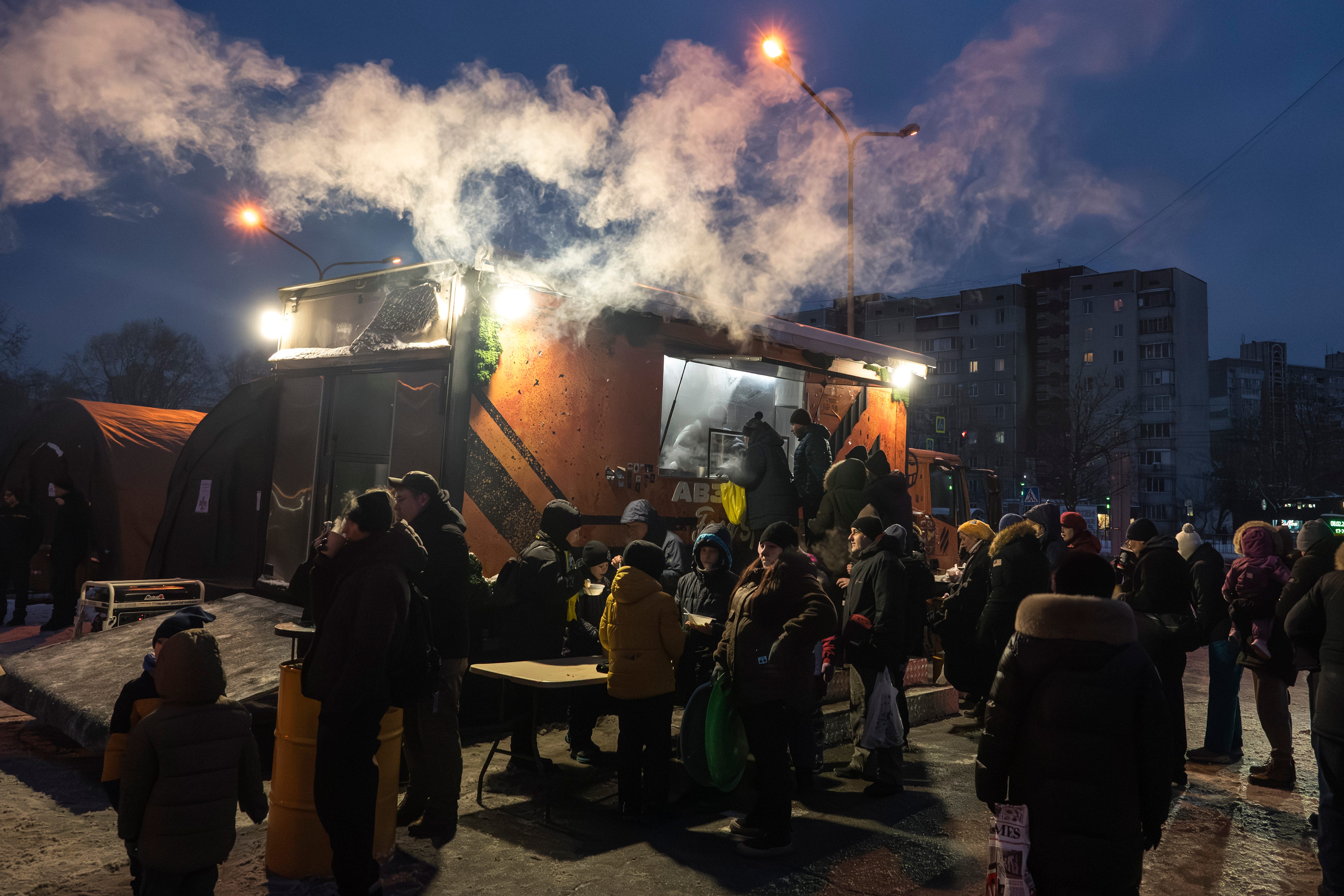
Since shortly after the Russian invasion of Ukraine in February 2022, Persuasion has been following the war through the voice of one Ukrainian, Kateryna Kibarova. Kateryna’s accounts of the ongoing horrors—from the first days, to her return home to Bucha, to surviving the most recent winter amid constant bombardment—capture the seemingly never-ending nightmare facing civilians far from the frontlines.
Following Kateryna’s last update during the holiday season, an unusually cold winter and repeated Russian targeting of the energy grid has made the situation in Kyiv dire. During a recent conversation, our call cut out as Kateryna’s makeshift home battery, charged during the few hours of electricity she has per day, failed. What follows is her most recent dispatch of life in this new reality. (You can read all of Kateryna’s installments here.)
In December, we announced the opening of a small fundraiser to help Kateryna repair a window broken by a nearby explosion. We—and she—were deeply moved by how quickly the community responded, surpassing our initial target in a matter of hours. Now, members of the Persuasion team—in our individual capacity—are once again raising some funds to help Kateryna as she seeks to replace her generator after repeated power surges destroyed it. If you’d like to consider supporting this effort, we’ve set up a GoFundMe page here.
With thanks for being part of our community, and for continuing to follow Kateryna’s story,
—David, Senior Advisor.
I had no heat in the apartment for a week. It was five degrees Celsius (41 degrees Fahrenheit) with no hot water, nothing. Because of the voltage fluctuations, the generator burned out. There are no repairmen who can fix it. Partly because of the massive mobilization, there aren’t any men left. There are no spare parts, either.
Technicians are trying to reconnect our power plants, to restore them. But we have voltage drops and fluctuations. If an outlet is supposed to run at 220 volts, we can have anywhere from 150 to 240 within a few seconds. Everything gets fried. Thank God they have now at least somewhat fixed my boiler so it’s usable—sort of usable.
We’re so burnt out that we’ve put life on pause. We are just waiting for something to change. In some districts of Kyiv, the situation is so critical due to the frost and lack of preparation that pipes in buildings just burst, and water floods the stairwells. People can’t even go down the stairs because it all freezes instantly. We have “heating points” pretty much everywhere now—tents that have gas burners where people can recover a little bit, charge their phones.
Buses and transport work very poorly. Metro lines are damaged, some are cut off. Trolleybuses need electricity, so they aren’t running, either. Whenever there is an air raid alert, people cannot get home. With weather like this, it’s like the end of the world. Rain pours down and freezes immediately.
I don’t remember such frosts in my lifetime. Russia waits eagerly for people to be in complete disarray, and they recently struck during these frosts. Sixteen missiles hit two Kyiv thermal power plants. They are hitting the plants and substations on purpose. Some are already beyond repair and closed forever.
You go to work, you come in, you sit for a bit. But you can’t generate any ideas, you can’t work fully. Or, you’re driving, and there are alerts, missiles are flying, Shaheds, reconnaissance drones. You’re living in this sort of slow motion. People prioritize what they need to survive, like finding a generator somewhere. The good generators are expensive. And they think of children: you need to feed them, you need to wash them, you need to entertain them. But there is no water, no light, no heating, nothing.
And all of this piles up on your head just like a snowball.
Sometimes I see moms dragging their kids up twenty flights of stairs because the elevator doesn’t work. People with children set up a tent in a room, they heat that tent up with kerosene heaters, or some kind of aluminum pipe, or candles. They zip it up and sleep in there. It’s even better to put it on the bed. Can you even imagine? There are lots of “life-hacks.”
If the end of the world comes, Ukrainians will survive 100 percent. No other nation will be able to come up with what Ukrainians come up with, because we’ve already approached the point of madness. Here we are, sleeping in tents inside apartments, heating them just to survive. And then we go to work.
My Kyiv relatives are staying with me, and we have this hack: we go to the hardware store, buy firebricks, and heat them on the gas water heater. They absorb the heat, and then you put them in this iron wheelbarrow, like a metal basin, and they hold the heat for 12 hours, like radiators. We migrate like this from one apartment to another, all sleeping in one room so it’s warmer. It’s hard to call this life; it’s just survival.
A lot of businesses have closed. Coffee shops and flower shops and large restaurants. Why are restaurants important? Because people can’t eat anywhere except in restaurants if there is no water, no power, no heat at home. In some regions—Bucha, Irpin, the satellite cities—there is gas. But if the houses are taller than, I think, nine or 11 floors, they don’t have the right to install gas boilers or connect gas at all. And so practically all of Kyiv is on electricity. For a restaurant to function, it costs 10,000 to 15,000 hryvnias a day just to refuel the generator. That’s $300. They are expensive machines. And then there are safety considerations. Businesses take all this crazy responsibility on themselves.
I can manage—I drive home from work, stop by a shopping mall where there is electricity, and walk around, look at things, just kill time either until the outage ends or it’s time to heat the place. But elderly people sit in this cold, and in the evenings they say goodbye to their children as if it were the last time. There are cases of people freezing to death. The weather conditions create unbelievable amounts of black ice. I’ve never seen anything like it in my life. People fall and are killed.

We have unity, but it’s not like it was. Now everyone is on their own. The generators have blown out. And a heap of other things: the kids are sick, nobody is really visiting each other anymore. It’s understandable, because people get tired. When you’re fully charged up, you can give kindness and energy to other people. But when you’re just running on fumes—when you can’t even help yourself—how can you talk about helping others?
That’s why it’s now really just close family, and we try to somehow solve these issues—and even then, how do you solve them if they’re impossible to solve? That’s why it’s a scary situation. All the media is writing about Kyiv being on the brink of catastrophe and it’s 100 percent true. The situation is critical. They’ve advised us to build outdoor toilets because the sewage system is freezing up.
And so, it’s the 21st century—some people fly to space, they drive electric cars, all while Ukrainians are building toilets on the street.
We can’t predict what the future holds. Recently, I was so happy, I thought that tomorrow there would be power for seven hours in a row—and then they changed the routine back to three hours on, seven hours off. Seven, three, on, off, like some kind of torture. It’s unreal that we survive in such conditions.
It would be better if we’d just been buried under rubble rather than living this incomprehensible, senseless life where you rejoice over basics. We get a huge rush of endorphins when we take a shower. Or when we wash our hair, or wash clothes. Maslow’s Hierarchy is in such a state of shock that we’ve reverted to basic needs. The truth is stranger than fiction. It’s some kind of horror.
I look at the future and I see... I don’t see anything.
Kateryna Kibarova is a Ukrainian economist and resident of Bucha.
Translated from the Russian by Julia Sushytska and Alisa Slaughter. This transcript has been lightly edited for concision and clarity.
About the Translators: Julia Sushytska was born in L’viv and is a Visiting Assistant Professor in Comparative Studies in Literature and Culture at Occidental College. Alisa Slaughter is Professor of Creative Writing at the University of Redlands. They recently co-edited and translated a selection of essays and lectures by Merab Mamardashvili, A Spy for an Unknown Country (ibidem-Verlag, Stuttgart, 2020).
Follow Persuasion on X, Instagram, LinkedIn, and YouTube to keep up with our latest articles, podcasts, and events, as well as updates from excellent writers across our network.
And, to receive pieces like this in your inbox and support our work, subscribe below:
Thank you for sharing Kateryna's heart-wrenching account of life in Kyiv right now. It is realistically hard to read, but necessary to get even a glimpse of how tortuous life there is for so many people.
I think it's important for another reason also. trump and Putin seem pretty tight, to put it lightly. One doesn't have to contort too far to imagine these are the kinds of things trump fantasizes about doing to anyone who criticizes or demeans him, or any state he lost in the '20 or '24 elections.
It is a crime that the Ukraine war was allowed to happen. Ordinary Ukrainians pay the price. I blame the entire self interested careerist empty headed foreign policy bubble that is dominated by neo cons of both the right and the left. The USA had been mucking around in Ukraine for years, including financing their color revoluation. Apparently we have biolabs there ( on the record testimony in Congress by neo con Victoria Nuland) and God knows what else.
Putin had been clearly signalling for years and then months that if his demands for security were not met, which included a commitment that Ukraine would not join NATO - that he would invade. Would the USA ever accept that Canada or Mexico was a member of a military alliance with one of our adversaries? Would we accept that China or Russia was actively meddling in the affairs of Mexico or Canada including arming and training soldiers? Meanwhile would be Winston Churchills sitting in their fancy offices in Europe want to fight until the last Ukrainian.