

The Case for Going to the Moon
Why wonder and ambition are important.

We recently published a piece by our associate editor Sam Kahn on why he’s continuing to boycott AI. In true Persuasion spirit, we decided to make him debate it. So tomorrow lunchtime, at 12:30pm Eastern, Sam will debate our contributing editor, Quico Toro, on all things AI—Sam from the perspective of an avid AI boycotter, Quico as an avid AI user. The debate will happen on Substack Live, so you’ll all get notified when it starts. Please tune in!
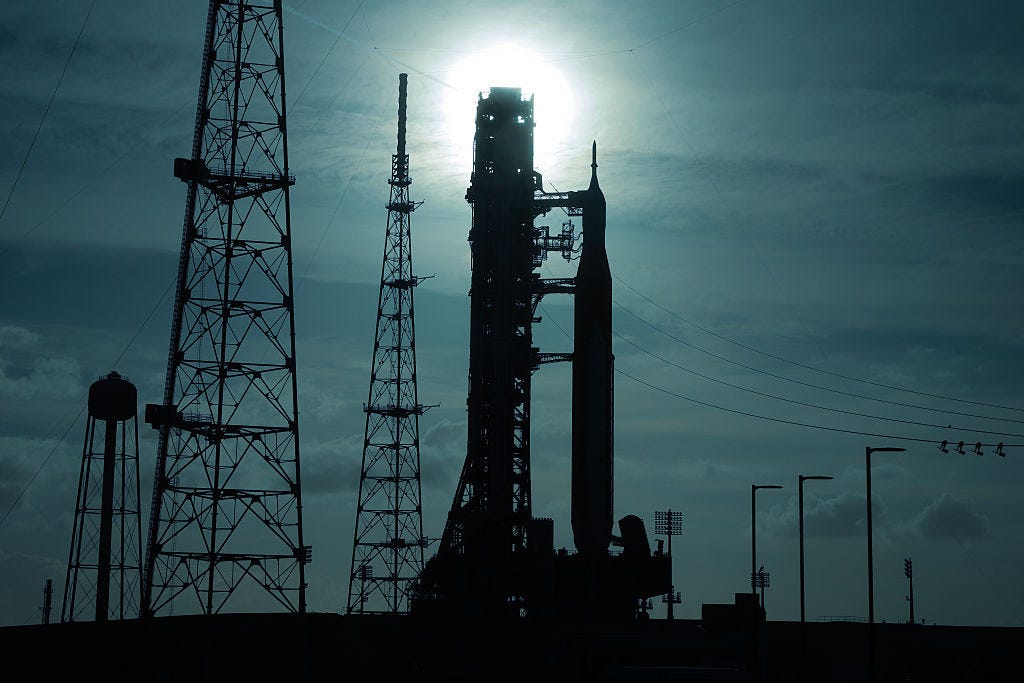
For as long as I can remember, I’ve been mildly obsessed with space. It really took off when, around the age of seven, my parents bought me several science books and encyclopedias containing stunning photos of galaxies and nebulae and planets. Those books inculcated in me a deep love of all the weird, cool, and mind-blowing things there are to learn about the cosmos. The history of Saturn’s rings. Theories of the Big Bang and the Big Crunch. Dark Matter and Dark Energy. What the universe was like when it was half a second old. The (then yet to be launched) James Webb Space Telescope. The “golden record” aboard the Voyager 1 probe which, if they ever discover it, will allow aliens to listen to humanity’s most iconic musical recordings, from Chuck Berry’s “Johnny B. Goode” to Mozart’s “Magic Flute,” as well as samples of the various languages of Earth.
Reading about all of this, there was so much I didn’t understand—what do you mean we don’t actually know what 85% of the universe is made of?—but I couldn’t escape the feeling that attempting to solve the mysteries of the cosmos was pretty much the most important thing anyone could ever do.
I never seriously considered pursuing science as a career. But something about space and space travel continued to fascinate me. I read about the Apollo missions, the decline of the Space Shuttle program, the Challenger and Columbia disasters, the lack of any serious attempt to send humans back to the moon after Apollo 17 in 1972. Francis Fukuyama has given the lowdown in these pages about the various bureaucratic impediments that stymied ambitious space travel in the 21st century. It always seemed a shame to me that mankind had lost the skill and ambition it once possessed that would allow us to step foot on distant worlds.

Recently, however, something changed. In 2022, five years after Trump signed Space Policy Directive 1 during his first term, NASA flew the first mission of the new Artemis program: an unmanned craft that shot into space, flew past the moon twice, then plunged back into the Pacific Ocean.
Artemis I was the first of five missions. According to the current plan, Artemis IV will land humans on the moon in late 2028. There were plans to build a permanent base in orbit, but those were recently scrapped by NASA’s ambitious new administrator, Jared Isaacman, to prioritize a base on the moon itself.
But before all of that—today, in fact, at around 6:20pm Eastern Time if all goes well—Artemis II will send the astronauts Reid Wiseman, Victor Glover, Christina Koch, and Jeremy Hansen into orbit around the moon—a precursor to the eventual manned landing. This will be the first time in a half-century that anyone has gone that far into space. In fact, their route is such that those astronauts will travel further than any human being has traveled. Ever.
The weird thing is that so few people seem to have been aware this was coming. Space travel simply isn’t on the public’s radar—certainly not to the extent it was back in the 1960s when the space race peaked. Even the international stakes don’t feel as pressing as they used to. Despite the best efforts of people like Ted Cruz to spin Artemis as part of a new space race, with China taking the place of the Soviet Union, most people just don’t care. They aren’t motivated enough by geopolitical competition or sticking it to the commies. It doesn’t matter to them whether the United States or China becomes the one to finally overcome humanity’s collective failure over half a century to do anything more ambitious than blast Katy Perry into orbit for 11 minutes.
I also suspect that the general indifference has something to do with who is leading space travel efforts. It was Donald Trump who signed the executive order that, to a large degree, laid the groundwork for the Artemis program. It’s billionaires like Elon Musk and Jeff Bezos whose companies—SpaceX and Blue Origin, respectively—are scrambling to build the capsules that NASA needs in time for the 2028 manned landing. Tech optimism in general, and interplanetary exploration in particular, have over the years become coded as right-wing: a “promethean irreverence” (as Alan Turing quipped in a different context) on the part of the rich and powerful who just want to play with their giant toys and exploit the resources of other celestial bodies in much the same way that they ravaged Earth’s natural resources.
In fact, as The New York Times bluntly put it this week, “Polling has consistently found that most people would prefer NASA spend money on things like monitoring climate change and averting asteroid collisions rather than human spaceflight.”
I’m not convinced. When, in 1961, John F. Kennedy announced America’s intention to put a man on the moon “by the end of the decade,” the United States—and the world—were in important ways in a much worse state than they are today. Much of the United States was effectively suffering under apartheid with the injustice of Jim Crow. The world faced the real possibility of nuclear armageddon, a prospect vividly underscored by the Cuban Missile Crisis in 1962. At the start of that decade, a full 55 percent of the world’s population lived in extreme poverty.
Plenty of reason to ditch space travel and focus on other things, then. But we know now that that’s not how it works. Far from letting our space ambitions become a distraction, the reality turned out not to be so zero-sum. The Civil Rights Movement happened and segregation in the United States was outlawed. The Cold War ended. Extreme poverty began sinking, eventually falling to below 10 percent. On top of which… we went to the moon.
What about the feeling of moral ickiness about the fact that it’s people like Trump and Musk driving this new age of space travel? Honestly, I don’t think it matters. Yes, our red-pilled billionaire class have emerged as the prime movers of space travel—but the increase in human knowledge and wonder that comes from exploring space lasts generations, long after the contributions of the politicians are all but forgotten. I’m willing to bet that most Americans know that Neil Armstrong was the first person to walk on the moon—and that far fewer know that it was Kennedy who set that process in motion eight years earlier. Likewise, in 50 or 100 years, most people will have forgotten Trump and Musk’s contributions to space travel. All they’ll remember is that, despite everything wrong with the world in our time, humanity dared to do it at all.
I want to make a case that you should care about space travel, a case that comes from a place of personal wonderment. Sometimes you are struck by an image that seems to capture everything truly mystifying about the universe. That could be the famous “pale blue dot” photographed by Voyager 1 in 1990. It could be the first ever image of a black hole, captured in 2019.
For me, it’s a photo taken a few years ago by the James Webb telescope:
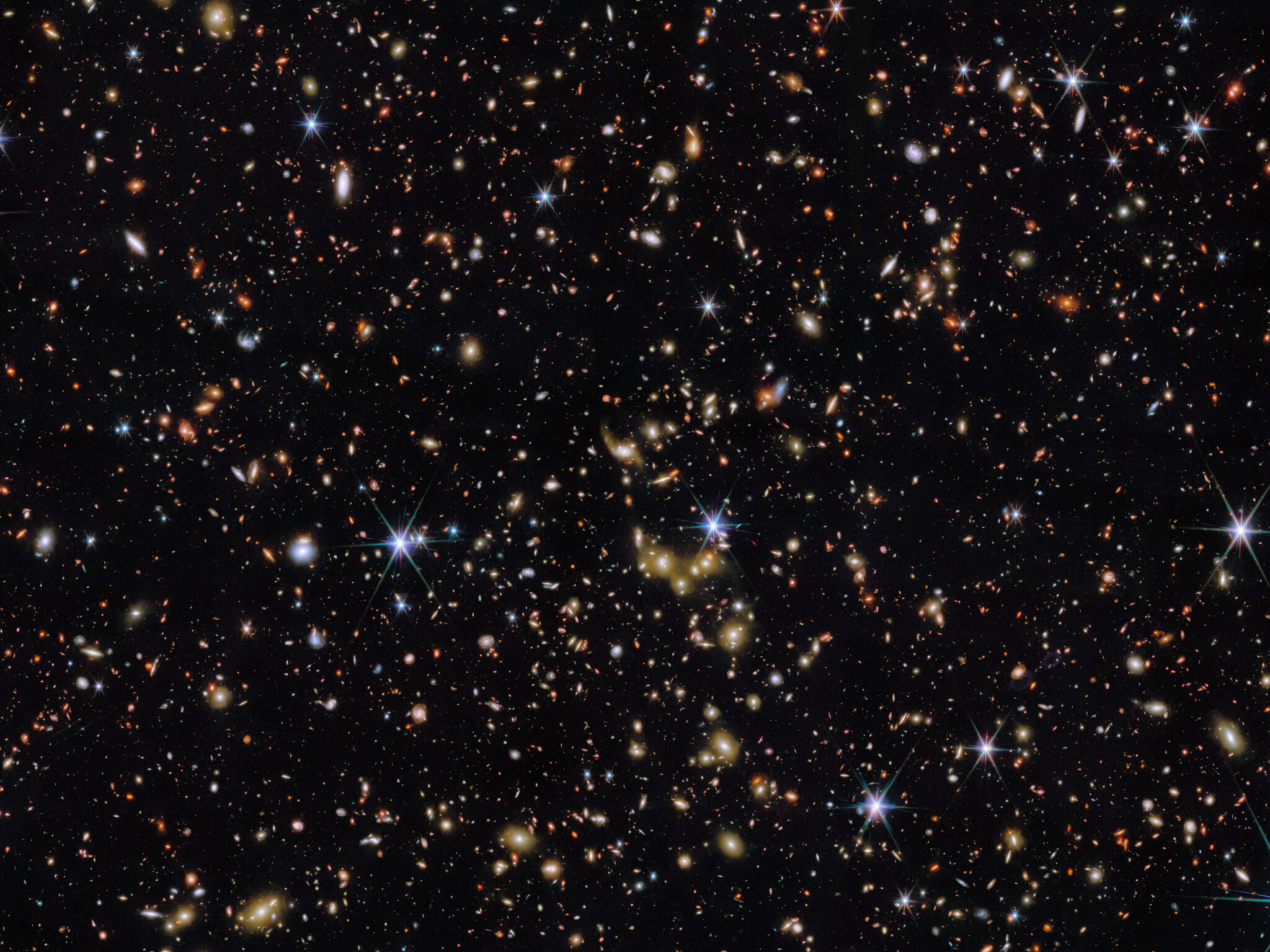
The more you think about it, the more amazing the photo seems. The bright white lights are stars in our own galaxy—our immediate cosmic neighbors. Everything else is a distant galaxy. Each galaxy can contain up to 100 billion stars. Because they are so far away, we are actually seeing many of those stars as they looked six billion years ago, because that’s how long it has taken the light to reach us. The older galaxies are red because, as the universe expands, light itself stretches into the red end of the spectrum. The very oldest splodges are likely galaxies that formed only around 300 million years after the Big Bang itself. To put that into perspective, various types of scorpion have inhabited the Earth for longer than 300 million years. From the perspective of cosmic time, it’s nothing. It’s not even the first baby steps—it’s the universe opening its eyes for the very first time. And we built the tools that allow us to see it.
I’m not saying that everyone has to find space cool and interesting. Plenty of people don’t. But it’s surely a shame that the culture as a whole finds itself unable, most of the time, to be awed and inspired by those parts of the universe that exist beyond the thin shell of our atmosphere. Exploration requires curiosity, and curiosity is deeply human. Unlike other animals, we aren’t driven to new environments simply because of resource scarcity or the threat of predators. We have a surplus of wonder that causes us to pursue knowledge and beauty wherever we find it, without quite knowing why.
Artemis II is just one small example of that spirit in action. But it’s worth celebrating nonetheless. If we lose the will to explore space, we lose the thing that makes us most human.
Luke Hallam is senior editor at Persuasion.
Follow Persuasion on X, Instagram, LinkedIn, and YouTube to keep up with our latest articles, podcasts, and events, as well as updates from excellent writers across our network.
And, to receive pieces like this in your inbox and support our work, subscribe below:
Elon Musk was the singular force behind SpaceX’s survival during its precarious first six years, serving simultaneously as its founder, chief engineer, and sole financial lifeline. He deeply integrated himself into the technical design of the Falcon , personally overseeing engine development and internalizing a culture of radical vertical integration to slash costs. And financed it with his own $100 million dollars. His involvement reached a desperate climax in 2008 when, facing near-total bankruptcy after three consecutive launch failures, he risked his final $30 million on one last attempt. That successful fourth flight not only reached orbit but earned SpaceX vital NASA contract, transforming Musk’s high-stakes gamble into the foundation of the modern private space industry.
The Falcon series reflected Musk’s engineering vision: regenerative cooling, reusable boosters, simplified manufacturing, and a willingness to break from traditional aerospace assumptions. SpaceX’s rapid cadence — launching rockets every few days and landing them for reuse — is precisely why spaceflight feels “routine” today compared to the 1960s and 70s. That normalization is itself a historic achievement.
And when Boeing and Lockheed struggled and failed to deliver a reliable a crewed capsule, it was SpaceX that ultimately carried American astronauts back to orbit from U.S. soil.
Your statement “of moral ickiness about the fact that it’s people like Trump and Musk driving this new age of space travel” is nothing but your political bias. Elon Musk and Donald Trump do not belong in the same sentence when discussing American space achievements.
SpaceX existed only because Musk personally funded it, personally engineered it, and personally kept it alive through six years of near‑failure. He risked his entire fortune, designed critical systems, drove the innovations that made low‑cost orbital access possible, and ultimately delivered the first American crewed launch after the Shuttle era.
If Americans see spaceflight as “routine” today, it’s because Musk made it routine — launching rockets every few days, landing them, reusing them, and proving that what once seemed extraordinary could become normal. That normalization is one of the most significant engineering achievements of the century.Musk for his Tesla, but he should be celebrated, honored and remembered for his contributions to America’s role in space. If we refuse to do that for political reasons, we have already lost the thing that makes us most human.
Years ago, I got up in the dark and headed for a small island that is a memorial to our war dead. I thought that it would be a good spot to watch the last night launch of the space shuttle. The island is in the middle of the Indian River and has a giant lighted American Flag as you cross a small bridge to get there. More than a dozen men arrived before me who had the same idea. We discovered our shared belief that ending manned space flight showcased how America had given up on its youthful ambitions. No longer were we the confident people who believed that anything could be achieved.
Reading this very fine essay has made me understand how young people have grown up without seeing the unbounded human spirit in action. For those of us who grew up on twentieth-century science fiction, the launches today were to be expected. Events around us reinforced the view that we would colonize the solar system and eventually the galaxy. Scientists in the private sector would be heroes admired for their vision and enterprise.
I find it sad that Luke never had that experience. Millions like him grew up with idea that managed decline was inevitable. Paul Ehrlich was their guru. Happily, this essay shows that one young man still has an inspired vision. That gives me hope, and I’m pretty certain that there are at least a dozen men like me who are a little less disheartened today.