

What Ceuta Shows About Europe
Why left vs right is too simplistic to explain attitudes to immigration.

This article is brought to you by American Purpose, the magazine and community founded by Francis Fukuyama in 2020, which is proudly part of the Persuasion family.
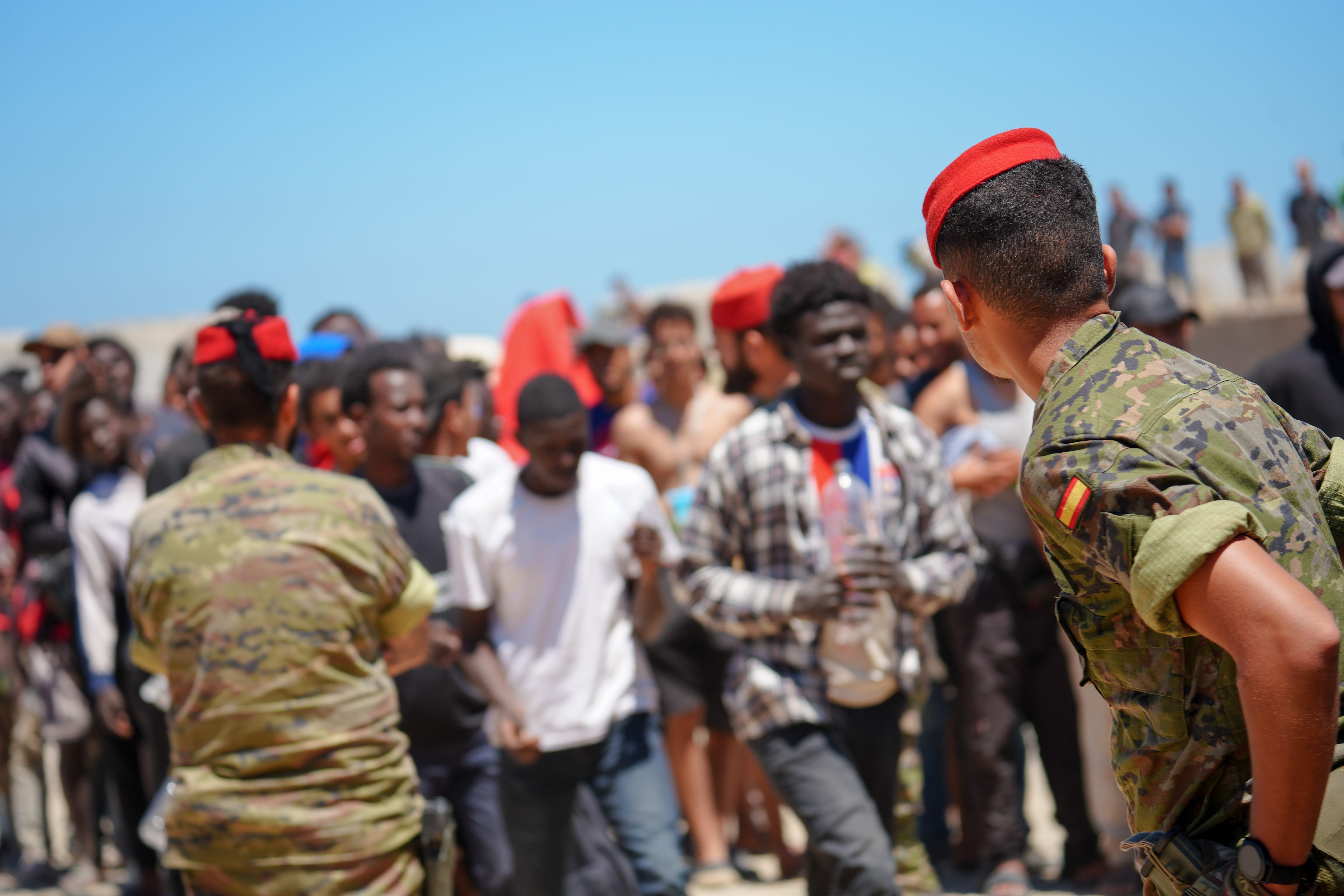
The scenes of mass border crossings from Morocco to Spanish Ceuta have split public opinion. One side supports the reaction expressed by 22 EU states criticizing Spain rather than confronting Morocco for the border chaos. The other side, meanwhile, condemns those 22 for turning on Spain instead of coming to its aid.
The usual commentary frames this as a left/right issue, but it is not that simple. What complicates the situation is the divide between Western and Eastern Europe. These differences are being exploited by external actors who are betting on internal divisions in Europe to achieve their own goals.
So, this is about Spain and Ceuta. Left and right. East and West. Ceuta did not create these divisions. It merely exposed them.
In years gone by, the left and right were differentiated largely, though not solely, by their economic policies—conservative voters (on the right) favored free markets and deregulation, while those with socialist leanings (on the left) supported state involvement and regulation, as well as greater equality of outcome. Religion, tradition, and attitudes to authority always played a part too, but economics was the axis around which the rest turned.
While the economy is still a bone of contention, it has paled in comparison to the modern-day sticking point—immigration. Debate on immigration is linked to a much larger problem plaguing both sides: intolerance of opposing opinions.
Here it is the left, more than the right, that has closed the door to debate by refusing to question attitudes on immigration. This means that views previously held by the extreme right have now spread far beyond the fringe, reaching people who were until recently happily sitting on the fence when it came to immigration. They see uncontrolled immigration, and the threats posed by individuals from incompatible value systems, as at least worthy of discussion. Instead of debating them, however, the left has declared that anyone unhappy with the changes mass immigration has brought to their societies must be racist. This has pushed people with otherwise liberal views further right. An open debate without labeling the other side bigoted might have achieved a different result.
At the same time, the pressure on liberal governments across Europe demands a response. Whether or not they truly believe in controlling immigration, they need to at least look as though they do. And this is where Spain was right—the reaction to Ceuta did look like political posturing.
The refusal to debate does not just alienate voters at home. It also means Western Europe cannot hear what Eastern Europe has been saying for years. The fight between the left and right on this subject is almost completely absent in Eastern Europe. What most Western Europeans do not realize is that, while we all come from the same Christian civilization and millennia of shared history, the last century has taken its toll.
Our understanding of what is important and what is not diverges. While Western Europe rebuilt its societies after the Second World War and enjoyed decades of prosperity, for Eastern Europe the war only really ended between 1989 and 1991. Until then, the survival of Eastern European states was under threat from what some people saw as communism, but in reality was naked and unabashed Russian imperialism.
Until relatively recently, Eastern European countries occupied by Russian soldiers could only dream of their own nation states (or rather, national states—a term used in the constitutions of several such countries to designate a state intended for a specific nation). In some countries, indigenous populations came perilously close to becoming a minority as a result of ethnic cleansing, forced Russification, and resettlement policies. Having a national state of their own was the dream of generations for over half a century.

In such countries, multiculturalism, which is perceived as another version of forced change, does not sell. That is why they would rather make financial contributions or provide operational support under the EU’s solidarity mechanism than accept migrant relocations imposed by new EU rules. When liberation movements gathered speed just before the fall of the USSR, there were millions of people willing to die just to get away from the demographic engineering imposed on them. While the rest of Europe had decades to enjoy their “singledom,” Eastern Europe is less trusting when it comes to newcomers. They have seen this movie; they know how it ends.
Another element missing from the Eastern European psyche when it comes to accepting immigration is the guilt over “white privilege.” Almost no Eastern European countries had any colonies and most Eastern Europeans themselves lived under serfdom. Serfdom in Eastern Europe meant peasants belonged to the lord who owned the land they lived on. Serfdom was finally eradicated in the last parts of Eastern Europe only in 1864, just one year before slavery was abolished in the United States. And, having been sold to the Kremlin for the “greater good” by the “victors” following WWII, Eastern Europeans did not feel particularly privileged. They fought for their right to have a nation state without external help, and some of them are still fighting for that right as we speak.
So no, we are not in this together. We are very much divided.
This division is what makes Europe vulnerable, yet it has largely been kept out of discussions around immigration. This makes Europe prey to predator states who understand these undercurrents all too well, and so can use them to destabilize the Western world and gain geopolitical influence.
Iran, for example, has supported the wars in the Middle East that triggered much of the refugee flows into Europe—including keeping Assad afloat in Syria for over a decade, funding Hezbollah in Lebanon, and backing other proxies in the region. Russia, meanwhile, has weaponized the flow of people. Through its proxy Belarus, Russia has pushed tens of thousands of Middle Eastern migrants to the Polish, Lithuanian, and Latvian borders, with reinforced tunnels dug under the border by Middle Eastern specialists to sustain the operation. In Africa, Russian influence has expanded through Mali, Burkina Faso, and Niger following recent coups, destabilizing the region in ways that risk generating the next wave of migration towards Europe. And a similar tactic has now been used in Ceuta—though the identity of anyone who might be helping Morocco is still up for debate.
China, on the other hand, does not send migrants. It does not need to. All it needs is to supply goods to Russia and buy its natural resources—the actions that helped the Russian economy stay afloat after it was cut off from the rest of the world. Beijing could pull the plug at any moment. It just chooses not to, because internal divisions leave Europe vulnerable to Chinese influence.
Once the pressure immigration has created in European societies takes root, Russia does what it is best at—running disinformation campaigns targeting both sides of the immigration argument and telling each what it wants to believe. Within days of the crisis, Ukraine’s foreign minister identified more than 1,500 Ceuta-related articles across a pro-Russian network led by Pravda and Russia Today, with almost 300 in the Spanish edition alone. The left is told the far right is on the march. The right is told that the left refuses to listen. All true. Europeans direct their anger at one another.
We are all sitting ducks—unless we remember that everything Western society has ever achieved was done through debate, not by shutting down the opposition.
Ines Burrell is a geopolitical analyst and political risk consultant based in the UK. Born in the Baltics, with a degree in International Relations from the University of Exeter, she writes and gives live commentary on European security and Russia.
Follow Persuasion on X, Instagram, LinkedIn, and YouTube to keep up with our latest articles, podcasts, and events, as well as updates from excellent writers across our network.
And, to receive pieces like this in your inbox and support our work, subscribe below:
 | A guest post by
|