

An Actually Popular British Politician
Andy Burnham looks ready to take down Keir Starmer. But what does he believe?

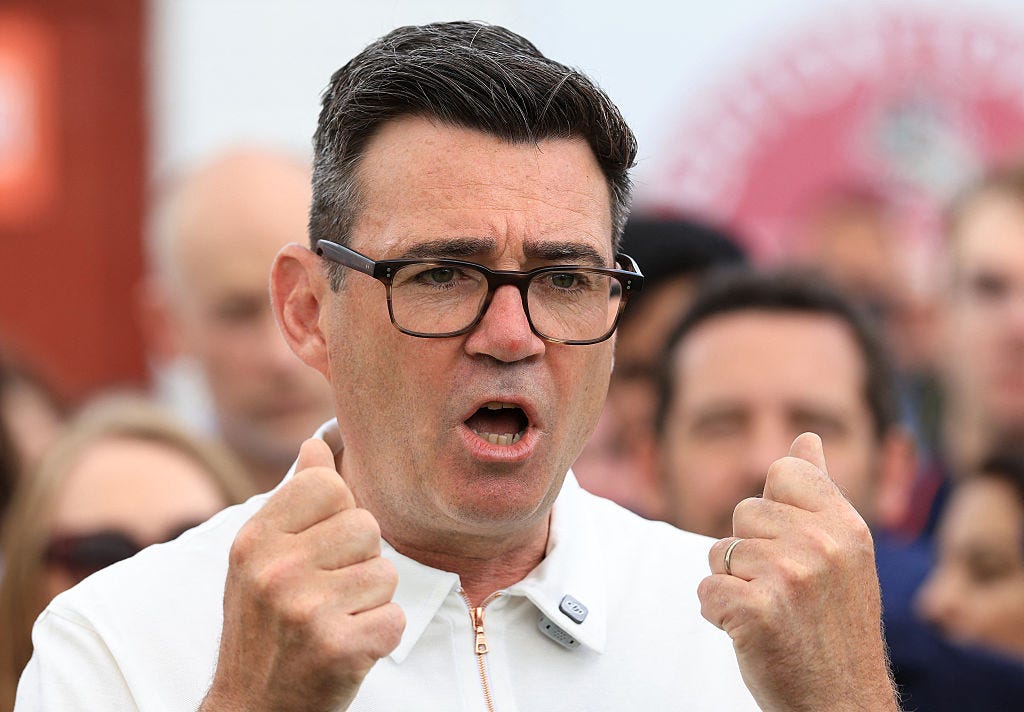
British politicos have feverishly spent the last week with their eyes on the parliamentary by-election that took place in the northern constituency of Makerfield yesterday. With the future of Britain’s government in the balance, Makerfield—a few miles west of Manchester—was the setting for a dramatic showdown between the governing Labour Party and right-wing challengers Reform. Most crucially, it was the first step in Manchester Mayor Andy Burnham’s campaign to replace his boss, Keir Starmer, as prime minister of the country.
Starmer’s growing unpopularity (he is now tied with Liz Truss for least popular prime minister ever) invited a series of challenges over the last few months, especially following a disastrous result for Labour in May’s local elections. But none of his opponents, including the ambitious health secretary Wes Streeting, managed to get sufficient backing from other Labour MPs to launch a challenge. The amateurish plotters resigned from the cabinet without drawing blood.

But all along, the real threat to Starmer was far from Westminster. Andy Burnham, the Mayor of Manchester since 2017, has long been gunning for the top job. Britain’s parliamentary system only allows MPs (or, more eccentrically, members of the House of Lords) to become prime minister, so Burnham has been on the hunt for a good seat for months. Last January, Starmer barred him from running in one by-election. But he was no longer in a position to replicate that power move when Labour’s Makerfield MP Josh Simons stood down from Parliament to pave Burnham’s road to Westminster.
Until last night’s results came in, Burnham’s bid seemed to face considerably more jeopardy than Makerfield’s history might suggest. The constituency is a historically safe seat for Labour, even staying true to its colours in the 2019 general election when Boris Johnson plucked most of Labour’s famed “red wall” seats in the north for the Conservatives. And yet with Nigel Farage’s nationalist Reform Party surging across the country, over half of Makerfield’s electorate backed Farage’s outfit in last month’s local election. Polls gave Burnham a single-digit lead over Reform’s Robert Kenyon.
But Burnham trounced Kenyon with a surprise 20-point win last night. It was a potent demonstration of the man’s political talents. Burnham will return to Westminster with the honorary title of “Britain’s most popular politician.” Thirty-five percent of the country has a positive opinion of the 56-year-old northerner, twice Starmer’s approval rating. Burnham is almost certain to launch a leadership bid against Starmer in the coming weeks—and he will probably win.
But who is Andy Burnham? What does he stand for?
A former member of Gordon Brown’s cabinet until 2010, and of Jeremy Corbyn’s shadow cabinet during one of Labour’s most left-wing periods following the 2015 election, Burnham was elected Mayor of Greater Manchester in 2017. Nine years later, his legacy in the city is largely positive. Manchester has been labelled the “star performer of the UK economy since 2008,” with private investment pouring in and employment growth in the top five of European cities over that period. His investment in the very popular (and very visible) bright yellow “Bee Network” of public buses and trams has been popular. Burnham was also instrumental in campaigning for a deal that granted Greater Manchester more devolved power in 2023.
Burnham plans to make this record key to his pitch to the country: an approach he has labelled “Manchesterism.” At its heart is regional devolution, an appealing prospect in one of the most financially centralized countries in the world, in which London holds most levers over infrastructure spending and taxation. Economically, Burnham claims that Manchesterism represents the “end of neoliberalism, the end of trickle-down economics.” He is also a vocal advocate of reindustrialising the UK’s economy.
But there’s a problem: the Manchesterism that Burnham has defended publicly contrasts starkly with the Manchesterism actually in effect in the city. Burnham is a regular advocate for nationalisation, having indeed brought much of Manchester’s transportation into public ownership. But in practice, Manchester’s success predates Burnham’s election, and was boosted by a surge in foreign direct investment encouraged by consistently pro-business political elites over the years. Regarding industrialisation, Manchester’s success has been decisively post-industrial, with an emphasis on the service economy. It’s unclear which vision of Manchesterism—the one in Burnham’s rhetoric, or the one that actually exists—he would seek to implement nationwide as prime minister.

On top of these ideological teething issues, Burnham would also inherit an incredibly tight fiscal situation. The British government spent around £110 billion (8.1% of public spending) on debt interest in the past year—one of the highest levels in 50 years, and a figure that continues to rise. Starmer has already attempted to juggle these impossible constraints. Burnham, likewise, would also face difficult arbitrage decisions. Will he commit to increase defense spending towards the 3% of GDP target? Could he do so without touching the £333 billion the UK is spending on welfare (up from £262 billion only three years ago)?
True, some key metrics are trending in the right direction. Illegal migrant crossings over the English Channel are down, waiting lists for the National Health Service are down, inflation is down. But Britain’s structural economic reality remains dire, something that will hurt Burnham just like it has hurt Starmer. As the churn of Conservative prime ministers over the past decade demonstrated, the polling bump enjoyed by fresh faces is only temporary.
Starmer’s fate will be decided in the next few weeks. But the prime minister has not yet signalled he will leave, and is obstinately clinging on. This could force Burnham to ask Cabinet ministers to heap pressure on Starmer to set out a timeline for resignation. Worse still, he might launch a protracted leadership bid that would take most of the summer.
The one potential lifeline for whoever becomes Britain’s next prime minister is the fragmentation of the political right. Yesterday’s by-election was a blow for Reform—the scale of the defeat in a constituency that is 95% white and that only a month ago elected a clean sweep of Reform local councillors will hurt.
Even further to the right, Restore Britain, a breakaway party created just this year, scored almost 7%. Replicated across the country, these results could very well cost Reform up to 70 seats in a general election. And while the Conservatives were a distant fourth in Makerfield with 2% of the vote, they gained almost 50% in the Aberdeen South by-election taking place the same night. For leader Kemi Badenoch, this will be much needed ammunition to prove that the Conservatives are still a threat to Reform.
But this won’t be enough to save Labour. The party has to deal with its own challengers, such as the rising popularity of the left-populist Greens. Most importantly, it will need to develop a clear narrative of how to fix the country and start lining up tangible results. It is unclear whether Andy Burnham is the solution to these problems—but right now, he might be the best Labour has to offer.
François Valentin is a senior consultant at London Politica.
Follow Persuasion on X, Instagram, LinkedIn, and YouTube to keep up with our latest articles, podcasts, and events, as well as updates from excellent writers across our network.
And, to receive pieces like this in your inbox and support our work, subscribe below:
It will indeed be interesting what kind of Burnham will be as PM.
And one point of geography, Makerfield might be north of London, but it's definitely not "northern" with respect to the whole of the UK.