

Britain’s Far Right Want Power
What I saw at Saturday's “Unite the Kingdom” rally.

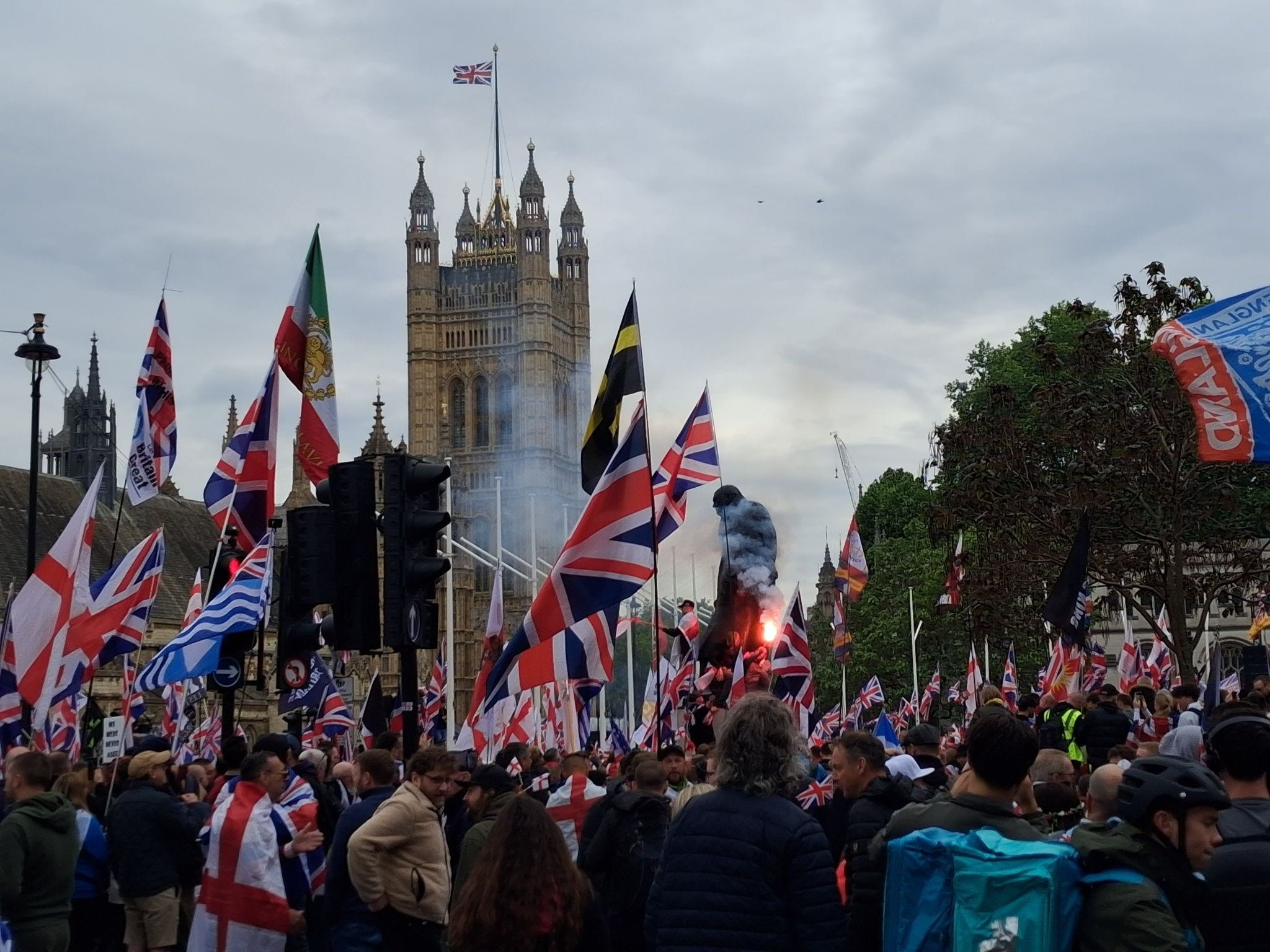
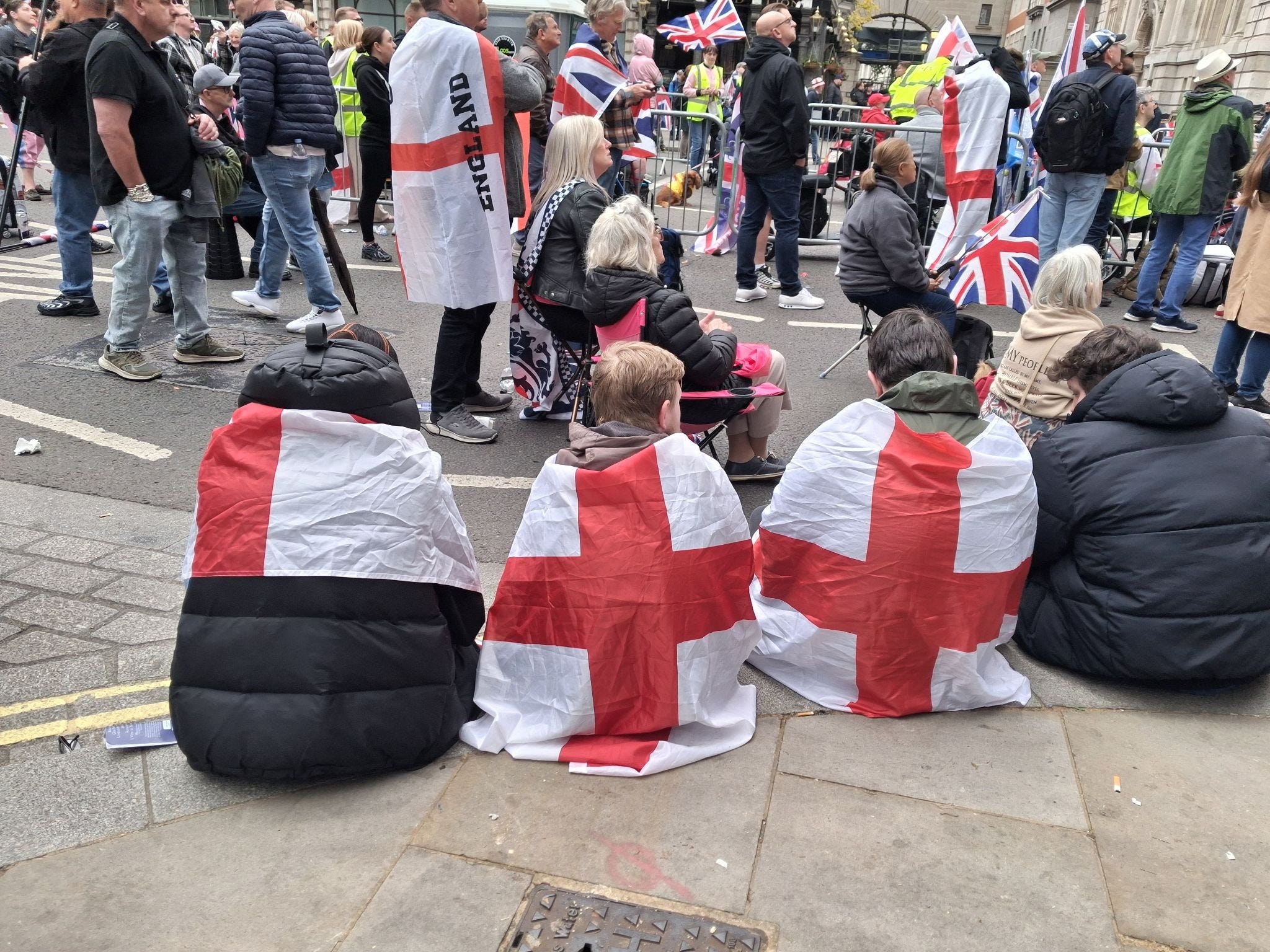
Parliament Square is heaving. All around me, thousands press towards a stage on which a black gospel choir is performing. There’s a sea of flags, lots of people are drinking beer.
I’m on the outskirts of the crowd, in the shadow of Big Ben, and I’ve struck up a conversation with a group of strangers who hadn’t met before today.
There’s an Iranian couple who’ve lived in the UK for several years. There’s an Indian student on a temporary visa. There’s a business owner who grew up Hindu in Germany but whose parents hail from Afghanistan. Suffice it to say, these are not the kinds of people I thought I’d end up meeting at the “Unite the Kingdom” march organized by the far-right activist Tommy Robinson.
The Iranian man is blunt. “I think what all these people have in common is a dislike of Islam,” he says, gesturing at the crowd. He’s been talking about his hatred of Sharia law, about his belief that it is being imposed in Britain, just like in his native Iran.
Beside him, a woman holds up a sign bearing the image of Reza Pahlavi, the son of the deposed Shah of Iran. She speaks fluently about the oppression of the Islamic Republic and her sympathy with the protesters in her home country. She believes that the same danger—radical Islam—is taking root in the UK.
Sneha, the Indian student, agrees. She tells me that she doesn’t plan to remain in the UK once her studies are over, but she does plan to return as a tourist. And when she does, “I don’t want Islam to be so prevalent. I don’t want Sharia here.”

The demographic diversity in this group is unusual. The rally is overwhelmingly white and working class—for the most part, it’s exactly the sort of crowd you’d expect. But almost without fail, everyone I speak to over the course of the day converges on this same view of Islam. I can tell that most people here are torn between wariness of voicing their views in public and feeling that things have gotten so bad that they just have to speak out.
All of this is taking place a week after the British public handed the Labour government a devastating loss in local elections. The right-populist Reform led by Nigel Farage emerged as the largest party, gaining well over a thousand council seats. Labour and the Conservative Party both flounder with abysmal poll numbers. The fallout from the election is almost certain to topple Keir Starmer’s premiership.
Which poses a question: Will these marchers be satisfied with protesting in the streets? Will the movement fizzle out, like so many far-right movements before it? Or do they represent something more permanent—a growing constituency of the British electorate that won’t rest until it sees itself represented in the halls of power?
Sceptered Isle
“The country’s in such an absolute mess. With this oppressive Labour government at the moment, if people don’t get out on the streets, nothing will change. I genuinely believe that.”
I’m talking to Daniel, a soft-spoken man from the East London suburbs. The march is just getting started, and we’re walking down the Strand towards Whitehall in central London.
The scene is lively. I see members of the public stand in bemusement as their path into town is interrupted by a sea of Union Jacks and Saint George’s crosses. Several kids have climbed up the scaffolding on a tall building and are throwing flares down onto the roofs of other buildings. Below, a speaker system blares Tracy Chapman’s “Talkin’ Bout a Revolution.”
“For the last thirty years,” Daniel tells me, “the British people have decisively voted for the party that promises to restrict immigration the most, and we’ve just been ignored. It’s not a question of being racist, it’s a question of numbers. We don’t have the infrastructure for it. Our public services are crumbling.”
It’s a sentiment I hear a lot over the coming hours: Britain is broken, nobody is fixing it. Again and again, people tell me they’re worried that immigrants don’t integrate, that they are a drain on public services. They reference various events from recent years to support their case. The Conservative Party promised that Britain’s exit from the European Union would bring down net migration, but net migration increased. Following a surge in refugee numbers after COVID, asylum seekers were put up in hotels around the country. And there have been scandals like the “grooming gangs”—the fact that, over several decades, police in multiple regions were slow to investigate the abuse of young girls by groups of mainly Asian men in England for fear of appearing racist.
One young man from Kent spoke for many when he told me, “When you’re allowing unvetted men in, creating vast problems in our country, then things need to change.”
Britain, of course, has real problems. Following the 2008 financial crisis, its economy simply did not grow as fast as the United States or much of the rest of Europe. Outside of London, many towns and cities suffer from decline. Successive governments have struggled to deal with a huge surge of refugees in recent years, including 200,000 crossing the English Channel on small boats since 2018.
There are also problems with integration on the edges of some of the UK’s Muslim communities. While it’s false to say that “sharia law” has been imposed on a wide scale in British cities, religious intimidation, flare-ups over blasphemy in schools, and instances of hardline imams on “sharia councils” arbitrating things like divorce are all real phenomena. Extremism and violence by some Palestinian activists—and violent attacks against British Jews—are also real.
None of these concerns can be dismissed out of hand. But in this crowd, they have been inflated to fit a vast narrative of terminal decline and elite betrayal. Issues like the grooming gangs and the migrant hotels are not failures to be learned from within a status quo that basically works; they are symptoms of civilizational collapse at the hands of one religion.
Kyle, a young man wrapped in an Israel flag (though he tells me he’s a Christian) says that World War III is coming “from Islam.” Tony, a construction worker from Birmingham, says of the Muslim month of Ramadan: “They don’t fast, they feast. When the sun’s up, they don’t eat and they tell everyone ‘we’re fasting, we’re fasting.’ But when the sun goes down they gorge again. They feast on everything.”
And a man who identifies himself as Stan Laurel because of his resemblance to the English comedian points up at the tall Victorian buildings all around. “We built all this. Our fucking peasants fucking built the fucking lot, mate. And now we’re fucking retaliating.”
Retaliating against who?
“Muslims.”
Oh, Tommy Tommy!
Today’s march has been organized by Tommy Robinson, the country’s most notorious far-right activist. Born Stephen Yaxley (he adopted his current name to conceal his criminal conviction for assaulting an off-duty police officer), Robinson first gained prominence in Luton as co-founder of the English Defense League in 2009.
Luton is a town that can easily stand in for various problems facing the UK. One of the country’s most densely-populated urban areas, it suffers from widespread relative poverty and social unrest. A decade or two ago, the town was a hub for several extremist Muslim groups. After one of these groups heckled a homecoming ceremony for soldiers returning from the war in Afghanistan, dozens of young white men and football hooligans mobilized and formed the EDL: a street movement protesting both jihadist extremists and regular Muslims.
The EDL’s tactics were antagonistic, regularly racist, and often violent. In the early 2010s, it was common to switch on the news and see them rioting, shouting slurs, and attacking police officers.
While the EDL eventually declined amidst infighting, other movements took its place. Far-right groups like “Britain First” made headlines for protesting against what they claimed was the “Islamification” of the country. Then, the Brexit vote in 2016 drew attention to the economic and cultural grievances of working class voters, putting immigration squarely on the national agenda.

Through it all, Robinson was never far from the headlines. Boyish, pugilistic, and a passionate orator, he’s the closest thing the British right has to a working-class hero. Unlike Nigel Farage and Boris Johnson—the upper-class faces of British populism—he looks and sounds the part.
It’s obvious from the way he MCs proceedings at Unite the Kingdom that he knows how to work a crowd. The second most common chant I hear (behind “Keir Starmer’s a wanker!”) is “Tommy Tommy Tommy Tommy Rob-in-son. Ohhhh, Tommy Tommy!”
Robinson has always been clever enough to distance himself from the more overt displays of violence and racism spawned by his movement. But he’s also authentic enough to retain the allegiance—even adoration—of broad swathes of the far right. He’s received a number of criminal convictions over the years, including for assault, fraud, and contempt of court—but in the eyes of his supporters these only reinforce his status as a martyr unjustly targeted by the elite.
A watershed moment came with the summer 2024 riots. After three young girls were stabbed to death and many others injured in the seaside town of Southport, it was rumored that the perpetrator was a Muslim asylum seeker. The claim was amplified by Robinson, and by the time it emerged that the real attacker was born in Wales to a Rwandan Christian family,1 27 towns and cities had been plunged into a week of unrest. Protesters were heard chanting Robinson’s name. Angry mobs firebombed migrant hotels. Hundreds were arrested, including Peter Lynch, a grandfather of three who later committed suicide in prison.
One of the first things I see at the Unite the Kingdom rally is Lynch’s face plastered across a banner:
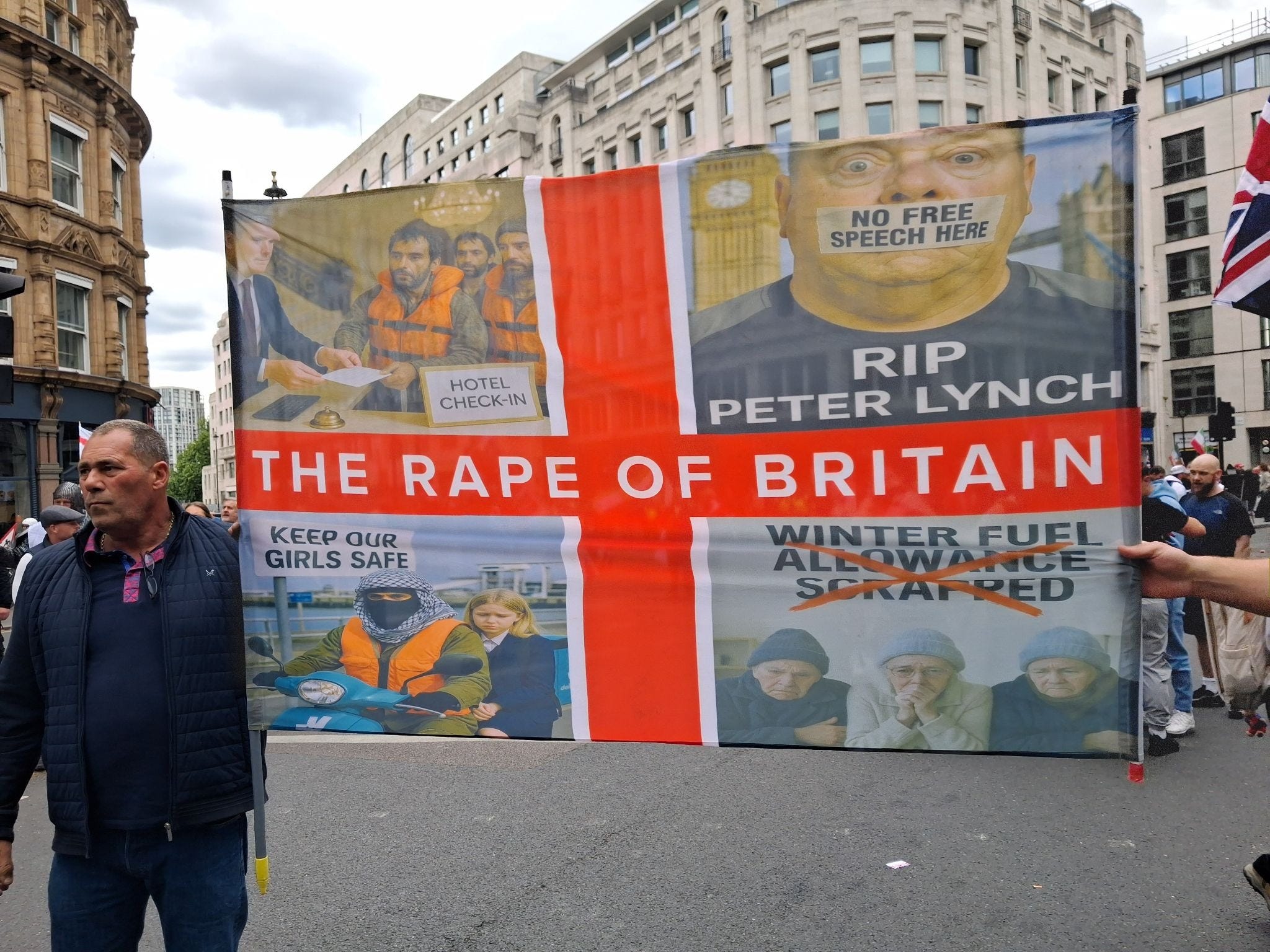
I suspect the Southport riots, more than anything else, explain how Robinson’s movement grew so big, so fast. It was proof that ordinary people all across the country, not just violent young men from deprived towns like Luton, can mobilize against immigrants. While during the height of the EDL in 2011 only a thousand people would show up to demonstrate, by September 2025 the first “Unite the Kingdom” rally was drawing an estimated 150,000 attendees.
Soldiers of Christ
We arrive at Parliament Square, where the sky is overcast. Up on the stage, a parade of speakers and musicians keeps the crowd alternately enraptured, enraged, and entertained.
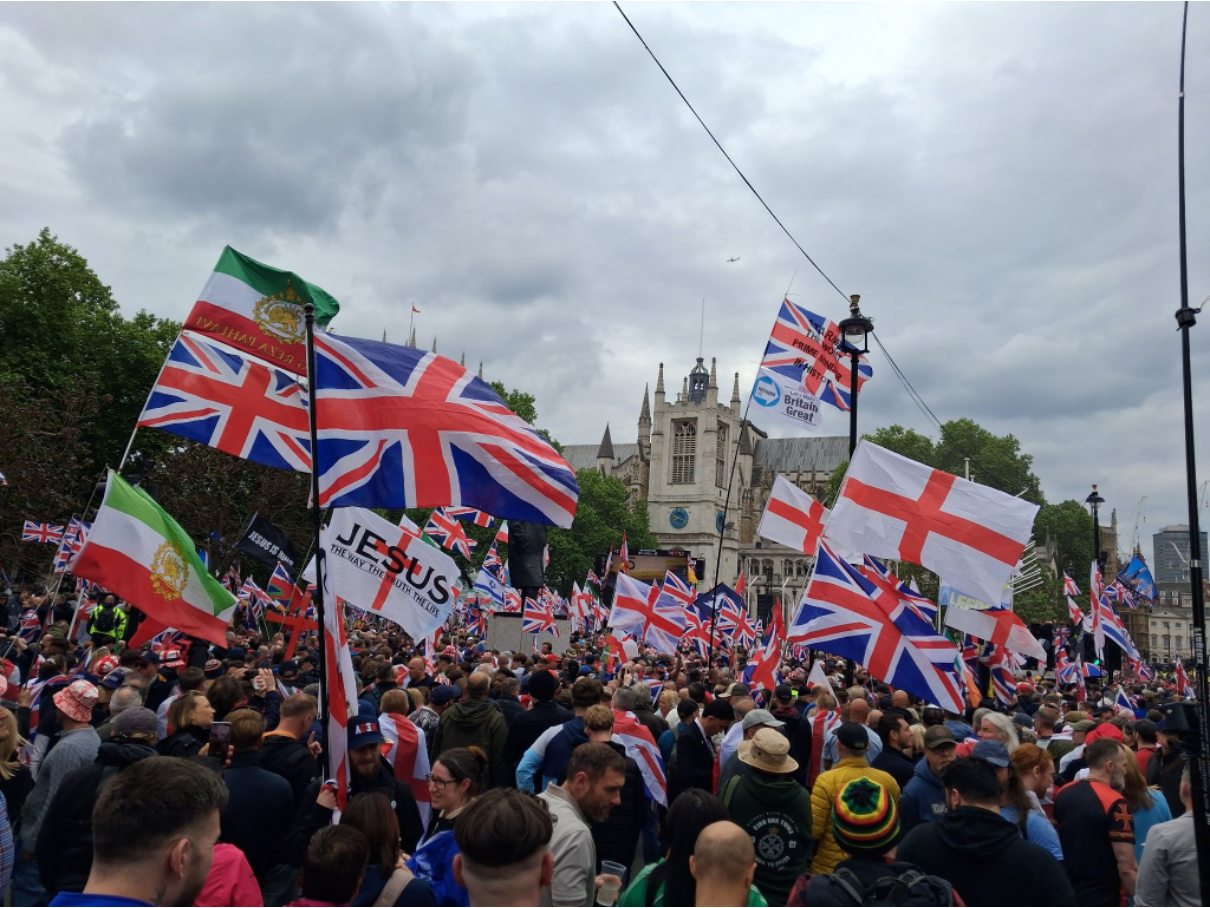
I’m struck by the proliferation of Christian imagery here. Dozens of marchers are carrying crucifixes and wooden crosses. Others hold signs reading “Christ is King.” At times, the tone is apocalyptic—a large banner reading “REPENT, TODAY WE ARE IN THE LAST DAYS” flutters against the clouded sky.
“I’m here to unite the Kingdom for Jesus,” says Topaz, a young woman who works as an online tutor. Like everyone else, she’s watching the speeches on huge screens above the stage. “I’m hoping that everyone starts to turn back to Jesus. I think that when we do we will be blessed again, like we once were as a nation.”
It’s strange to hear this sentiment expressed in the UK where, until quite recently, the intermingling of religion and politics was viewed with suspicion. Faith is a private thing, and few will actively invoke the Bible to push a political agenda.
That’s starting to change. Many of those attending Unite the Kingdom are convinced of the need for an assertive Christianity in public life. I speak to Richard, one of several people wearing high-vis jackets on which are written lines from the New Testament. Richard says he is part of a group invited by Robinson to hand out the Gospel of Saint John. He tells me that Robinson is a good Christian, despite his criminal convictions.
“When he was jailed, the prison chaplain met with him every day and taught him about the Bible and about Jesus Christ,” Richard explains. “I would say he’s very close to putting his full trust in Jesus as his Savior.”
Christians are just one part of the coalition Robinson has assembled here. Unite the Kingdom has folded into its ranks working-class Brexit voters, Iranian monarchists, and British admirers of Donald Trump. (Up on stage, Robinson plays a videoclip of U.S. Secretary of State Marco Rubio. He also vociferously praises Charlie Kirk.) Perhaps surprisingly, ethnic minorities are frequently among those giving speeches or leading the music. Back in September, during the first Unite the Kingdom rally, I’d been startled to see a group of Māori performing a haka.
That’s what stands out most: the (for want of a better word) intersectionality of it all. It’s a far cry from young men smashing up police vans in Luton because they want England to remain white. In fact, many people at Unite the Kingdom actively express solidarity with other countries that take a hard line on immigration. “In North Korea you get shot. In Russia you get five years in jail for entering illegally,” says the man who looks like Stan Laurel.
The prevailing view is that every civilization has a right to defend itself—and that includes Britain.
“Are You Ready?”
You can’t reconcile the view of immigrants displayed here with my own experience of London.
Some people go out of their way to tell me that they don’t object to most Muslims, just the minority of radical Islamists. But plenty of people either don’t supply that caveat, or actively claim that the problem is most Muslims. They tell me that Islam is an exception among all religions in the world: the one faith that simply cannot integrate.
I live in the North London borough of Haringey, which is 57% white. It contains a diverse mix of Turks, Greeks, Muslims, and is adjacent to the Stamford Hill ultra-Orthodox Jewish community. Costas, my Greek landlord, collects the rent. Mohamed, a Muslim Uber driver, takes me into town the day after the rally. Yogita, the Indian shopkeeper, sells me beer on the weekend.
Many of the marchers here are convinced that such diversity is neither desirable nor possible—or, at the very least, that all the non-Muslim groups live in constant fear of Muslims and refugees.
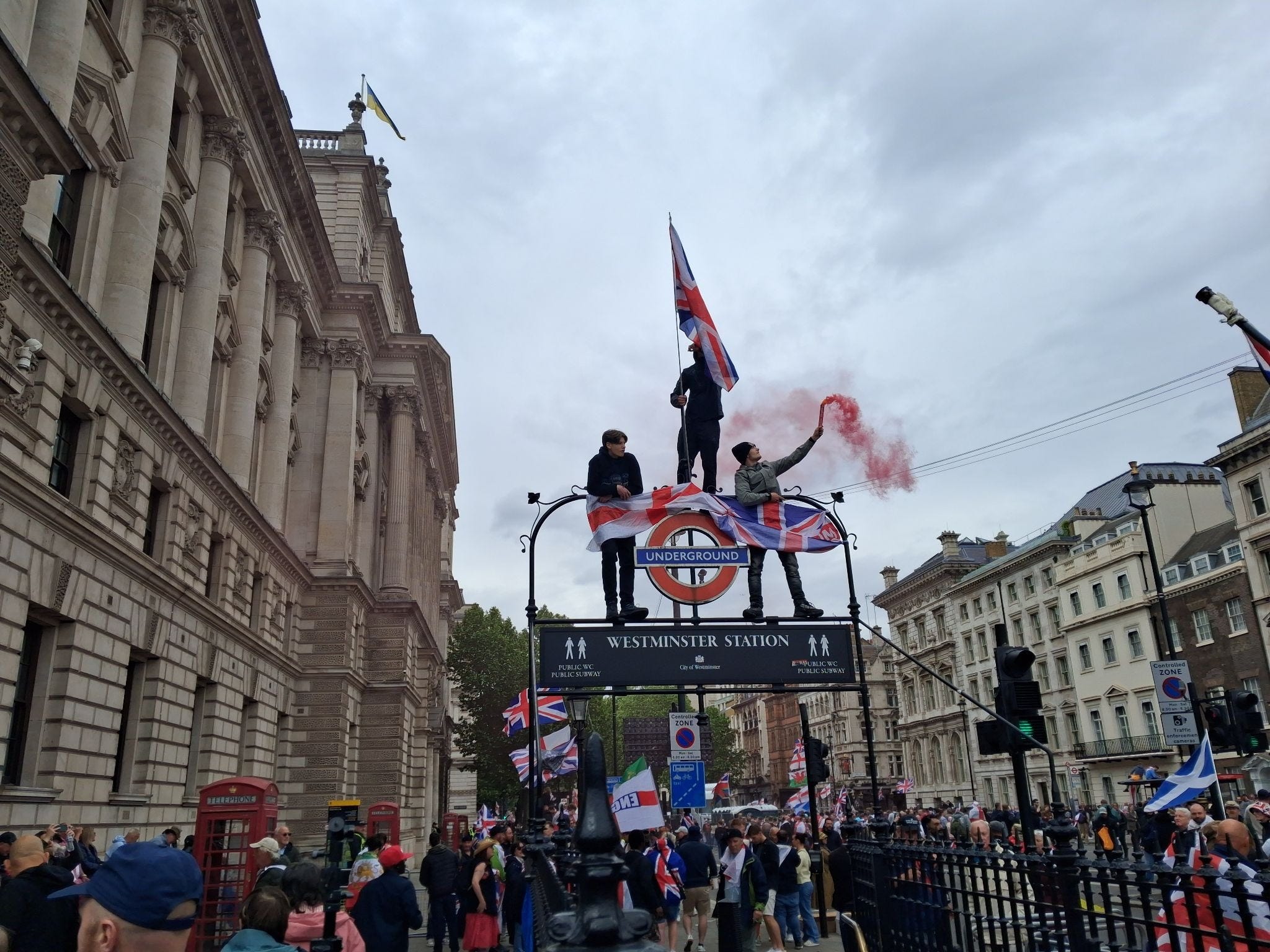
It’s nearly 5pm. I can already tell that this Unite the Kingdom march isn’t as big as the one held in September. I can see it in the vast empty spaces that have opened up in front of the TV screens spaced out along Whitehall. Later that night, police will estimate that roughly 60,000 people showed up, compared to more than 150,000 the first time round.
It’s tempting to chalk up this decline in attendance to a lack of momentum. Some in the media are already claiming that the movement is fading, that the far right remains fringe.
I’m not convinced. Unite the Kingdom was years in the making, fed by a drip of news stories and narratives that are slowly coalescing into a coherent—if apocalyptic—worldview in Britain. It’s not just Brexit. It’s not just the rise of right-populist media like GB News (by some metrics the most-watched news channel in the country), which has long pushed the conspiratorial narratives I heard at the rally. It’s not just the refugee crisis of the 2010s or the small boats crisis of the 2020s. It’s not just the Southport riots or Islamophobia. It’s not even the failures of successive governments to fix what feels like a terminally stagnant economy.
It’s a combination of it all, along with an intractable sense of powerlessness that just isn’t going away, no matter what the establishment does.
Which is why I don’t think these marchers will be satisfied until they attain real power. They feel betrayed by a Conservative Party that delivered Brexit but then oversaw a surge of migration. They feel even more betrayed by a Labour Party that promised radical change but has managed to please exactly nobody.
So now, in the words of Tracy Chapman, they’re talkin’ bout a revolution. Most are willing to give their vote to Nigel Farage and Reform—but only, as a couple of people tell me, because he is the most viable candidate to the right of the Conservatives. If they could, they’d vote for parties to the right of Reform.
Things are starting to wind down, and Robinson once again takes to the stage. “Are you ready for the Battle of Britain?” he shouts. “If you don’t send a message in the next election—if you don’t register to vote, if you don’t get involved, if you don’t become activists—we are going to lose our country forever!”
Britain’s far right is eyeing power. The question many of us are asking is how far they’ll be willing to go if they get it.
Luke Hallam is senior editor at Persuasion.
Follow Persuasion on X, Instagram, LinkedIn, and YouTube to keep up with our latest articles, podcasts, and events, as well as updates from excellent writers across our network.
And, to receive pieces like this in your inbox and support our work, subscribe below:
Much has been made of the fact that Axel Rudakubana, the 17-year-old perpetrator of the attack, downloaded an Al-Qaeda training manual onto his computer. But as detailed in a lengthy report last month, there’s no evidence that he was motivated by Islamic fundamentalism, and the manual was part of a pattern of downloading extreme and violent material. His computer also contained “grossly offensive and graphic” anti-Islamic material.
The ability of liberals to carefully construct an alternative reality that prevents them from dealing with the difficult aspects of actual reality never ceases to astonish. Here are some of the questions that this artfully crafted fantasy never comes close to addressing:
* What are the violent crime rates, by nationality, of different immigrant groups?
* How often are illegal migrants actually removed from the country? How often are migrants who are convicted of violent crimes *not* removed from the country because they might face some inconvenience? Which countries are able to send an infinite number of migrants to the UK, because due to "human rights," zero of them may be returned to their own country?
* What is the rationale for allowing millions of low-skilled migrants who will be a fiscal burden for their entire lives? Even The Economist, head cheerleader for mass migration, has been forced to concede that every low-skilled migrant is a fiscal burden.
https://www.economist.com/content-assets/images/20250315_FNC123.png
https://www.economist.com/finance-and-economics/2025/03/13/your-guide-to-the-new-anti-immigration-argument
https://migrationobservatory.ox.ac.uk/resources/briefings/the-fiscal-impact-of-immigration-in-the-uk/
* How often do the police caution members of the public for making critical comments about the sacred dogmas of immigration and multiculturalism? In what sense does this constitute "freedom"? Why does liberalism, which is nominally committed to open debate, throw itself so enthusiastically into the cause of suppressing and silencing dissent about its fundamental dogmas (e.g. migration and multiculturalism)? Why does liberalism remain unable to account for its critics except in terms of emotion-driven pseudo-categories such as "hate"?
* How is it an advance for liberalism to have multiple MPs elected on an openly sectarian, pro-Gaza platform?
* What does it imply about the legitimacy of a political system, when the public repeatedly votes for one thing (less immigration) and gets the opposite (more immigration)? How can such a system be considered legitimate? What, in the liberal view, is the actual purpose of elections? (A rhetorical question of course: the liberal answer is that "when the people vote for less liberalism, we give them more liberalism and that is the essence of democracy.")
https://papers.ssrn.com/sol3/papers.cfm?abstract_id=4230288
https://www.slowboring.com/p/a-boring-theory-of-the-populist-right
https://www.chathamhouse.org/2017/02/what-do-europeans-think-about-muslim-immigration
* What percentage of housing in London -- one of the most expensive cities in the world -- is social housing? What percentage of this housing is occupied by migrants who have made no contribution to the country other than arriving there, and immediately receiving social housing based on their 'need'? What percentage of this housing is occupied by the multiple families of polygamous patriarchs?
* What is the number of new immigrants to the UK over recent decades, in comparison with the quantity of new housing built over the same decades?
In what possible sense could this system be considered to "basically work"?
The author is correct that Tommy Robinson is a distasteful, nasty character. So too is Donald Trump. Liberals might wish to reflect on how it is that such figures come to receive the support of millions. A simple theory is the following: Most people want less immigration, or at a very minimum, that foreign criminals, benefit spongers, and those who do not share the host country's values (e.g. about blaspheming the Prophet) should not be admitted. Liberalism declares that meeting these demands is utterly impossible. Under no circumstances will foreign criminals be deported if they might face 'harm'; under no circumstances will any migrant be hindered from immediately receiving social housing for life; and if anyone raises objections to the blasphemy laws (e.g. about Koran desecration) being implemented by 'community leaders', the police will caution the objector, not the theocrat. So, after all other options have been exhausted, the public will hold its nose and vote for the nasty character. A simple alternative to this would be for liberals to 1. Take seriously the public's rational concerns about immigration, 2. Implement a minimally sane migration policy that does not entail having the public's generosity abused by foreign benefit scroungers and criminals. Denmark has actually done this to some extent, and, hey presto, the so-called 'far right' is not a problem there.
But instead -- again and again -- liberals prefer to construct for themselves comforting fairy tales in which their opponents are motivated by lurid fantasies with little relationship to reality, and comfort themselves by assuring themselves that if the official narrative of the BBC and Westminster is simply repeated often enough, and if dissenters are silenced firmly enough, it will somehow all work out in the end. Good luck with that!
"Far right".
Naw, ya'll are so far left and that normal ideological values are falsely branded as such.
True "far right" circles all the way back around to adopt racism and totalitarianism... you know, the thing that liberal progressives in the US and liberal EUtards demonstrate today. But desiring cultural cohesion and national sovereignty are just center moderate values.