

Why American Governments Can’t Get Things Done
We used to build things. Today, the state is hampered by red tape and veto points.

We’re delighted to announce the launch of Ask the Author—regular Zoom hangouts with our authors, during which they will discuss their writing and answer your questions! The first will take place on Monday with Francis Fukuyama discussing this article. Click here to find out more and sign up!
We’ve done some rearranging here at Persuasion. From now on, you will all receive Francis Fukuyama’s articles directly into your inbox, by default. Exciting! But if for some reason you would prefer not to receive these emails, simply opt out by clicking here and sliding off the toggle labeled “Francis Fukuyama.” This will not affect the other Persuasion content you receive.
This post is part of the ongoing series “The ‘Deep State’ and Its Discontents,” published by American Purpose and Persuasion. The series aims to analyze the modern administrative state and critique the political right’s radical attempts to dismantle it. We hope you enjoy!
My topic today is the crisis in American state capacity. By “state capacity” I mean the ability of the American government to accomplish the tasks set for it by the American people. In my last article, I talked about declining capacity at NASA, as illustrated by their inability to return human beings to the Moon over the course of 20 years. This crisis in capacity exists in many other realms, for example in the government’s difficulty building public infrastructure or, in many American cities, adequate affordable housing.
Before I begin talking about the crisis in state capacity, however, I need to put the problem in a broader historical context. My first observation has to do with the cultural attitude of Americans towards their own government. Seymour Martin Lipset, my former colleague and mentor, argued over the course of his career that one of the deepest characteristics of American political culture is distrust of government, which makes the United States different from virtually every other advanced democracy in Europe and Asia. In other liberal democracies, people have a more favorable view of their government, which they typically see as protecting them from external and internal threats and providing valuable public services. In the United States, by contrast, people on both the left and the right tend to see government as a threat to their liberties.

On the right, there has been a longstanding narrative that “unelected bureaucrats” are running wild, implementing a left-wing agenda outside the control of elected representatives. It is this view that underlies the Trump administration’s attack on what it calls the “deep state,” using language that comes from authoritarian countries like Turkey and Egypt that have in fact been run from behind the scenes by their security establishments. It was this “deep state” narrative that gave rise to Elon Musk’s (now defunct) Department of Government Efficiency, which in the early days of the second Trump administration led to the arbitrary firing of thousands of civil servants and the closing of entire agencies. Musk in particular seems to believe that federal bureaucrats don’t do anything of value, and therefore should be randomly fired in the interests of saving money.
There is, however, a similar anti-government narrative on the left. The 1960s saw the rise of “public interest” law and figures like Ralph Nader, who argued that the government had been captured by corporate interests and needed to be brought to heel. Idealistic young people wanting to advance social justice goals no longer went into government service, as they did during the Progressive Era and New Deal era between the 1890s and 1940s, but rather into public interest law firms that litigated against the government to stop it from doing what they considered to be harmful things. The rise of the environmental movement, in particular, fueled an anti-establishment mentality and new constraints on state power.
Thus, by the time of Ronald Reagan’s election in 1980, there was a meeting of minds on both the right and left that government power was not a force for good, and that it needed to be constrained, de-funded, or abolished altogether. Public service lost its luster, and ambitious young people either went into the private sector or to nonprofits and public interest law.
This, I think, is the background for the current crisis of American state capacity. The way that the American government has evolved since the 1960s has involved the piling on of successive layers of constraints on state power. Many groups in American society, from corporations to labor unions to homeowners to nonprofit organizations, were given veto power to stop initiatives they didn’t like, leading to a situation I have elsewhere labeled “vetocracy”—rule by veto.
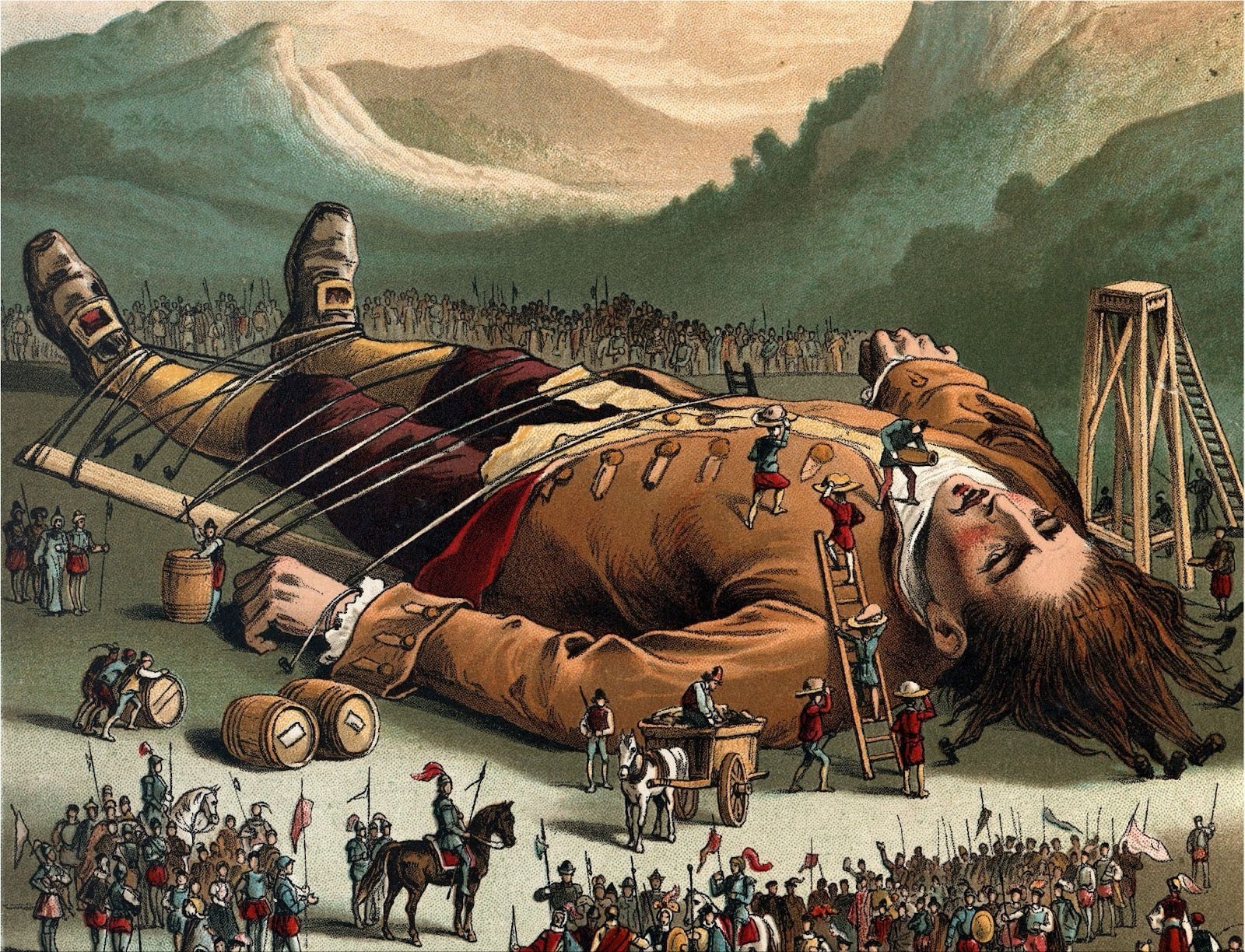
The actual problem with government is in fact the opposite of the conservative narrative of an out-of-control bureaucracy riding roughshod over American democracy. While there are specific cases of this happening, the broader picture is of a government—at municipal, state, and federal levels—that is over-constrained by layers of rules and procedures that make decision-making and policy implementation extremely difficult.

Let me give you some examples of this. Government procurement of anything from office furniture to F-35 fighter jets falls under something called the Federal Acquisition Regulations (FAR), which comprise hundreds of pages of detailed rules with which federal procurement officers must comply. Some of these rules were put there in the wake of long-ago corruption scandals; others were aimed at social justice goals like increasing the number of minority-owned, women-owned, and small businesses. Meanwhile, those who unsuccessfully bid for government contracts have rights to appeal decisions, throwing many simple purchasing decisions to the courts. FAR is one of the reasons why government procurement of everything from hammers to toilet seats is slower and far more costly than in the private sector.
Another example is “notice-and-comment.” The 1946 Administrative Procedure Act, which was intended precisely to limit the ability of bureaucrats to make up new rules on their own, mandates that any proposed rule change by a federal agency must be published in the Federal Register. The rule is subject to a 90-day period during which ordinary citizens can make comments, and the agency must show that it has taken these comments into account. Notice-and-comment was one of the first formal mechanisms mandated by Congress to ensure broad public participation in government decision-making.
The problem is that notice-and-comment has expanded way beyond the intentions of its framers. A major rule change can engender hundreds of thousands of comments, and the agency proposing it can be sued if citizens think their comments did not receive an adequate response. While this limits the government’s discretionary authority, it also greatly slows down the entire rule-making process.
A final example of procedural complexity in American government has to do with something called “private right of action.” In contrast to most other modern democracies, the United States does not enforce many of its own rules. This is often left up to “private attorneys general,” that is, private citizens who have standing to sue other parties or the government itself for violating the law. This makes sense in an area like employment, where violations of labor laws are hard to detect except by those victimized by them. But private right of action is also used extensively in environmental law at both federal and state levels. In this domain, legal discovery—the process by which the parties in a legal dispute obtain information and evidence—is far less important, since there are many other mechanisms, like environmental impact assessments, that can be used to uncover environmental abuses. Private right of action throws law enforcement into a costly and time-consuming common law process, where the goalposts for what constitutes violations of law are constantly moving.
Thus, at least one cause of declining state capacity in the United States has to do with the increasing levels of procedural complexity imposed on government action. This complexity seems to be an inevitable feature of modern liberalism. Conservatives, of course, want to put obstacles in the way of state action. But as the legal scholar Nicholas Bagley pointed out in a seminal 2019 article in Michigan Law Review, many progressives who want the government to do more in pursuit of social justice also believe that legitimacy comes from procedural correctness. Over time, they have encumbered the state with complex rules that end up preventing the state from taking the actions they desire. With regard to the environment, for example, progressives want to abate carbon emissions, but have added procedural barriers to the building of infrastructure like alternative energy and transmission lines that would help solve the problem.
The private sector has complained for many years of over-regulation by the government. But the government itself faces decades of accumulated regulations that limit its ability to act effectively. There are many powerful interest groups who want to limit regulation of the private sector, but relatively few voices advocating de-regulation of the government itself. Indeed, many on the right and left believe that the government has too much discretionary power and needs to be further constrained.
Restoration of state capacity will thus depend on a culling of the veto points that have been delegated over the years to different stakeholders in and out of government, and delegation of actual authority to the appropriate parts of the government to carry out the people’s wishes. We need new mechanisms to hold that form of delegated power accountable to the people. It has been done before in American history—remember the Apollo program?—and can in theory be done again.
Francis Fukuyama is the Olivier Nomellini Senior Fellow at Stanford University. His latest book is Liberalism and Its Discontents. He is also the author of the “Frankly Fukuyama” column, carried forward from American Purpose, at Persuasion.
Due to an editorial error, this piece originally cited the wrong article by Nicholas Bagley. We regret the error.
Follow Persuasion on X, Instagram, LinkedIn, and YouTube to keep up with our latest articles, podcasts, and events, as well as updates from excellent writers across our network.
And, to receive pieces like this in your inbox and support our work, subscribe below:
Some excellent points (retired city planner here).
Good overview of a critical issue. I hope Francis Fukuyama will follow up this important piece with one that outlines steps to create a fair process by which this country COULD get things done. An essay like that would help restore hope... and, perhaps, spark the possibility of renewed faith by all political sides in our national government.