

Why I'm Rooting Against My Own Country
When America bullies its allies, patriotism means supporting those who still defend liberal values.

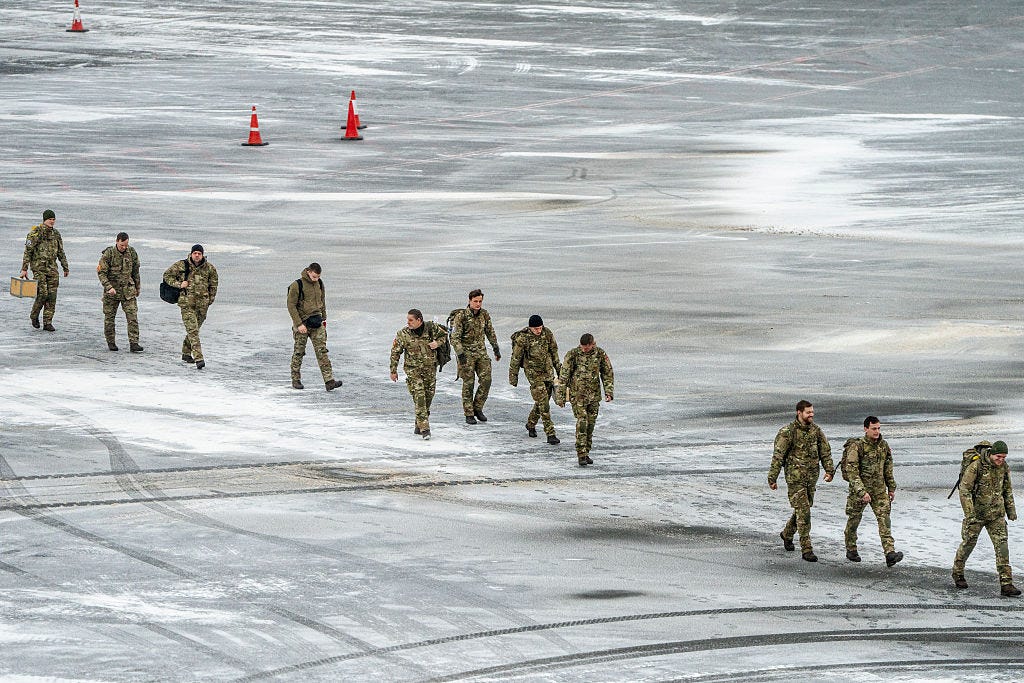
Last weekend, President Trump threatened to impose escalating tariffs on several of the United States’ closest European allies in an effort to annex Greenland from Denmark. Trump said he would ratchet up tariffs on Europe by 10 percent and that duties would increase to 25 percent in June if the United States didn’t “own” the territory by then.
European leaders refused. They issued a series of defiant condemnations. European troops landed in Greenland. When the European Parliament met on Wednesday, it halted work on a major trade deal between the United States and the EU. By Wednesday evening, Trump caved and announced the “framework of a future deal with respect to Greenland”—and the territory remains, for now, under Danish control.
The image of European soldiers disembarking from transport aircraft in response to threats from the United States is not one that America’s allies will soon forget. Nor will I. At that moment, I felt greater solidarity with Denmark, France, Germany, and other European states than with the government of my own country—which was trying to bully a stalwart ally into sacrificing its sovereignty and territorial integrity for the president’s vanity.
This realization was jarring, as I consider myself a patriotic American. But it’s possible to love one’s country while feeling deep disillusionment about its behavior. When it looked like there was going to be a trade war between the United States and Europe, I hoped Europe would win. I also felt this way when Trump and Vice President JD Vance berated Ukrainian President Volodymyr Zelenskyy in the Oval Office early last year, and I spoke with many Americans who shared this sense of shame. Zelenskyy is the president of an embattled democracy who courageously remained in Kyiv as Russian tanks rolled across the Ukrainian border. Watching the president and vice president insult, threaten, and lecture him—and demand gratitude after drastically slashing U.S. support for Ukraine—was a dismal spectacle.
The past year has demonstrated that the United States is no longer the leader of the free world. As Canadian Prime Minister Mark Carney observed at the World Economic Forum this week, there has been a “rupture” in the liberal international order. He didn’t need to say it explicitly, but he was referring to the United States’ abdication of its outsize role in holding that order together. As Trump becomes increasingly erratic, bellicose, and illiberal, Europe must assume responsibility for defending the principles of NATO and the global order that the United States has anchored since the end of World War II.
Americans, meanwhile, must choose patriotism over nationalism. This means supporting the countries that remain committed to liberal democracy even when they confront the United States. There’s a profound difference between loving your country—I always will, regardless of what the United States does or becomes—and supporting its government no matter what.
This is a distinction that nationalists reject. During a recent speech at the Claremont Institute, Vance argued that fidelity to the “creedal principles of America” isn’t enough to make someone American. He said it’s time to “redefine the meaning of American citizenship in the twenty-first century.” This redefinition has less to do with the United States’ founding liberal principles than with cultural homogeneity: “America is not just an idea,” Vance said. “We’re a particular place with a particular people and a particular set of beliefs and way of life.” He declared that the “people whose ancestors fought in the Civil War have a hell of a lot more claim over America” than other citizens. Trump recently expressed an even uglier form of parochialism when he described Somali Americans as “garbage” and declared that immigrants are “poisoning the blood of our country.”

This insular view of American identity leaves less room for solidarity between democracies—and it’s no wonder that Vance is more hostile to Europe than anyone else in the administration. Nationalism of this sort tends to descend into jingoism. After the Venezuela operation, Katie Miller (wife of Stephen Miller, Trump’s deputy chief of staff) posted a picture of Greenland with an American flag superimposed over the map with the caption “SOON.” Senior members of the administration have been posting similar memes, while MAGA influencers have been crowing about American dominance and calling for a new age of imperialism.
The Founders, by contrast, constantly emphasized the universalism of America’s founding principles. Alexander Hamilton said the American Revolution was a vindication of the “sacred rights of mankind.” The Founders were powerfully influenced by Enlightenment thinkers like John Locke, who argued that natural rights are the innate possession of every human being. Thomas Jefferson observed that “All eyes are opened or opening, to the rights of man” and looked forward to the day when all people would “assume the blessings and security of self-government.”
The United States, in other words, is an idea. There’s no religious or cultural test for citizenship—but we do demand that Americans take their oath to the creedal principles that Vance believes are secondary to heritage.
That’s why, for millions of Americans, patriotism and citizenship have nothing to do with how many generations of their family are buried in American soil. I’m proud to be an American because the United States embodies universal values such as democracy and the rule of law. But when another part of the world embodies those values more completely—which Europe clearly does in the dispute over Greenland—then it has my support.
It’s true that European countries have spent the past year placating Trump with flattery, gifts, and diplomatic overtures—an appeasement campaign that culminated in a trade deal that accepts 15 percent tariffs on European goods with very few concessions from the United States. The Trump administration repaid this acquiescence with contempt. During his speech in Davos, he repeatedly claimed that the United States has received “absolutely nothing in return” for its role in NATO—apparently forgetting that the only time the alliance has ever invoked Article 5 in defense of a member state was after the September 11 attacks.

But in the past few days, Europe has demonstrated that it can function as a powerful check on Trump’s illiberalism. It challenged Trump’s claim to dominance over Greenland, and he quickly buckled. Trump has left Europe with no alternative but to pursue strategic autonomy, and over time this will make the continent a heavier counterweight to the United States. While there are historic risks associated with European rearmament—particularly given the rise of the populist right in countries like Germany and France—these risks are outweighed by the threat of overreliance on the United States as Trump does everything in his power to dismantle the liberal international order.
As an American, it’s depressing and infuriating to see my country devolve from the arsenal of democracy into just another marauding and rapacious great power. But as a liberal, there’s some comfort in seeing other democracies stand up for the values America used to defend.
Matt Johnson is an essayist and the author of How Hitchens Can Save the Left: Rediscovering Fearless Liberalism in an Age of Counter-Enlightenment.
Follow Persuasion on X, Instagram, LinkedIn, and YouTube to keep up with our latest articles, podcasts, and events, as well as updates from excellent writers across our network.
And, to receive pieces like this in your inbox and support our work, subscribe below:
 | A guest post by
|
HI Matt. Do I agree with Trump's style, no. Do I agree the Europeans need a frozen cod upside their heads for not investing in their own defense for 80 years, absolutely. Trump's berating Europe over the last 10 years, far more so than any other president, has moved them to a position of defending themselves rather than asking us to pay for their defense. Trump's style of win-lose is despicable, but it has produced results that reduces past abuses of the "relationship". A little balance please.
According to Vance then, I am less of an American because my ancestors came here in the early 20th century. My uncle, who was killed during the Battle of the Bulge and is buried in the American Military Cemetery Luxembourg, did not give up his life for opportunists and charlatans.