


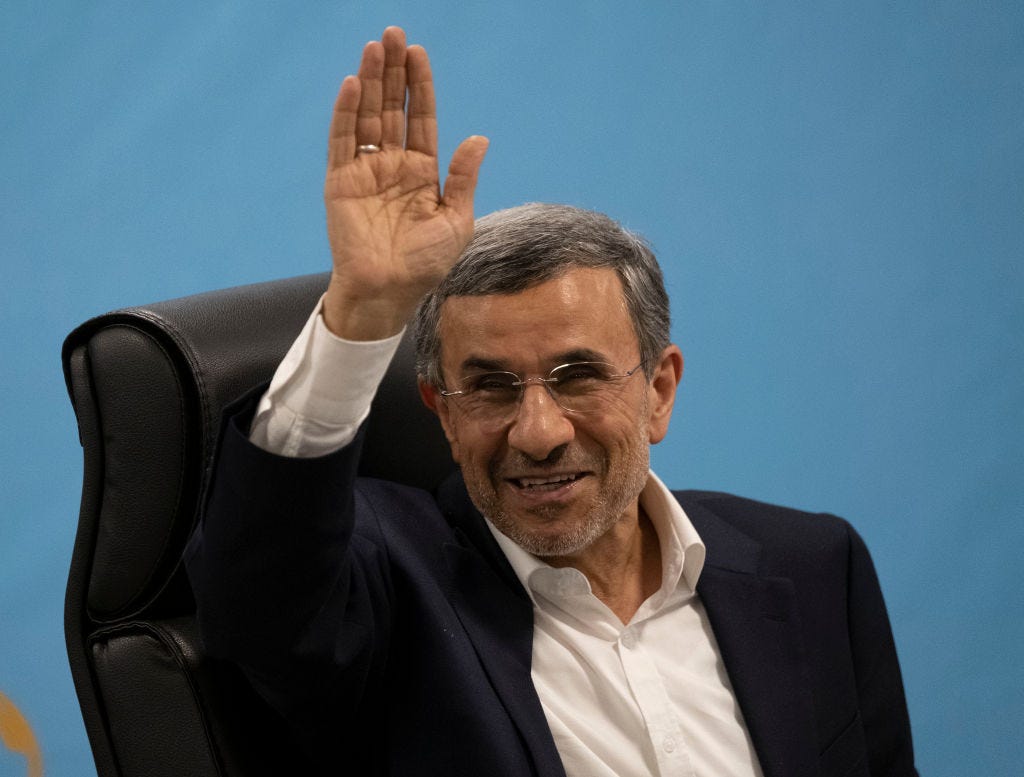
Of all the names that could appear in a Western-backed plan for postwar Iran, Mahmoud Ahmadinejad may be the strangest. The former president was once known for Holocaust denial, anti-Israel speeches, claims that gay people don’t exist in Iran, support for his country’s nuclear program, and the violent repression of domestic dissent.
Yet according to a new report in The New York Times, the United States and Israel considered him as a possible political leader after the killing of Supreme Leader Ayatollah Ali Khamenei in the early days of the war. They consulted with Ahmadinejad about the plan, and attempted to free him from house arrest in February on the first day of the war. But he was injured in the strikes, became disillusioned, and has not been heard from since.
The story sounds too crazy to be true. But if it is true, it shows just how little the Trump administration understands the way power works in the Islamic Republic.
Learning from the experience in January of deposing Nicolás Maduro and installing Delcy Rodríguez in Venezuela, Trump’s plan appeared to assume that Iran’s regime could be changed by finding an insider with name recognition to become the new leader. Yet the Islamic Republic is not a leader-centered regime like Venezuela, waiting for a simple replacement. It is a theocratic-security state: real power resides in an alliance of theocratic institutions with the extensive security establishment.

Ahmadinejad served as Iran’s president from 2005 to 2013, and before that as the mayor of Tehran. As a regime hardliner and former member of the state-backed Basij paramilitary organization, Ahmadinejad was part of the core of the Islamic Republic. He understood the regime deeply, and had populist appeal among the lower classes because of cash handouts to the poor he oversaw while president.
Yet his relationship with Khamenei was rocky. The Supreme Leader strongly supported Ahmadinejad after a disputed presidential election in 2009, but the next year Ahmadinejad clashed with the Ayatollah’s circle, criticizing Khamenei and accusing officials, including the IRGC, of corruption. That’s why Khamenei rejected Ahmadinejad’s presidential candidacy in 2017, and why Ahmadinejad has been repeatedly blocked from running since then.
To the Trump administration, it may have looked as if Ahmadinejad was an “insider-outsider”—someone who came from the regime but could be used against it. But this missed a crucial point. Even during his presidency, Ahmadinejad never controlled Iran’s powerful security structure. Khamenei and his theocratic network merely used Ahmadinejad when it served their interests. They saw him as a tool for controlling the state bureaucracy when it was not yet completely under the Ayatollah’s control.

Ahmadinejad opened up the state to IRGC and Basij veterans, who entered ministries, governorships, municipalities, and state companies in large numbers. During his first term, many cabinet positions went to figures with IRGC backgrounds, and the Guard expanded its role in the economy, gaining access to state contracts and advancing further into politics. After the disputed 2009 election, the IRGC and Basij violently suppressed the popular Green Movement to keep Ahmadinejad in power.
But the relationship was transactional. The Guard had little personal loyalty to Ahmadinejad. They answered only to Khamenei. This became clear during Ahmadinejad’s second term when the president’s relationship with Khamenei deteriorated. Ahmadinejad and his circle began to criticize the Supreme Leader, but the IRGC did not stand with the man who had empowered it. It stood with Khamenei, targeting Ahmadinejad and arresting many in his network. The regime labeled Ahmadinejad’s loyalists the “deviant current” and placed the former president under house arrest.
This history shows why Trump’s reported regime change plan was unrealistic. If Ahmadinejad could not command the IRGC when he was president, why would he be able to command it after a foreign-backed war and the killing of Khamenei?
The United States seems to have confused removing a ruler with building authority. It naively assumed that after Khamenei disappeared, the regime could be redirected to install any recognizable face the Americans and Israelis chose. But in reality, the Islamic regime is thicker than that. The IRGC is an ideological armed force that was created in 1979 to defend the Islamic Revolution and clerical rule. It has spent four decades preparing for coups, infiltration, elite defection, uprisings, and foreign attack. Nobody—not even Ahmadinejad—can rule without first controlling the security-theocratic structure.
If the Times report is true, it raises hard questions about the Trump administration’s judgment. It suggests Washington entered the war with too much confidence that the regime would collapse easily and a successor could be found. And if Washington misread the Iranian political structure at the start, it is likely to misread what kind of settlement is possible in the end.
Everything that’s happened since February proves the plan was a fantasy.
Saeid Golkar is an associate professor of political science at the University of Tennessee-Chattanooga.
Follow Persuasion on X, Instagram, LinkedIn, and YouTube to keep up with our latest articles, podcasts, and events, as well as updates from excellent writers across our network.
And, to receive pieces like this in your inbox and support our work, subscribe below:

If they attacked Iran to keep them from pursuing nuclear weapons, Ahmadinejad is not the guy you'd want in power.
If they attacked Iran to liberate the Iranian people from an oppressive theocracy, Ahmadinejad is not the guy you'd want in power.
If they attacked Iran to keep them from threatening Israel, Ahmadinejad is not the guy you'd want in power.
So why did they attack Iran?