

Houston, We Have a Problem
It's not rocket science that kept America from returning to the moon. It's state capacity.

Over at American Purpose, we are publishing an ongoing series called “The ‘Deep State’ and Its Discontents.” Today, we decided to share the latest installment with all Persuasion readers! To make sure you receive all American Purpose content—and further exclusive writing by Francis Fukuyama—visit your account settings and toggle on the relevant buttons!
I’ve been watching the Apple TV series For All Mankind for the past few weeks. It’s a brilliantly produced show about the Apollo space program that creates an alternative history of the past 50 years. The starting premise is that the Soviets beat the United States to the moon in the mid-1960s, and proceeded to build a permanent base there. The Nixon administration was shocked into action, and after a first successful landing in 1969 it accelerated the schedule of subsequent Apollo missions to catch up. Instead of ending the Apollo program in 1972 with Apollo 17, they created a permanent U.S. moon base called Jamestown and flew dozens more missions over the succeeding years.
What is striking about this story is that it’s a reminder of how unbelievably impressive the Apollo program was. In 1961, President John F. Kennedy announced the intention to land a man on the moon, and the United States actually followed through and accomplished that goal with Apollo 11 in 1969. For All Mankind illustrates both the scale of the ambition involved and the enormous risks that NASA took in accomplishing this feat.
Many Americans may be surprised to learn that NASA has been trying to return to the moon for two decades now, but hasn’t been able to do so. Something has gone wrong with American state capacity. Getting to the moon in eight years under the Apollo program was perhaps the most vivid example of American government prowess. It came on the heels of other major accomplishments in the 20th century: big infrastructure projects like the Hoover Dam, the Golden Gate Bridge, and electrification of the upper South under the Tennessee Valley Authority; mobilization for the Second World War, and victory over Japan and Germany; and then, after the war, construction of the interstate highway system. The United States in this period was seen globally as the exemplar of modernity, a country able to master complex technology and use it for important public purposes.
Since the 1960s, however, American state capacity has declined. The United States has world-beating tech companies that are currently racing to build artificial intelligence data centers. The U.S. military remains the best in the world. But other parts of the government have struggled to master difficult tasks like building a high-speed rail system, rolling out healthcare.gov, or connecting rural communities with broadband.
This lack of capacity is evident in NASA itself. Why has it taken so long, and cost so much money, to repeat a feat that was accomplished 50 years ago?

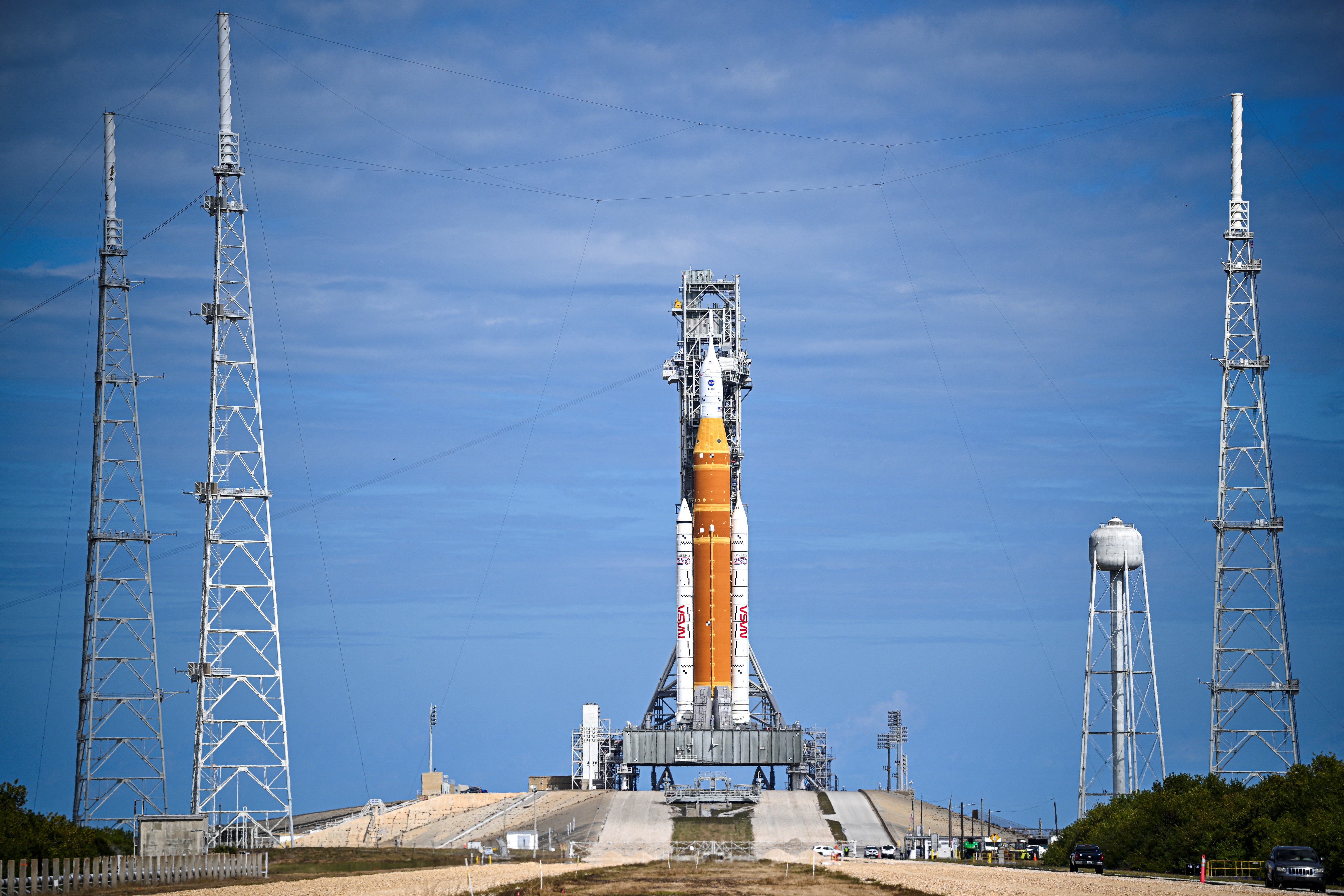
Artemis is simply the latest name for a NASA effort to build a rocket, orbiter, and lunar lander that are capable of returning humans to the moon. Following the Space Shuttle Columbia disaster in 2003, President George W. Bush announced the end of the Space Shuttle program, and set a goal of returning to the moon by 2020. Artemis had its origins in the Constellation program, which included the Ares I and V rockets and an Orion space capsule. It sought to make use of engines and other components left over from the Space Shuttle. Constellation was never funded properly, and a commission led by aerospace guru Norm Augustine pointed to its fiscal unsustainability. The Obama administration consequently tried to shut it down and replace it with a collection of other goals, like sending astronauts to explore the asteroid belt.
More importantly, the technocrats at NASA had a vision for proceeding differently in the way they procured spacecraft. Lori Garver, the Deputy Administrator at NASA under Obama, proposed a Commercial Crew program that would solicit bids for a vehicle to transport astronauts into low Earth orbit—bids that could come from companies like SpaceX or Blue Origin in the newly emerging commercial space flight sector. Instead of having the government design and operate the spacecraft under traditional cost-plus contracting (as in the Constellation program), Commercial Crew would write fixed-cost contracts that allowed the private sector to compete in the design, construction, and operation of the spacecraft. Under this kind of contracting, they would have strong incentives to work quickly and efficiently.
The Obama administration’s effort to cancel the Constellation program met fierce opposition from Congress. This came particularly from senators representing states in which Ares and Orion were being built, as well as the old-line aerospace contractors like Boeing and Northrop Grumman and their workers. The confrontation between Congress and the White House led to a compromise: the Ares 5 booster was re-packaged as the Space Launch System (SLS), and funding for the Orion capsule was extended, while NASA was permitted to experiment with Commercial Crew. SLS and Orion were thus the legacy systems around which the Artemis program was to be built.
The idea of using the parts and knowledge left over from the Space Shuttle program sounded good on paper. But SLS was underfunded from the start, just as Constellation had been, and creating a new heavy lift vehicle from old parts proved both expensive and technically challenging. The SLS-Orion package was rebranded as Artemis in 2018, and continued to suffer big delays in launching. Costs ballooned to over $4 billion per launch. According to a report, “NASA continues to experience significant scope growth, cost increases, and schedule delays on its booster and RS-25 engine contracts, resulting in approximately $6 billion in cost increases and over 6 years in schedule delays above NASA’s original projections.” An uncrewed Artemis I finally flew successfully in 2022, and Artemis II is supposed to send four astronauts around the moon sometime this year (the current planned launch date is early March). NASA will be lucky if it can land humans on the moon by the end of this decade.
It is interesting to follow what happened to the innovative Commercial Crew program. Both Boeing and SpaceX were awarded contracts for Commercial Crew in 2014. Boeing received $4.2 billion while SpaceX received $2.6 billion. Since then, SpaceX’s Crew Dragon has flown almost 70 people in 18 manned missions, and 12 Dragon cargo International Space Station resupply missions. Boeing by contrast flew one unsuccessful flight in 2019. Starliner delivered two astronauts, Butch Wilmore and Suni Williams, to the International Space Station in 2024, but experienced multiple failures and stranded them there for nine months. They had to be rescued by a reconfigured SpaceX Crew Dragon. Though Starliner was a bust, the idea of competition in fixed-price contracting proved its worth.
Meanwhile, NASA’s failure to return to the moon in a timely fashion probably does not lie in a straightforward decline in its internal capacity. NASA remains staffed with competent engineers and administrators. The fundamental driver of dysfunction was rather the problem of what is called “state capture.” The money poured into Constellation-Ares-Orion-SLS was dictated by Congress. NASA itself was not of one mind back in 2010; Administrator Charlie Bolden was skeptical of the ability of new entrants like SpaceX to deliver, and was not fully supportive of the direction being pushed by Lori Garver. If there was a decline in capacity, it probably lay in those old-school industrial behemoths like Boeing, which in recent years has suffered big management problems not just with Starliner but with its 737 and 787 programs.
The second reason the United States has had problems getting back to the moon is a combination of complacency and loss of national focus. Once the moon landing succeeded, the nation relaxed and shifted from space exploration to efforts to routinize space travel with the Space Shuttle program. Not only was this far less inspiring than the original Apollo program, it also failed in its own terms. Space flight did not become cheap and routine, nor, as the Columbia and Challenger accidents indicated, did it become safe.
But nor has NASA’s objective of returning to the moon sparked widespread public interest. For All Mankind suggests that competition with the Soviet Union drove continuing investment in a moon program. One would think that competition with China would play a similar role today, but that hasn’t materialized. Perhaps Americans are already cowed by China, which has managed to build the world’s largest high-speed rail network in less than a decade.
The problems of the Artemis program and America’s difficulties in returning to the moon are emblematic of a broader problem of declining American state capacity. NASA has been hobbled by the political mandates placed on it by Congress. Of course, Congress is the principal and NASA the agent in a democratic principal-agent relationship. But while members of Congress say they want to return to the moon, they are actually much more interested in maintaining employment in their districts and getting re-elected. Their goals are not forward-looking and innovative; rather, they are profoundly conservative. To maintain the status quo, they are happy to override and compromise the technical judgments of the experts they’ve hired to serve them.
Conservatives complain endlessly that “unelected bureaucrats” have escaped the control of their democratically-elected masters and are implementing an agenda at odds with the wishes of the American people. Would this were so as far as NASA is concerned. The reality is rather the opposite: bureaucrats find themselves endlessly constrained by the narrow-minded and self-serving mandates placed on them by their political bosses. The Apollo program succeeded because NASA was given a single, overriding mandate to get to the moon by the end of the decade. It had much more freedom in how to achieve this goal than it does today.
As I will argue in subsequent articles, if Americans want to restore state capacity, they need to give bureaucrats more discretionary authority to do their jobs, fund them adequately, and eliminate the many political barriers that have been erected over the years that prevent them from doing so.
Francis Fukuyama is the Olivier Nomellini Senior Fellow at Stanford University. His latest book is Liberalism and Its Discontents. He is also the author of the “Frankly Fukuyama” column, carried forward from American Purpose, at Persuasion.
Follow Persuasion on X, Instagram, LinkedIn, and YouTube to keep up with our latest articles, podcasts, and events, as well as updates from excellent writers across our network.
And, to receive pieces like this in your inbox and support our work, subscribe below:
His recommended solution to NASA's problem—“ give bureaucrats more discretionary authority to do their jobs, fund them adequately, and eliminate the many political barriers that have been erected over the years that prevent them from doing so”—is fanciful, if not absurd and dangerous.
Every bureaucracy is part of our government and is under the exclusive control of the President. And every bureaucracy relies solely on Congress for funding. Further, all members of Congress and the President are political animals. Always have been and always will be. And patronage fuels their political careers. You can't change human nature.
Finally, you must always remember and never forget what we were taught by Emily St. John Mandel in her book, “Sea of Tranquility”:
"What you have to understand is that bureaucracy is an organism, and the prime goal of every organism is self-protection. Bureaucracy exists to protect itself."
Government should limit itself to doing those few things it does well, e.g., defense, building roads, public safety, etc., and enlist the assistance of the private sector for complex enterprises which require specialized expertise and need to be done quickly and efficiently. You want to go to the moon? Then give SpaceX, Blue Origin, or Virgin Galactic a call. They'll get you there—and for a helluva lot less money.
For an explanation, look at the graph of grade inflation and SAT score declines. We have replaced useful business and STEM rigor with social justice indoctrination hogwash. The small population of students that power through all that crap to get a good education don't end up in government jobs. It is the grade-inflated victim studied graduates that end up in the public sector.
Is it any wonder that nothing in government gets done when the politicians and government bosses are focused on DEI programs as their first priority?