

Why Our Flag Brings Americans Together
A day to celebrate the best parts of our nation.
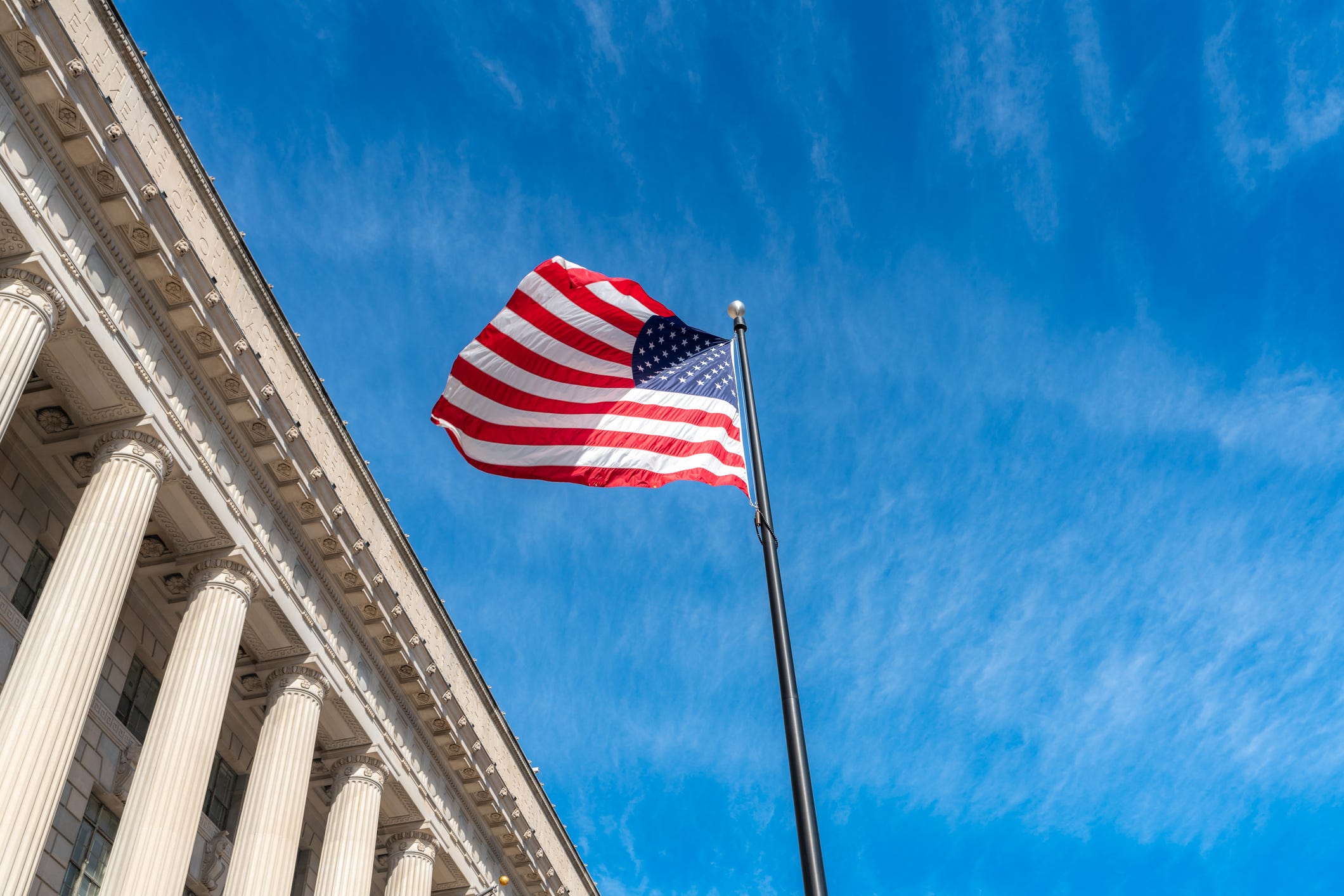
June 14 is an important halfway point in America’s summer civic holidays, connecting Memorial Day with Independence Day—and in more ways than one. June 14 is the anniversary of the birth of the U.S. Army in 1775—and is today celebrated as Flag Day.
“A yearly contemplation of our flag strengthens and purifies the national conscience,” declared President Calvin Coolidge. Echoing sentiments Woodrow Wilson expressed in his 1916 proclamation recommending the annual observance of “Flag Day,” Coolidge succinctly summed up the point for such a national holiday: “We see in [the flag] the great multitude of blessings, of rights and privileges that make up our country. But … we must remember that it is equally a symbol of our duties. Every glory that we associate with it is the result of duty done.”
Like Achilles’ famous shield depicting both war and peace, the American flag symbolizes the blessings and the duties of a self-governing nation dedicated to freedom and equality. The blessings are frequently invoked, while flag-draped coffins of fallen soldiers show viscerally both the glory and the cost of “duty done.” But, as successive presidents from Wilson onward have noted in relation to Flag Day, the stars combined with the red and white stripes remind us of the ongoing and current duties we carry as citizens, chief of which is respect for the rule of law.
“In whatever direction we may go we are always confronted with the inescapable conclusion that unless we observe the law we cannot be free,” noted Coolidge. Or, as that philosophical grandfather of America John Locke put it, “the end of law is not to abolish or restrain but to preserve and enlarge freedom.” In the American tradition, this observance of the law as a supreme principle is two-pronged: it means that laws when made must not designate winners and losers, applying unequally to different persons or groups of society; it also means that all alike, from those in elected office, enjoying positions of economic power, to the those struggling to make ends meet, must follow the law—and can enjoy the shared peace this brings.
But, as the stories in our newspapers seem frequently to remind us, the rule of law is much easier to invoke than to practice, particularly as it relies upon the goodwill of human agents. Like the flag itself, it is fragile without both.
Flag Day is not an official holiday. Rather, mandated by a 1949 act of Congress, the president is “requested to issue each year a proclamation, calling on United States Government officials to display the flag of the United States on all Government buildings on Flag Day; and urging the people of the United States to observe Flag Day as the anniversary of the adoption on June 14, 1777.”
America’s flag, and indeed all flags in general, originally had a predominantly military purpose. It emerged out of the Revolutionary War (although not sewn by Betsy Ross) and its martial image became fixed for many Americans through the “gave proof through the night / that our flag was still there” lines in “The Star-Spangled Banner,” an 1814 poem that over a century later would be adopted as the national anthem. Marking the 200th anniversary of “The Star-Spangled Banner” in 2014, American composer extraordinaire John Williams celebrated the link between the nation’s flag and its national anthem, when on the steps of the U.S. Capitol he debuted a new arrangement of the Star-Spangled Banner. During this 250th anniversary year of our American nation, we are reminded that our flag is still here. Remember its glories; remember, too, its requests.
Rebecca Burgess is a senior fellow with the Yorktown Institute and at Independent Women. She serves as an advisory board member at the Thomas Jefferson Foundation at Monticello.
Follow Persuasion on X, Instagram, LinkedIn, and YouTube to keep up with our latest articles, podcasts, and events, as well as updates from excellent writers across our network.
And, to receive pieces like this in your inbox and support our work, subscribe below: