


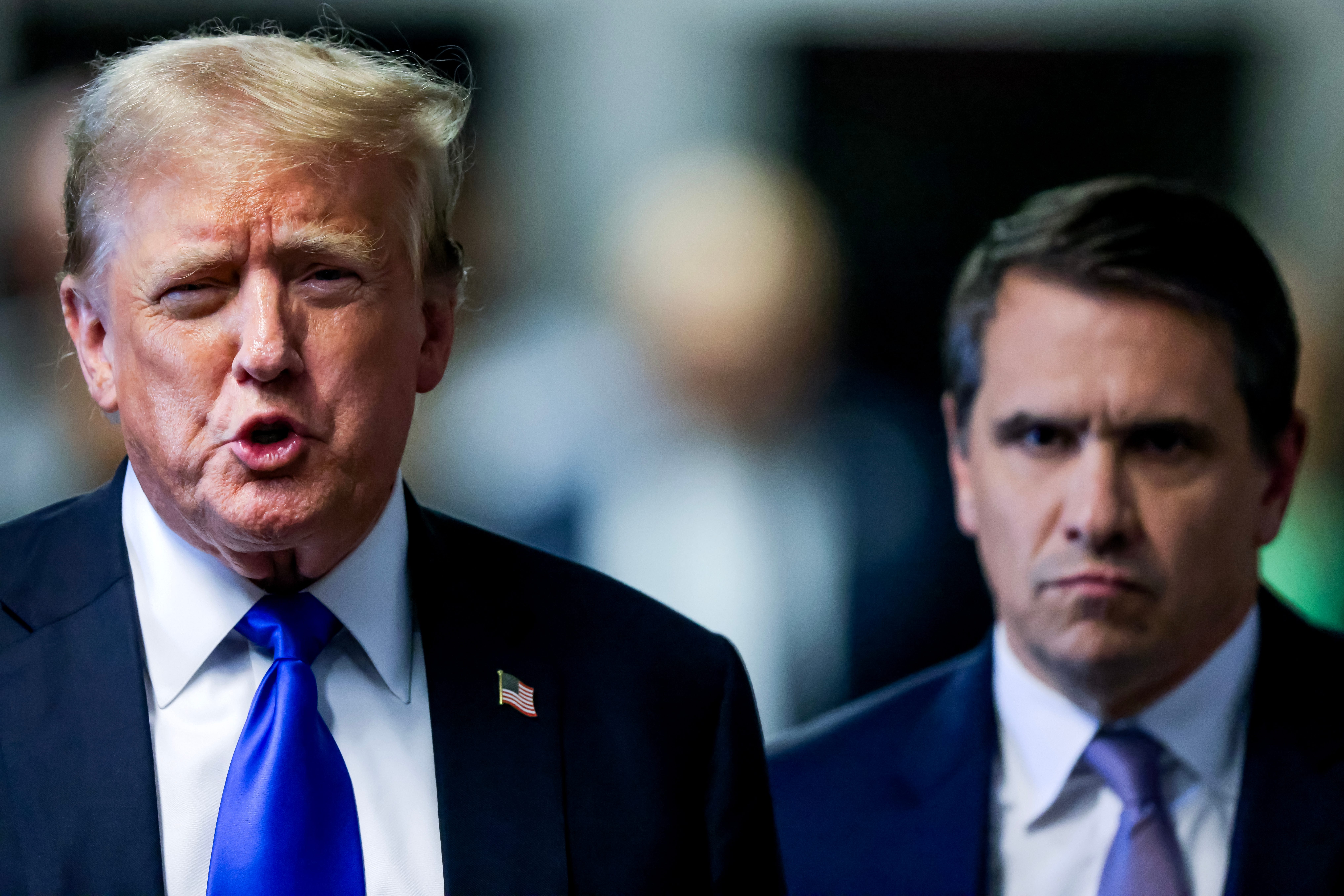
Donald Trump is attempting to engineer a $1.8 billion taxpayer-funded slush fund to be paid to persons and groups that got in legal trouble promoting his interests. It’s one of the most notable legal stories of this (or almost any) year.
In January, Trump and two of his sons sued the federal government, claiming that his own Internal Revenue Service had failed to prevent a rogue contractor from unlawfully leaking parts of his tax returns to the press in 2019 and 2020. U.S. District Judge Kathleen Williams was skeptical about the suit, since Trump had appointed and could fire the officials charged with defending the U.S. Treasury.
On Monday, it was announced that Trump had dropped the suit, forcing the judge to relinquish her jurisdiction. Within hours, he unveiled a “settlement” with the IRS, which at that point could proceed without judicial supervision. On Tuesday, an “addendum” to the settlement was released, signed by Acting Attorney General Todd Blanche.
Legal journalist Roger Parloff was among the first to dig into the language of the purported settlement. He writes:
The Trump/Blanche “settlement” fund purports to be challengeable only by those who colluded to create it.
To help themselves to nearly $2B of our tax dollars, claimants present evidence to the (wink-wink) “settlement” fund that they were victims of “Lawfare” or “Weaponization,” terms that are nowhere defined.
The fund is administered by 5 people chosen by Acting AG Todd (“I love you, sir”) Blanche, and are removable at will by Trump.
The identities of those given our tax dollars, and how much, will be kept secret from us, and known only to Todd (“I love you, sir”) Blanche.
The procedures for processing these claims can be as secret as Blanche’s appointees choose to make them.
Two other provisions of note: the fund must wrap up operations and liquidate by December 2028, ensuring that later administrations cannot get their hands on it (or more to the point, I suspect, its records).
It has a second, longer section purporting to exclude judicial review: “there shall be no appeal, arbitration, or judicial review of claims, offers, or other determinations” made by the fund.
The sum transferred is to be $1.776 billion, a number that is cute but reveals the arbitrariness at work. Blanche’s argument that this is the sum expected to be paid had claimants gone through regular legal processes is baldly mendacious. At any rate, no judge had anything to do with that number.
Additionally, under Tuesday’s addendum to the settlement, the IRS is “FOREVER BARRED and PRECLUDED” (capitals in original) from asserting civil or criminal claims against Trump, his companies, and his family over any tax returns filed up to the present date. At least so Blanche—who is also Trump’s former personal attorney—has agreed.
Nice deal if you can get it! Maybe you can get it if you’re “negotiating” with someone who serves at your pleasure?
The slush fund has not been without its supporters. The most common line of defense is that prior administrations did something similar, setting a precedent for creative use of large-scale settlements by the government. As the Cato Institute’s Tad DeHaven and Molly Nixon note, Blanche cites earlier cases under the Obama and Clinton administrations in which the United States Department of Agriculture (USDA) “resolved discrimination claims brought by Native American, Hispanic, and female farmers” who claimed that they had been discriminated against in agricultural loans and other programs.
Blanche stated that those cases were “settled on similar terms” to the new slush fund.
No, they weren’t. The USDA discrimination settlements indeed deserved the vigorous criticism I and others directed at them at the time. And as DeHaven and Nixon write, they “did indeed tap the Judgment Fund”—the permanent fund established by Congress in 1956 to pay out claims against the federal government, which is the same pool that Trump’s slush fund is drawing from.

But those USDA claims were overseen by the courts, and were intended for people who had made claims in the legal system or who were similarly situated to people who had made claims. The underlying issue was USDA discrimination, so the funds were intended for people alleging such discrimination.
This new slush fund, by contrast, is not structured to assist victims of improper tax disclosure, which was the allegation behind Trump’s original lawsuit. Nor has the settlement been overseen by the courts. Instead, the level of generality as to offense committed and injury suffered is set high enough to give the fund broad discretion to reward Trump’s friends and turn away his foes so long as they can claim they were “targets” of lawfare during the Biden administration. There is no neutral third party administration, no appeal, no public accounting, and of course no court supervision from the get-go, the whole thing having been engineered to escape scrutiny by any judge. Not much of a comparison to the Clinton- and Obama-era USDA discrimination settlements, then.
It’s also true, of course, that the persons and groups given money in those settlements had not been prosecuted for crimes meant to prevent the peaceful transfer of power following an election. Blanche, on the other hand, has explicitly refused to rule out that part of the new $1.8 billion fund will be paid out to rioters convicted of storming the Capitol on January 6, 2021.
I’ll close by quoting Nick Catoggio in The Dispatch:
It’s simple theft packaged in the argle-bargle of “weaponization” and “compensation.” … The president behaves with impunity because he believes most of his party will unthinkingly defend anything he does, and he’s correct.
Harvard professor of government Ryan Enos, meanwhile, calls this “the most brazenly corrupt action in U.S. Presidential history.”
I’m not prepared to pronounce either way on that. But it seems fair as applied to the presidents I’ve followed over my lifetime.
Walter Olson is a senior fellow at the Cato Institute’s Robert A. Levy Center for Constitutional Studies.
Versions of this piece first appeared in The UnPopulist and on Walter Olson’s Substack.
Follow Persuasion on X, Instagram, LinkedIn, and YouTube to keep up with our latest articles, podcasts, and events, as well as updates from excellent writers across our network.
And, to receive pieces like this in your inbox and support our work, subscribe below:

“The cheaper the crook, the gaudier the patter.” Bogart, The Maltese Falcon comes to mind.
listening to Jaimy Rifkin in Congress where he exquisitely pulled apart the grift with Todd as the cog, it is unlikely they will stash out 1.8 bil at all.. not happening.