

America Is Now a Family Business
Trump is transforming the constitutional republic into a patrimonial regime before our eyes.


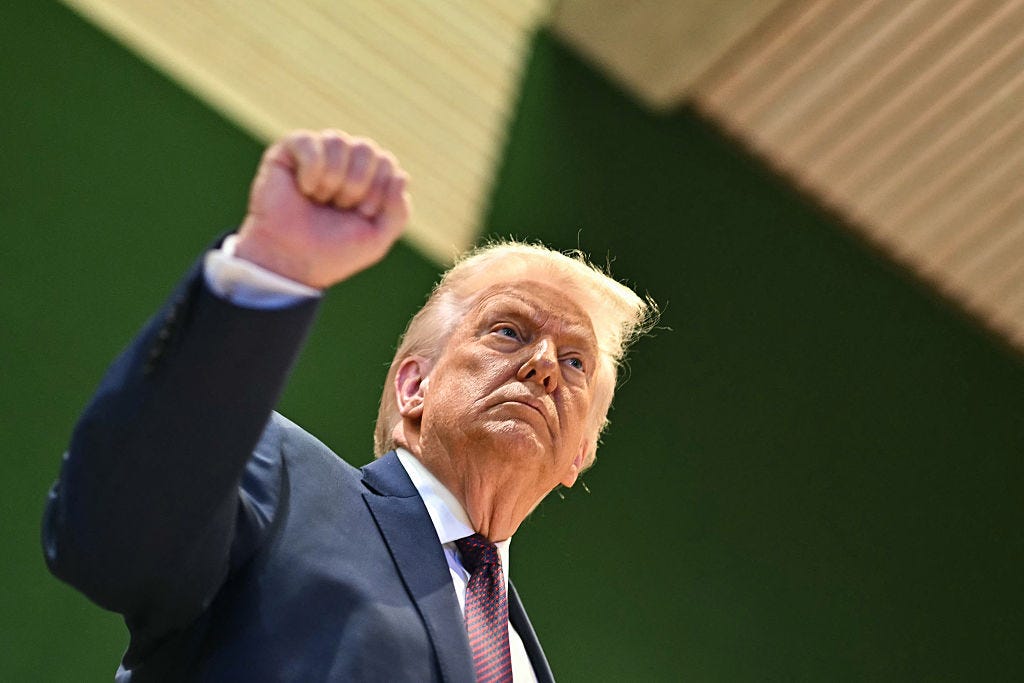
Donald J. Trump has returned to the presidency with a simple, radical ambition: to turn the American state into a family business. And business is booming: since Trump took office, he and his family have made an estimated $3.4 billion. Meanwhile, the scale of transformation of the American body politic has been jaw-dropping. Loyalty now counts for more than competence in government service, public office is openly monetized, and personal favor has replaced impersonal rule as the basis of authority.
More than a century ago, Max Weber identified this form of government and gave it a name—patrimonialism. In patrimonial systems, the state is not an institution standing above its ruler, but instead the ruler’s personal property. What once seemed incompatible with American constitutionalism is now taking shape in plain sight.
Vital government agencies have been shuttered or hollowed out; universities are being browbeaten into ideological conformity; and executive power is exercised not as a bounded branch of government, but instead as a personal prerogative. Trump and his inner circle have pursued self-enrichment on a staggering scale, blurring any remaining distinction between public authority and private interest through ties to foreign autocrats, compliant corporate leaders, and speculative financial schemes. Trump’s revived appetite for imperial assertion abroad—threatening NATO allies, flirting with territorial revisionism, and meting out extraterritorial justice—only deepens this transformation. Patrimonial rule can also degenerate into overt coercion and episodic brutality at home. In Minnesota, Trump has provided immunity for federal officers caught killing U.S. citizens. While enforcing Trump’s policies, ICE agents know they are shielded from independent oversight of their actions.
The question, then, is no longer whether Trumpism represents regime change. It does. The real question is whether anything can still be done to reverse the tide.
The answer is a qualified yes—but only if Americans learn to read patrimonial politics accurately. Too often, the ordinary workings of patrimonialism are mistaken for signs of imminent collapse, while the Trump regime’s real points of fragility go unnoticed. Distinguishing between these is essential for effective resistance.
Will Trumpism be undone by the leader’s creeping cognitive decline? Trump’s outlandish statements and actions are often treated as evidence of incipient dementia or loss of control. In fact, they are central instruments of patrimonial rule. Conduct that seems “outrageous” and “unpresidential” demonstrates powerfully that the ruler is above the constraints that apply to ordinary people. Public threats against political enemies, casual talk of seizing allied territory, renaming national institutions after himself—such as affixing his name to the Kennedy Center—along with demands for personal loyalty oaths, public humiliation of subordinates, and the routine conflation of the presidency with his private brand, all serve a common purpose. They dramatize personal dominance and signal that no realm of public life lies beyond the ruler’s reach.
The recent revelations surrounding Jeffrey Epstein function in much the same way. Rather than triggering elite defection or popular disillusionment, Trump’s repeated proximity to the affair—and his evident insulation from legal or political consequences—reinforces the central lesson of patrimonial rule: the ruler has immunity. What would be a career-ending scandal in an impersonal legal order instead becomes another demonstration of selective impunity.

Even seemingly trivial projects, like Trump’s obsession with constructing a grand White House ballroom bearing his personal imprint, or the installation of self-congratulatory plaques under presidential portraits that pointedly demean his two immediate predecessors, fit squarely within this logic. Such gestures are not about utility or historical commemoration but about symbolic possession—marking the seat of government as an arena of personal triumph and grievance. In patrimonial systems, architecture and inscription alike become claims: the state is not merely governed by the ruler; it is reshaped in his image and memory.
Factional infighting also poses little threat to Trump. Patrimonial rulers benefit from rivalry among subordinates, so long as it does not turn into opposition to the ruler himself. In Trump’s orbit, public disputes rarely translate into open challenges to his authority. Those unwilling to accept subordinate status typically exit rather than rebel; those who remain compete to demonstrate their unflinching loyalty. The recent marginalization and eventual resignation from Congress of Marjorie Taylor Greene illustrates this dynamic: even highly visible allies who fall out of favor are more likely to depart the royal court than to organize opposition within it. In short, there is no “MAGA civil war”—only court politics in its classic form.
Another common misunderstanding is that the judiciary will eventually step in to save us when Trump’s violations of constitutionalism get too brazen or his “conflicts of interest” go too far. This sadly romantic notion of the power of the third branch of government ignores the lessons of history. Whether in Putin’s Russia, Orbán’s Hungary, or Netanyahu’s Israel, courts do not simply disappear under patrimonialism. They continue to function, applying the law in routine cases. What changes is the boundary of judicial autonomy. When the ruler’s core interests are threatened, informal pressure and selective enforcement quietly override formal legality. Legal institutions survive, but their independence becomes conditional. It’s not surprising that appellate judges appointed by Trump have sided with him in 92% of the cases involving his administration.
Finally, imperial overreach abroad is unlikely to bring Trumpism crashing down. The more libertarian elements of Trump’s coalition may worry about his military interventions in Venezuela, Syria, and Iran, combined with his threats to do the same in Colombia, Mexico, Canada, and Greenland. But for Trump’s loyalists and core supporters, these “muscular” assertions of U.S. power are thrilling. In fact, foreign military interventions often strengthen personalist regimes by mobilizing nationalist sentiment and normalizing emergency rule. Even costly or inconclusive ventures rarely undermine leaders who control the narrative. One has only to look at Putin’s Russia, now approaching its fourth year in a botched, incompetent, and unrelentingly brutal invasion of Ukraine, to see that military failure by itself is not necessarily fatal to patrimonial rulers. Imperialism with fuzzy borders is not an aberration of contemporary politics; it is increasingly its organizing principle.
Patrimonial regimes are not invulnerable. But their weaknesses are structural, gradual, and often unspectacular. These can be exploited.
Time limits matter. Research on personalist systems shows that instability begins when elites perceive an approaching endpoint to the current regime. Trump’s outrageous rhetoric and rambling speeches may not threaten his power, but his advancing age combined with the Constitution’s two-term limit do introduce a potentially corrosive uncertainty about the staying power of Trumpism. Political succession is the Achilles’ heel of patrimonial rule, and the mere anticipation of a post-Trump future encourages hedging, quiet disloyalty, and a search for alternatives long before any transition formally begins.
This is why Trump’s frequent discussion of a possible third term, including the promotion of “Trump 2028” merchandise and encouraging hangers-on to explore the legal options for circumventing the 22nd Amendment, is not mere bluster or distraction. It is an implicit acknowledgment of this vulnerability and an attempt to neutralize it. By signaling that even formal term limits may be negotiable, Trump is trying to freeze elite calculations, suppress succession planning, and extend the time horizon of personal rule. In patrimonial systems, uncertainty about the ruler’s exit destabilizes loyalty; promises of indefinite tenure are meant to restore it. This is precisely why proposals for an extended presidency should be vocally opposed and ridiculed, not indulged as speculative theater.
Declining popularity also matters. MAGA may remain disciplined, but the rest of us are deeply unhappy. Elections, protests, and open dissent function as signals to the uncommitted, communicating that power is contested and that not only disobedience but also loyalty to the regime carries risk. Civic courage is not just symbolic—it is strategic. Every refusal to normalize Trumpism weakens its aura of inevitability; every accommodation strengthens it. This is why sustained efforts to chip away at Trump’s popularity and to increase the margins of electoral defeat for MAGA-backed candidates are not ancillary but central to democratic resistance.

Another real vulnerability of patrimonial regimes like Trump’s is that they are lousy at providing public goods. Systems that purge expertise and reward loyalty over competence eventually fail at basic governance. These failures may arrive suddenly and catastrophically—as in botched disaster response, financial panic, or an unchecked global pandemic—or accumulate more quietly through slow decay, chronic underperformance, and the normalization of dysfunction. The cumulative effect is the same: public institutions cease to be experienced as sources of protection and predictability. As institutions hollow out, citizens encounter the regime less as a source of order than as a source of danger.
Finally, while Trump’s foreign policy adventurism is unlikely to threaten him domestically, it will certainly face growing opposition abroad. For decades, Europeans, Canadians, and other partners “bandwagoned” with U.S. power not merely out of fear or dependence, but rather because American leadership was embedded in a shared international order that delivered mutual benefits. Trump’s increasingly transactional, coercive, and revisionist posture is quickly unraveling that bargain. As trust erodes, allies will stop accommodating U.S. demands and instead begin quietly balancing against American power through independent defense initiatives, alternative trade arrangements, and diplomatic hedging.
Already, key allies have distanced themselves, or even openly criticized, Trump’s intervention to seize Nicolás Maduro and his wife in Venezuela. Any use of U.S. military might to pry Greenland away from Denmark, our allies warn, will mean the end of the NATO alliance. The resulting disruption in global security arrangements may prompt U.S. adversaries to try to carry out long-held military plans of their own. MAGA acolytes may hanker for a return to 19th century “spheres of influence,” but plenty of national security hawks in Congress, executives of military industries accustomed to selling weaponry to NATO countries, and even members of the U.S. military itself, have reasons to fear it.
Max Weber warned that patrimonialism is inherently hostile to modern statehood. It personalizes authority, corrodes institutions, and undermines the very capacity to govern. Trumpism’s greatest strength—its concentration of power in one man—is also its deepest weakness. Whether the American constitutional republic survives will depend not on waiting for scandal or spectacle to do the work for us, but on resisting patrimonial rule before the state itself is reduced to the personal property of Trump and his cronies.
Stephen E. Hanson is Lettie Pate Evans Professor of Government at William & Mary.
Jeffrey S. Kopstein is Dean’s Professor of Political Science at the University of California, Irvine.
Follow Persuasion on X, Instagram, LinkedIn, and YouTube to keep up with our latest articles, podcasts, and events, as well as updates from excellent writers across our network.
And, to receive pieces like this in your inbox and support our work, subscribe below:
 | A guest post by
|
 | A guest post by
|
"Vital government agencies have been shuttered or hollowed out"
Unnecessary, costly and harmful government programs and agencies have been eliminated or reduced.
"Universities are being browbeaten into ideological conformity"
Universities are being required to stop indoctrinating students into ideological conformity and to support freedom of speech and expression laws.
"executive power is exercised not as a bounded branch of government, but instead as a personal prerogative."
Democratic elections outcomes based on candidate campaign promises are being met as the legislature gets nothing done.
"Trump and his inner circle have pursued self-enrichment on a staggering scale"
Trump and his administration have pursued ending the Democrats staggering self-enrichment from fraud.
There, fixed it for ya'.
All accurate; but, to paraphrase Napoleon, the word "patrimonial" is not in Donald Trump's lexicon. If awakened in the middle of the night and charged with patrimonialism, he'd say, "Oh, is that what it's called?"
This essay is a couple of intelligent people's analysis, written for other intelligent people to read, of something Trump was bound to do with presidential power the way a python is bound to swallow anything it can although conceptually it's over his (Trump's, but also the python's) head. He has no theory of government. He has no politics. He just does what Donald Trump does. However, it is good to know what it's called and what its typical ramifications are.